
BOOK
0
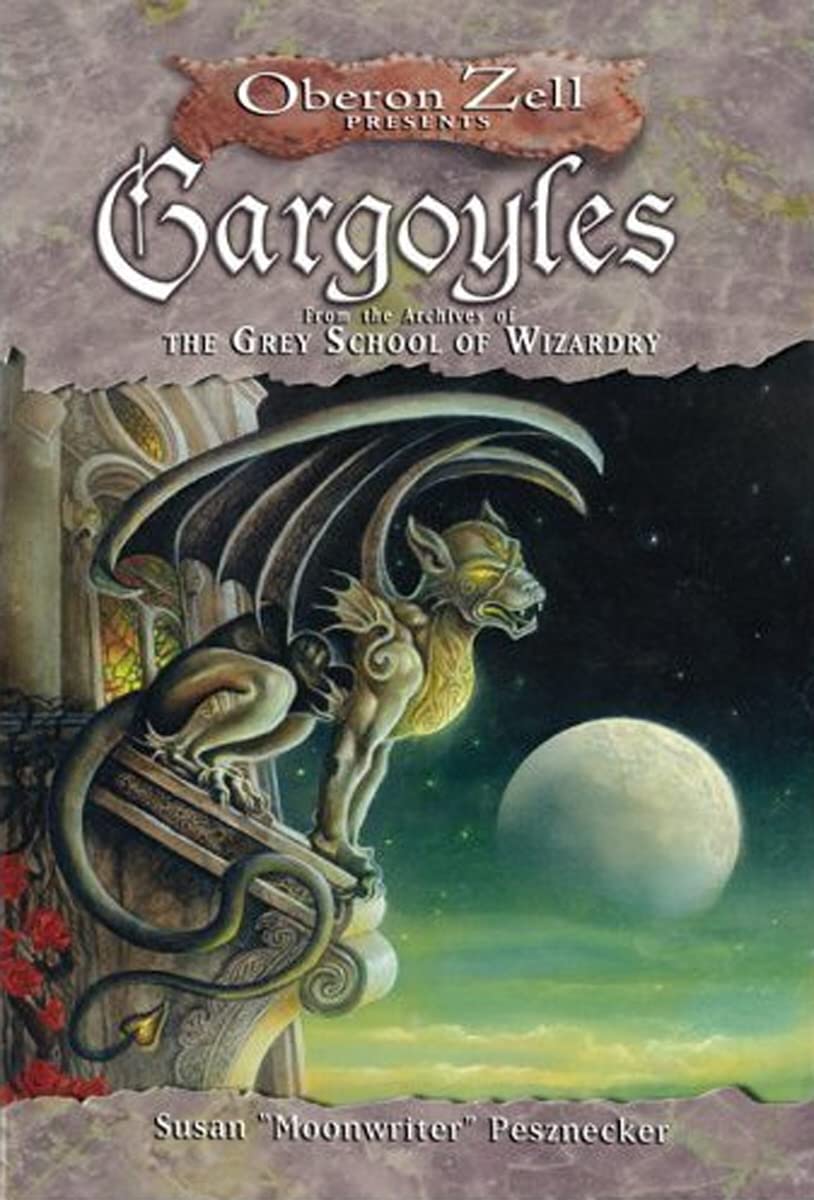
Gargoyles takes you on a journey into a mysterious world, through bestiaries and traveling menageries, past grotesques and chimeras, through medieval cities and guilds and into huge stone buildings. Gargoyles are an embodiment of form and function -- serving a clear architectural purpose but, also, symbolically important. Whether warding off evil, frightening away fear or showcasing human foibles, when a gargoyle was placed on a building, people noticed. The book delves into historic models of arcane craftsmanship and architecture, considering the reasons for gargoyles coming into being and hearing the legends of the gargoyle, both mythic and modern. It, also, covers the emergence of stone creatures into popular culture. For modern magick users, Gargoyles explores the role of the gargoyle in magickal practice, including gargoyle use in elemental correspondences, stone magick, protection, warding, egregores, talismans, animal associations, ritual and spell work.
GargoylesFrom the Archives of the Grey School of WizardryBy Susan "Moonwriter" Pesznecker, Gina TalucciRed Wheel/Weiser, LLCCopyright © 2007 Susan "Moonwriter" PeszneckerAll rights reserved.ISBN: 978-1-56414-911-4ContentsTitle Page, Copyright Page, Dedication, Acknowledgements, Foreword, Introduction, Part 1: All Things Gargoyle, Chapter 1 - Introduction to Gargoyles, Chapter 2 - The Beasts, Chapter 3 - The Humans, Chapter 4 - The Details, Chapter 5 - Gargoyles and History, Chapter 6 - Life in the Middle Ages, Chapter 7 - The Riddle of Gargoyles, Chapter 8 - Medieval Architecture, Chapter 9 - The Stone Trades and Guilds, Chapter 10 - Building the Cathedral, Chapter 11 - Modern Incarnations, Chapter 12 - Gargoyles Today, Chapter 13 - Gargoyles and Folklore, Part II: Magick and Legend, Chapter 14 - Gargoyles and Magick, Chapter 15 - Stone Magick, Part III: Especially for the Gargoyle Hunter, Chapter 17 - A Field Guide to Gargoyles, Appendix A: A Glossary of Magickal and Medieval Terms, Appendix B: Template for Recording Fieldwork, Notes, Resources, About the Author, CHAPTER 1Introduction to GargoylesPicture an old, Gothic cathedral, its stone towers and archways reaching into the sky. Now, cast your eyes to the top of the eaves and the peak of the ridgeline. If you look carefully, you're likely to spot one or more creatures clinging to the side of the building, or balancing atop a needle-sharp spire.Gargoyles!Have you ever wondered why they were created, who made them, and how they got there? Carved sculptures of fantastic creatures appear throughout the history of human civilization. These figures stir our imaginations, as they stirred the imaginations of artists and craftspeople centuries earlier.The story of the gargoyle will take you on a journey through bestiaries and traveling menageries, past grotesques and chimeras, through medieval guilds, and into huge, stone buildings. We will delve into the Middle Ages, explore historic models of arcane craftsmanship and architecture, consider the reasons that gargoyles came into being, and investigate the legend and myth of the gargoyle. We'll reflect on the role of the gargoyle in modern culture and examine the magickal implications of gargoyles and their stony kin, investigating ways to integrate these ideas into magickal practices. Finally, we'll wander through a "field book" of gargoyles — both old and new — that can still be seen today. But first. ...What Is a Gargoyle?You've probably seen gargoyles at one time or another, whether in pictures or in person. They're interesting creatures, often frightening and sometimes humorous as they haunt a building's highest reaches.The word gargoyle shares a root with the word "gargle"; both come from gargouille, an old French word for throat and the French verb gargariser, meaning "to gargle." The word gargoyle is also derived from the Latin gurgulio, which has a double meaning: (a) throat, and (b) a kind of gurgling sound. The Spanish gárgola shares the same Latin roots. In Greek, gargoyles are known as gargarizein, again meaning "to gargle." In Italy, they are known by a more architecturally oriented phrase, grónda sporgente, or "protruding gutter." The German gargoyle is a Wasserspeier, literally meaning a "water spitter," while the Dutch version is waterspuwer — "water spitter" or "water vomiter."Are gargoyles gurglers? Spitters? Vomiters?The dictionary definition of gargoyle is a waterspout or drainpipe carved in the form of a decorative face or figure and projecting from a roof gutter. In other words, gargoyles are carved structures on the outside of buildings that work with the guttering system to carry rainwater away from a building, so that it doesn't pool up around the building's base, or run down the walls. Simply said, gargoyles are dynamic, decorated drainpipes!According to Russell Sturgis, writing in his Illustrated Dictionary of Architecture and Building, a gargoyle is: "A water spout, especially one projecting from a gutter and intended to throw the water away from the walls and foundations. In medieval architecture, the gargoyles, which had to be numerous because of the many gutters which were carried on the tops of flying buttresses, and higher and lower walls, were often very decorative, consisting, as they did, of stone images of grotesque animals, and the like, or, in smaller buildings of iron or lead."When we look at gargoyles — either in photographs or in person — we almost always see them from below or from the side, and from that vantage they appear to be oddly elongated sculptures of exotic- looking creatures. From the top, the view is different. Medieval gargoyles are actually a kind of trough, open toward the sky to easily collect rain and snow. Water collects in the trough, which is slanted to direct the water toward and through the creature's open mouth. The water is then thrown several feet clear of the building wall and hits the street (or perhaps an unlucky passerby). Depending on how sharply the gargoyle is slanted, it might appear to drool, spit, or even vomit.Most modern gargoyles are either fitted with drainage pipes instead of open troughs or are worked into the actual drainage system. Both practices minimize weathering and erosion, and prevent the collection of leaves, bird droppings, and other materials.Regardless of structure, water exits through the mouth of most gargoyles. Occasionally, the draining water pours out through something that is being held by the gargoyle. The Basilica Di San Marco in Venice features carvings of men who hold large urns, from which rainwater spills. Gargoyles on the Milan Cathedral hold animals and the water issues from the animals' mouths. In a few "defecating gargoyles," water exits through a different orifice, at ... ahem ... the other end of the alimentary tract. There are no known urinating gargoyles.GrotesquesAn unusual carved creature that looks similar to a gargoyle but doesn't have a drainpipe function is properly called a grotesque. Many carved faces, statues, and other architectural features that onlookers refer to as gargoyles are actually grotesques. Grotesques can serve a water "directing" function, in some cases channeling the water as it flows over or around them. This can be compared to the way water diverts around a rock or log poking up in a stream. However, unlike gargoyles, grotesques are designed solely for appearance, rather than function.ChimerasIn classic Greek mythology, the chimera (KIH-murr-uh) combined a lion's head, goat's body, and snake's tail, with the ability to breathe fire. Eventually the term came to represent any sort of human/animal composite or any surreal creature that was not of this world and could not exist in reality. Gargoyles and grotesques were often chimeras featuring animal-human combinations or a combination of parts from two or more animals in a single sculpture. Some of the best known chimeras include the centaur, griffin (var. gryphon), harpy, and mermaid.Medieval artists loved to create or invoke chimeras, and used them liberally in creating gargoyles and grotesques. In medieval times, the chimera often served as a warning as to what befell people who underestimated the Devil. It also warned of the consequences of indiscriminate sexual activity or physical deception, as well as being a symbol of the physical disorder that could result when the laws of nature and God were transgressed, or became tangled.What motivated medieval artists to create chimeras? Some may have resulted from simple confusion, either in the correct makeup of exotic animals, or in errors in judgment between real and imaginary animals. For example, evidence suggests that the features of rams, unicorns, and rhinoceros were sometimes confused in bestiaries; if the bestiary, which formed a starting point for most medieval animal sculpture, was in error, the sculpture was likely to go wrong as well.Isidore of Seville, one of the greatest medieval scholars, wrote that criminals were often forced to eat magick plants, which supposedly transformed them into animal-human hybrids (chimeras). Medieval people also believed in wildmen, who were said to be wild people living in the woods; they were regarded as a lower type of human that had allowed their inner beast to triumph and rise to the surface. Wildmen were a type of chimera in which the laws of civility and nature had become confused, creating a monstrous, fearsome race. Wildman gargoyles were giant humans, typically covered with long hair and sporting exaggerated extremities and fierce expressions. Some cryptozoologists believe that the Wildman gargoyles were representative of creatures akin to Bigfoot, Yeti, Sasquatch, and others of the mystery or "monstrous" races still thought to walk the earth today.Medieval chefs had their own culinary chimeras: the cockatrice was a tasty beast created by cutting a suckling pig and a capon in half, stuffing them, and sewing them back together — each to the other's half. The delicious result featured two roasts: One had the front half of the suckling pig and the rear half of the capon, the other had the front half of the capon and the rear half of the suckling pig. The cockentrice was an expensive dish reserved for state occasions . A modern version of this chef's chimera is the "turducken," in which a turkey is stuffed with a duck, which is stuffed with a chicken, which is stuffed with a smaller game bird (pheasant, quail, dove), which itself may be stuffed!Most gargoyles are either zoomorphic (taking the form of real or imaginary animals), anthropomorphic (taking human or humanoid form), or a combination of the two. A few gargoyles, such as demonic versions, fall off into fringe groups.In today's modern times, the term gargoyle is loosely applied to any sort of structural carving that takes the shape of these creatures. For ease within this book, the term gargoyle will thus be used to describe gargoyles, grotesques, and chimeras, unless otherwise specified.Throughout the ages, gargoyles have given carvers and sculptors a chance to display their creativity. Artists apparently enjoyed creating these pieces, and viewers have always been fascinated by the results. But whom are these creatures creeping over the edges of medieval buildings? Who created them, and why?CHAPTER 2The BeastsIncipit liber de naturis bestiarum. De leonibus et pardis et tigribus, Lupis et vulpibis, canibus et simüs.Here begins the book of the nature of beasts. Of lions and panthers and tigers, wolves and foxes, dogs and apes.— Aberdeen Bestiary, c. 1200In the Middle Ages, people came to believe in the duality of Christ as both god and living flesh; this paralleled the medieval beliefs that viewed life as a struggle over good vs. evil, light vs. darkness, and so on. This outlook further extended into the idea that humans must also possess a dual nature, and that life was a constant struggle to ensure that the good side triumphed. Even the simplest of everyday creatures were thought to have dual natures and special or mystical powers. Medieval people believed that all animals — real or otherwise — had certain powers and proclivities, both positive and otherwise. Likewise, human qualities were often ascribed to animals — that is, the animals were anthropomorphized. This resulted in serious misunderstandings between humans and animals, and sometimes in a great deal of misplaced fear, as seen in the assumed "evil" relationship between cats and Witches. In 1474, a medieval chicken was tried and sentenced to death for allegedly laying a basilisk's egg, while in 1394, a pig was tried and hung for sacrilege. Its crime? Munching on some communion wafers.During medieval times, people rarely kept animals as cuddly pets; usually they were either part of the food chain — as in the cow, which gave milk, produced more little cows, and was eventually slaughtered for meat — or they presented hazards or dangers that had to be surmounted, such as a pack of wolves, or a much-feared dragon. The idea of keeping domestic animals was a romantic notion, and mostly limited to the wealthy, who could afford to keep the proverbial bird in the gilded cage. If an animal was kept regularly as a house pet by common folk, it was most likely to be a cat, which was self-sufficient and could earn its keep by mousing or ratting.Animals filled important roles in everyday medieval life, providing food and assisting with heavy labor. Sometimes they were acknowledged in outward displays of public appreciation. In the Middle Ages, it was common to pay homage to saints and church figures by posting their images along a church's roofline. At the Laon Cathedral in France, bulls had held the task of pulling the construction materials to the hilltop building site. In return, the grateful populace placed a row of sculpted bulls atop the cathedral's tower as it was built, giving the bulls equal billing with the local saints.Traveling Menageries and BestiariesStonemasons found a constant source of inspiration in nature, and used their studies of local flora and fauna to craft detailed sketchbooks. For animals that weren't found locally, the stonemason's knowledge came from traveling menageries and bestiaries.The traveling menagerie became a kind of mobile zoo that went from town to town. In the 17th and 18th centuries, the only chance most people had to see live wild animals was when a traveling menagerie came to town, an event that caused great excitement. The idea of the menagerie dates back to classical times, where Roman Emperors (and later, European Royalty) kept menageries for both entertainment and prestige. Famed menageries included those of Emperor Frederick II and King Louis the IX. The menagerie was the forerunner of today's modern circus. It also gave artists and stonecutters a chance to view and study animals that were not native to their home lands, which they otherwise would never have seen.Bestiaries were illustrated medieval books of animal lore that described the nature and habits of animals (fantastical and real) and attached moral and religious meanings, including parallels to Christ, the Devil, and the virtues and vices. Most bestiaries derived from the 4th-century Greek work Physiologus, literally "the natural philosopher," thought to have been compiled at Alexandria around the second century by a Christian ascetic. The work included discussions of almost 50 creatures, plants, and stones from classical mythology and Christian tradition.The animal symbolism portrayed in bestiaries informed the fables, parables, and allegories that influenced medieval intellectual life. Many of the symbolic conclusions drew their origins from second and third century Eastern literature, particularly forms of Asian and Egyptian animal worship. In both Romanesque and Gothic art, the standard forms were largely based on material from bestiaries. By the 12th and 13th centuries, these ideas had become both popular and refined, evolving into written codes for interpreting all types of medieval animal symbolism. The rise of bestiaries and their peak of public interest mirrored the rise of gargoyles, with many gargoyles subsequently becoming a three- dimensional rendition of the bestiaries themselves.The following list mentions some of the best-known historical bestiaries (sorted chronologically):* The Libri moralium (or Moralium libri) was created by Pope St. Gregory I (also known as Gregory the Great), around the early fifth century. Later bestiaries obtained a lot of valuable material from this work.* The Etymologiae of Isidore of Seville, written between 615-630 C.E., represented his attempt to create an encyclopedia of all knowledge. The work proved invaluable to later bestiary compilers, as the Etymologiae not only recorded facts but also traced and assigned meanings through word histories. .* The Speculum Naturale ("Mirror of Nature") was written in the early to mid-11th century in France by Vincent of Beauvais, a Dominican friar. The work, comprising 32 books and 3,718 chapters, summarized the science and natural history known to western Europe toward the middle of the 13th century, as well as including the author's own remarks.* The medieval Physiologus, known as a natural history of the Middle Ages, was credited to Bishop Theobald, who probably created it around 1125. This Physiologus provided a basis for virtually all of the other medieval bestiaries.* The Bestiaire was written by Philippe de Thaun, an Anglo-Norman poet. His first book, Livre des Creatures ("Lives of Creatures"), was probably written around 1119. In addition to describing creatures, he also delved into the calendar, planets, Zodiac, and night sky, particularly in terms of mystical significance. Shortly after 1121, Philippe wrote his Bestiaire, 3,194 lines of verse in Anglo-Norman dialect. The work is the oldest of the French bestiaries, with only three existing extant manuscripts.* The Aberdeen Bestiary was written and illuminated in England around 1200. This bestiary may have represented a chef d'oeurve — a culminating "chief work" — of an apprentice. It is considered to be one the best representations of a medieval bestiary, particularly because it includes notes, sketches, marginalia, and other evidence explaining its design. The entire collection has been digitized, and the contents and illustrations are available online.* The Liber de natura rerum of Thomas of Cantimpré was written between 1230-1245. Thomas was a medieval writer, preacher, and theologian. His Liber was a vast encyclopedic compilation of the natural history knowledge of his time, including anthropology, zoology, botany, mineralogy, astronomy, astrology, and meteorology. (Continues...)Excerpted from Gargoyles by Susan "Moonwriter" Pesznecker, Gina Talucci. Copyright © 2007 Susan "Moonwriter" Pesznecker. Excerpted by permission of Red Wheel/Weiser, LLC. All rights reserved. No part of this excerpt may be reproduced or reprinted without permission in writing from the publisher.Excerpts are provided by Dial-A-Book Inc. solely for the personal use of visitors to this web site.
Find it on
AmazonNo videos available yet.
No news articles linked to this title yet.

Overall
Overall rating of the media
Atmosphere
How immersive and tense is the atmosphere
Gore
Level and quality of gore/violence
Story
Quality of the storyline and plot
Writing
Quality of the written content
Character Development
Depth and growth of characters
Pacing
Flow and timing of the narrative