BOOK
0
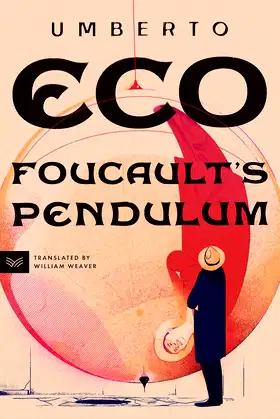
International bestselling and award-winning author Umberto Eco's Foucault's Pendulum is "an intellectual adventure story, as sensational, thrilling, and packed with arcana as Raiders of the Lost Ark or The Count of Monte Cristo" (The Washington Post Book World).Bored with their work, three Milanese editors cook up "the Plan," a hoax that connects the medieval Knights Templar with other occult groups from ancient to modern times. This produces a map indicating the geographical point from which all the powers of the earth can be controlled — a point located in Paris, France, at Foucault’s Pendulum. But in a fateful turn the joke becomes all too real, and when occult groups, including Satanists, get wind of the Plan, they go so far as to kill one of the editors in their quest to gain control of the earth.Orchestrating these and other diverse characters into his multilayered semiotic adventure, Eco has created a superb cerebral entertainment. "An encyclopedic detective story...An intellectual triumph"—Anthony Burgess"Endlessly diverting . . . Even more intricate and absorbing than his international bestseller The Name of the Rose."—Time
If a copy (often unread) of The Name of the Rose on the coffee table was a badge of intellectual superiority in 1983, Eco's second novel--also an intellectual blockbuster--should prove more accessible. This complex psychological thriller chronicles the development of a literary joke that plunges its perpetrators into deadly peril. The narrator, Casaubon, an expert on the medieval Knights Templars, and two editors working in a branch of a vanity press publishing house in Milan, are told about a purported coded message revealing a secret plan set in motion by the Knights Templars centuries ago when the society was forced underground. As a lark, the three decide to invent a history of the occult tying a variety of phenomena to the mysterious machinations of the Order. Feeding their inspirations into a computer, they become obsessed with their story, dreaming up links between the Templars and just about every occult manifestation throughout history, and predicting that culmination of the Templars' scheme to take over the world is close at hand. The plan becomes real to them--and eventually to the mysterious They, who want the information the trio has "discovered." Dense, packed with meaning, often startlingly provocative, the novel is a mixture of metaphysical meditation, detective story, computer handbook, introduction to physics and philosophy, historical survey, mathematical puzzle, compendium of religious and cultural mythology, guide to the Torah (Hebrew, rather than Latin contributes to the puzzle here, but is restricted mainly to chapter headings), reference manual to the occult, the hermetic mysteries, the Rosicrucians, the Jesuits, the Freemasons-- ad infinitum . The narrative eventually becomes heavy with the accumulated weight of data and supposition, and overwrought with implication, and its climax may leave readers underwhelmed. Until that point, however, this is an intriguing cerebral exercise in which Eco slyly suggests that intellectual arrogance can come to no good end. Copyright 1989 Reed Business Information, Inc.
Student of philology in 1970s Milan, Casaubon is completing a thesis on the Templars, a monastic knighthood disbanded in the 1300s for questionable practices. At Pilades Bar, he meets up with Jacopo Belbo, an editor of obscure texts at Garamond Press. Together with Belbo's colleague Diotallevi, they scrutinize the fantastic theories of a prospective author, Colonel Ardenti, who claims that for seven centuries the Templars have been carrying out a complex scheme of revenge. When Ardenti disappears mysteriously, the three begin using their detailed knowledge of the occult sciences to construct a Plan for the Templars[...] In his compulsively readable new novel, Eco plays with "the notion that everything might be mysteriously related to everything else," suggesting that we ourselves create the connections that make up reality. As in his best-selling The Name of the Rose, he relies on abstruse reasoning without losing the reader, for he knows how to use "the polyphony of ideas" as much for effect as for content. Indeed, with its investigation of the ever-popular occult, this highly entertaining novel should be every bit as successful as its predecessor. Previewed in Prepub Alert, LJ 6/1/89. -- Barbara Hoffert, "Library Journal"Copyright 1989 Reed Business Information, Inc.
“As brilliant and quirky as The Name of the Rose, as mischievous and wide-ranging . . . A virtuoso performance.”
“An encyclopedic detective story about a search for the center of an ancient, still-living conspiracy of men who seek not merely power over the earth but the power of the earth itself . . . An intellectual triumph.”
“Reads as if it were written by the most popular lecturer on campus with the instincts of a Catskill Mountains tumbler who keeps the one-liners coming . . . On almost every page, Eco comes up with some fresh notion or turn of phrase that displays his original mind. . . . Once the reader gets on the Eco carousel it's hard to get off.”
“Over the course of the book, we encounter medieval history, mysticism, Gnosticism, cabalism, time charts and numerology, pagan rituals, World War II nostalgia, Brazilian macumba religion, satires of contemporary Italian leftism and intellectual life, jabs at publishing practices, a computer named Abulafia, and . . . nods toward Sam Spade and other pop-culture icons. . . . Eco chooses the path less chosen by intellectual novelists
“Foucault's Pendulum is Eco's magical mystery tour of the Western mind. . . . With this book, Eco puts himself in the grand and acerbic tradition of Petronius, Rabelais, Swift, and Voltaire.”
“Rich and witty.”
“A salubrious feast of words and ideas . . . A seriocomic interpretation of the modern mind. Like Erasmus and Swift, Eco plays the fool to teach us better about ourselves.”
“By turns scholarly, spooky, satirical and deadly. . . . No reader is likely to stop reading. Or want to.”
Find it on
AmazonNo videos available yet.
No news articles linked to this title yet.

Overall
Overall rating of the media
Atmosphere
How immersive and tense is the atmosphere
Gore
Level and quality of gore/violence
Story
Quality of the storyline and plot
Writing
Quality of the written content
Character Development
Depth and growth of characters
Pacing
Flow and timing of the narrative