BOOK
0
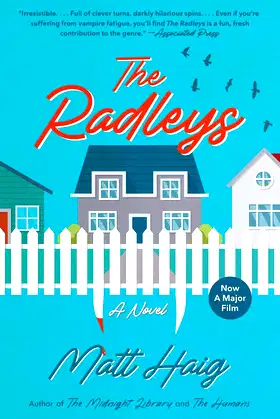
Just about everyone knows a family like the Radleys. Many of us grew up next door to one. They are a modern family, averagely content, averagely dysfunctional, living in a staid and quiet suburban English town. Peter is an overworked doctor whose wife, Helen, has become increasingly remote and uncommunicative. Rowan, their teenage son, is being bullied at school, and their anemic daughter, Clara, has recently become a vegan. They are typical, that is, save for one devastating exception: Peter and Helen are vampires and have—for seventeen years—been abstaining by choice from a life of chasing blood in the hope that their children could live normal lives. One night, Clara finds herself driven to commit a shocking—and disturbingly satisfying—act of violence, and her parents are forced to explain their history of shadows and lies. A police investigation is launched that uncovers a richness of vampire history heretofore unknown to the general public. And when the malevolent and alluring Uncle Will, a practicing vampire, arrives to throw the police off Clara’s trail, he winds up throwing the whole house into temptation and turmoil and unleashing a host of dark secrets that threaten the Radleys’ marriage. The Radleys is a moving, thrilling, and radiant domestic novel that explores with daring the lengths a parent will go to protect a child, what it costs you to deny your identity, the undeniable appeal of sin, and the everlasting, iridescent bonds of family love. Read it and ask what we grow into when we grow up, and what we gain—and lose—when we deny our appetites.
Starred Review. This witty vampire novel from British author Haig (The Possession of Mr. Cave) provides what jaded fans of the Twilight series need, not True Blood exactly, but some fresh blood in the form of a true blue family. Dr. Peter Radley and his wife, Helen, have fled wild London for the village of Bishopthorpe, where they live an outwardly ordinary life. The Radleys, who follow the rules of The Abstainer's Handbook (e.g., "Be proud to act like a normal human being"), haven't told their 15-year-old vegan daughter, Clara, and 17-year-old son, Rowan, who's troubled by nightmares, that they're really vampires. A crisis occurs when a drunken classmate of Clara's, Stuart Harper, attacks her on her way home from a party and inadvertently awakens the girl's blood thirst. Peter's call for help to his brother, Will, a practicing vampire, leads to scary consequences. The likable Clara and Rowan will appeal to both adult and teen readers. (Dec.) (c) (c) Copyright PWxyz, LLC. All rights reserved.
Despite the saturation of vampire books, television, and movies, the reviews of The Radleys suggest that readers everywhere have not yet tired of these bloodsucking (or, in this case, mostly abstaining) beings. Although each vampire novel differs from the next, critics quickly pointed out that Haig’s offering, at heart a family drama, contains some unique elements, including references to vampire pop culture both old and new as well as thoughtful inquiries into the nature of morality and identity. Yet though smart and witty, the novel often overstates its case in its presentation of right and wrong. Still, fans of the genre will rejoice in this new addition to vampire lore—and its planned sequels.
The Radleys—Peter, Helen, and their two teenagers, Clara and Rowan—live outwardly in domestic bliss, but it comes at a price: Peter and Helen are abstainers, vampires who view blood drinking as an addiction, and keeping up the facade has strained their marriage. They’ve kept the truth from their children, but this backfires when Clara’s vegan diet (dangerous for abstainers, who need meat) causes uncontrollable blood lust, culminating in her ripping a boy to shreds. Enter Uncle Will, an unrepentant vampire, whose subtle and dangerous charm brings even more trouble. This is a dark domestic drama about a loving but dysfunctional family that just happens to be vampires, though delicious moments of gore maintain its horror connection. Excerpts from The Abstainer’s Handbook, which the Radley’s rigidly follow, cleverly mimic self-help manuals, and Haig’s sly digs at suburbia’s forced banality and conformity are on target. As Rowan says, “Everyone represses everything. . . . We’re middle-class and we’re British. Repression is in our veins.” A white-picket-fence-style happy ending caps off this unusual blended story. --Krista Hutley
"Very original spin on the myth...The bite-size chapters guide the reader from one viewpoint to another....Haig's depiction of teen politics is spot on....insightful, frightening and uplifting....Uncle Will [is] a splendidly evil yet believable character...Haig pays just about enough respect to the conventions of the genre that the average vampire fan should find lots to enjoy, but it's the blackly comic dissection of the family that makes this book stand out."
"Dark humor pervades Haig's entertaining vampire family soap opera...a refreshing take on an oversaturated genre."
“Terrific, droll, and touching.”
“The Radleys is effortlessly sleek and witty.”
“Haig’s contribution is freshly weird and ultimately thirst-quenching for fans of the genre.”
“As befits a vampire story, the wit tends to be sharp….Haig does justice to the effect of…betrayal on the souls of his characters
“Matt Haig’s novel is not only head and shoulders above Twilight and all those other wimpy vampire romances, but, as an explorer of contemporary mores, Haig is more enjoyable company than writers with more ‘literary’ pedigrees.”
“The genius of novelist Matt Haig’s book is that the vampirism takes a back seat
“Haig classifies his books as black comedies, and The Radleys certainly fits that description…. [It’s] laced with lethal doses of humor.”
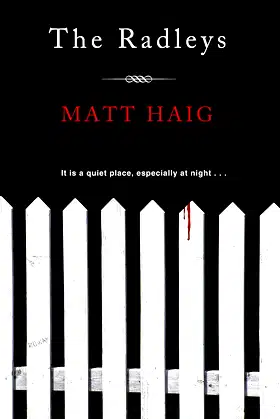
Orchard LaneIt is a quiet place, especially at night.Too quiet, you’d be entitled to think, for any kind of monster to live among its pretty, tree-shaded lanes.Indeed, at three o’clock in the morning in the village of Bishopthorpe, it is easy to believe the lie indulged in by its residents—that it is a place for good and quiet people to live good and quiet lives.At this hour, the only sounds to be heard are those made by nature itself. The hoot of an owl, the faraway bark of a dog, or, on a breezy night like this one, the wind’s obscure whisper through the sycamore trees. Even if you stood on the main street, right outside the pub or the Hungry Gannet delicatessen, you wouldn’t often hear any traffic or be able to see the abusive graffiti that decorates the former post office (though the word FREAK might just be legible if you strain your eyes).Away from the main street, on somewhere like Orchard Lane, if you took a nocturnal stroll past the detached period homes lived in by solicitors and doctors and project managers, you would find all their lights off and curtains drawn, secluding them from the night. Or you would until you reached number seventeen, where you’d notice the glow from an upstairs window filtering through the curtains.And if you stopped, sucked in that cool and consoling fresh night air, you would at first see that number seventeen is a house otherwise in tune with those around it. Maybe not quite as grand as its closest neighbor, number nineteen, with its wide driveway and elegant Regency features, but still one that holds its own.It is a house that looks and feels precisely how a village family home should look—not too big, but big enough, with nothing out of place or jarring on the eye. A dream house in many ways, as estate agents would tell you, and certainly perfect to raise children.But after a moment you’d notice there is something not right about it. No, maybe “notice” is too strong. Perhaps you wouldn’t actively realize that even nature seems to be quieter around this house, that you can’t hear any birds or anything else at all. Yet there might be an instinctive sense that would make you wonder about that glowing light and feel a coldness that doesn’t come from the night air.If that feeling grew, it might become a fear that would make you want to leave the scene and run away, but you probably wouldn’t. You would observe the nice house and the moderately expensive car parked outside and think that this is the property of perfectly normal human beings who pose no threat to the outside world.If you let yourself think this, you would be wrong. For 17 Orchard Lane is the home of the Radleys, and despite their very best efforts, they are anything but normal.© 2010 Matt Haig
Find it on
AmazonNo videos available yet.
No news articles linked to this title yet.
No tags available.

Overall
Overall rating of the media
Atmosphere
How immersive and tense is the atmosphere
Gore
Level and quality of gore/violence
Story
Quality of the storyline and plot
Writing
Quality of the written content
Character Development
Depth and growth of characters
Pacing
Flow and timing of the narrative