

BOOK
0
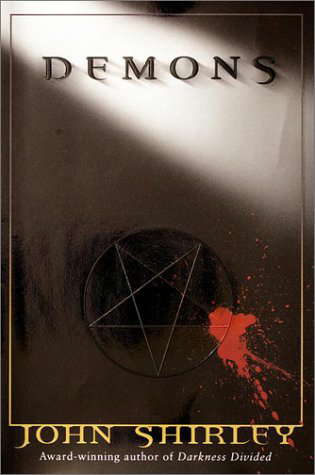
Writers from Clive Barker to Bruce Sterling and Roger Zelazny have praised John Shirley’s searing, apocalyptic visions of postmodern hell on earth. Now this perversely brilliant author, one of the seminal representatives on the cyberpunk movement, unleashes his newest masterpiece.DEMONSIn a future uncomfortably close to the present day, the apocalypse has surpassed all expectations. Hideous demons roam the streets in an orgy of terror, drawing pleasure from torturing humans as sadistically as possible. Divided into seven clans, these grisly invaders–gnashing, writhing, bloodthirsty monsters–seem horrifically to belong in our world.Ira, a young San Francisco artist, becomes involved with a strange group of scientists and philosophers desperately trying to end the bloody siege. Yet through it all, Ira continues to paint–for in his canvasses lie crucial clues to the demons’ origins.Yet the demons draw their strength from an all-too-familiar evil–a deadly malevolence supported by some of the greatest powers on earth, concealed beneath the trappings of status, success, and abused power. Ira and his allies– including a compelling young seeress–come to believe these demons didn’t just appear. They were summoned. But the most shocking revelation is yet to come . . .EXCLUSIVE TO THIS EDITION: The original novella Demons was published as an acclaimed, limited edition hardcover which Publishers Weekly called a “mini-masterpiece.” Now the terror continues, as the sequel story, “Undercurrents,” takes the reader on a macabre journey into the center of the conspiracy that may lay waste to the Earth.
Nightmarish demons terrorize the world in this sharp-edged tale of horror and humanity from award-winner John Shirley. A young artist from San Francisco witnesses the demons' arrival and the world's response--panic, denial, and even cooperation in the slaughter. He joins a group of people who believe that human action brought the demons into the world and that the power of human consciousness--awareness of one's true self--is the only defense against them. Then nine years later, in the face of a new threat, the group must overcome conspiracy and the world's disbelief to battle demons once again. Themes of wakefulness and sleep--the struggle for self-awareness against the deliberate denial of what's happening around us--form the counterpoint for the terrifying and often brutal events of the story. This is a fast-paced, finely told horror tale combined with a pointed examination of the ways in which people so often conspire in their own destruction. --Roz Genessee
To a novella of the same title, Shirley (...And the Angel with Television Eyes) adds a lengthy aftermath that, though it couples clunkily, offers a crafty elaboration of the dark metaphysics in the original parable about corporate greed. Nine years after the benevolent Conscious Circle group exorcised the ravenous demons who arose in response to toxic disaster, it's business as usual in America. Stephen Isquerat, a naf climbing the corporate ladder at the West Wind company, is convinced like most everyone else that the past demonic convergence was a hallucinogen-induced exercise in mass hysteria. Little does he know that his company's interest in "psychonomics," the manipulation of the spiritual power of business, is laying the foundation for a demon resurrection, or that his work marketing Dirvane 17, a potent neurotoxic pesticide, is making him the perfect vessel for their second coming. The first part of the novel is a fascinating if talky take on clinical demonology that greases the wheels for escalating events in the second part. Though the author conceived the two halves of his story as variations on the same theme, their differing approaches seem out of synch, a problem most notable in the perfunctory relationship of Conscious Circle members to Stephen's experiences. For all the narrative gear grinding, Shirley succeeds in fashioning an over-the-top occult thriller solidly anchored in a bedrock of social consciousness. (Mar.)July 24, 2000).Copyright 2002 Cahners Business Information, Inc.
The apocalypse has come and gone and demons prowl Earth, forging a path of violence and torture as they rampage across the planet. A few scientists, aided by a young San Franciscan artist, pool their resources in a bold maneuver to end the reign of these creatures. From the streets of America's cities to the heart of the Middle East, Shirley's latest novel, based on an earlier story, combines fast-paced action, outrageous science, and graphic horror in a novel suitable for large horror collections. Copyright 2002 Cahners Business Information, Inc.
Shirley's well-turned apocalyptic tale, redolent with the terror of inexplicable carnage, is two novels in one: a first-person account of an initial advent of demons in everyday reality, followed by the story of their later return. Ira, narrator of the first, plays a significant role in the second, and Shirley links the two episodes nearly seamlessly. Ira reports a world gone mad with demonic possession, its people clinging to normality for dear life. After discovering the horrible truth behind the invasion, a group of the spiritually "awake," the Circle, sends the demons back where they came from. Proving that people don't learn from experience, nine years later the invasion is dismissed as a mass hallucination, and a group of industrialists become bent on bringing the demons back. Shirley plays well with the old themes of universal consciousness and spiritual enlightenment as well as the darkness and light in the human psyche. His brand of horror mixes the blatant--corporeal demons--and the subtle to disclose the merely human capacity for atrocity. Regina SchroederCopyright © American Library Association. All rights reserved
“John Shirley is an adventurer, returning from dark and troubled regions with visionary tales to tell. I heartily recommend a journey with John Shirley at your side.”
Clive Barker to Bruce Sterling and Roger Zelazny have praised John Shirley s searing, apocalyptic visions of postmodern hell on earth. Now this perversely brilliant author, one of the seminal representatives on the cyberpunk movement, unleashes his newest masterpiece.DEMONSIn a future uncomfortably close to the present day, the apocalypse has surpassed all expectations. Hideous demons roam the streets in an orgy of terror, drawing pleasure from torturing humans as sadistically as possible. Divided into seven clans, these grisly invaders gnashing, writhing, bloodthirsty monsters seem horrifically to belong in our world.Ira, a young San Francisco artist, becomes involved with a strange group of scientists and philosophers desperately trying to end the bloody siege. Yet through it all, Ira continues to paint for in his canvasses lie crucial clues to the demons origins.Yet the demons draw thei
“John Shirley is an adventurer, returning from dark and troubled regions with visionary tales to tell. I heartily recommend a journey with John Shirley at your side.”——CLIVE BARKER “John Shirley accomplishes things that most writers would not dare to attempt.”–BRUCE STERLING Author of Schismatrix“John Shirley’s prophet-in-the-cyberwilderness voice deserves high billing among the best.”–ROGER ZELAZNY Author of the Amber series “Destined to become a new major voice in science fiction.”–ROBERT SILVERBERG
As for me . . . I was up in a high-rise in San Francisco those months ago the morning the demons came.I had gone to see Professor Paymenz or, to be perfectly honest, to see his daughter under the auspices of seeing the professor. It was housing that San Francisco State had arranged for him—they had a program supplying subsidized housing to teaching staff—and as I arrived I saw another eviction notice from SFSU on the door. Paymenz had refused to teach comparative religion anymore, would lecture only about extremely obscure occult practices and beliefs, and rarely showed up even for those classes. He hadn’t ever had his tenure settled, so they simply fired him. But he’d refused to leave the university housing on the simple but contumacious grounds, as he explained, that he deserved this more than the teacher down the hall, who taught “existential themes in daytime television.”Vastly bearded, restless-eyed, in the grimy alchemist’s robe that he wore as a nightgown, Paymenz looked over my shoulder into the hallway behind me. Expecting to see someone back there. He always did that, and he never met my eyes, no matter how earnestly he spoke to me.He seemed almost happy to see me as he ushered me in. He even said, “Why, hello, Ira.” He rarely troubled with social niceties.I saw that Professor Shephard was there, small-brimed fedora in hand. Shephard seemed poised between staying and going. Maybe that was why Paymenz was happy to see me: It gave him an excuse to get rid of an unwanted visitor.Shephard was a short, fiftyish, bullet-shaped man in an immaculate gray suit, vest, tie that matched the season. He had a shaved head, eyes the color of aluminum, a perpetual pursed smile, and a jutting jaw.He put his hat on his head but didn’t go. Standing there in the exact middle of the small living room, with his arms by his sides, his small feet in shiny black shoes neatly together, Shephard looked out of place in Paymenz’s untidy, jumbled apartment. He looked set up and painted like one of those Russian toys, the sort made of smooth wood containing ever-smaller copies. Shephard was an economics professor who believed in “returning economics to philosophy, as it was with our Found- ing Fathers, and, yes, with Marx”—but his philosophy had something to do with “pragmatic postmodernism.” Today his tie was all coppery maple leaves against rusty orange, celebrating autumn.I knew Shephard from the last conference on Spirituality and Economics he’d put together—he’d hired me to create the poster, with “appropriate imagery,” and paid me three times for doing three versions, each version less definite, blander than the one before. At every poster-design discussion, he’d brought up Paymenz. “I understand you’re his good friend. What is he up to? And his daughter? How is she?”The questions always felt like non sequiturs. Now, recognizing me, he nodded pleasantly. “Ira. How are you?”“Dr. Shephard,” Paymenz said before I could reply, “thank you for dropping in—I have guests, as you see. . . .”Shephard’s head swiveled on his shoulders like a turret, first at me, then to Paymenz. “Of course. I am sorry to have precipitated myself upon you, as it were; perhaps certain matters are of some urgency. Perhaps not. I only wished to plant the seed of the idea, so to say, that, should the conference on Spiritual Philosophy and Economics not come about this weekend for any reason, I do wish to stay in touch—very closely in touch. Please feel free to call me.” He handed Paymenz a business card and was moving toward the door. He startled me by not seeming to move on rollers; he walked as any man his size might. A normal walk seemed odd on him. “I will speak to the board about your housing issue, as promised, one more time. Au revoir!” He opened, passed through, and closed the door with hardly a sound, smooth as smoke up a chimney.Paymenz irritably tossed the business card onto a lamp table heaped with cards, unopened letters, bills. “That man’s arrogance, the way he just shows up unexpectedly . . . always as if he has no agenda . . . babbling about his conference not coming off—when there’s no reason it shouldn’t . . . I should never have agreed to go to his antiseptic-yet-strangely-septic conference, if he hadn’t offered me a fee . . . but he knows perfectly well I need the money.”Hoping Paymenz remembered he actually had invited me over for coffee, I looked around for some place to hang my leather jacket. But of course there was no place, really, to put it. The closet was crammed full with clothes no one wore; and with junk. The other apartments in the twenty-story high-rise were underdecorated minimalist-modern affairs, trying to echo the utilitarian, airy curviness that the architects of the building had borrowed from I. M. Pei or Frank Lloyd Wright. Paymenz, however, had covered the walls with an ethnically disconnected selection of tapestries and carpets—Persian and Chinese and a Southwestern design from Sears. He collected old lava lamps, and though the electricity had been turned off, they churned away, six of them crudely wired to car batteries, with lots of electrical tape around half-stripped connections. The lamps sat on the car batteries and on end tables and mantels, shape-shifting in waxen primary colors. A week previous, it was said, the entire SFSU board of tenure review had come out to the university parking lot to find their cars mysteriously inert.Half a dozen more lava lamps were broken, used as bookends for the many hundreds of books that took up most of the space that wasn’t tapestry. Two candles were burning, and a fading battery.Cats darted behind chairs and moved sinuously up and down much-clawed cat trees. I counted four cats—no, five: They’d taken in a new one.There were bits of breakfast toast in Paymenz’s long, shovel-shaped gray-and-black beard; his eyes, red-rimmed gray under bristling brows, rested on me for only a flicker as he spoke. “Many the auguries this morning, Ira. Would you like to see?”“You know how I feel about medieval techniques, especially any that involve damp, decaying guts,” I said, looking about for Melissa. I was an aficionado of the arcane meta- physical, being the former art director for the now-defunct Visions: The Magazine of Spiritual Life, but I drew the line at peering into rotting intestines.“It’s fresh pig bladder,” he said, “none of that decaying stuff anymore. Melissa made me promise. I suppose the place is rank enough already.”The place wasn’t quite rank, but it bore a distinct smell: pipe tobacco and cat boxes and cloying Middle Eastern incense, all vying for dominance.“I see you have some new lava lamps.”“Yes. Look at this one—a confection of gold-flecked red ooze fighting its way into a feverish primeval swelling. Unconsciously, the designer was thinking of the philosopher’s stone.”“I don’t know if they bothered with a designer for these things after the first one.”“They don’t need one, it’s true—and that’s the point. The lava lamp is protosociety’s purely unconscious expression of the primeval ooze on one level, shaping itself into our most remote sea-slime ancestors; on another level, the lava lamp is the pleroma, the fundamental stuff that gives birth to the existential condition. Hank, down at the antique shop, tells me he likes to smoke pot and look into his lava lamps, and then he sees girls there, apparently, in all those sinuous lava-bubbling curves—like Moscoso drawings—but it’s all quite unconscious . . . tabula rasa for the subconscious. . . . Freud not utterly discredited after all, if we consider Hank and his lamps . . .”Paymenz noticed my attention wandering; my gaze must have drifted to Melissa’s bedroom door. “Oh good lord. Typical young person today. Post-MTV generation. Internet-surfing brain damage. Attention span of a gnat. Melissa! Come in here, this young man is already weary of pretending he’s here to see me! He’s a-quiver with desire for you!” He clutched his reeking alchemist’s robe about himself—Melissa had made it for him, as a mother will make a Superman cape for her little boy—and stumped off to the kitchen to finish his breakfast. “He’s sniffing the air for your pheromones!” he called to her as he went.I grimaced, but I was used to the professor’s indifference to social insulation of any kind whatsoever.Melissa came in then, wearing a long black skirt, no shoes, a loose, low-cut Gypsy-type purple blouse. Her crooked smile was even more to one side of her triangular face than usual in wry deprecation of her father’s vulgarity.“Shephard is gone?” she asked.“He is,” I said, “unless he’s somehow watching us through his business card.”“Wouldn’t surprise me. He makes my skin contract on my body,” she said, locking the front door. “He asked me if he could hear me sing for him sometime! Like to hear my songs, he said.”I was thinking that Shephard had always had an unhealthy interest in her but decided not to remark on it. My own interest in her, I told myself, was . . . earthy.She was a few inches taller than me, a big girl with tiny feet; I don’t know how she kept from teetering. Her forehead was high, this only mildly mitigated by the shiny black bangs; long raven wings of hair fell straight to her pale, stooped shoulders and coursed round them. Her large green eyes looked at me frankly; they seemed to coruscate. Her chin was just a little sl...
Find it on
AmazonNo videos available yet.
No news articles linked to this title yet.

Overall
Overall rating of the media
Atmosphere
How immersive and tense is the atmosphere
Gore
Level and quality of gore/violence
Story
Quality of the storyline and plot
Writing
Quality of the written content
Character Development
Depth and growth of characters
Pacing
Flow and timing of the narrative