
BOOK
0
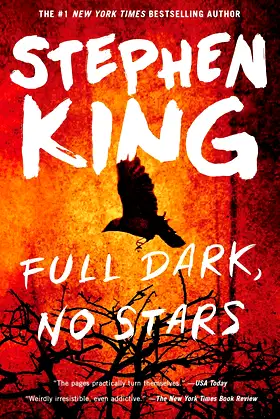
"I believe there is another man inside every man, a stranger . . ." writes Wilfred Leland James in the early pages of the riveting confession that makes up "1922," the first in this pitch-black quartet of mesmerizing tales from Stephen King. For James, that stranger is awakened when his wife, Arlette, proposes selling off the family homestead and moving to Omaha, setting in motion a gruesome train of murder and madness. In "Big Driver," a cozy-mystery writer named Tess encounters the stranger along a back road in Massachusetts when she takes a shortcut home after a book-club engagement. Violated and left for dead, Tess plots a revenge that will bring her face-to-face with another stranger: the one inside herself. "Fair Extension," the shortest of these tales, is perhaps the nastiest and certainly the funniest. Making a deal with the devil not only saves Dave Streeter from a fatal cancer but provides rich recompense for a lifetime of resentment. When her husband of more than twenty years is away on one of his business trips, Darcy Anderson looks for batteries in the garage. Her toe knocks up against a box under a worktable and she discovers the stranger inside her husband. It’s a horrifying discovery, rendered with bristling intensity, and it definitively ends a good marriage. Like Different Seasons and Four Past Midnight, which generated such enduring films as The Shawshank Redemption and Stand by Me, Full Dark, No Stars proves Stephen King a master of the long story form.
Amazon Best Books of the Month, November 2010: When a master of horror and heebie-jeebies like Stephen King calls his book Full Dark, No Stars, you know you’re in for a treat--that is, if your idea of a good time is spent curled up in a ball wondering why-oh-why you started reading after dark. King fans (and those who have always wanted to give him a shot) will devour this collection of campfire tales where marriages sway under the weight of pitch-black secrets, greed and guilt poison and fester, and the only thing you can count on is that "there are always worse things waiting." Full Dark, No Stars features four one-sitting yarns showcasing King at his gritty, gruesome, giddy best, so be sure to check under the bed before getting started. --Daphne Durham Amazon Exclusive: Justin Cronin, Suzanne Collins, Margaret Atwood, and T.C. Boyle Review Stephen King's Full Dark, No Stars "King is Poe's modern heir, and no writer has a richer sense of the dark rooms in the human psyche and fiction's singular power to capture them." Read more of Justin Cronin's review of "1922" "Fast-paced and beautifully plotted, 'Big Driver' pulls you into Tess's fragmented mind and holds you hostage until the story concludes." Read more of Suzanne Collins's review of "Big Driver" "It wouldn't be Stephen King if somebody's messily bleeding neck did not sprout a huge white knob. As it were." Read more of Margaret Atwood's review of "A Good Marriage" "[King's] very ordinary-looking devil has no use for human souls, which, in these enervated times, 'have become poor and transparent things.'" Read more of T.C. Boyle's review of "Fair Extension"
Starred Review. Eerie twists of fate drive the four longish stories in King's first collection since Just After Sunset (2008). In "1922," a farmer murders his wife to retain the family land she hopes to sell, then watches his life unravel hideously as the consequences of the killing suggest a near-supernatural revenge. "Big Driver" tells of an otherwise ordinary woman who discovers her extraordinary capacity for retribution after she is raped and left for dead. "A Good Marriage" explores the aftermath of a wife's discovery of her milquetoast husband's sinister secret life, while "Fair Extension," the book's most disturbing story, follows the relationship between a man and the best friend on whom he preternaturally shifts all his bad luck and misfortune. As in Different Seasons (1982), King takes a mostly nonfantastic approach to grim themes. Now, as then, these tales show how a skilled storyteller with a good tale to tell can make unsettling fiction compulsively readable. (Nov.) (c) Copyright © Reed Business Information, a division of Reed Elsevier Inc. All rights reserved.
*Starred Review* King begins his afterword by stating, “The stories in this book are harsh.” The man ain’t whistlin’ Dixie. Returning to the novella—possibly his brightest canvas—King provides four raw looks at the limits of greed, revenge, and self-deception. The first, “1922,” is an outright masterpiece and takes the form of the written confession of one Wilf James. Back in 1922, see, Wilf killed his wife to prevent her selling off part of the farm, but tossing her corpse down the well didn’t exactly stop her. It’s Poe meets Creepshow by way of Steinbeck and carries the bleak, nearly romantic doom of an old folk ballad about murderin’ done wrong. A pair of the remaining tales feature female protagonists considering hiding others’ crimes: “Big Driver” is a rape-revenge tale about a writer of cozy mysteries who ends up in the uncoziest of situations, while “A Good Marriage” stars a wife whose husband of 27 years turns out to be hiding an unimaginable secret. Though the shortest story by far, “Fair Extension” is no slouch, submitting for your approval one Mr. Elvid (get it?), who is out to shine a little light on our blackest urges. Rarely has King gone this dark, but to say there are no stars here is crazy. High-Demand Backstory: King has gone on record saying he believesthat American readers should pay more attention to the virtues of short fiction; and if anyone can get reluctant short-story and novella readers into the swing, he certainly can with this book. --Daniel Kraus
“King [is] the most wonderfully gruesome man on the planet… The pages practically turn themselves.”
“Full Dark, No Stars is an extraordinary collection, thrillingly merciless, and a career high point.”
“A page turner.… King … seems able to write compact tales or gargantuan ones with equal ease.”
“Might yield another classic… Solid psychological chillers.”
“Just as gripping as his epic novels.”
- 1 -The one thing nobody asked in casual conversation, Darcy thought in the days after she found what she found in the garage, was this: How’s your marriage? They asked how was your weekend and how was your trip to Florida and how’s your health and how are the kids; they even asked how’s life been treatin you, hon? But nobody asked how’s your marriage?Good, she would have answered the question before that night. Everything’s fine.She had been born Darcellen Madsen (Darcellen, a name only parents besotted with a freshly purchased book of baby names could love), in the year John F. Kennedy was elected President. She was raised in Freeport, Maine, back when it was a town instead of an adjunct to L.L.Bean, America’s first superstore, and half a dozen other oversized retail operations of the sort that are called “outlets” (as if they were sewer drains rather than shopping locations). She went to Freeport High School, and then to Addison Business School, where she learned secretarial skills. She was hired by Joe Ransome Chevrolet, which by 1984, when she left the company, was the largest car dealership in Portland. She was plain, but with the help of two marginally more sophisticated girlfriends, learned enough makeup skills to make herself pretty on workdays and downright eye-catching on Friday and Saturday nights, when a bunch of them liked to go out for margaritas at The Lighthouse or Mexican Mike’s (where there was live music).In 1982, Joe Ransome hired a Portland accounting firm to help him figure out his tax situation, which had become complicated (“The kind of problem you want to have,” Darcy overheard him tell one of the senior salesmen). A pair of briefcase-toting men came out, one old and one young. Both wore glasses and conservative suits; both combed their short hair neatly away from their foreheads in a way that made Darcy think of the photographs in her mother’s MEMORIES OF ’54 senior yearbook, the one with the image of a boy cheerleader holding a megaphone to his mouth stamped on its faux-leather cover.The younger accountant was Bob Anderson. She got talking with him on their second day at the dealership, and in the course of their conversation, asked him if he had any hobbies. Yes, he said, he was a numismatist.He started to tell her what that was and she said, “I know. My father collects Lady Liberty dimes and buffalo-head nickels. He says they’re his numismatical hobby-horse. Do you have a hobby-horse, Mr. Anderson?”He did: wheat pennies. His greatest hope was to some day come across a 1955 double-date, which was—But she knew that, too. The ’55 double-date was a mistake. A valuable mistake.Young Mr. Anderson, he of the thick and carefully combed brown hair, was delighted with this answer. He asked her to call him Bob. Later, during their lunch—which they took on a bench in the sunshine behind the body shop, a tuna on rye for him and a Greek salad in a Tupperware bowl for her—he asked if she would like to go with him on Saturday to a street sale in Castle Rock. He had just rented a new apartment, he said, and was looking for an armchair. Also a TV, if someone was selling a good one at a fair price. A good one at a fair price was a phrase with which she would grow comfortably familiar in the years to come.He was as plain as she was, just another guy you’d pass on the street without noticing, and would never have makeup to make him prettier… except that day on the bench, he did. His cheeks flushed when he asked her out, just enough to light him up a little and give him a glow.“No coin collections?” she teased.He smiled, revealing even teeth. Small teeth, nicely cared for, and white. It never occurred to her that the thought of those teeth could make her shudder—why would it?“If I saw a nice set of coins, of course I’d look,” he said.“Especially wheat pennies?” Teasing, but just a little.“Especially those. Would you like to come, Darcy?”She came. And she came on their wedding night, too. Not terribly often after that, but now and then. Often enough to consider herself normal and fulfilled.In 1986, Bob got a promotion. He also (with Darcy’s encouragement and help) started up a small mail-order business in collectible American coins. It was successful from the start, and in 1990, he added baseball trading cards and old movie memorabilia. He kept no stock of posters, one-sheets, or window cards, but when people queried him on such items, he could almost always find them. Actually it was Darcy who found them, using her overstuffed Rolodex in those pre-computer days to call collectors all over the country. The business never got big enough to become full-time, and that was all right. Neither of them wanted such a thing. They agreed on that as they did on the house they eventually bought in Pownal, and on the children when it came time to have them. They agreed. When they didn’t agree, they compromised. But mostly they agreed. They saw eye-to-eye.How’s your marriage?It was good. A good marriage. Donnie was born in 1986—she quit her job to have him, and except for helping with Anderson Coins & Collectibles never held another one—and Petra was born in 1988. By then, Bob Anderson’s thick brown hair was thinning at the crown, and by 2002, the year Darcy’s Macintosh computer finally swallowed her Rolodex whole, he had a large shiny bald spot back there. He experimented with different ways of combing what was left, which only made the bald spot more conspicuous, in her opinion. And he irritated her by trying two of the magical grow-it-all-back formulas, the kind of stuff sold by shifty-looking hucksters on high cable late at night (Bob Anderson became something of a night owl as he slipped into middle age). He didn’t tell her he’d done it, but they shared a bedroom and although she wasn’t tall enough to see the top shelf of the closet unaided, she sometimes used a stool to put away his “Saturday shirts,” the tees he wore for puttering in the garden. And there they were: a bottle of liquid in the fall of 2004, a bottle of little green gel capsules a year later. She looked the names up on the Internet, and they weren’t cheap. Of course magic never is, she remembered thinking.But, irritated or not, she had held her peace about the magic potions, and also about the used Chevy Suburban he for some reason just had to buy in the same year that gas prices really started to climb. As he had held his, she supposed (as she knew, actually), when she had insisted on good summer camps for the kids, an electric guitar for Donnie (he had played for two years, long enough to get surprisingly good, and then had simply stopped), horse rentals for Petra. A successful marriage was a balancing act—that was a thing everyone knew. A successful marriage was also dependent on a high tolerance for irritation—this was a thing Darcy knew. As the Stevie Winwood song said, you had to roll widdit, baby.She rolled with it. So did he.In 2004, Donnie went off to college in Pennsylvania. In 2006, Petra went to Colby, just up the road in Waterville. By then, Darcy Madsen Anderson was forty-six years old. Bob was forty-nine, and still doing Cub Scouts with Stan Morin, a construction contractor who lived half a mile down the road. She thought her balding husband looked rather amusing in the khaki shorts and long brown socks he wore for the monthly Wildlife Hikes, but never said so. His bald spot had become well entrenched; his glasses had become bifocals; his weight had spun up from one-eighty into the two-twenty range. He had become a partner in the accounting firm—Benson and Bacon was now Benson, Bacon & Anderson. They had traded the starter home in Pownal for a more expensive one in Yarmouth. Her breasts, formerly small and firm and high (her best feature, she’d always thought; she’d never wanted to look like a Hooters waitress) were now larger, not so firm, and of course they dropped down when she took off her bra at night—what else could you expect when you were closing in on the half-century mark?—but every so often Bob would still come up behind her and cup them. Every so often there was the pleasant interlude in the upstairs bedroom overlooking their peaceful two-acre patch of land, and if he was a little quick on the draw and often left her unsatisfied, often was not always, and the satisfaction of holding him afterward, feeling his warm man’s body as he drowsed away next to her… that satisfaction never failed. It was, she supposed, the satisfaction of knowing they were still together when so many others were not; the satisfaction of knowing that as they approached their Silver Anniversary, the course was still steady as she goes.In 2009, twenty-five years down the road from their I-do’s in a small Baptist church that no longer existed (there was now a parking lot where it had stood), Donnie and Petra threw them a surprise party at The Birches on Castle View. There were over fifty guests, champagne (the good stuff), steak tips, a four-tier cake. The honorees danced to Kenny Loggins’s “Footloose,” just as they had at their wedding. The guests applauded Bob’s breakaway move, one she had forgotten until she saw it again, and its still-airy execution gave her a pang. Well it should have; he had grown a paunch to go with the embarrassing bald spot (embarrassing to him, at least), but he was still extremely light on his feet for an accountant.But all of that was just history, the stuff of obituaries, and they were still too young to be thinking of those. It ignored the minutiae of marriage, and such ordinary mysteries, she believed (firmly believed), were the stuff that validated the partnership. The time sh...
Find it on
AmazonNo videos available yet.
No news articles linked to this title yet.

Overall
Overall rating of the media
Atmosphere
How immersive and tense is the atmosphere
Gore
Level and quality of gore/violence
Story
Quality of the storyline and plot
Writing
Quality of the written content
Character Development
Depth and growth of characters
Pacing
Flow and timing of the narrative