

BOOK
0
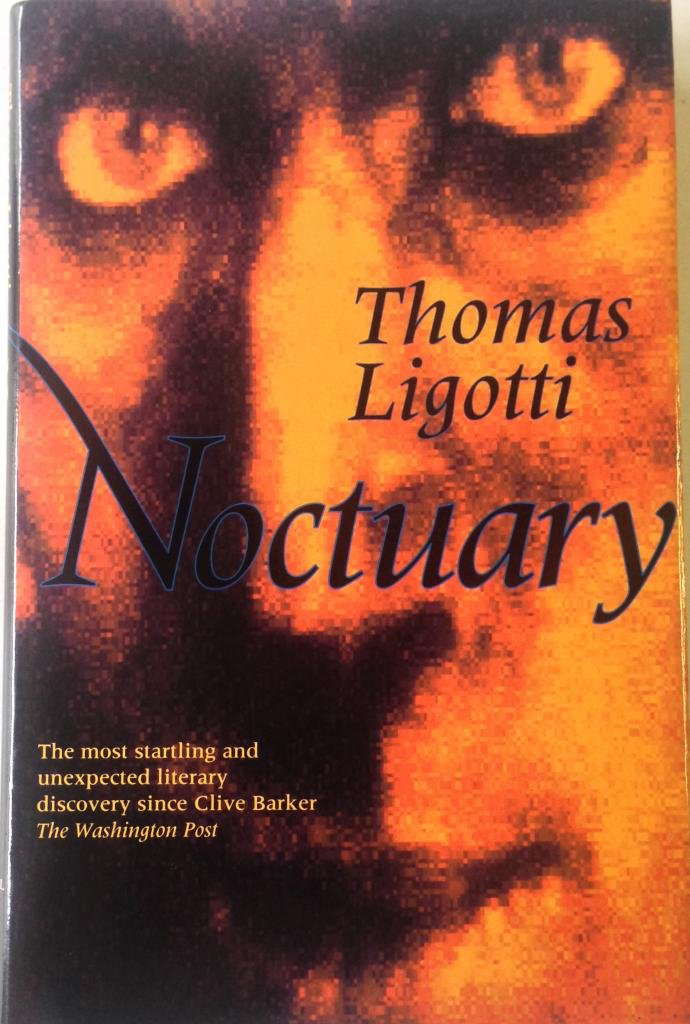
This collection of horror stories, many previously unpublished, includes "The Medusa," "Conversations in a Dead Language," and "Mad Night of Atonement"
Ligotti's ( Grimscribe ) clever title suggests the marriage of "nocturne" and "mortuary," an appropriate preparation for this dark grouping of tales. In the foreword, the author explains that they fall in the category of "weird fiction," that is, extreme gothic horror, featuring macabre endings and unremitting doom. The studied extravagance in the narration of the some of the stories verges on stylistic overkill. Nevertheless, as gothic tales, a number of them are interesting. Three good tales are "The Medusa," which tells of a scholar obsessed with the Gorgon whom Perseus apparently did not kill; "Mrs. Rinaldi's Angel," a tale that lends new meaning to the term "bad dreams"; and the novella-length "The Tsalal," a gothic work of demonic prophecy that boasts a gruesome ending. These 27 stories describe shadowy worlds of blurred dimensions and ill-lit interiors; as with all such tales, the "when" and "where" are much less important than the atmosphere of gothic horror produced by Ligotti's baroque prose. Copyright 1993 Reed Business Information, Inc.
Ligotti has written another colorful collection of horror stories ( Grimscribe , Songs of a Dead Dreamer , both Carroll & Graf Pubs., 1991), which spring on the unsuspecting reader the combination of supernatural characters, natural props, and "weird" circumstances. Stories include "The Medusa," which recounts the horror of Lucian Dregler, a man obsessed with finding the Medusa, the hideous woman with serpents on her head whose look turns men to stone. "Conversations in a Dead Language" is told from the perspective of an insane candy giver on three subsequent Halloweens; suspense mounts with each year as the reader witnesses the narrator's physical and mental deterioration. The last section of the book, "Notebook of the Night," is filled with short, lurid vignettes--snapshots of horror that demonstrate Ligotti's command of language and rich imagination. Starkly colored images keep the reader gasping. Recommended for horror collections.- Stacie Browne Chandler, Plymouth P.L., Mass.Copyright 1994 Reed Business Information, Inc.
The most disturbing terror comes from within, springs unexpectedly from bland or half-formed memories of the past. This is the terror that Ligotti cultivates in the richly evocative tales of this book, which slowly inundate the reader with a dread that even at a story's climax remains formless and shrouded, though undeniably present. Ligotti's protagonists are introspective psychic adventurers, such as a boy being taken to an old healer lady or an academic in pursuit of a fiend in the form of the Medusa, and his demons and horrors are both universal and very personal. His writing style is atmospheric, so much so that it at times risks turgidness. In the main, it serves his subject matter well, although it means his stories may prove inaccessible for run-of-the-mill horror fans. For those willing to immerse themselves in Ligotti's world, however, the rewards are great. Mike Tribby
Supersaturated with supernal purple: a third sheaf of horror shorts from Ligotti (Grimscribe, Songs of a Dead Dreamer) that binds bodiless slumberings into a lurid triumph of wordcraft over forlorn weirdness. The present nighttime ditties (earlier magazine publication was not noted in our galley) show him again focused on the decaying glow of a scholarly solitary obsessed by horrific studies and going over the edge as his worst, most hidden fear rises up concretely before him. As in Verdi, Ligotti stories witness the unstoppable force of Fate. Character rarely develops, is only acted upon by an inscrutable malignancy, seen in the indigo of death's twilight glamour. Here, the author opens with a note ``on the appreciation of weird fiction'' whose ideas and sidelights woo us down a gleaming path in a dim woods: ``A man awakes in the darkness and reaches over for his eyeglasses. The eyeglasses are placed in his hand.'' In ``The Medusa,'' a bookish philosopher fixated on the faces of the Medusa in human existence (the horrific is everywhere) finally meets his goddess--and becomes one with the horror in his soul. In ``Conversations in a Dead Language,'' a fat postman given to babytalk is trick-or-treated into his dreamfate by midget vampires and jack-o'-lanterns amid the delirium and disorder of Halloween. In his descriptive short novel ``Tsalal'' (Tsalal is a book of mock scholarship like H.P. Lovecraft's heady but fictitious volume of abstruse weirdness, The Necronomicon), Ligotti relates spiritual particulars of a half-world borderland community called Moxton, which is seen with the vivid brightness of nicked lead. The final ``Notebook of the Night'' slips us into a dozen or so drab labyrinths past all lamplight. An exhalation of evenings with the half-dead. -- Copyright ©1993, Kirkus Associates, LP. All rights reserved.
Find it on
AmazonNo videos available yet.
No news articles linked to this title yet.

Overall
Overall rating of the media
Atmosphere
How immersive and tense is the atmosphere
Gore
Level and quality of gore/violence
Story
Quality of the storyline and plot
Writing
Quality of the written content
Character Development
Depth and growth of characters
Pacing
Flow and timing of the narrative