
BOOK
0
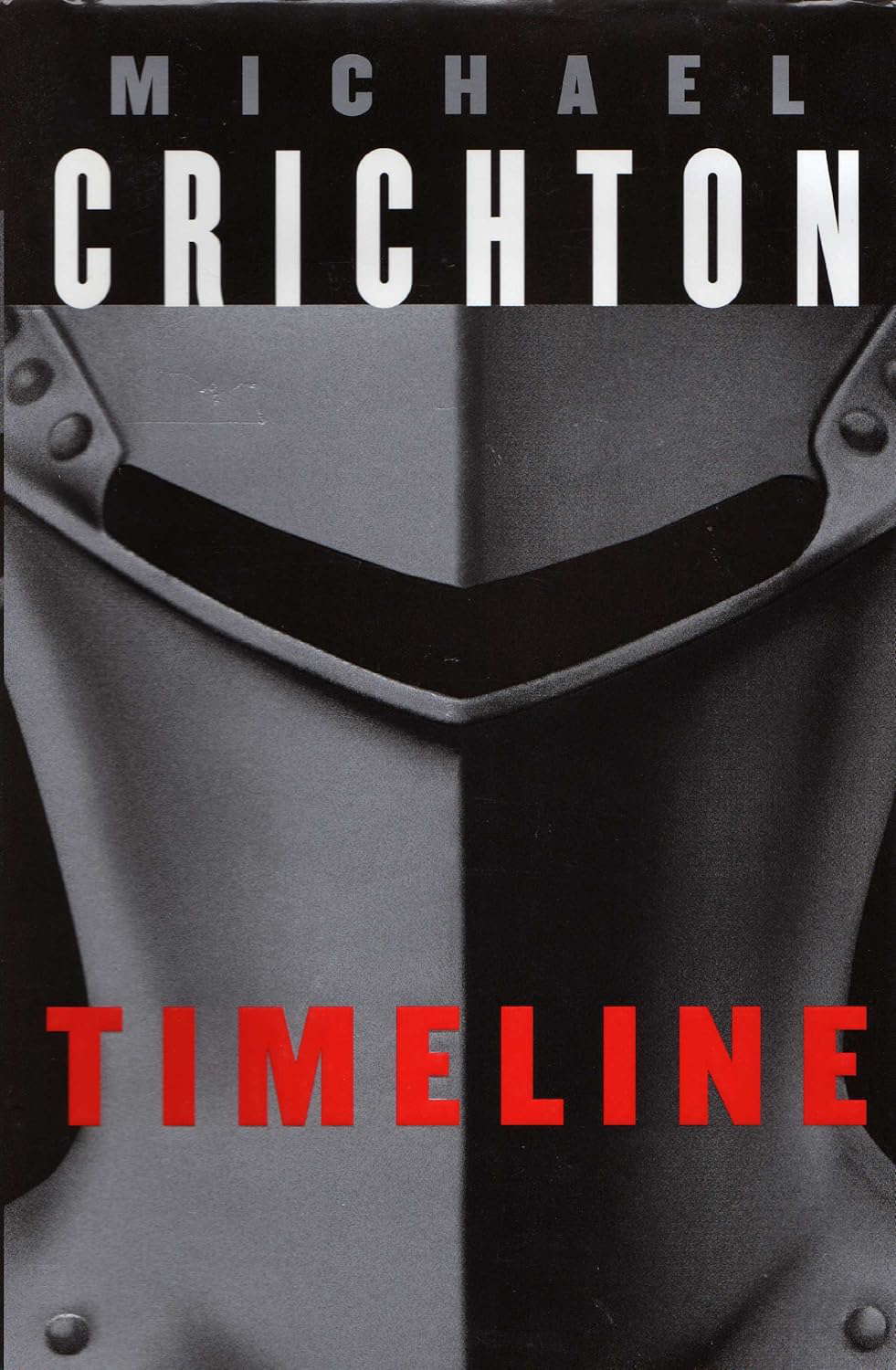
An old man wearing a brown robe is found wandering disoriented in the Arizona desert. He is miles from any human habitation and has no memory of how he got to be there, or who he is. The only clue to his identity is the plan of a medieval monastery in his pocket. So begins the mystery of Timeline, a story that will catapult a group of young scientists back to the Middle Ages and into the heart of the Hundred Years' War. Timeline cements Michael Crichton's place as the king of the high-concept thriller, and a master storyteller to boot.
It all begins with an unwitting couple accidentally striking down a mysterious scientist with their car in the middle of a New Mexico desert. In the flashes of events that occur thereafter, Crichton takes listeners on a quantum journey through past and present. Stephen Lang is a great fit for this edgy mystery. He balances the story's incredible occurrences with an even-keeled performance. Lang gives life not only to the characters he reads but to their environs. Timeline will not disappoint longtime fans or newcomers to Crichton's work. R.A.P. (c) AudioFile 2000, Portland, Maine-- Copyright © AudioFile, Portland, Maine --This text refers to an out of print or unavailable edition of this title.
“COMPULSIVE READING . . . BRILLIANTLY IMAGINED.”–Los Angeles Times“THE PRESENT AND THE LONG-AGO PAST COLLIDE. . . . [as] three young historians whisk themselves back to fourteenth-century feudal France to rescue a friend–and engulf themselves in all manner of mind-blowing intrigue.”–Chicago Sun-Times“[A] BIG ROLLICKING BOOK.”–The Wall Street Journal“EXCITING . . . CLASSIC ADVENTURE . . . [A] SWASHBUCKLING NOVEL . . . CRICHTON DELIVERS.”–USA Today“EXCITING . . . CLASSIC ADVENTURE . . . [A] SWASHBUCKLING NOVEL . . . CRICHTON DELIVERS.”–USA Today --This text refers to an out of print or unavailable edition of this title.
YA-Combining time travel, archaeological exploration, and a power struggle in medieval France, this action-packed story will grab teens' attention from the very first page. ITC, a company located in the New Mexico desert, is at the forefront of the new science of quantum technology. It has secretly developed a means of transporting humans back in time. In the Dordogne region of southwest France, a team of company-sponsored archaeologists and historians is unearthing the remains of a medieval castle, village, and monastery with the goal of developing a major tourist attraction. The words "HELP ME" followed by "4/7/1357" written in ink and on paper used in the 14th century are found at the site. It seems that Professor Johnston, the team leader, demanded that he be transported back to the settlement, and obviously he is in danger there. A rescue effort is launched, and five people are transported back to April 1357: two escorts from ITC and three historians from the Dordogne project. Their time machine allows them 37 hours for the rescue, but within minutes of their arrival, the escorts are killed by a band of horsemen. The three survivors set out to find the missing man, and their race against time results in a gripping tale. YAs will be fascinated by this juxtaposition of modern-day physics with details of a medieval siege.Molly Connally, Kings Park Library, Fairfax County, VA Copyright 2000 Reed Business Information, Inc. --This text refers to an out of print or unavailable edition of this title.
"And the Oscar for Best Special Effects goes to: Timeline!" Figure maybe three years before those words are spoken, for Crichton's new novelAdespite media reports about trouble in selling film rights, which finally went to ParamountAis as cinematic as they come, a shiny science-fantasy adventure powered by a superior high concept: a group of young scientists travel back from our time to medieval southern France to rescue their mentor, who's trapped there. The novel, in fact, may improve as a movie; its complex action, as the scientists are swept into the intrigue of the Hundred Years War, can be confusing on the page (though a supplied map, one of several graphics, helps), and most of its characters wear hats (or armor) of pure white or black. Crichton remains a master of narrative drive and cleverness. From the startling opening, where an old man with garbled speech and body parts materializes in the Arizona desert, through the revelation that a venal industrialist has developed a risky method of time-travel (based on movement between parallel universes; as in Crichton's other work, good, hard science abounds), there's not a dull moment. When elderly Yale history prof Edward Johnston travels back to his beloved 15th century and gets stuck, and his assistants follow to the rescue, excitement runs high, and higher still as Crichton invests his story with terrific period detail and as castles, sword-play, jousts, sudden death and enough bold knights-in-armor and seductive ladies-in-waiting to fill any toystore's action-figure shelves appear. There's strong suspense, too, as Crichton cuts between past and present, where the time-travel machinery has broken: Will the heroes survive and make it back? The novel has a calculated feel but, even so, it engages as no Crichton tale has done since Jurassic Park, as it brings the past back to vigorous, entertaining life. Agent, Lynn Nesbit. 1,500,000 first printing; Literary Guild nain selection; simultaneous large-print edition and audiobook. (Nov. 16) Copyright 1999 Reed Business Information, Inc. --This text refers to an out of print or unavailable edition of this title.
With Timeline, Crichton has written his best book since Jurassic Park. Sometime in the future, a group of students is studying an archaeological site in France when the professor in charge disappears. While uncovering 600-year-old documents from the remains of a monastery, they discover a note dated April 7, 1357, and written in the professor's hand that says "Help me." Three people then embark on a journey back in time to rescue the professor. The first third of the book sets up the plot and discusses quantum technology. The rest of the story is a heart-pounding adventure in 14th-century France. Crichton is a master at explaining complex concepts in simple terms. As in most of his novels, the characters are forgettable and overshadowed by ideas, but who reads Crichton for his characters? His plot is intriguing, and his well-researched history and science are certain to prompt discussions. Highly recommended.---Jeff Ayers, Seattle P.L. Copyright 1999 Reed Business Information, Inc. --This text refers to an out of print or unavailable edition of this title.
He should never have taken that shortcut.Dan Baker winced as his new Mercedes S500 sedan bounced down the dirt road, heading deeper into the Navajo reservation in northern Arizona. Around them, the landscape was increasingly desolate: distant red mesas to the east, flat desert stretching away in the west. They had passed a village half an hour earlier- dusty houses, a church and a small school, huddled against a cliff- but since then, they'd seen nothing at all, not even a fence. Just empty red desert. They hadn't seen another car for an hour. Now it was noon, the sun glaring down at them. Baker, a forty-year old building contractor in Phoenix, was beginning to feel uneasy. Especially since his wife, an architect, was one of those artistic people who wasn't practical about things like gas and water. His tank was half-empty. And the car was starting to run hot. "Liz," he said, "are you sure this is the way?" Sitting beside him, his wife was bent over the map, tracing the route with his finger. "It has to be," she said. "The guide-book said four miles beyond the Corazon Canyon turnoff." "But we passed Corazon Canyon twenty minutes ago. We must have missed it." "How could we miss the trading post?" she said. "I don't know." Baker stared at the road ahead. "But there's nothing out here. Are you sure you want to do this? I mean, we can get great Navajo rugs in Sedona. They sell al kinds of rugs in Sedona." "Sedona," she sniffed, "is not authentic." "Of coarse it's authentic, honey. A rug is a rug." "Weaving." "Okay." He sighed. "A weaving." "And no, it's not the same," she said. "Those Sedona stores carry tourist junk- they're acrylic, not wool. I want the weavings that they sell on the reservation. And supposedly the trading post has an old Sandpainting weaving from the twenties, by Hosteen Klah. And I want it.""Okay Liz." Personally, Baker didn't see why they needed another Navajo rug-weaving- anyway. They already had two dozen. She had them all over the house. And packed away in closets, too.They drove on in silence. The road ahead shimmered in the heat so it looked like a silver lake. And there were mirages, houses or people rising up on the road, but always when you came closer, there was nothing there. Dan Baker sighed again. "We must've passed it." "Let's go a few more miles," his wife said. "How many more?" "I don't know. A few more." "How many, Liz? Let's decide how far we'll go with this thing. "Ten more minutes," she said. "Okay," he said, "ten minutes." He was looking at his gas gauge when Liz threw her hand to her mouth and said, "Dan!" Baker turned back to the road just in time to see a shape flash by-a man, in brown, at the side of the road- and hear a loud thump from the side of the car. "Oh my God!" she said. "We hit him!" "What?" "We hit that guy." "No, we didn't. We hit a pothole." In the rearview mirror, Baker could see the man still standing at the side of the road. A figure in brown, rapidly disappearing in the dust cloud behind the car as they drove away. "We couldn't have hit him," Baker said. "He's still standing." "Dan. We hit him. I saw it." "I don't think so, honey."Baker looked again in the rearview mirror. But now he saw nothing except the cloud of dust behind the car. "We better go back," she said. "Why?"Baker was pretty sure that his wife was wrong and that they hadn't hit the man on the road. But if they had hit him, and if he was even slightly injured- just a head cut, a scratch- then it was going to mean a very long delay in their trip. They'd never get to Phoenix by nightfall. Anybody out here was undoubtedly a Navajo; they'd have to take him to a hospital, or at least to the nearest big town, which was Gallup, and that was out of their way- "I thought you wanted to go back,: she said. "I do." "Then let's go back." "I just don't want any problems, Liz." "Dan. I don't believe this." He sighed, and slowed the car. "Okay, I'm turning. I'm turning." And he turned around, being careful not to get stuck in the red sand at the side of the road, and headed back the way they had come."Oh Jesus." Baker pulled over, and jumped out into the dust cloud of his own car. He gasped as he felt the blast of heat on his face and body. It must be 120 degrees out here, he thought.As the dust cleared, he saw the man lying down at the side of the road, trying to raise himself up on his elbow. The guy was shaky, about seventy, balding and bearded. His skin was pale; he didn't look Navajo. His brown clothes were fashioned into long robes. Maybe he's a priest, Baker thought. "Are you all right?" Baker said as he helped the man to sit up on the dirt road. The old man coughed. "Yeah. I'm all right." "Do you want to stand up?" he said. He was relieved not to see any blood. "In a minute." Baker looked around. "Where's your car?" he said. The man coughed again. Head hanging limply, he stared at the dirt road. "Dan, I think he's hurt," his wife said. "Yeah," Baker said. The old guy certainly seemed to be confused. Baker looked around again: there was nothing but flat desert in all directions, stretching away into shimmering haze. No car. Nothing. "How'd he get out here?" Baker said. "Come on," Liz said, "we have to take him to the hospital." Baker put his hands on under the man's armpits and helped the old guy to his feet. The man's clothes were heavy, made of a material like felt, but he wasn't sweating in the heat. In fact, his body felt cool, almost cold. The old guy leaned heavily on Baker as they crossed the road. Liz opened the back door. The old man said, "I can walk. I can talk." "Okay. Fine." Baker eased him into the back seat. The man lay down on the leather, curling into a fetal position. Underneath his robes, he was wearing ordinary clothes: jeans, a checked shirt, Nikes. He closed the door, and Liz got back in the front seat. Baker hesitated, remaining outside in the heat. How was it possible the old guy was out here all alone? Wearing all those clothes and not sweating? ... --This text refers to an out of print or unavailable edition of this title.
In an Arizona desert a man wanders in a daze, speaking words that make no sense. Within twenty-four hours he is dead, his body swiftly cremated by his only known associates. Halfway around the world archaeologists make a shocking discovery at a medieval site. Suddenly they are swept off to the headquarters of a secretive multinational corporation that has developed an astounding technology. Now this group is about to get a chance not to study the past but to enter it. And with history opened to the present, the dead awakened to the living, these men and women will soon find themselves fighting for their very survival-six hundred years ago. . . . --This text refers to an out of print or unavailable edition of this title.
When you step into a time machine, fax yourself through a "quantum foam wormhole," and step out in feudal France circa 1357, be very, very afraid. If you aren't strapped back in precisely 37 hours after your visit begins, you'll miss the quantum bus back to 1999 and be stranded in a civil war, caught between crafty abbots, mad lords, and peasant bandits all eager to cut your throat. You'll also have to dodge catapults that hurl sizzling pitch over castle battlements. On the social front, you should avoid provoking "the butcher of Crecy" or Sir Oliver may lop your head off with a swoosh of his broadsword or cage and immerse you in "Milady's Bath," a brackish dungeon pit into which live rats are tossed now and then for prisoners to eat. This is the plight of the heroes of Timeline, Michael Crichton's thriller. They're historians in 1999 employed by a tech billionaire-genius with more than a few of Bill Gates's most unlovable quirks. Like the entrepreneur in Crichton's Jurassic Park, Doniger plans a theme park featuring artifacts from a lost world revived via cutting-edge science. When the project's chief historian sends a distress call to 1999 from 1357, the boss man doesn't tell the younger historians the risks they'll face trying to save him. At first, the interplay between eras is clever, but Timeline swiftly becomes a swashbuckling old-fashioned adventure, with just a dash of science and time paradox in the mix. Most of the cool facts are about the Middle Ages, and Crichton marvelously brings the past to life without ever letting the pulse-pounding action slow down. At one point, a time-tripper tries to enter the Chapel of Green Death. Unfortunately, its custodian, a crazed giant with terrible teeth and a bad case of lice, soon has her head on a block. "She saw a shadow move across the grass as he raised his ax into the air." I dare you not to turn the page! Through the narrative can be glimpsed the glowing bones of the movie that may be made from Timeline and the cutting-edge computer game that should hit the market in 2000. Expect many clashing swords and chase scenes through secret castle passages. But the book stands alone, tall and scary as a knight in armor shining with blood. --Tim Appelo --This text refers to an out of print or unavailable edition of this title.
So you think, along with all those benighted scientists, that the physical world has been pretty completely explained, and theres not likely to be anything new under the sun? Well, then, suggests blockbuster king Crichton, how about something old- and-newspecifically, quantum teleportation back to medieval France? Readers who checked under the bed for raptors after finishing The Lost World (1995), and whoever else remains ignorant of the hundreds of time-travel fantasies by non-bestselling authors, will be happily scared to know that the perils of journeying through time are just as great even if its a bunch of modern investigators of a contemporary mystery, rather than sleeping dinosaur DNA, making the trip. (First printing of 1,500,000; Literary Guild Main Selection) -- Copyright ©1999, Kirkus Associates, LP. All rights reserved. --This text refers to an out of print or unavailable edition of this title.
Find it on
AmazonNo videos available yet.
No news articles linked to this title yet.

Overall
Overall rating of the media
Atmosphere
How immersive and tense is the atmosphere
Gore
Level and quality of gore/violence
Story
Quality of the storyline and plot
Writing
Quality of the written content
Character Development
Depth and growth of characters
Pacing
Flow and timing of the narrative