BOOK
0
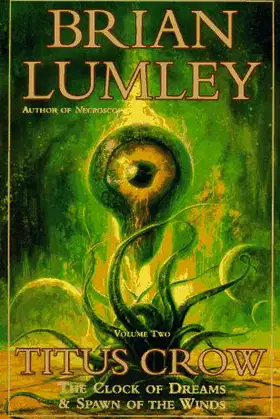
In the first two of six stories never before published in the United States, Titus Crow and his faithful companion fight the forces of evil and darkness, as they battle the Elder Gods, including Cthulhu and his dark minions.
Although horror writer Lumley is best-known in the U.S. for his Necroscope series, he first achieved international attention for his Titus Crow saga, modeled on H.P. Lovecraft's seminal Cthulhu mythos. This volume, containing the short novels The Burrowers Beneath and The Transition of Titus Crow, is the first of three Titus Crow volumes to be published by Tor, each of which will contain two novels. Lumley's style here is straight out of the classic pulp era, fast-paced and full of eerie landscapes and sinister plots. Titus Crow and his Watsonian sidekick, Henri Laurent de Marigny, face one danger after another with a mix of horrified fascination and grim determination. In The Burrowers Beneath, research into a series of underground disturbances leads the duo into a deadly encounter with the evil minions of Cthulhu. A cliffhanger ending segues directly into The Transition of Titus Crow, in which an antique grandfather clock turns out to be a vehicle for traveling through space and time. Lumley's settings are worthy of H.G. Wells as well as Lovecraft. The ornate style retains the distinctive tone of Lovecraft's work without being excessive, offering a refreshing change of pace from the usual, hard-driving modern horror novel. Copyright 1996 Reed Business Information, Inc.
First hardcover volume of three, each holding two Titus Crow novels from Lumley's earlier days as an H.P. Lovecraft disciple. Lumley is best-known for his Harry Keogh Necroscope vampire cycle (Necroscope: Resurgence Vol.II, The Lost Years, p. 1178, etc.). The two ``adventure-horror'' novels in the present book, The Burrowers Beneath and The Transition of Titus Crow, were written back in 1974 and 1975, when fantastic elaboration and great arabesques of description spooled out like bolts of paisley were more highly prized than they are today. Lumley borrows wholesale from Lovecraft's Cthulhu mythos, going into greater anthropological detail than the master cared to on those indescribable protoplasmic horrors with tentacled faces, the underground spawn of the gray, milelong mass of evil called Cthulhu, who swims ``into the deeper magma, against strange tides of molten-rock oceans, those oceans which hold these lily pads we call continents afloat!'' Cthulhu's children build nests, slowly multiply, and are given such names as Yibb-Tsill, Yog-Sothoth, Ithaqua, Hastur, and Lloigor. In The Burrowers Beneath, Titus Crow and Henri de Marigny join forces with a secret group pledged to fight the subterranean monsters. The telepathic creatures, it turns out, fear radiation and water, so Titus, Henri, and their comrades devise some ingenious ways to use these elements against them. At novel's end, Crow and Marigny tumble into a time-machine. In Transition, they return ten years later, looking hardly a day older. In fact, a robot culture in time-space has rebuilt Titus, turning him into a synthetic man in a considerably improved version of a human body. Transition follows Titus's adventures in time, ranging from his tour of Earth's earliest days to his trip forward to the end of time, and including his visit to Elysia, the home of the Elder Gods who were responsible for imprisoning the evil Cthulhu underground. Hideous mobile sludge, hellish dreams, babbling madness, the horror, the horror! -- Copyright ©1996, Kirkus Associates, LP. All rights reserved.
Find it on
AmazonNo videos available yet.
No news articles linked to this title yet.

Overall
Overall rating of the media
Atmosphere
How immersive and tense is the atmosphere
Gore
Level and quality of gore/violence
Story
Quality of the storyline and plot
Writing
Quality of the written content
Character Development
Depth and growth of characters
Pacing
Flow and timing of the narrative