BOOK
0
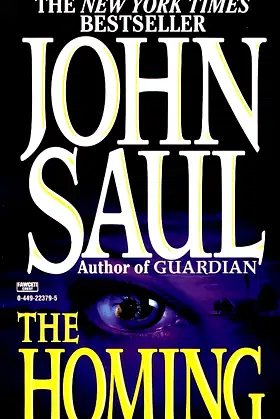
From the bestselling author of "Guardian," "Creature," and "Black Lightning," a spine-tingling tale of all-consuming evil as riveting and chilling as any he has ever produced.It will be a sweet homecoming for Karen Spellman. After years of living in Los Angeles, the pretty, young widow and her two daughters are returning to the lush countryside of Pleasant Valley, where Karen grew up. In this verdant, fertile place, Karen hopes to find not only a refuge from urban chaos, but love, for she is going home to marry her high school sweetheart.But something sinister awaits her. Something as primal as nature, as demonic as hell itself. For long ago, a shadowy menace stalked Pleasant Valley. A menace forgotten, thought dead. But only sleeping.Now Karen's homecoming will become a confrontation with terror as she battles to protect her daughters from a malign, preternatural force that must satisfy its gruesome thirst for innocent prey . . .
Though Saul ( Guardian ) has kept up with readers' tastes by depicting far more graphic violence than he did years back, he still offers the sort of old-fashioned terrors, told without a whisper of literary experimentation, that for 17 years have made him the most consistently bestselling horror writer next to King and Koontz. His 18th novel, no exception, is a snappily paced extravaganza of insect phobia, featuring a mad scientist who doubles as a serial killer, hordes of creepy-crawlies and some threatened kids--here, teens in the oven-hot flatlands of California's San Joaquin Valley. Julie Spellman, 15, thinks she has it bad being forced to move from L.A. to the farm where her mom's new husband lives. But her real trouble starts when Carl Henderson, a crazed entomologist with a lethal thing for girls with long dark hair, arranges for the brunette newcomer to get a shot of his latest concoction. Soon the girl is gestating a swarm of mutant insects that controls her mind, grants her dominion over other insects and forces her to implant the swarm into other teens. Meanwhile, Henderson chortles as he listens to the screams of his latest homicide victim, under attack from his pet ants: "Eaten alive! She was actually being eaten alive! " Onslaughts of bees, termites, spiders and scorpions round out the somewhat repetitive but always intense action, which, despite an unexpectedly dark ending, will no doubt send sales of this novel--and cans of Raid--soaring. Copyright 1994 Reed Business Information, Inc.
This novel may be the ultimate stomach turner. Saul follows his standard theme: a group of dangerous young people must be destroyed for the world to be safe. The story begins with Julie falling victim to a strain of bees whose venom is unusually toxic. The man who developed the bees, and their antitoxin, is a serial killer. Not wanting Julie to survive, he switches the antitoxin for an untried substance that turns out to be a new species of insect that requires a mammalian host for survival. Julie survives, infested with internal insects, and spews them forth to infect her friends. The horror of her condition is thoroughly detailed. Saul also gives us a splendidly creepy bug-infested house of horrors and a fitting revenge for the villain. Not for the weak of stomach, but essential for any library that has Saul fans.--Marylaine Block, St. Ambrose Univ. Lib., Davenport, Ia.Copyright 1994 Reed Business Information, Inc.
Once again, it's evil-science time with John Saul and his usual cast of kid victims. Karen Spellman and her daughters Julie, 16, and Molly, 9, move from L.A. back to the bucolic community in which Karen grew up. For with the girls' father years dead, Karen has remet and decided to marry farmer Russell Owen. Things start going awry right away: at Karen and Russell's home wedding, Molly is stung by a bee, and although it's happened before with no untoward results, this time she nearly dies. More accidents with bees and other insects occur--not least to Julie--and while local entomologist Carl Henderson, who works for the agricultural branch of a huge chemical company, is able to provide seemingly effective antivenins when folks react badly to bites, he also occasionally behaves most peculiarly. Besides, as local head cop Mark Shannon knows, more strange stuff has been happening, such as the disappearance of teen runaway Dawn Sanderson. Could Carl be behind it all? As Bugs Bunny used to say--ears cocked, brows arching off his face, mouth bowed into a leer of epic proportions--"Hmmmmmmmmmmm, COULD beeee!" Routine cheapo sf-horror-thriller fare from a reliable vendor who's been better. Ray Olson
In his contrived but fast-paced thriller, bestselling novelist Saul (Guardian, 1993) does for insects what Hitchcock's The Birds did for our feathered friends. The action takes place in central California, where a teenage girl running away from home to escape her mother's lecherous boyfriend reinvents herself as Dawn Morningstar en route to Hollywood. She unwisely accepts a ride from a stranger who turns out to be entomologist Carl Henderson, an evil genius who, before Dawn's dreadful death, holds her hostage in the dank basement of his Pleasant Valley home, making her the object of monstrous experiments with bees, scorpions, ants, etc. At around the same time, widow Karen Spellman travels to Pleasant Valley from Los Angeles with her two daughters, nine-year-old Molly and sullen teenager Julie. Karen is getting hitched to her high school sweetheart, Russell Owen, who owns a farm, some horses, and a barn full of beehives with which Carl has been fooling around on the sly. After Molly nearly dies from a strangely virulent bee sting, Julie investigates, gets assaulted by Carl, and is stung herself while trying to flee. Russell's cranky father, Otto, saves her, but Carl tampers with the experimental antivenin the local clinic gives Julie, hoping it will be lethal. Instead, the chemical compound turns her into a ravenous queen bee host who seduces boys by the bizarre technique of spewing forth a swarm of the buzzing, biting creatures. ``And from Julie's mouth emerged a swirling black cloud, a dark and writhing mist that split instantly into dozens of serpentine tongues...and curled around Jeff Larkin's head like tentacles,'' writes Saul with characteristic hyperbole. His excessive style will never win him any literary prizes, but it's creepily compelling. A skillful manipulation of primal fears about the natural world and the corruption of innocence. -- Copyright ©1994, Kirkus Associates, LP. All rights reserved.
tselling author of "Guardian," "Creature," and "Black Lightning," a spine-tingling tale of all-consuming evil as riveting and chilling as any he has ever produced.It will be a sweet homecoming for Karen Spellman. After years of living in Los Angeles, the pretty, young widow and her two daughters are returning to the lush countryside of Pleasant Valley, where Karen grew up. In this verdant, fertile place, Karen hopes to find not only a refuge from urban chaos, but love, for she is going home to marry her high school sweetheart.But something sinister awaits her. Something as primal as nature, as demonic as hell itself. For long ago, a shadowy menace stalked Pleasant Valley. A menace forgotten, thought dead. But only sleeping.Now Karen's homecoming will become a confrontation with terror as she battles to protect her daughters from a malign, preternatural force that must satisfy its gruesome thirst for innocent prey . . .
Caroline Evans’s dream was not a nightmare, and as it beganevaporating into the morning light, she tried to cling to it,wanting nothing more than to retreat into the warm, sweet blissof sleep where the joy and rapture of the dream and the realityof her life were one and the same.Even now she could feel Brad’s arms around her, feel hiswarm breath on her cheek, feel his gentle fingers caressing herskin. But none of the sensations were as sharp and perfect asthey had been a few moments ago, and her moan—a moan thathad begun in anticipation of ecstasy but which had alreadydevolved into nothing more than an expression of pain andfrustration—drove the last vestiges of the dream from her consciousness.The arms that a moment ago had held her in comfort weresuddenly a constricting tangle of sheets, and the heat of hisbreath on her cheek faded into nothing more than the weakwarmth of a few rays of sunlight that had managed to penetratethe blinds covering the bedroom window.Only the fingers touching her back were real, but they werenot those of her husband leading her into a morning of slowlovemaking, but of her eleven-year-old son prodding her to getout of bed.“It’s almost nine,” Ryan complained. “I’m gonna be late forpractice!”Caroline rolled over, the image of her husband rising in hermemory as she gazed at her son.So alike.The same soft brown eyes, the same unruly shock of brownhair, the same perfectly chiseled features, though Ryan’s hadnot quite emerged from the softness of boyhood into the perfectlydefined angles and planes that had always made every-one—men and women alike—look twice whenever Bradentered a room.Had the person who killed him looked twice? Had he lookedeven once? Had he even cared? Probably not—all he’d want-edwas Brad’s wallet and watch, and he’d gone about it in themost efficient method possible, coming up behind Brad, slippingan arm around his neck, and then using his other hand toshove Brad’s head hard to the left, ripping vertebrae apart andcrushing his spinal cord.Maybe she shouldn’t have gone to the morgue that day,shouldn’t have looked at Brad’s body lying on the cold metalof the drawer, shouldn’t have let herself see death in his face.Caroline shuddered at the memory, struggling to banish it.But she could never rid herself of that last image she had of herhusband, an image that would remain seared in her memoryuntil the day she died.There were plenty of other people who could have identifiedhim at the morgue. Any one of the partners in his law firmcould have done it, or any of their friends. But she had insistedon going herself, certain that it was a mistake, that it hadn’tbeen Brad at all who’d been mugged in the park.A terrible cold seized her as the memory of that evening lastfall came over her. When Brad had gone out for his run aroundpart of the lake and through the Ramble she’d worried that itwas too dark. But he’d insisted that a good run might help himget over the jumpiness that had come over him in the last coupleof weeks. She’d been helping Laurie with her math homeworkand barely responded to Brad’s quick kiss before he’dheaded out.Hardly even nodded an acknowledgment of what turned outto be his last words: “Love you.”Love you.The words kept echoing through her mind six hours laterwhen she’d gazed numbly down at the face that was so utterlyexpressionless as to be almost unrecognizable. Love you . . . loveyou . . . love you . . . “I love you, too,” she whispered, her visionmercifully blurred by the tears in her eyes. But in the monthsthat had passed since that night more than half a year ago, hertears had all but dried up. Sometimes they still came, sneakingup on her late at night when she was alone in bed, trying to fallasleep, trying to escape into the dream in which Brad was stillalive, and neither the tears nor the anger were a part of her life.Caroline wasn’t quite sure when the anger had begun tocreep up on her.Not at the funeral, where she’d sat with her arms holding herchildren close. Maybe at the burial, where she’d stood clutchingtheir hands in the fading afternoon light as if they, too,might disappear into the grave that had swallowed up her husband.That was when she’d first realized that Brad must haveknown he’d be alone in total darkness by the time he finishedhis run around the lake. And both of them knew how dangerousthe park was after dark. Why had he gone? Why had herisked it? But she knew the answer to those questions, too.Even if he’d thought about it, he’d have finished his run. Thatwas one of the things she loved about him, that he always finishedwhatever he started.Books he didn’t like, but finished anyway.Rocks that looked easy to climb, but turned out to be almostimpossible to scale. Almost, but not quite.“Well, why couldn’t you have quit just once?” she’d whisperedas she peered out into the darkness of that evening fourdays after he’d died. “Why couldn’t you just once have said,‘This is really stupid,’ and turned around and come home?”But he hadn’t, and she knew that even if the thought hadoccurred to him, he still would have finished what he set out todo. That was when anger had first begun to temper her grief,and though the anger brought guilt along with it, she also knewthat it was the anger rather than the grief that had let her keepfunctioning during those first terrible weeks after her life hadbeen torn apart. Now, more than half a year later, the anger wasfinally beginning to give way to something else, something shecouldn’t yet quite identify. The first shock of Brad’s death wasover. The turmoil of emotions—first the numbness brought onby the shock of his death, followed by the grief, then theanger—was finally starting to settle down. As each new dayhad crept inexorably by, she had slowly begun to deal with thenew reality of her life. She was by herself now, with two childrento raise, and no matter how much she might sometimeswish she could just disappear into the same grave in whichBrad now lay, she also knew she loved her children every bitas much as she had loved their father.No matter how she felt, their lives would go on, and sowould hers. So she’d gone back to work at the antique shop,and done her best to help her children begin healing from thewounds the loss of their father had caused. There had been justenough money in their savings account to keep them afloat fora few months, but last week she had withdrawn the last of it,and next week the rent was due. Her financial resources hadsunk even lower than those of her emotions.“Mom?” she heard Laurie calling from the kitchen. “Is thereany more maple syrup?”Sitting up and untangling herself from the sheets—and theturmoil of her own emotions as well—Caroline shooed her sonout of the room. “Go tell your sister to look on the second shelfin the pantry. There should be one more bottle. And you’re notgoing to be late for baseball practice. I promise.”As Ryan skittered out of the room, already yelling to his sister,Caroline got out of bed, opened the blinds, and looked outat the day. As the smell of Laurie’s waffles filled her nostrilsand the brilliant light of a spring Saturday flooded the room,Caroline shook off the vestiges of the previous night’s dream.“We’re going to be all right,” she told herself.She only wished she felt as certain as the words sounded.From the Paperback edition.
Find it on
AmazonNo videos available yet.
No news articles linked to this title yet.

Overall
Overall rating of the media
Atmosphere
How immersive and tense is the atmosphere
Gore
Level and quality of gore/violence
Story
Quality of the storyline and plot
Writing
Quality of the written content
Character Development
Depth and growth of characters
Pacing
Flow and timing of the narrative