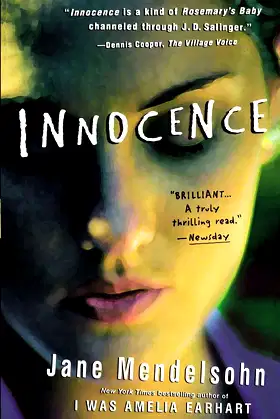
An adolescent girl growing up in New York City must deal with the "Beautiful Girls" at school, her attraction to a bad boy named Tobey, and persistent nightmares. By the author of I Was Amelia Earhart. 100,000 first printing.
Amazon.com Review
When Beckett is transplanted to an upscale school in Manhattan after the death of her mother, she is not surprised to be snubbed by the in-crowd. What does surprise her, and her loving father, is that when she looks out her apartment window one night, the three most popular girls in school are dead on the asphalt below, their blue jeans seeping blood. Beckett is already prone to Holden Caulfield-like observations about the fakeness around her, the propensity of the people she meets to become only "movie stars" acting their parts. Are the suicides imaginary? And what about her new friend, Pamela, the school nurse, who begins to date her father? Is this woman's concern purely affectionate or does Beckett, a beautiful young virgin, have something that she wants? Following the quiet wedding of Pamela and Beckett's father, held in the apartment, Beckett opens her bathroom door to find the toilet full of blood. At once she recognizes the blood as "a sacred symbol, a message, a warning, a sign." In fear, she imagines it spilling over the bowl, splashing her hands and face. "Then the fear dies down," Beckett explains, "and I see that the blood is just a liquid, nothing but a surprise. But as the loud, throaty sound of the flush fills my head and I turn off the light, I know that the blood means something. I know that the blood is not just a surprise. I know that it is meant for me." Using Carol Clover's concept of the final girl--the one who survives by learning to kill--in slasher films, Jane Mendelsohn (I Was Amelia Earhart) offers a brilliant and sinister vision of a schoolgirl's loss of innocence. As for the virgin suicides, the bats, the bloody bundles in the freezer, the reader comes to realize, with Beckett, that it doesn't matter what is real, only what is true. --Regina Marler
From Library Journal
Adolescence is a tough time for most people, and it is especially hard for 14-year-old Beckett, whose mother was killed in a drunk-driving accident in the suburbs. After the accident, her father, Miles, decides to move to an apartment on the Upper West Side of Manhattan, enrolling Beckett in an exclusive private school. Strange things are happening at this schoolDseveral girls have formed suicide pacts, and three girls kill themselves shortly after Beckett begins school. It is through these events that Beckett meets Pam, the school nurse, who begins dating Miles and eventually becomes Beckett's new stepmother. Part modern Gothic, the novel flows along in a stream-of-consciousness narrative that reveals Beckett's inner turmoil. We also learn that all is not as it seems with Pam and the strange events at school. The book offers an interesting spin on the traditional coming-of-age story as it keeps the reader wondering, Is this fantasy or is this reality? Suitable for adults, this second novel by the author of I Was Amelia Earhart might also appeal to a mature young adult reader. Recommended for public libraries.-DRobin Nesbitt, Columbus Metropolitan Lib., OH Copyright 2000 Reed Business Information, Inc.
From Booklist
Mendelsohn's novels, including I Was Ame lia Earhart (1996), are distinguished by their vivid visualizations of mental states and delight in confusing the imagined with the real. Here she depicts the convulsive coming-of-age of a privileged New York teenager called Beckett, whose mother was killed by a drunk driver. Her father enrolls her in a fancy private school infamous for student suicides, then he falls in love with Pamela, the sexy school nurse. Beckett's first menstrual period hits her as hard as the vehicle that killed her mother, and once her father and Pamela decide to get married, her world turns nightmarish. Her stepmother-to-be morphs into a blood-sucking monster right out of a B horror movie, and Beckett, who sees herself reflected everywhere she looks, from mirrors to television and computer screens, fears for her life. Mendelsohn uses this obsession with appearance to dramatize the toll our image-saturated culture exacts from the young and sensitive. But she, too, is seduced by surface gloss and fails to go beyond the seductive beauty and cleverness of her narrative to achieve genuine emotion, let alone catharsis. Donna SeamanCopyright © American Library Association. All rights reserved
About the Author
Jane Mendelsohn's first novel, I Was Amelia Earhart, spent fourteen weeks on the New York Times bestseller list and was published in fifteen languages.
News
Horror Society
•
1 month ago
From new partner label Yellow Veil Pictures comes the four-disc THE WORLDS OF LUCILE HADŽIHALILOVIĆ, featuring the award-winning French-Bosnian filmma...