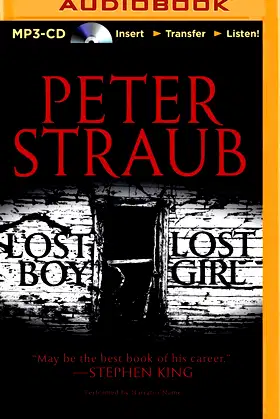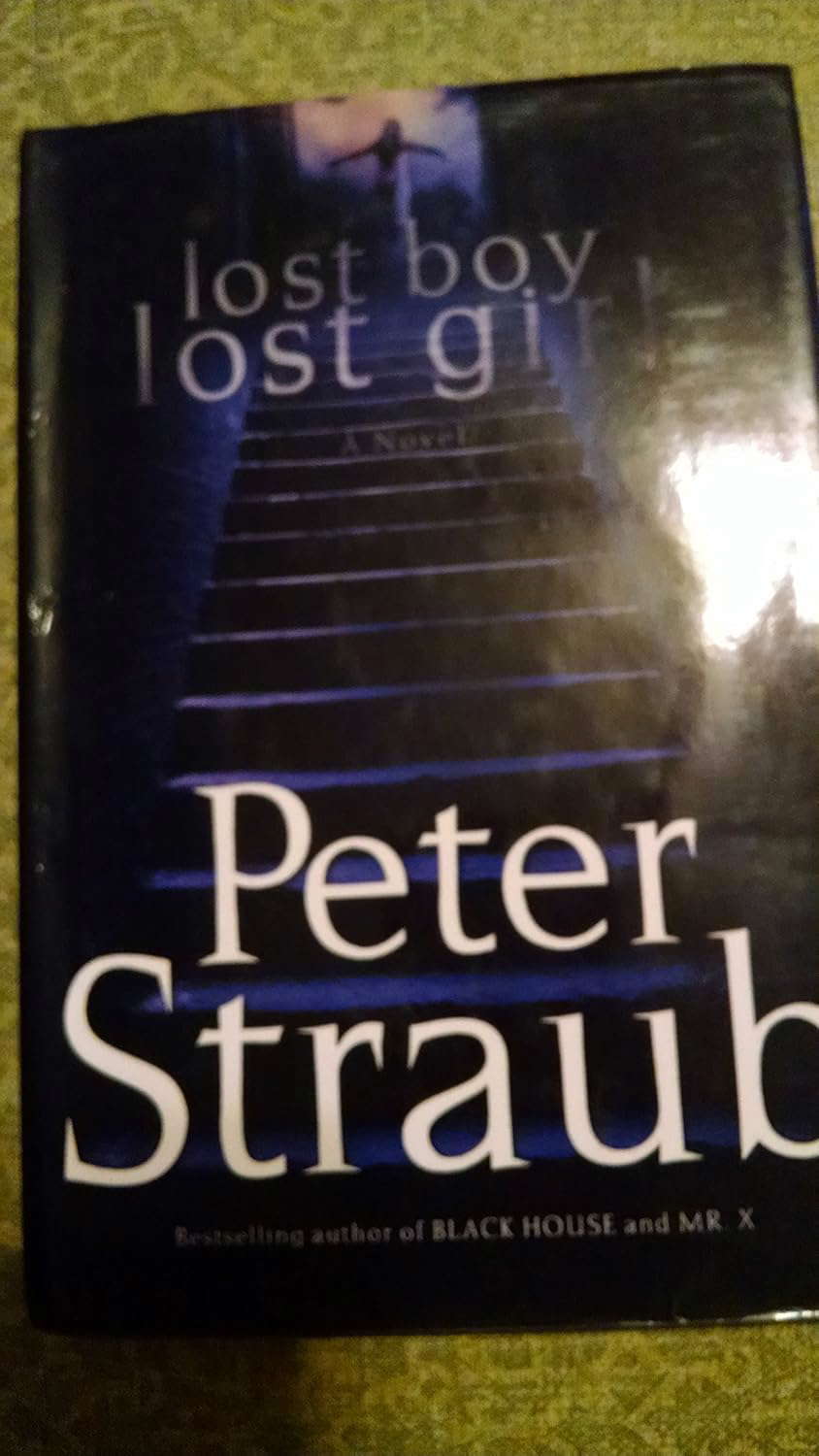


BOOK
0
A woman commits suicide for no apparent reason. A week later, her son—beautiful, troubled fifteen-year-old Mark Underhill—vanishes from the face of the earth. To his uncle, horror novelist Timothy Underhill, Mark’s inexplicable absence feels like a second death. After his sister-in-law’s funeral, Tim searches his hometown of Millhaven for clues that might help him unravel this mystery of death and disappearance. He soon learns that a pedophilic murderer is on the loose in the vicinity, and that shortly before his mother’s suicide Mark had become obsessed with an abandoned house where he imagined the killer might have taken refuge. No mere empty building, the house on Michigan Street whispers from attic to basement with the echoes of a long-hidden true-life horror story, and Tim Underhill comes to fear that in investigating its unspeakable history, Mark stumbled across its last and greatest secret: a ghostly lost girl who may have coaxed the needy, suggestible boy into her mysterious domain.With lost boy lost girl, Peter Straub affirms once again that he is the master of literary horror.
For its high artistry and uncanny mix of dread and hope, Straub's 16th novel, his shortest in decades, reaffirms the author's standing as the most literate and, with his occasional coauthor Stephen King, most persuasive of contemporary novelists of the dark fantastic. This brilliant variation on the haunted house tale distills themes and characters from Straub's long career, including two of the author's most popular creations: Manhattan novelist Tim Underhill (from Koko, Mystery and The Throat) and Tim's friend, legendary private detective Tom Pasmore (from Mystery and The Throat). Written from multiple viewpoints, the narrative shuttles disturbingly through time and space as Tim travels home to Millhaven, Ill., to attend the funeral for his sister-in-law, a suicide. In that small city based loosely on Straub's hometown of Milwaukee, Tim spends time with his callow widowed brother, Philip, and his nephew, sensitive Mark, 15, who found his mother's naked body in the bathtub, wrists slit and a plastic bag over her head. Meanwhile, a serial killer is snatching teen boys from a local park, and Mark and his sidekick, Jimbo, begin to explore a nearby abandoned house. Mark grows obsessed with the house, eventually revealed as the rotting source of the evil that stalks Millhaven, but also as the harbor of a great marvel. When Mark disappears, Tim pursues his trail and, with Tom Pasmore's help, that of the serial killer who may have taken the boy away. Straub remains a master of place and character; his insight into teens, in particular, is astonishingly astute. His myriad narrative framings allow multiple interpretations of events, making this story work on many levels, yet they also increase the urgency of the story, up to its incandescent ending. With great compassion and in prose as supple as mink, Straub has created an exciting, fearful, wondrous tale about people who matter, in one of his finest books to date.Copyright 2003 Reed Business Information, Inc.
Once more, Straub employs the scene (Millhaven, Illinois) and the protagonists--'nam-vet novelist Tim Underhill and rich, super-attentive and -intuitive P.I. Tom Pasmore--of his hefty best-sellers Koko (1988), Mystery (1989), and The Throat (1993). Relegating Pasmore to the secondary cast and using Tim as both first-person recorder of events and third-person general narrator, Straub explores two appalling tragedies. Tim's sister-in-law, Nancy, an appealing woman whom many pity for marrying ill-tempered Philip Underhill, kills herself for no apparent reason. Mere days later, Philip and Nancy's handsome 15-year-old, Mark, disappears. Since a serial killer has been "disappearing" middle-teen boys from the park in which Mark and his best friend, Jimbo, hung out nights, the worst is feared. With Pasmore working behind the scenes, Tim sets out to understand his two losses. Mostly, he must get Jimbo to reveal all that he knows. As he succeeds with the boy, Tim discovers that in the abandoned house across the alley from Philip and Nancy's are the keys to the puzzles of her death, Mark's vanishing, and other mysteries. Much of what Tim learns is hideous, but some of it points to transcendent redemption for Mark and a girl who disappeared long ago in even grislier circumstances. This is the great novel of the supernatural Straub has always had it in him to write, one as beautiful, moving, and spiritually rich as the best stories in his dazzling collections Houses without Doors (1990) and Magic Terror (2000). Ray OlsonCopyright © American Library Association. All rights reserved
“The scariest book I’ve ever read . . . It crawls under your skin and into your dreams.”
“Brilliantly written . . . an inspired thriller.”
“Disturbing . . . satisfying . . . a blood-stained tapestry of stunning emotional power.”
A woman commits suicide for no apparent reason. A week later, her son beautiful, troubled fifteen-year-old Mark Underhill vanishes from the face of the earth. To his uncle, horror novelist Timothy Underhill, Mark s inexplicable absence feels like a second death. After his sister-in-law s funeral, Tim searches his hometown of Millhaven for clues that might help him unravel this mystery of death and disappearance. He soon learns that a pedophilic murderer is on the loose in the vicinity, and that shortly before his mother s suicide Mark had become obsessed with an abandoned house where he imagined the killer might have taken refuge. No mere empty building, the house on Michigan Street whispers from attic to basement with the echoes of a long-hidden true-life horror story, and Tim Underhill comes to fear that in investigating its unspeakable history, Mark stumbled across its last and greatest secret: a ghostly lost girl who may have coaxed the needy, suggestible boy into her mysterious domain.With lost boy lost girl, Peter Straub affirms once again that he is the master of literary horror.
A woman commits suicide for no apparent reason. A week later, her son—beautiful, troubled fifteen-year-old Mark Underhill—vanishes from the face of the earth. To his uncle, horror novelist Timothy Underhill, Mark’s inexplicable absence feels like a second death. After his sister-in-law’s funeral, Tim searches his hometown of Millhaven for clues that might help him unravel this mystery of death and disappearance. He soon learns that a pedophilic murderer is on the loose in the vicinity, and that shortly before his mother’s suicide Mark had become obsessed with an abandoned house where he imagined the killer might have taken refuge. No mere empty building, the house on Michigan Street whispers from attic to basement with the echoes of a long-hidden true-life horror story, and Tim Underhill comes to fear that in investigating its unspeakable history, Mark stumbled across its last and greatest secret: a ghostly lost girl who may have coaxed the needy, suggestible boy into her mysterious domain.With lost boy lost girl, Peter Straub affirms once again that he is the master of literary horror.
Chapter 1Nancy Underhill’s death had been unexpected, abrupt—a death like a slap in the face. Tim, her husband’s older brother, knew nothing more. He could scarcely be said really to have known Nancy. On examination, Timothy Underhill’s memories of his sister-in-law shrank into a tiny collection of snapshots. Here was Nancy’s dark, fragile smile as she knelt beside her two-year-old son, Mark, in 1990; here she was, in another moment from that same visit, snatching up little Mark, both of them in tears, from his baby seat and rushing from the dim unadorned dining room. Philip, whose morose carping had driven his wife from the room, sat glaring at the dried-out pot roast, deliberately ignoring his brother’s presence. When at last he looked up, Philip said, “What?”Ah Philip, you were ever a wonder. The kid can’t help being a turd, Pop said once. It seems to be one of the few things that make him feel good.One more of cruel memory’s snapshots, this from an odd, eventful visit Tim had paid to Millhaven in 1993, when he flew the two and a half hours from La Guardia on the same carrier, and from all available evidence also the same craft, as this day: Nancy seen through the screen door of the little house on Superior Street, beaming as she hurried Tim-ward down the unlighted hallway, her face alight with the surprise and pleasure given her by the unexpected arrival on her doorstep of her brother-in-law (“famous” brother-in-law, she would have said). She had, simply, liked him, Nancy had, to an extent he’d understood only at that moment.That quietly stressed out little woman, often (Tim thought) made wretched by her husband and sewn into her marriage by what seemed determination more than love, as if the preparation of many thousands of daily meals and a succession of household “projects” provided most of the satisfaction she needed to keep her in place. Of course Mark must have been essential; and maybe her marriage had been happier than Tim imagined. For both their sakes, he hoped it had been.Philip’s behavior over the next few days would give him all the answers he was likely to get. And with Philip, interpretation was always necessary. Philip Underhill had cultivated an attitude of discontent ever since he had concluded that his older brother, whose flaws shone with a lurid radiance, had apparently seized from birth most of the advantages available to a member of the Underhill clan. From early in his life, nothing Philip could get or achieve was quite as good as it would have been but for the mocking, superior presence of his older brother. (In all honesty, Tim did not doubt that he had tended to lord it over his little brother. Was there ever an older brother who did not?) During all of Philip’s adult life, his grudging discontent had been like a role perfectly inhabited by an actor with a gift for the part: somewhere inside, Tim wanted to believe, the real Philip must have lived on, capable of joy, warmth, generosity, selflessness. It was this inner, more genuine self that was going to be needed in the wake of Nancy’s mysterious death. Philip would need it for his own sake if he were to face his grief head-on, as grief had to be faced; but more than that, he would need it for his son. It would be terrible for Mark if his father somehow tried to treat his mother’s death as yet another typical inconvenience different from the rest only by means of its severity. From what Tim had seen on his infrequent returns to Millhaven, Mark seemed a bit troubled, though he did not wish to think of his nephew in the terms suggested by the word “troubled.” Unhappy, yes; restless; unfocused; afflicted with both a budding arrogance and what Tim had perceived was a good and tender heart. A combination so conflicted lent itself naturally to restlessness and lack of focus. So, as far as Tim remembered, did being fifteen years old. The boy was trim and compact, physically more like his mother than his father: dark-haired and dark-eyed—though presently his hair was clipped so short its color was merely some indeterminate shade of darkness—with a broad forehead and a narrow, decisive chin. Two steel rings rode the outer ridges of his right ear. He slopped around in big T-shirts and oversized jeans, alternately grimacing and grinning at the music earphoned into his head from an improbably tiny device, an iPod or an MP3 player. Mark was devoted to a strange cross section of contemporary music: Wilco, the Magnetic Fields, the White Stripes, the Strokes, Yo La Tengo, Spiritualized, and the Shins, but also Bruce Springsteen, Jimmy LaFave, and Eminem, whom he seemed to appreciate in an ironic spirit. His “pin-up girl,” he had informed his uncle in an e-mail, was Karen O of the Yeah Yeah Yeahs.In the past sixteen months, Mark had e-mailed his uncle four times, not so briefly as to conceal a tone Tim found refreshing for being sidelong, sweet, and free of rhetorical overkill. Mark’s first and longest e-mail used the excuse of a request for advice, Tim thought, as a way to open communications between them.From: [email protected]: [email protected]: Sunday, February 3, 2002 4:06 PMSubject: speak, o wise onehi de hothis is your nephew mark in case u couldn’t decipher the from line. so I was having this lil disagreement with my father, and I wanted 2 ask your advice. after all u managed 2 get out of this burg & travel around & u write books & u live in nyc & all that means u shd have a pretty open mind. I hope it does.bcuz u & u alone will decide what i do next. my dad sez he will go along with u no matter what. I dunno maybe he doesn’t want 2 have 2 decide. (mom sez, quote, don’t ask me, I don’t want to hear abt it, unquote. that’s what mom sez.)i turn 14 next month and 2 celebrate my bday I’d like 2 get a tongue piercing. 1 of my friends has a pierced tongue and he sez it isn’t 2 painful at all and its over in a jiff. I’d really like 2 do this. don’t u think 14 is the rite age 2 go out and do something dumb, provided u do think it is dumb to pierce your tongue, which I obviously do not? in a year or 2 I’ll take it out & go back 2 being boring & normal. or what d’you say, move up 2 a cool tat?waiting 2 hear from the famous unkmFrom: [email protected]: [email protected]: Sunday, February 3, 2002 6:32 PMSubject: Re: speak, o wise oneDear Mark,First of all, it is wonderful to hear from you! Let’s do this more often. I like the idea of our being in touch.I’ve been thinking about your question. To begin with, I’m flattered that you thought to ask my opinion on such a personal matter. I’m also flattered that your father placed the decision in my hands, but I suppose he really did not want to think about his son having his tongue pierced! If I had a son, I wouldn’t want to think about it, either.bcuz, as u wld say, the idea of tongue piercings makes me feel a bit queasy. I like your earrings and I think they look good on you, but whenever I see some young person with a metal ball riding on top of his/her tongue, I begin to fret about the discomfort of such an arrangement. Doesn’t it complicate the whole eating business? I almost hate to admit this to you, but to me tongue piercings really do seem like weird self-mutilation. So you are far ahead of me in this regard.This is not the answer you were expecting, I’m sure. I’m sorry to stand in the way of you getting what you want, but you asked and I had to answer you truthfully. I’d rather think of you without a metal ball in your mouth than with one. Sorry, kiddo, but I love you anyhow.Is there anything special you’d like me to get for your birthday? Maybe I can make up for being so boring and middle-class.Uncle TimThe next day two messages from his family turned up in his Inbox.From: [email protected]: [email protected]: Monday, February 4, 2002 7:32 AMSubject: Re: speak, o wise oneTYim, this is nme Philip using Mark’s computyer. Hje showed me what you wrote him. I hadf the feeling you’d do the right thing for once. So, well, thanks. IO hate that crap too.From: [email protected]: [email protected]: Monday, February 4, 2002 5:31 PMSubject: Re: speak, o wise one >Is there anything special you’d might like me to get for your birthday? now that you mention it, yep. ordnance. :)mFor once, as his brother would put it, Tim was grateful for the Internet’s assumption that its users were incapable of perceiving a joke unaccompanied by a nudge in the ribs. Philip’s error-riddled message contained a different kind of reassurance—that of its having been sent at all.During Pop’s life, the brothers had come together—meaning that Tim flew to Millhaven from New York—once or twice a year; in the five years since his death, they had scarcely spoken. Pop had come to New York once, as a widower of two years in his late seventies, saying that he wanted to see what all the fuss was about, and he had stayed in Tim’s loft at 55 Grand Street, which he had found awkward and discomfiting. His knees made the trek up and down three flights of stairs difficult, and Tim had overheard him complain to dear Michael Poole, who lived one floor up with the amazing and equally dear Maggie Lah, that he had imagined his son was at least rich enough to put in an elevator. (“I used to run an elevator, you know,” he told Michael. “At the famous St. Alwyn Hotel, right there in Pigtown. All the big musicians stayed there, niggers included.”) The next day, at an informal little get-together Tim put togethe...
Find it on
AmazonNo videos available yet.
No news articles linked to this title yet.

Overall
Overall rating of the media
Atmosphere
How immersive and tense is the atmosphere
Gore
Level and quality of gore/violence
Story
Quality of the storyline and plot
Writing
Quality of the written content
Character Development
Depth and growth of characters
Pacing
Flow and timing of the narrative