
BOOK
0
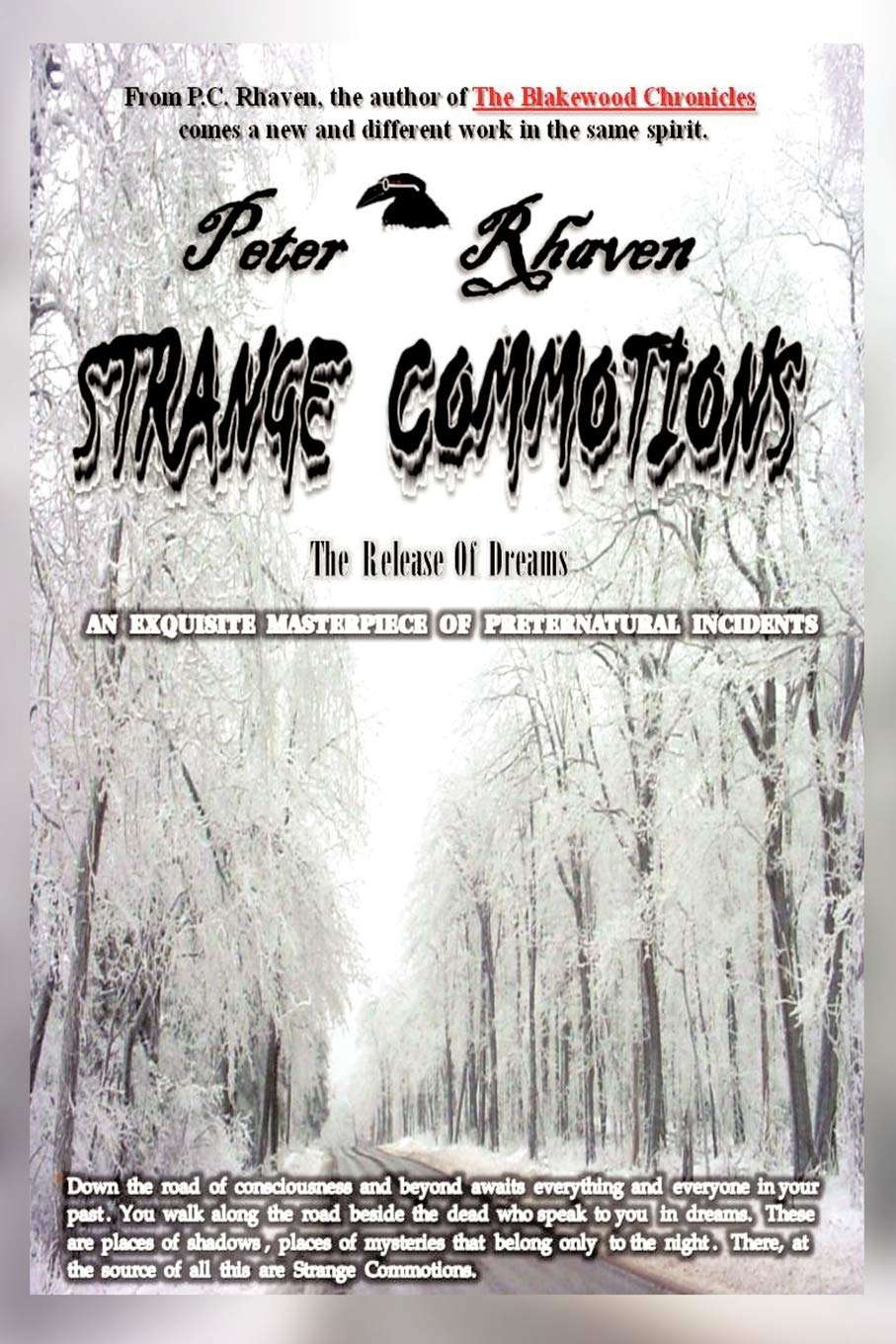
STRANGE COMMOTIONS This book is a psychological journey into that outer fringe of reality. It is not necessarily meant to be a work of horror, suspense or science fiction, although there are elements of each, but rather a collection of stories that have a tangible sense of apprehension about them. It is more in the traditions of "The Twilight Zone" or "The Outer Limits" and not the typical horror/suspense. Now enter here into the twisted congeries and haunting reflections of the human mind where all strange commotions begin.
STRANGE COMMOTIONSThe Release of DreamsBy Peter RhavenAuthorHouseCopyright © 2009 Peter KosanovichAll right reserved.ISBN: 978-1-4389-5464-6ContentsExcerpt, Just This Side of Midnight........................................................Inside CoverINTRODUCTION The Mind & The Leap Beyond Reality............................................1THE FIRST COMMOTION Something Strange Is Inside That House.................................2-13THE SECOND COMMOTION Statuesque............................................................14-50THE THIRD COMMOTION The Shot Heard Around The World ... And Back Again.....................51-106THE FOURTH COMMOTION Yesterday Calling.....................................................107-145THE FIFTH COMMOTION The Other..............................................................146-187THE SIXTH COMMOTION The Dreamer of Port Matilda............................................188-227THE SEVENTH COMMOTION Endless..............................................................228-252THE EIGHTH COMMOTION Just This Side of Midnight............................................253-280THE NINTH COMMOTION It Don't Mean a Thing If It Ain't Got That Swing.......................281-299THE TENTH COMMOTION The Refuge (Exerpt From The Blakewood Chronicles)......................300-328THE ELEVENTH COMMOTION The Texts of Alderon................................................329-366THE TWELFTH COMMOTION The Cowboy...........................................................367-400THE THIRTEENTH COMMOTION It Was Under The Ground...........................................401-449THE FORTEENTH COMMOTION The Vanisher.......................................................450-498FINAL WORDS FROM THE AUTHOR Reality........................................................501FUTURE BOOKS FROM THE AUTHOR Ambershade & The Saurian......................................503-504ABOUT THE AUTHOR In Brief..................................................................505Chapter One Sam Tucker walked through town in the falling rain, the occasional flashes of lightening and the frightening rolls of thunder. He paid no attention. Like so many others, he had lost his job without the promise of finding another. His wife had packed up and left him taking the children with her to live with her parents in Pittsburgh. He knew that she loved him and he knew that she was only thinking of the children's welfare. However, he couldn't find it in him to leave the place he had known all of his life, the place he and his family had come to love without giving it one more try. They had all been happy there until the jobs had all dried up. "I love you Sam," his wife had said to him as she got into the car, "but we've got to consider the children. When you've given up, come and join us. I know how you feel. I want to stay and so do the children. They can't seem to stop crying at loosing their home, all their friends. It's the only home they've ever known but this town's falling apart. We love you. Come join us soon." With that last statement, she drove away, leaving him standing there beside the foreclosure sign in his front yard. He was feeling abandoned, living in his house in which the bank was about to foreclose. Now, he was alone in the town in which he had grown up. He'd had roots here and he had loved his hometown. He had tried desperately to find some sort of a job to keep his family but he failed. He was soaked from head to foot as her last words seeped into his mind. The rain was dripping from his forehead and into his eyes. The rain mixed with his tears to blur his path but he continued on. He looked at every store window as he passed by. They were boarded up. He remembered when he was just six or seven; his father took him by the hand to look in all the store windows at Christmas. There would be Christmas scenes and little mechanical elves in a make-believe Santa's workshop. There were parades up and down Main Street and there were thousands of people, elbow to elbow. Nowadays, those same streets were empty. He had believed in miracles back then. And at this time there was no magic, no miracles. His father and mother had long since passed away and his sister got married and moved to California. There was nothing, no one here anymore, nothing except the memories and the feeling of mourning for the passing of what once was. He looked about the town that had prepared for dark. He and his neighbors had prayed that something would happen that would save their town but nothing changed. Except for the rain, there was no other sound coming from the street. He walked to the town's Central Park, found a bench and was about to sit down but stopped. Across the path from his bench was a statue. It was the statue of the founder of his hometown. It was marble and stood up a few steps on a marble platform. He walked up the few steps and over to the life size statue as if it were another man and he spoke. He wiped away his tears with the palms of his hands. "I tried," he said to the statue, "but it was no good. What can I do? I've lost them. My wife left me and took the kids. Everyone I knew, all my friends and neighbors, gone. Soon the whole town will be gone. What can I do? "What, no words of wisdom?" he said to the statue after a few seconds. There was a hint of slur in his words. He had attempted to drown his sorrow in alcohol but failed miserably. He continued his tipsy, one-way conversation. "They taught us in school that you were some sort of a hero, that you saved the town from outlaws; you saved the town from Indians. Well, where the hell are you now?" Sam stumbled down the steps, fell back across the path and onto the bench and cried. "Where the hell are you now?" He held his head in his hands. "God, please help us," he said. He had lost everything he and his wife had worked for and more. After a few moments, he stood and staggered away from town and back toward his empty house. He would be able to live there for two more weeks. After that he did not know what he would do. The park was empty once again. Sam Tucker and all the citizens of Gainerton, Pennsylvania are about to have their prayers answered but not in the way they think. Providence will drop by their town. They are all about to experience a rather unusual, very strange commotion. An hour after Sam had stumbled his way back home, the Central Park of Gainerton, Pennsylvania was silent. The rain had stopped and it began to get cold. It was only just after half past five p.m. and already the people had gone away from town. The silence was a companion to a frosty fog that moved slowly into this piece of nature in the midst of man-made buildings. It moved slowly, creeping through and about the trees and seemed to smother the early spring flowers with its milky-white blanket. It was a sign that darkness was coming to rule the Earth once again and a warning to those who feared the gods of darkness. Over by the marble steps that lead to a dais, also of marble came a strange commotion. It started as an unearthly, soft yellow glow, pushing aside both fog and shadow, pulsating in all directions like ripples in a quiet pond. It grew and grew until it suddenly went out as if by a switch, leaving only the twilight and fog once again. John T. Gainer hurried across the city's Central Park and onto the main street of Gainerton. However, he had no money, no place to stay and would not go unnoticed because of they way he was dressed. However, he knew of a homeless shelter not far from the center of town. He'd arrived in this place without money but not without a plan. He walked brusquely toward his destination because it was beginning to get dark and on an early spring night, it would be cold. John knew that no mortal would be able to survive a night outside this time of year and so, he hurried on his way. As he ran across the main street in town, he saw a strange commotion off to his left. It was soft red and blue lights flashing in the fog. It was a police car coming his way with its flashing lights on. What he had feared happened. He had been spotted by two policemen on patrol. They stopped their police car and one of them got out and made him put his hands on the hood. He understood that as peace officers they had no way of knowing whether he meant to do good or bad. John had attracted attention by his clothes and by running across Main Street at twilight. "Spread um," one of the policemen ordered as he frisked John. "Hey buddy," the cop said, after he had frisked him. "You've got no ID and no money, just this antique, rusty old key." He handed the three-inch long key back to John who placed it back into his pocket. "What's your name?" "John Gainer," John answered, "one n' only, ain't no other." "I don't know if you're trying to be a smartass or if that's what your real name is," the cop replied. On closer inspection, John was able to see the man better. The cop who had just frisked him was at least six feet four and had to weigh about two-hundred and fifty pounds. That wasn't all, the two-hundred fifty odd pounds was pure muscle. No one wanted to mess with this man and John was no different. "Why would you be sayin' that officer?" John asked. "John Gainer happens to be the name of the founder of our town," the cop answered. "This is Gainerton, Pennsylvania, as if you didn't know." "Maybe he saw the name on a sign," the other, older policeman said from inside the car. John could see that the man's hair was longer and gray compared to that of his larger partner. "We can clear this up with an electronic fingerprint test," the cop who frisked him said. The officer then moved John over to the police car where the other policeman was still seated. The man behind the wheel of the police car handed his partner a small, flat electronic device. The gadget was about eight by ten inches with a small screen in the center. The other officer put John's hand on the screen. It lit up at John's touch. That being done, the cop handed the electronic fingerprint device back to his partner in the car. That officer then plugged a wire into the back of the machine and waited. The officer that stood outside the vehicle and John waited for the response. "The guy comes up clean," the policeman in the car finally reported. "He's clean, no warrants, no record." "Nothing in his pockets," his partner said, "no weapons or drugs." He turned to John. "Where were you goin' so fast buddy?" The big man asked. "We've had a ruckus here in the park just a few moments ago. That's why we stopped ya." "The guy couldn't possibly have it on him," the other policeman still in the vehicle commented, sticking his head out the window of the driver's side. "What were you up to dressed in that Davy Crocket outfit buddy?" The younger cop asked, pointing to John's clothes. "I was rushin' ta git ta the homeless shelter afore it got dark," John answered looking down at his clothes. John saw nothing wrong with his attire. His Buckskin jacket and coonskin cap were just normal clothes after all. He looked back up at the officer. "They close the doors at six. I wuz afeerd I'd be stuck out here n the cold. I hate the cold. I don't look pretty bein' all blue, ya know." "Alright," the policeman standing said. He couldn't help but smile at the way John talked. The man seemed kind of pure, innocent somehow. The man looked like something out of the Ozarks. His clothes and speech indicated that much. The officer opened the back door of the patrol car for John to get in. John hesitated. "We're not goin' to bust ya, fella," the older policeman in the car said. "There's no law against dressing retro, though maybe there should be. We'll drive you over to the shelter and make sure they don't lock you out. We don't want anyone to be out in the cold for the Easter Holiday." After their explanation, John sat in the back seat and the huge policeman behind him closed the door and walked over to the passenger side and got in. "My name's Harold Malinski," the policeman driving said, looking at John through the rearview mirror. "My partner's name is William Benson. We call him, Willie. He don't say much." "I know," John replied. "His great, great, great, great-grandfather wasn't much fer conversation neither, quiet as a hummingbird, that one, yes sir." "Wahoo, lotta' 'greats' there buddy. Are you kidding?" Harold asked. "No," Willie interrupted. "My grandfather used to tell me that. He'd said that I was a lot like his great, grandfather and a long line of Bensons. The Bensons live long lives. My question is how did you know such a thing?" Willie wasn't sure he liked a stranger to know so much about his family. "My family's from Gainerton," John began, "Must a heerd it said by someone n the family. I'm a thinkin' they must a known the Benson's." "Where are you from John?" Willie asked, not quite convinced by John's answer. Willie tried not to show how spooked he was at John's comment. And who are you really? Willie's thoughts added. "Come outta' New York but got tared o the city. I wanted ta find a nice wilderness n settle down, never had much use fer the big city." "You got no reason to lie now. Ain't no warrant or anything on you." Harold said. "Is your name really John Gainer?" "One n' only, ain't no other," John replied. "Inherited it from ma pappy n him from his pappy afore him." "You don't sound like you're from New York," Harold commented. "I said that I come out o New York," John replied. "I wuz from all over afore that." "If you were looking for a wilderness," Officer Willie said, "You're certainly dressed for it but Gainerton is a small town. It isn't a wilderness." "Just wait around awhile though," Harold commented. "It will be soon." "I don't catch yer meanin'," John said. "The steel mills have closed," Harold began to explain. "The coal mines have all petered out and we're afflicted with what economists call, 'brain drain'." "'Brain drain', now that's two words I ain't never heard put tagether," John replied, "sounds powerfully painful." "In a way it is. It means our best kids are moving out of town after they've finished college," Willie explained with a chuckle. "They realize that there's nothing here for them anymore. All the jobs are gone as the mill companies and mining companies either went elsewhere or they went bankrupt." "Sorry ta hear that," John said. "I wuz hopin' ta git some kinda' work whilst I wuz here." "I'm sure there are some small, odd jobs to tide you over son," Harold said. "But if you're looking for a job to support a family, Gainerton's not the place for you." "Fer now that's good enough fer me," John replied. "Wife n' family been dead fer a long time." "I'm sorry about that," Willie said. "So is they," John replied. "You wouldn't have happened to have accidentally, ooohh, maybe murdered them or something like that, would you John?" Willie asked. "Maybe dismembered them in your basement?" "Well, here we are," Harold said, pulling up to the front door of the shelter. John got out and walked around to the driver's side door. The window came down and Harold leaned his head out the window. "I hope you have a happy Easter while you're here in Gainerton, John. Good luck," Harold said. "I hope they can find you some better clothes while you're in this shelter. If you need any help, just call the station. We ain't got much more to do now a days." I think it's you that'll be needin' my help my friend, John thought. "Same ta younz both and thank younz," John replied. "Nice kid but a little slow," Harold said to his partner as they drove away. "He sure does know how to spin a yarn. That outfit certainly could use an upgrade. The way he talks gets on your nerves after awhile. I guess ya see all kinds in this job." "I don't know about that but I have the feeling there's more to him than we can see on the surface, a whole lot more. I don't know if it's good or bad," Willie added. "I don't know if that innocent country boy act is real or if he's playing some game. He is just a young kid but talks like an old man." John turned and walked through the door of the shelter without the need to open it. As he did so, he looked at his watch. "Five-fifty-eight," he said to himself. "Ma timin' is still perfect. Glad I thought ta bary this here a watch." John turned to his right and walked down a hallway to a counter where a white woman in her late thirties or early forties stood. As soon as he approached the counter, she pulled out a set of sheets, pillow with pillowcase and a blanket. John went over to her. He was taken aback by how fast she had produced the bed linen without even looking at him. Her attention was on a television attached to the wall directly opposite her counter. John turned to see what had so mesmerized her. She was watching the local news. The local news anchor was talking. The news anchor stood in what John recognized as the town's central park. He was holding a microphone and talking to the camera. "Police are baffled tonight by the theft of our town's statue of its founder, John Tobias Gainer," the newsman stated. "The statue was made in his honor almost a hundred and fifty years ago by the Swiss artist, Harcourt Brice. The artist had been hired by the city to create the likeness from several paintings and from historical descriptions of our city's founder. It has often been said how lifelike the statue seemed. Critics through the decades stated that Brice seemed to have captured something of Gainer's soul in his sculpture. "The statue weighs almost a ton and would take special heavy-duty machinery to move it. And yet police tell me that there are no tracks or disturbance of any kind here in Central Park that would indicate that any such equipment was used in the theft. According to police, no one living near the park heard or saw anything. Also, police could find no motive for the theft. As the town should be celebrating Easter at this time of spring and renewal, the loss of our statue is yet another blow to the citizens of Gainerton and gives us even less reason to celebrate. Channel 13 will have more about this strange theft and on the life of Harcourt Brice and our own, John Gainer at eleven." (Continues...) Excerpted from STRANGE COMMOTIONSby Peter Rhaven Copyright © 2009 by Peter Kosanovich. Excerpted by permission. All rights reserved. No part of this excerpt may be reproduced or reprinted without permission in writing from the publisher.Excerpts are provided by Dial-A-Book Inc. solely for the personal use of visitors to this web site.
Find it on
AmazonNo videos available yet.
No news articles linked to this title yet.

Overall
Overall rating of the media
Atmosphere
How immersive and tense is the atmosphere
Gore
Level and quality of gore/violence
Story
Quality of the storyline and plot
Writing
Quality of the written content
Character Development
Depth and growth of characters
Pacing
Flow and timing of the narrative