
BOOK
0
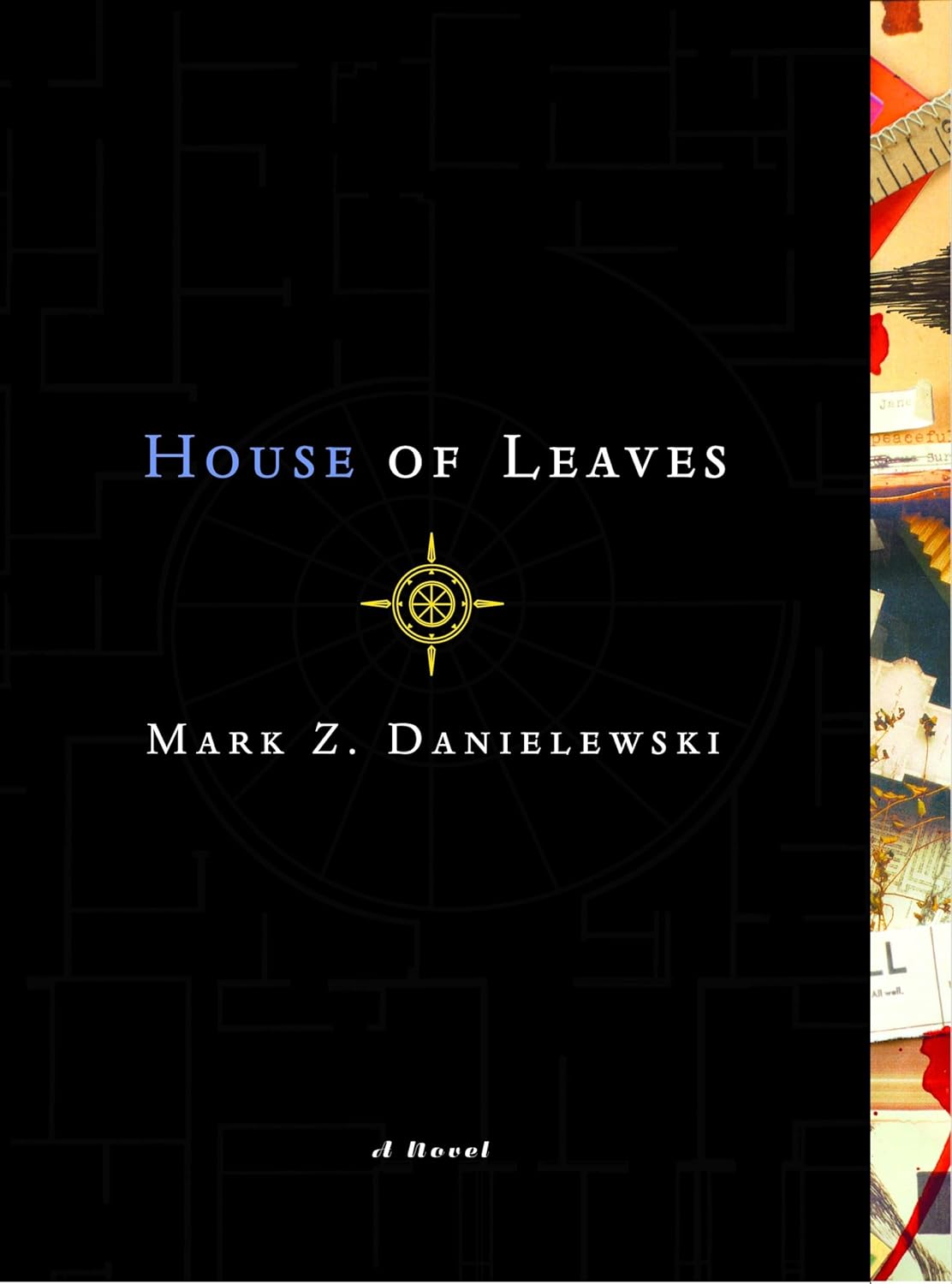
THE MIND-BENDING CULT CLASSIC ABOUT A HOUSE THAT’S LARGER ON THE INSIDE THAN ON THE OUTSIDE • A masterpiece of horror and an astonishingly immersive, maze-like reading experience that redefines the boundaries of a novel.''Simultaneously reads like a thriller and like a strange, dreamlike excursion into the subconscious." —Michiko Kakutani, The New York Times "Thrillingly alive, sublimely creepy, distressingly scary, breathtakingly intelligent—it renders most other fiction meaningless." —Bret Easton Ellis, bestselling author of American Psycho “This demonically brilliant book is impossible to ignore.” —Jonathan Lethem, award-winning author of Motherless BrooklynOne of The Atlantic’s Great American Novels of the Past 100 YearsYears ago, when House of Leaves was first being passed around, it was nothing more than a badly bundled heap of paper, parts of which would occasionally surface on the Internet. No one could have anticipated the small but devoted following this terrifying story would soon command. Starting with an odd assortment of marginalized youth—musicians, tattoo artists, programmers, strippers, environmentalists, and adrenaline junkies—the book eventually made its way into the hands of older generations, who not only found themselves in those strangely arranged pages but also discovered a way back into the lives of their estranged children.Now made available in book form, complete with the original colored words, vertical footnotes, and second and third appendices, the story remains unchanged. Similarly, the cultural fascination with House of Leaves remains as fervent and as imaginative as ever. The novel has gone on to inspire doctorate-level courses and masters theses, cultural phenomena like the online urban legend of “the backrooms,” and incredible works of art in entirely unrealted mediums from music to video games. Neither Pulitzer Prize-winning photojournalist Will Navidson nor his companion Karen Green was prepared to face the consequences of the impossibility of their new home, until the day their two little children wandered off and their voices eerily began to return another story—of creature darkness, of an ever-growing abyss behind a closet door, and of that unholy growl which soon enough would tear through their walls and consume all their dreams.
Had The Blair Witch Project been a book instead of a film, and had it been written by, say, Nabokov at his most playful, revised by Stephen King at his most cerebral, and typeset by the futurist editors of Blast at their most avant-garde, the result might have been something like House of Leaves. Mark Z. Danielewski's first novel has a lot going on: notably the discovery of a pseudoacademic monograph called The Navidson Record, written by a blind man named Zampanò, about a nonexistent documentary film--which itself is about a photojournalist who finds a house that has supernatural, surreal qualities. (The inner dimensions, for example, are measurably larger than the outer ones.) In addition to this Russian-doll layering of narrators, Danielewski packs in poems, scientific lists, collages, Polaroids, appendices of fake correspondence and "various quotes," single lines of prose placed any which way on the page, crossed-out passages, and so on. Now that we've reached the post-postmodern era, presumably there's nobody left who needs liberating from the strictures of conventional fiction. So apart from its narrative high jinks, what does House of Leaves have to offer? According to Johnny Truant, the tattoo-shop apprentice who discovers Zampanò's work, once you read The Navidson Record, For some reason, you will no longer be the person you believed you once were. You'll detect slow and subtle shifts going on all around you, more importantly shifts in you. Worse, you'll realize it's always been shifting, like a shimmer of sorts, a vast shimmer, only dark like a room. But you won't understand why or how. We'll have to take his word for it, however. As it's presented here, the description of the spooky film isn't continuous enough to have much scare power. Instead, we're pulled back into Johnny Truant's world through his footnotes, which he uses to discharge everything in his head, including the discovery of the manuscript, his encounters with people who knew Zampanò, and his own battles with drugs, sex, ennui, and a vague evil force. If The Navidson Record is a mad professor lecturing on the supernatural with rational-seeming conviction, Truant's footnotes are the manic student in the back of the auditorium, wigged out and furiously scribbling whoa-dude notes about life. Despite his flaws, Truant is an appealingly earnest amateur editor--finding translators, tracking down sources, pointing out incongruities. Danielewski takes an academic's--or ex-academic's--glee in footnotes (the similarity to David Foster Wallace is almost too obvious to mention), as well as other bogus ivory-tower trappings such as interviews with celebrity scholars like Camille Paglia and Harold Bloom. And he stuffs highbrow and pop-culture references (and parodies) into the novel with the enthusiasm of an anarchist filling a pipe bomb with bits of junk metal. House of Leaves may not be the prettiest or most coherent collection, but if you're trying to blow stuff up, who cares? --John Ponyicsanyi
Danielewski's eccentric and sometimes brilliant debut novel is really two novels, hooked together by the Nabokovian trick of running one narrative in footnotes to the other. One-the horror story-is a tour-de-force. Zampano, a blind Angelino recluse, dies, leaving behind the notes to a manuscript that's an account of a film called The Navidson Report. In the Report, Pulitzer Prize-winning news photographer Will Navidson and his girlfriend move with their two children to a house in an unnamed Virginia town in an attempt to save their relationship. One day, Will discovers that the interior of the house measures more than its exterior. More ominously, a closet appears, then a hallway. Out of this intellectual paradox, Danielewski constructs a viscerally frightening experience. Will contacts a number of people, including explorer Holloway Roberts, who mounts an expedition with his two-man crew. They discover a vast stairway and countless halls. The whole structure occasionally groans, and the space reconfigures, driving Holloway into a murderous frenzy. The story of the house is stitched together from disparate accounts, until the experience becomes somewhat like stumbling into Borges's Library of Babel. This potentially cumbersome device actually enhances the horror of the tale, rather than distracting from it. Less successful, however, is the second story unfolding in footnotes, that of the manuscript's editor, (and the novel's narrator), Johnny Truant. Johnny, who discovered Zampano's body and took his papers, works in a tattoo parlor. He tracks down and beds most of the women who assisted Zampano in preparing his manuscript. But soon Johnny is crippled by panic attacks, bringing him close to psychosis. In the Truant sections, Danielewski attempts an Infinite Jest-like feat of ventriloquism, but where Wallace is a master of voices, Danielewski is not. His strength is parodying a certain academic tone and harnessing that to pop culture tropes. Nevertheless, the novel is a surreal palimpsest of terror and erudition, surely destined for cult status. (Mar.) Copyright 2000 Reed Business Information, Inc.
When Johnny Truant attempts to organize the many fragments of a strange manuscript by a dead blind man, it gains possession of his very soul. The manuscript is a complex commentary on a documentary film (The Navidson Record) about a house that defies all the laws of physics. Navidson's exploration of a seemingly endless, totally dark, and constantly changing labyrinth in the house becomes an examination of truth, perception, and darkness itself. The book interweaves the manuscript with over 400 footnotes to works real and imagined, thus illuminating both the text and Truant's mental disintegration. First novelist Danielewski employs avant-garde page layouts that are occasionally a bit too clever but are generally highly effective. Although it may be consigned to the "horror" genre, this novel is also a psychological thriller, a quest, a literary hoax, a dark comedy, and a work of cultural criticism. It is simultaneously a highly literary work and an absolute hoot. This powerful and extremely original novel is strongly recommended for all public and academic libraries.-Jim Dwyer, California State Univ. Lib., Chico Copyright 2000 Reed Business Information, Inc.
This stunning first effort is destined for fast-track cult status. A photographer decides to create a film document of his family moving into a new home. The project runs smoothly until the interior dimensions of the house turn out to be larger than the exterior. Over time, a maze of passageways appear and disappear, perhaps inhabited by an unseen malevolent creature. Equipped with cameras, a team tries to explore the shifting labyrinth, but they are forced out after the expedition proves deadly. But what they have managed to film is a critical success, generating thousands of pages of analysis. Years later, a trunk of these documents fall into the hands of a young man after the curious death of a neighbor. He finds that the dimensions of his own life may not be as fixed as he once imagined, and that he might also be pursued by an unknown entity. This work is a kaleidoscopically layered and deconstructed H. P. Lovecraft-style horror story. It hums and resonates with wonder, dread, and insight. Eric Robbins
“Any hope or fear that the experimental novel was an aberration of the twentieth century is dashed by the appearance of Mark Z. Danielewski’s House of Leaves, the first major experimental novel of the new millennium. And it’s a monster. Dazzling.”
“An intricate, erudite, and deeply frightening book.”
“A great novel. A phenomenal debut. Thrillingly alive, sublimely creepy, distressingly scary, breathtakingly intelligent
“[Its] chills spark vertigo, its erudition brings on dislocating giddiness . . . House of Leaves is dizzying in every respect.”
“Stunning . . . What could have been a perfectly entertaining bit of literary horror is instead an assault on the nature of story.”
“This demonically brilliant book is impossible to ignore, put down, or persuasively conclude reading. In fact, when you purchase your copy you may reach a certain page and find me there, reduced in size like Vincent Price in The Fly, still trapped in the web of its malicious, beautiful pages.”
“[A] tour de force first novel. [It] can keep you up at nights and make you never look at a closet in quite the same way again . . . Staggeringly good fun.”
“A novelistic mosaic that simultaneously reads like a thriller and like a strange, dreamlike excursion into the subconscious.”
“If you can imagine that Peter Pan’s enemy is not Captain Hook but Neverland itself, or that the whale that swallows Jonah is Moby-Dick, you’ll begin to appreciate what this book is about. Anticipate it with dread, seize, and understand. A riveting reading experience.”
“Grabs hold and won’t let go . . . The reader races through the pages exactly as her mind races to find out what happens next.”
“Like Melville’s Moby-Dick, Joyce’s Ulysses, and Nabokov’s Pale Fire, Danielewski’s House of Leaves is a grandly ambitious multi-layered work that simply knocks your socks off with its vast scope, erudition, formal inventiveness, and sheer storytelling skills.”
"This demonically brilliant book is impossible to ignore, put down, or persuasively conclude reading. In fact, when you purchase your copy you may reach a certain page and find me there, reduced in size like Vincent Price in The Fly, still trapped in the web of its malicious, beautiful pages."-- Jonathan Lethem, author of Motherless Brooklyn "An amazingly intricate and ambitious first novel -- ten years in the making -- that puts an engrossing new spin on the traditional haunted house tale...Danielewski skillfully manipulates the reader's expectations and fears, employing ingeniously skewed typography...The story's very ambiguity steadily feeds its mysteriousness and power, and Danielewski's mastery of post-modernist and cinema-derived rhetoric up the ante continuously, and stunningly. One of the most impressive excursions into the supernatural in many a year."-- Kirkus Reviews (starred)"The novel is a surreal palimpsest of terror and erudition, surely destined for cult status....The story of the house is stitched together from disparate accounts, until the experience becomes somewhat like stumbling into Borges's Library of Babel...The horror story -- is a tour de force."--Publishers Weekly
Years ago, when House of Leaves was first being passed around, it was nothing more than a badly bundled heap of paper, parts of which would occasionally surface on the Internet. No one could have anticipated the small but devoted following this terrifying story would soon command. Starting with an odd assortment of marginalized youth -- musicians, tattoo artists, programmers, strippers, environmentalists, and adrenaline junkies -- the book eventually made its way into the hands of older generations, who not only found themselves in those strangely arranged pages but also discovered a way back into the lives of their estranged children.Now, for the first time, this astonishing novel is made available in book form, complete with the original colored words, vertical footnotes, and newly added second and third appendices.The story remains unchanged, focusing on a young family that moves into a small home on Ash Tree Lane where they discover something is terribly wrong: their house is bigger on the inside than it is on the outside.Of course, neither Pulitzer Prize-winning photojournalist Will Navidson nor his companion Karen Green was prepared to face the consequences of that impossibility, until the day their two little children wandered off and their voices eerily began to return another story -- of creature darkness, of an ever-growing abyss behind a closet door, and of that unholy growl which soon enough would tear through their walls and consume all their dreams.
Years ago, when House of Leaves was first being passed around, it was nothing more than a badly bundled heap of paper, parts of which would occasionally surface on the Internet. No one could have anticipated the small but devoted following this terrifying story would soon command. Starting with an odd assortment of marginalized youth -- musicians, tattoo artists, programmers, strippers, environmentalists, and adrenaline junkies -- the book eventually made its way into the hands of older generations, who not only found themselves in those strangely arranged pages but also discovered a way back into the lives of their estranged children. Now, for the first time, this astonishing novel is made available in book form, complete with the original colored words, vertical footnotes, and newly added second and third appendices. The story remains unchanged, focusing on a young family that moves into a small home on Ash Tree Lane where they discover something is terribly wrong: their house is bigger on the inside than it is on the outside. Of course, neither Pulitzer Prize-winning photojournalist Will Navidson nor his companion Karen Green was prepared to face the consequences of that impossibility, until the day their two little children wandered off and their voices eerily began to return another story -- of creature darkness, of an ever-growing abyss behind a closet door, and of that unholy growl which soon enough would tear through their walls and consume all their dreams.
Find it on
AmazonNo videos available yet.
No news articles linked to this title yet.

Overall
Overall rating of the media
Atmosphere
How immersive and tense is the atmosphere
Gore
Level and quality of gore/violence
Story
Quality of the storyline and plot
Writing
Quality of the written content
Character Development
Depth and growth of characters
Pacing
Flow and timing of the narrative