
BOOK
0
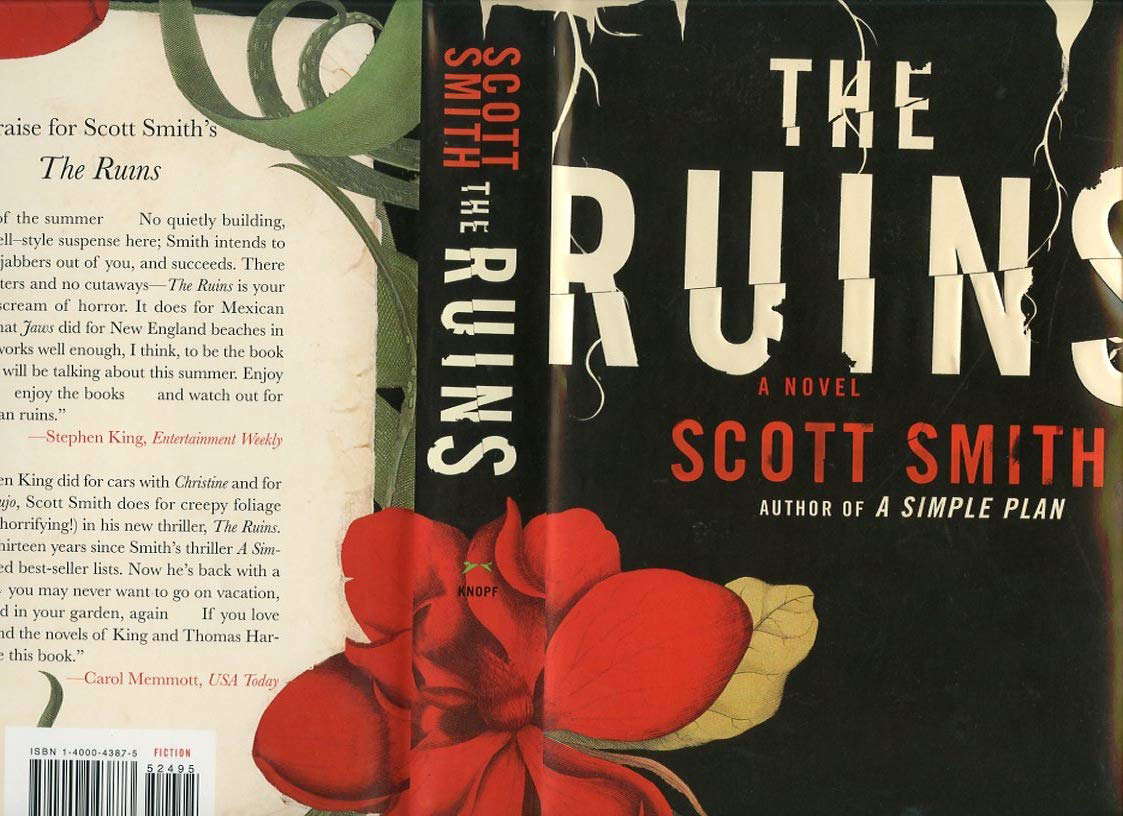
Eerie, terrifying, unputdownable—Scott Smith’s first novel since his best-selling A Simple Plan (“Simply the best suspense novel of this year—hell, of the 1990s”—Stephen King). The Ruins follows two American couples, just out of college, enjoying a pleasant, lazy beach holiday together in Mexico as, on an impulse, they go off with newfound friends in search of one of their group—the young German, who, in pursuit of a girl, has headed for the remote Mayan ruins, site of a fabled archeological dig. This is what happens from the moment the searchers—moving into the wild interior—begin to suspect that there is an insidious, horrific “other” among them . . .
In 1993, Scott Smith wowed readers with A Simple Plan, his stunning debut thriller about what happens when three men find a wrecked plane and bag stuffed with over 4 million dollars--a book that Stephen King called "Simply the best suspense novel of the year!" Now, thirteen years after writing a novel that turned into a pretty great movie featuring Bill Paxton and Billy Bob Thornton, Smith is back, with The Ruins, a horror-thriller about four Americans traveling in Mexico who stumble across a nightmare in the jungle. Who better to tell readers if Smith has done it again than the undisputed King of Horror (and champion of Smith's first book)? We asked Stephen King to read The Ruins and give us his take. Check out his review below. --Daphne DurhamGuest Reviewer: Stephen KingStephen King is the author of too many bestselling books to name here, but some of our favorites include: Cell, The Stand, On Writing, The Shining, and the entire Dark Tower series. King also received the National Book Foundation 2003 Medal for Distinguished Contribution to American Letters, has had many movies and television miniseries adapted from his novels, short stories, and screenplays, and is a regular columnist for Entertainment Weekly. Keep your eyes peeled for Lisey's Story (October 2006), a new television series on TNT based on Nightmares & Dreamscapes (July 2007), and a graphic novel series based on the Dark Tower books coming from Marvel (2007). When I heard that Scott Smith was publishing a new novel this summer, I felt the way I did when my kids came in an hour or two late from their weekend dates: a combination of welcoming relief (thank God you're back) mingled with exasperation and anger (where the hell have you been?). Well, it's only a book, you say, and maybe that's true, but Scott Smith is a singularly gifted writer, and it seems to me that the twelve years between his debut--the cult smash A Simple Plan--and his return this summer with The Ruins is cause for exasperation, if not outright anger. Certainly Smith, who has been invisible save for his Academy Award-nominated screenplay for the film version of A Simple Plan, will have some 'splainin to do about how he spent his summer vacation. Make that his last twelve summer vacations. But enough. The new book is here, and the question devotees of A Simple Plan will want answered is whether or not this book generates anything like Plan's harrowing suspense. The answer is yes. The Ruins is going to be America's literary shock-show this summer, doing for vacations in Mexico what Jaws did for beach weekends on Long Island. Is it as successful and fulfilling as a novel? The answer is not quite, but I can live with that, because it's riskier. There will be reviews of this book by critics who have little liking or understanding for popular fiction who'll dismiss it as nothing but a short story that has been bloated to novel length (I'm thinking of Michiko Kakutani, for instance, who microwaved Smith's first book). These critics, who steadfastly grant pop fiction no virtue but raw plot, will miss the dazzle of Smith's technique; The Ruins is the equivalent of a triple axel that just misses perfection because something's wrong with the final spin. It's hard to say much about the book without giving away everything, because the thing is as simple and deadly as a leg-hold trap concealed in a drift of leaves or, in this case, a mass of vines. You've got four young American tourists--Eric, Jeff, Amy, and Stacy--in Cancun. They make friends with a German named Mathias whose brother has gone off into the jungle with some archeologists. These five, plus a cheerful Greek with no English (but a plentiful supply of tequila), head up a jungle trail to find Mathias's brother the archaeologists and the ruins. Well, two out of three ain't bad, according to the old saying, and in this case; what's waiting in the jungle isn't just bad, it's horrible. Most of The Ruins's 300-plus pages is one long, screaming close-up of that horror. There's no let-up, not so much as a chapter-break where you can catch your breath. I felt that The Ruins did draw on a trifle, but I found Scott Smith's refusal to look away heroic, just as I did in A Simple Plan. It's the trappings of horror and suspense that will make the book a best seller, but its claim to literature lies in its unflinching naturalism. It's no Heart of Darkness, but at its suffocating, terrifying, claustrophobic best, it made me think of Frank Norris. Not a bad comparison, at that. One only hopes Mr. Smith won't stay away so long next time.--Stephen King
Starred Review. At long last, Smith follows up his bestselling first novel, A Simple Plan (1993), the film of which received an Oscar nomination for best screenplay, with a stunning horror thriller. Four American friends on vacation in Cancún, Mexico—Jeff, Amy, Eric and Stacy—meet a German tourist, Mathias, who persuades them to join his hunt for his younger brother, Henrich, last seen headed off with a new girlfriend toward some ruins. The four soon regret their impulsive decision after they find themselves lost in the jungle and freaked out by signs that they're headed for danger. Smith builds suspense through the slow accretion of telling details, until a deadly menace starts taking its toll, leaving the survivors increasingly at each other's throats. While admirers of such classic genre writers as John Wyndham or Algernon Blackwood may find the horror less suggestive than they might wish, the eerie atmosphere and compelling plot should appeal to fans of ABC's hit TV series Lost, who will help propel this page-turner up bestseller lists. Ben Stiller's production company has bought film rights. 100,000 first printing. (July) Copyright © Reed Business Information, a division of Reed Elsevier Inc. All rights reserved.
Adult/High School–Two American couples just out of college head to Mexico for a sun- and tequila-filled vacation. They befriend some like-minded Greek tourists and a German man whose brother has followed an archaeologist to the site of her dig. The Americans and one of the Greeks decide to go into the jungle to help Matthias find his brother. Blissfully ignorant, they head off with minimal rations, but lots of tequila. Despite all warning signs, they continue to a desolate Mayan village whose residents seem intent on keeping them away. Once American Amy steps off the path into a patch of vines, things suddenly change. As in A Simple Plan (Knopf, 1993), Smith creates a gripping story in which each character's uncertainties and human frailties are as horrific as the actual horror around them. Though the story is told in the third person, each American spends time as a protagonist, giving readers an understanding of his or her fears and motivations. This also allows readers to second-guess the characters. The book has no chapter breaks, which echoes the long and dreadful adventure. Even though only a few days pass, it feels much longer, as the plot moves minute-by-minute through each day. The ending is highly satisfactory and perfectly tragic. Though there are some brief scenes of gore, most of the suspense is psychological, but no less frightening. Fans of everything from Jurassic Park to Lost to Stephen King will love this book.–Jamie Watson, Harford County Public Library, MD Copyright © Reed Business Information, a division of Reed Elsevier Inc. All rights reserved.
The Ruins, the long-awaited second novel from the author of the acclaimed A Simple Plan, is more horror than thriller, a shift that most critics found intriguing. A few reviewers, ample with praise, even compared it to Joseph Conrad's Heart of Darkness. Readers who approach Ruins as genre fiction and expect plenty of gore and fear will get just what they're looking for. Although the novel does include a fair amount of character development and analysis, readers hoping for in-depth psychological studies (or who are disturbed by grotesque violence and bodily fluids) will probably be disappointed. This is not a novel about "why": you'll have many questions that will go unanswered. That left three critics severely disappointed, and it's up to you to figure out if you're ready for the slasher portion of the novel. Regardless of genre, Scott Smith remains a skillful and incisive writer.Copyright © 2004 Phillips & Nelson Media, Inc.
Smith's smash-hit debut, A Simple Plan (1993), a psychological thriller about greed, was made into a popular film. Now, after a long absence, Smith turns in a suspense novel tainted with remedial horror. Imagine an episode of Friends on psilocybin mushrooms. Two twentysomething American couples are vacationing in Cancun, where they befriend Mathias, an English-speaking German, and Pablo, an easygoing Greek. Amy is the worrier. Stacy, her best friend, is an impulsive airhead. Jeff is the ambitious can-do guy. Eric is laid-back and passive. All they intend to do is party, but when Mathias goes to look for his brother at an archaeological site near some Mayan ruins, the others go along. Naive and hubristic, the vacationers are soon entrapped by people they can't understand and besieged by a creepy, inexplicable power. Smith has crafted a harrowing page-turner all right, but it is so grim, the horror so simplistic and relentless, and the cultural implications so dubious that drama and scariness give way to dismay and disgust. Donna SeamanCopyright © American Library Association. All rights reserved
“Simply the best suspense novel of this year
“[It] fulfills every expectation of a novel of suspense, leading the reader on a wild exploration of the banality of evil . . . Smith demonstrates the eerie ease with which the mundane can descend to the unthinkable . . . Smith’s imagination never palls.
“The reader is drawn along by fascination. It’s like watching a train wreck: there is nothing to be done, but it is impossible to turn away . . . an almost tragic tale of pure greed . . . as compelling [as] The Treasure of the Sierra Madre.”
“The year’s finest literary shivers . . . A beautifully controlled piece of writing, all the more impressive for being the debut of its author.”
“A Simple Plan works a devastating variation on the idea of the banality of evil . . . Beautifully controlled and disturbing . . . Cunningly imagined.”
“It is remarkable to read such a terrifying work expressed in such a seductively reasonable voice. A work of singular power, carrying within it a moral that might well be a metaphor for a society in love with wretched excess.”
“Electrifying . . . An eerily flat confessional whose horror is only deepened by its flashes of tenderness. Think of a backwater James M. Cain, or a contemporary midwestern Unforgiven–and don’t think about getting any sleep tonight.”
“Astonishing.”
“Its unveiling of a conspiracy of greed gone wrong couldn’t be more finely calibrated. Its lithe rendering of how partners-in-crime become predators bent on destroying one another recalls B. Traven’s The Treasure of the Sierra Madre or the better work of Jim Thompson (The Grifters, After Dark, My Sweet).”
“That rare and satisfying combination: a compulsive thriller which also happens to be a beautifully-written and original work of art.”
Only one word does justice to Scott Smith's The Ruins, and it's the last word to leave the lips of Joseph Conrad's Mr. Kurtz: horror.Smith turned heads with his gripping first novel, A Simple Plan (1993), which chronicled the downfall of three men who find millions of dollars in the wreckage of an airplane. His second novel proves worth the 13-year wait. The Ruins is a tour de force of terror, a novel that seduces, shocks and dares you to keep reading -- and never relents, not even on its final page. Like A Simple Plan, it's driven by a keen sense of character, the collision of the mundane and the extraordinary, and an abiding fascination with choices and their consequences.The Ruins proceeds from a premise familiar to fans of latter-day horror fiction and film: the Road Trip to Hell, made mythic in "The Texas Chainsaw Massacre" and "The Hills Have Eyes." Smith's travelers are apple-pie American, four fresh-faced college grads intent on one last fling in Cancún before confronting adulthood and the obligations of the real world. That confrontation comes far sooner than expected.Bright and beautiful Amy will enter medical school in the fall with her boyfriend, Jeff, an alpha male and former Eagle Scout -- ever calm, ever industrious, ever prepared. Stacy is headed nowhere with her boyfriend, Eric, who is built less of logic and muscle than playfulness and imagination: "He was going to teach children and remain a child forever, while Stacy advanced implacably into adulthood, leaving him behind." Bored and in need of a little adventure, the four join a dour German tourist on a day-trip search for his missing brother. A hand-drawn map leads them inland by bus, then truck, then foot to a remote archaeological dig. The journey is part Joseph Conrad, part B. Traven -- and turns fatal when they reach a Mayan village that guards the ruins, unearthed by miners on a silent hill:"The hill was rocky, oddly treeless, and covered with some sort of vinelike growth -- a vivid green, with hand-shaped leaves and tiny flowers. The plant spread across the entire hill, clinging so tightly to the earth that it almost seemed to be squeezing it in its grasp. The flowers looked like poppies, the same size and color: a brilliant stained-glass red." Another red -- the red of blood -- soon follows. The villagers refuse to let the outsiders come down from the hill, forcing them to confront a mysterious nemesis among the empty ruins -- and, in turn, their own faults and fears. That vined plant, beguiling in its beauty, is carnivorous and somehow conscious. Only the lexicon of H.P. Lovecraft could offer meaningful descriptions: eldritch, noisome, tenebrous, a crawling chaos beyond simplistic notions of man and monster, primitive and civilized, good and evil.Faced with a lethal dilemma -- death now, at the hands of the Mayans, or death later, in the grip of abomination -- the friends hope for rescue or an opportunity for escape; and that's when the real story, a harrowing saga of survival, begins.Smith's assured narrative circles inward patiently, interrogating his characters' responses to a scenario that, in lesser hands, might read like 1930s pulp fiction. He eschews an omniscient point of view, sweeping and swerving through the limited viewpoints of the four Americans, and that refusal to know all preserves the novel from horror's anathema: the eagerness to tell all. The events on that lonely hill are all the more disturbing because they cannot entirely be explained, and Smith's claustrophobic style makes the moments of violence, when they come, stark and searing:"She kept clearing the vine away, buffeted by [his] screaming, seeing and not seeing, not bone white, but bone itself, the flesh stripped cleanly from it, blood beginning to pool now, pool and drip, as the plant was pulled free, revealing more white, more bone white, more bone, his lower leg nothing but bone, the skin and muscle and fat gone, eaten, blood dripping from the . . . knee, dripping and pooling, a long tendril wrapped completely around his shinbone, gripping it, refusing to relinquish its hold, a trio of flowers hanging from the length of green, red flowers, bright red, bloodred."There's something else powering these pages: The reader feels trapped with Smith's terrorized tourists in their desperate struggle for survival -- and for understanding. And nothing seems to work: not instinct or intellect, love or labor, friendship or faith. That isolated hill and its inexplicable predator suggest discomforting metaphors; it's difficult not to read this novel about Americans caught in a dire morass on foreign soil without thinking of the day's headlines.But there's a more timeless fable at work here, one that prompts thoughts of Heart of Darkness. Courageous in its pessimism and its embrace of horror, Smith's powerful tale, like Conrad's masterpiece, cautions against such reassuring conceits as civilization, conscience, morality, superiority -- and yes, good and evil. Hidden somewhere in the vines of The Ruins, like those of the Congo, beats the heart of an impenetrable darkness. Reviewed by Douglas E. Winter Copyright 2006, The Washington Post. All Rights Reserved.
They met Mathias on a day trip to Cozumel. They'd hired a guide to take them snorkeling over a local wreck, but the buoy marking its location had broken off in a storm, and the guide was having difficulty finding it. So they were just swimming about, looking at nothing in particular. Then Mathias rose toward them from the depths, like a merman, a scuba tank on his back. He smiled when they told him their situation, and led them to the wreck. He was German, dark from the sun, and very tall, with a blond crew cut and pale blue eyes. He had a tattoo of an eagle on his right forearm, black with red wings. He let them take turns borrowing his tank so they could drop down thirty feet and see the wreck up close. He was friendly in a quiet way, and his English was only slightly accented, and when they pulled themselves into their guide's boat to head back to shore, he climbed in, too.They met the Greeks two nights later, back in Cancun, on the beach near their hotel. Stacy got drunk and made out with one of them. Nothing happened beyond that, but the Greeks always seemed to be turning up afterward, no matter where they went or what they were doing. None of them spoke Greek, of course, and the Greeks didn't speak English, so it was mostly smiling and nodding and the occasional sharing of food or drinks. There were three Greeks—in their early twenties, like Mathias and the rest of them—and they seemed friendly enough, even if they did appear to be following them about.The Greeks not only didn't know English; they couldn't speak Spanish, either. They'd adopted Spanish names, though, which they seemed to find very amusing. Pablo and Juan and Don Quixote was how they introduced themselves, saying the names in their odd accents and gesturing at their chests. Don Quixote was the one Stacy made out with. All three looked enough alike, however—wide-shouldered and slightly padded, with their dark hair grown long and tied back in ponytails—that even Stacy had a hard time keeping track of who was who. It also seemed possible that they were trading the names around, that this was part of the joke, so the one who answered to Pablo on Tuesday would smilingly insist on Wednesday that he was Juan.They were visiting Mexico for three weeks. It was August, a foolish time to travel to the Yucatán. The weather was too hot, too humid. There were sudden rainstorms nearly every afternoon, downpours that could flood a street in a matter of seconds. And with darkness, the mosquitoes arrived, vast humming clouds of them. In the beginning, Amy complained about all these things, wishing they'd gone to San Francisco, which had been her idea. But then Jeff lost his temper, telling her she was ruining it for everyone else, and she stopped talking about California—the bright, brisk days, the trolley cars, the fog rolling in at dusk. It wasn't really that bad anyway. It was cheap and uncrowded, and she decided to make the best of it.There were four of them in all: Amy and Stacy and Jeff and Eric. Amy and Stacy were best friends. They'd cut their hair boyishly short for the trip, and they wore matching Panama hats, posing for photos arm in arm. They looked like sisters—Amy the fair one, Stacy the dark—both of them tiny, barely five feet tall, birdlike in their thinness. They were sisterly in their behavior, too, full of whispered secrets, wordless intimacies, knowing looks.Jeff was Amy's boyfriend; Eric was Stacy's. The boys were friendly with each other, but not exactly friends. It had been Jeff's idea to travel to Mexico, a last fling before he and Amy started medical school in the fall. He'd found a good deal on the Internet: cheap, impossible to pass up. It would be three lazy weeks on the beach, lying in the sun, doing nothing. He'd convinced Amy to come with him, then Amy had convinced Stacy, and Stacy had convinced Eric.Mathias told them that he'd come to Mexico with his younger brother, Henrich, but Henrich had gone missing. It was a confusing story, and none of them understood all the details. Whenever they asked him about it, Mathias became vague and upset. He slipped into German and waved his hands, and his eyes grew cloudy with the threat of tears. After awhile, they didn't ask anymore; it felt impolite to press. Eric believed that drugs were somehow involved, that Mathias's brother was on the run from the authorities, but whether these authorities were German, American, or Mexican, he couldn't say for certain. There'd been a fight, though; they all agreed upon this. Mathias had argued with his brother, perhaps even struck him, and then Henrich had disappeared. Mathias was worried, of course. He was waiting for him to return so that they could fly back to Germany. Sometimes he seemed confident that Henrich would eventually reappear and that all would be fine in the end, but other times he didn't. Mathias was reserved by nature, a listener rather than a talker, and prone in his present situation to sudden bouts of gloom. The four of them worked hard to cheer him up. Eric told funny stories. Stacy did her imitations. Jeff pointed out interesting sights. And Amy took countless photographs, ordering everyone to smile.In the day, they sunned on the beach, sweating beside one another on their brightly colored towels. They swam and snorkeled; they got burned and began to peel. They rode horses, paddled around in kayaks, played miniature golf. One afternoon, Eric convinced them all to rent a sailboat, but it turned out he wasn't as adept at sailing as he'd claimed, and they had to be towed back to the dock. It was embarrassing, and expensive. At night, they ate seafood and drank too much beer.Eric didn't know about Stacy and the Greek. He'd gone to sleep after dinner, leaving the other three to wander the beach with Mathias. There'd been a bonfire burning behind one of the neighboring hotels, a band playing in a gazebo. That was where they met the Greeks. The Greeks were drinking tequila and clapping in rhythm with the music. They offered to share the bottle. Stacy sat next to Don Quixote, and there was much talking, in their mutually exclusive languages, and much laughter, and the bottle passed back and forth, everyone wincing at the burning taste of the liquor, and then Amy turned and found Stacy embracing the Greek. It didn't last very long. Five minutes of kissing, a shy touch of her left breast, and the band was finished for the night. Don Quixote wanted her to go back to his room, but she smiled and shook her head, and it was over as easily as that.In the morning, the Greeks laid out their towels alongside Mathias and the four of them on the beach, and in the afternoon they all went jet skiing together. You wouldn't have known about the kissing if you hadn't seen it; the Greeks were very gentlemanly, very respectful. Eric seemed to like them, too. He was trying to get them to teach him dirty words in Greek. He was frustrated, though, because it was hard to tell if the words they were teaching him were the ones he wanted to learn.It turned out that Henrich had left a note. Mathias showed it to Amy and Jeff early one morning, during the second week of their vacation. It was handwritten, in German, with a shakily drawn map at the bottom. They couldn't read the note, of course; Mathias had to translate it for them. There wasn't anything about drugs or the police—that was just Eric being Eric, jumping to conclusions, the more dramatic the better. Henrich had met a girl on the beach. She'd flown in that morning, was on her way to the interior, where she'd been hired to work on an archaeological dig. It was at an old mining camp, maybe a silver mine, maybe emeralds—Mathias wasn't certain. Henrich and the girl had spent the day together. He'd bought her lunch and they'd gone swimming. Then he took her back to his room, where they showered and had sex. Afterward, she left on a bus. In the restaurant, over lunch, she'd drawn a map for him on a napkin, showing him where the dig was. She told him he should come, too, that they'd be glad for his help. Once she left, Henrich couldn't stop talking about her. He didn't eat dinner and he couldn't fall asleep. In the middle of the night, he sat up in bed and announced to Mathias that he was going to join the dig.Mathias called him a fool. He'd only just met this girl, they were in the midst of their vacation, and he didn't know the first thing about archaeology. Henrich assured him that it was really none of his business. He wasn't asking for Mathias's permission; he was merely informing him of his decision. He climbed out of bed and started to pack. They called each other names, and Henrich threw an electric razor at Mathias, hitting him on the shoulder. Mathias rushed him, knocking him over. They rolled around on the hotel room floor, grappling, grunting obscenities, until Mathias accidentally head-butted Henrich in the mouth, cutting his lip. Henrich made much of this, rushing to the bathroom so that he could spit blood into the sink. Mathias pulled on some clothes and went out to get him ice, but then ended up going downstairs to the all-night bar by the pool. It was three in the morning. Mathias felt he needed to calm down. He drank two beers, one quickly, the other slowly. When he got back to their room, the note was sitting on his pillow. And Henrich was gone.The note was three-quarters of a page long, though it seemed shorter when Mathias read it out loud in English. It occurred to Amy that Mathias might be skipping some of the passages, preferring to keep them private, but it didn't matter—she and Jeff got the gist of it. Henrich said that Mathias often seemed to mistake being a brother with being a parent. He forgave him for this, yet he still couldn't accept it. Mathias might call him a fool, but he be...
Find it on
AmazonNo videos available yet.
No news articles linked to this title yet.

Overall
Overall rating of the media
Atmosphere
How immersive and tense is the atmosphere
Gore
Level and quality of gore/violence
Story
Quality of the storyline and plot
Writing
Quality of the written content
Character Development
Depth and growth of characters
Pacing
Flow and timing of the narrative