

BOOK
0
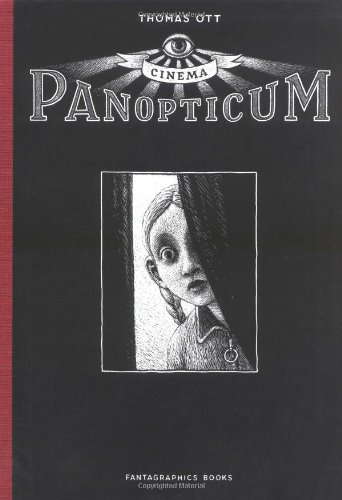
T. Ott plunges into the darkness with five new graphic horror novelettes: "The Prophet," "The Wonder Pill," "La Lucha," "The Hotel," and the title story, each executed in his hallucinatory and hyper-detailed scratchboard style and running between 16 to 20 pages. The first story in the book introduces the other four: A little girl visits an amusement park. She looks fascinated, but finds everything too expensive. Finally, behind the rollercoaster she eyeballs a small booth with "CINEMA PANOPTICUM" written on it. Inside there are boxes with screens. Every box contains a movie; the title of each appears on each screen. Each costs only a dime, so the price is right for the little girl. She puts her money in the first box: "The Prophet" begins. In the film, a vagrant foresees the end of the world and tries to warn people, but nobody believes him. They will soon enough. In the second film, "The Wonderpill," a short-sighted man initially goes blind from some pills his doctor gave him, but soon the blindness wears off and he finds they accord quite a view. "La Lucha," the third story, introduces a Mexican wrestler who fights against death himself. In a typical Ott twist, he wins and loses at the same time. The final story, "The Hotel," depicts a traveler who goes to sleep in what seems to be an otherwise empty hotel. His awakening is the stuff of nightmares... Ott's O. Henry-esque plot twists will delight fans of classic horror like The Twilight Zone and Tales From the Crypt, or modern efforts like M. Night Shamalayan's films; his artwork will haunt you long after you've put the book down.
Comics are popularly defined as a combination of words and pictures, but words are no more necessary to the comics than sound is to cinema. Swiss cartoonist Ott employs neither dialogue nor captions in his stories; words appear rarely, usually as chapter titles or signs in the background. Appropriately, Ott uses the early silent cinema as a motif. In the framing sequences, a morose little girl wanders through an old-fashioned amusement park and finds herself alone in the "Cinema Panopticon," which holds coin-operated machines showing silent films. Each film recounts a macabre tale which overturns the laws of reality, leading to a twist ending reminiscent of The Twilight Zone. A man enters a hotel but cannot leave; a masked wrestler battles Death; a patient finds a grotesque cure for his failing vision; a homeless man discovers signs of approaching Apocalypse. In keeping with the silent movie motif, Ott uses black, white and grays, enveloping his realistically drawn characters and settings in an expressionistic mood. The characters initially display understated emotions, and their situations seem familiar. Ott's storytelling moves at a slow but steady pace, making his protagonists' extreme reactions more believable when they, and the readers, are caught in Ott's imaginatively conceived, masterfully executed traps. Copyright © Reed Business Information, a division of Reed Elsevier Inc. All rights reserved.
"Internal and psychological terrors are Ott's concerns, and language couldn't convey them as powerfully as do his disquieting, foreboding illustrations."
"[...] Ott's storytelling moves at a slow but steady pace, making his protagonists' extreme reactions more believable when they, and the readers, are caught in Ott's imaginatively conceived, masterfully executed traps."
"The wordless noir morality plays are both meticulous and unnerving."
Find it on
AmazonNo videos available yet.
No news articles linked to this title yet.

Overall
Overall rating of the media
Atmosphere
How immersive and tense is the atmosphere
Gore
Level and quality of gore/violence
Story
Quality of the storyline and plot
Writing
Quality of the written content
Character Development
Depth and growth of characters
Pacing
Flow and timing of the narrative