
BOOK
0
Lisey Debusher Landon lost her husband, Scott, two years ago, after a twenty-five-year marriage of the most profound and sometimes frightening intimacy. Scott was an award-winning, bestselling novelist and a very complicated man. Early in their relationship, before they married, Lisey had to learn from him about books and blood and bools. Later, she understood that there was a place Scott went -- a place that both terrified and healed him, that could eat him alive or give him the ideas he needed in order to live. Now it's Lisey's turn to face Scott's demons, Lisey's turn to go to Boo'ya Moon. What begins as a widow's effort to sort through the papers of her celebrated husband becomes a nearly fatal journey into the darkness he inhabited. Perhaps King's most personal and powerful novel, Lisey's Story is about the wellsprings of creativity, the temptations of madness, and the secret language of love.
Since his first novel was published in 1974, Stephen King has stretched the boundaries of the written word, not only bringing horror to new heights, but trying his hand at nearly every possible genre, including children's books, graphic novels, serial novels, literary fiction, nonfiction, westerns, fantasy, and even e-books (remember The Plant?). With Lisey's Story, once again King is trying something different. Lisey's Story is as much a romance as it is a supernatural thriller--but don't let us convince you. Who better to tell readers if King has written a romantic thriller than Nora Roberts? We asked Nora to read Lisey's Story and give us her take. Check out her review below. --Daphne DurhamGuest Reviewer: Nora RobertsNora Roberts, who also writes under the pseudonym J.D. Robb, is the author of way too many bestselling books to name here (over 150!), but some of our favorites include: Angels Fall, Born in Death, Blue Smoke, and The Reef. Stephen King hooked me about three decades ago with that sharply faceted, blood-stained jewel, The Shining. Through the years he's bumped my gooses with kiddie vampires, tingled my spine with beloved pets gone rabid, justified my personal fear of clowns and made me think twice about my cell phone. I've always considered The Stand--a long-time favorite--a towering tour de force, and have owed its author a debt as this was the first novel I could convince my older son to read from cover to cover. But with Lisey's Story, King has accomplished one more feat. He broke my heart.Lisey's Story is, at its core, a love story--heart-wrenching, passionate, terrifying and tender. It is the multi-layered and expertly crafted tale of a twenty-five year marriage, and a widow's journey through grief, through discovery and--this is King, after all--through a nightmare scape of the ordinary and extraordinary. Through Lisey's mind and heart, the reader is pulled into the intimacies of her marriage to bestselling novelist Scott Landon, and through her we come to know this complicated, troubled and heroic man. Two years after his death, Lisey sorts through her husband's papers and her own shrouded memories. Following the clues Scott left her and her own instincts, she embarks on a journey that risks both her life and her sanity. She will face Scott's demons as well as her own, traveling into the past and into Boo'ya Moon, the seductive and terrifying world he'd shown her. There lives the power to heal, and the power to destroy. Lisey Landon is a richly wrought character of charm and complexity, of realized inner strength and redoubtable humor. As the central figure she drives the story, and the story is so vividly textured, the reader will draw in the perfumed air of Boo'ya Moon, will see the sunlight flood through the windows of the Scott's studio--or the night press against them. Her voice will be clear in your ear as you experience the fear and the wonder. If your heart doesn't hitch at the demons she faces in this world and the other, if it doesn't thrill at her courage and endurance, you're going to need to check with a cardiologist, first chance.Lisey's Story is bright and brilliant. It's dark and desperate. While I'll always consider The Shining, my first ride on King's wild Tilt-A-Whirl, a gorgeous, bloody jewel, I found, on this latest ride, a treasure box heaped with dazzling gems. A few of them have sharp, hungry teeth. --Nora Roberts
Starred Review. Following King's triumphant return to the world of gory horror in Cell, the bestselling author proves he's still the master of supernatural suspense in this minimally bloody but disturbing and sorrowful love story set in rural Maine. Lisey's husband, Pulitzer Prize–winning author Scott Landon, has been dead for two years at the book's start, but his presence is felt on every page. Lisey hears him so often in her head that when her catatonic sister, Amanda, begins speaking to her with Scott's voice, she finds it not so much unbelievable as inevitable. Soon she's following a trail of clues that lead her to Scott's horrifying childhood and the eerie world called Boo'ya Moon, all while trying to help Amanda and avoid a murderous stalker. Both a metaphor for coming to terms with grief and a self-referencing parable of the writer's craft, this novel answers the question King posed 25 years ago in his tale "The Reach": yes, the dead do love. (Oct.) Copyright © Reed Business Information, a division of Reed Elsevier Inc. All rights reserved.
In his intricate new novel, King explores two hidden worlds - the private life of a recently deceased best-selling writer, as seen from the perspective of his widow, and the imaginative landscape that formed the foundation of his work. As the novel opens, Lisey, Scott Landon's widow, is a sardonic observer of toadying academics, dangerously obsessive fans, and fame-struck bystanders. As she sorts through papers that Landon has left behind, she also becomes a traveller in a fantastical parallel world called Boo'ya Moon, to which he retreated during a horrific childhood and on which he drew throughout his creative life. It takes some time for these narrative strands to converge, but when they do Lisey moves between worlds at an exhilarating pace. Along the way, King also reveals, with subtle precision, the profound strangeness of widowhood, when someone who was present for so much of a shared life is gone. Copyright © 2006 Click here to subscribe to The New Yorker
Even by Stephen King standards, Lisey's Story is haunting. Yet though it contains some supernatural elements, it is really a love story that speaks to passion, the intimacy of marriage, the craft of writingand true madness. In Scott's escapist world and its relation to Lisey, the horrific elements come into play, but most critics agreed that despite the emotional punch of the story, it is not King's best. A convoluted stream-of-consciousness style, flashbacks within flashbacks, too much baby talk, and the novel's sheer length put off some reviewers, while others questioned whether what makes King's novels selltheir haunting, horrific goresuccessfully works here. Still, it's classic Stephen King: you should know by now whether that's to your taste. Copyright © 2004 Phillips & Nelson Media, Inc.
In the two years since her husband Scott's sudden death, professors and collectors mad to lay their hands on his unpublished manuscripts and letters, those of one of the most successful and lauded writers of his generation, have besieged Lisey (rhymes with CeeCee) Landon. The last of them, initially ingratiating, wound up threatening her. That decided her to prepare Scott's papers for donation to an appropriate archive. In the midst of doing that, she gets an answering machine message, then a telephone call and a written note, as well as a dead cat in the mailbox, from a grammatically challenged man who says he'll "hurt [her] places you didn't let the boys to touch at the junior high dances." Fortunately, she's been hearing Scott's voice lately, more than in recollection, and it leads her back to a place, another dimension, that he'd told her about but that she'd forgotten. The boy Scott and his long-dead brother went there to escape their sometimes psychopathic father; the grown-up Scott, to heal from many wounds, including those from a shooting that would have been fatal if Lisey hadn't intervened. It is paradisiacally beautiful but dangerous at night, when weird, savage creatures hunt in it. In this long, often long-feeling, utterly Stephen Kingish novel, Scott's strange and eventful past is thoroughly recovered, and Lisey's strength is revealed and confirmed, though not before the maniac does indeed hurt her. The book is also, perhaps, a parable about love and imagination that affirms love as the more salvific of the two. Ray OlsonCopyright © American Library Association. All rights reserved
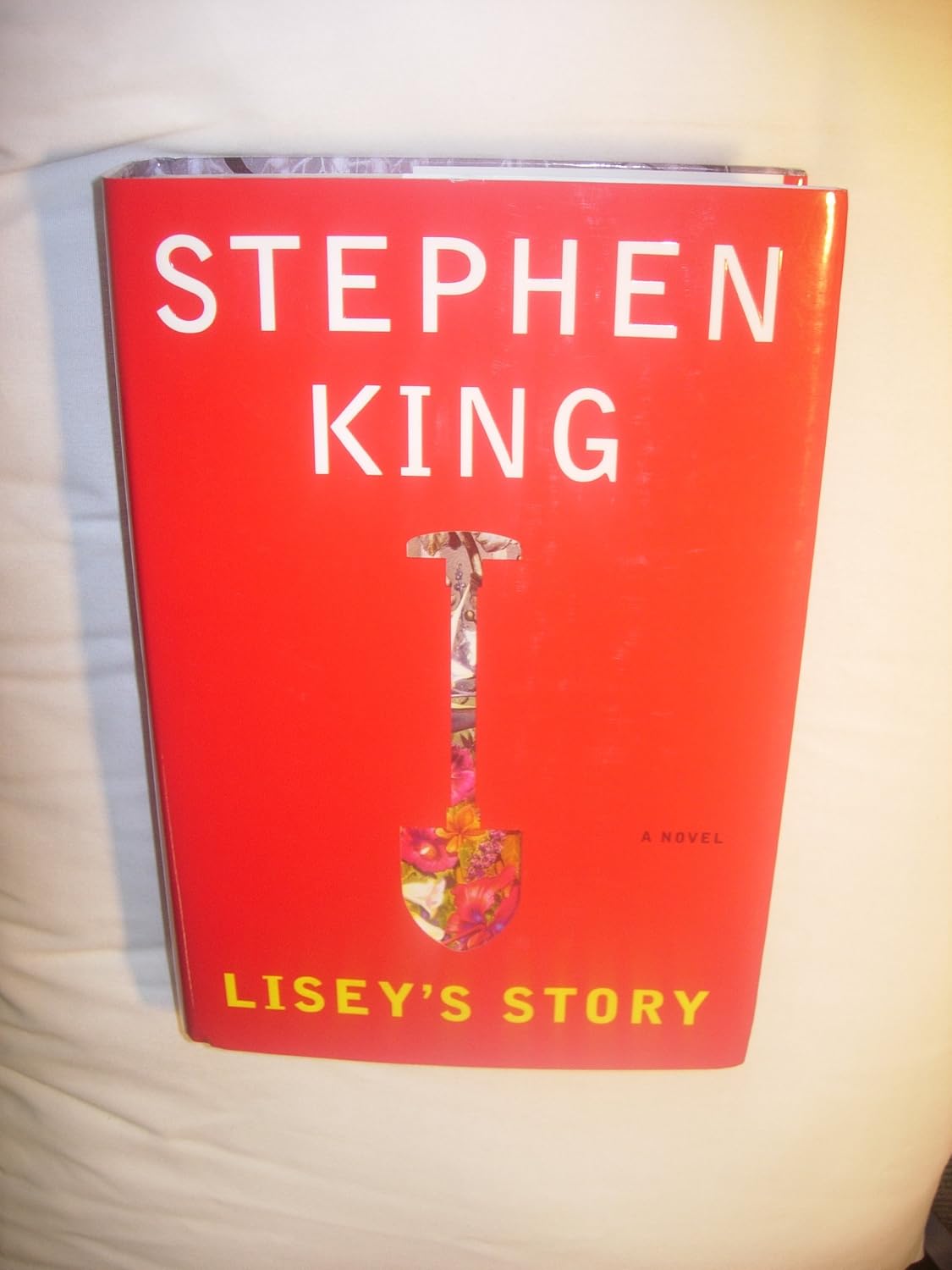
Admit it: You've been a horrible snob about Stephen King. You've rolled your eyes at passengers on the Metro reading "Pet Sematary." You've told your son to put down "Salem's Lot" and get a real book. When King won a lifetime achievement award from the National Book Foundation, you gleefully quoted Harold Bloom's crack about this new "low in the shocking process of dumbing down our cultural life."Well, suck it up. Even that faint praise about how you can appreciate him for being good at "what he does" isn't going to cut it anymore. With Lisey's Story, King has crashed the exclusive party of literary fiction, and he'll be no easier to ignore than Carrie at the prom. His new novel is an audacious meditation on the creative process and a remarkable intersection of the different strains of his talent: the sensitivity of his autobiographical essays, the insight of his critical commentary, the suspense of his short stories and the psychological terror of his novels. (And yes, a few hairy monsters.) They're all evoked here in this moving story about the widow of a famous writer trying to lay her grief to rest.King claims in an afterword that this character -- Lisey -- is not based on his wife, but there's no denying who the famous writer is, and King fanatics will pounce on these personal details like Cujo on a bucket of chicken wings. The story opens two years after the death of Scott Landon, a prolific horror writer almost as popular as King but more critically acclaimed. For months, Lisey has been hounded for access to Scott's papers by "the collectors and the academics who maintained their positions in large part by examining the literary equivalent of navel-lint in each other's abstruse journals; ambitious, overeducated goofs who had lost touch with what books and reading were actually about and could be content to go on spinning straw into footnoted fool's gold for decades on end." (Take that, Dr. Bloom!) Though entering Scott's office is like scratching the scab of her mourning, once Lisey finally starts sorting, boxing and labeling his effects, the work inspires waves of nostalgia. She's drawn back into memories of her 25-year marriage with a brilliant, loving man who was haunted by childhood trauma. But two alarming events disrupt her reverie: First, her sister Amanda suffers a violent relapse in her battle against depression. Then, in the middle of that crisis, an anonymous caller threatens to kill Lisey if she doesn't immediately donate her husband's papers to the University of Pittsburgh. The caller sounds like a kook, but his threat forces her to recall an earlier insane fan who tried to assassinate Scott during a lecture tour.Of course, this is not the first time King has written about the misery of ardent fans. We all have reason to fear zombies and demonic Plymouths, but the world's most popular living writer is especially terrified about the adulation that his gory tales inspire. The word "fan," after all, is just one padded cell away from "fanatic." King delivers a number of self-deprecating cracks here about the benefits of fame and wealth, but when it comes to the dangers of entertaining millions with fantasies of mayhem, he's dead serious.Lisey's Story moves in several different directions at once, but everything that happens seems part of a complicated plan arranged in advance by Scott Landon to show his wife how much he loved her. Lisey finds among his papers a kind of scavenger hunt -- a "bool," he calls it -- that leads her through the major events of their long marriage, "to allow her to face in stages something she couldn't face all at once." In fact, one of the great charms of this novel is King's attention to the private language of affection: the silly phrases, lyrics, puns and pet names that Lisey cherishes as signs of their intimacy.Her battle against Scott's mad scholar-fan lurches erratically from grisly to goofy, but fortunately much of the novel takes place in Lisey's memories as she recalls Scott's desperate courtship and his struggle to explain his father to her. He was a reclusive manic-depressive who loved his sons even as he savaged them. During the most horrific of these tales, when describing his father overcome with "endless swirling bad-gunky," Scott used to revert to his childhood voice. Read this on a bright afternoon: It's emotionally draining, and blood-draining, too -- King at his most psychologically acute, as sympathetic as he is terrifying, wielding a startling blend of affection, pathos and horror.But there's something else lurking in this novel, something very strange, even for Stephen King. At its center, Lisey's Story contains a huge, ungainly metaphor for the source of creative inspiration. It's an otherworldly place that Scott called Boo'ya Moon, a lush garden of delights and dangers, blooming lupines and dark trees, just on the other side of our dimension. (Under its blood-red dust jacket, the book's cover sports a psychedelic painting of Boo'ya Moon.) By concentrating hard, Scott could slip over to this alternate reality to escape his father, recover from his wounds and find fresh ideas. It contains a "pool where we all go down to drink, to swim, to catch a little fish from the edge of the shore; it's also the pool where some hardy souls go out in their flimsy wooden boats after the big ones. It is the pool of life, the cup of imagination." King works this hallucinatory vision hard throughout the novel, but it seems like a metaphor that never met a meaning it didn't like: It's an oasis of healing, but also a place of grave danger; a retreat for receiving insight, but also an island of Lotus Eaters; a sanctuary from harm, but also the realm of a piebald fiend called "the long boy," which is sometimes an embodiment of Scott's depression but other times just a scary monster that eats people.This amorphous metaphor feels like something King has rolled around in his mind for a long time, and his willingness to lay out such an intimate vision is endearing even if it's not entirely coherent. But what works beautifully throughout Lisey's Story is the rich portrait of a marriage and the complicated affection that outlives death. Who would have thought that a man who's spent the last 30 years scaring the hell out of us would produce a novel about the kind of love that carries us through grief? Reviewed by Ron Charles Copyright 2006, The Washington Post. All Rights Reserved.
I. Lisey and Amanda(Everything the Same)1To the public eye, the spouses of well-known writers are all but invisible, and no one knew it better than Lisey Landon. Her husband had won the Pulitzer and the National Book Award, but Lisey had given only one interview in her life. This was for the well-known women's magazine that publishes the column "Yes, I'm Married to Him!" She spent roughly half of its five-hundred-word length explaining that her nickname rhymed with "CeeCee." Most of the other half had to do with her recipe for slow-cooked roast beef. Lisey's sister Amanda said that the picture accompanying the interview made Lisey look fat.None of Lisey's sisters was immune to the pleasures of setting the cat among the pigeons ("stirring up a stink" had been their father's phrase for it), or having a good natter about someone else's dirty laundry, but the only one Lisey had a hard time liking was this same Amanda. Eldest (and oddest) of the onetime Debusher girls of Lisbon Falls, Amanda currently lived alone, in a house which Lisey had provided, a small, weather-tight place not too far from Castle View where Lisey, Darla, and Cantata could keep an eye on her. Lisey had bought it for her seven years ago, five before Scott died. Died Young. Died Before His Time, as the saying was. Lisey still had trouble believing he'd been gone for two years. It seemed both longer and the blink of an eye.When Lisey finally got around to making a start at cleaning out his office suite, a long and beautifully lit series of rooms that had once been no more than the loft above a country barn, Amanda had shown up on the third day, after Lisey had finished her inventory of all the foreign editions (there were hundreds) but before she could do more than start listing the furniture, with little stars next to the pieces she thought she ought to keep. She waited for Amanda to ask her why she wasn't moving faster, for heaven's sake, but Amanda asked no questions. While Lisey moved from the furniture question to a listless (and day-long) consideration of the cardboard boxes of correspondence stacked in the main closet, Amanda's focus seemed to remain on the impressive stacks and piles of memorabilia which ran the length of the study's south wall. She worked her way back and forth along this snakelike accretion, saying little or nothing but jotting frequently in a little notebook she kept near to hand.What Lisey didn't say was What are you looking for? Or What are you writing down? As Scott had pointed out on more than one occasion, Lisey had what was surely among the rarest of human talents: she was a business-minder who did not mind too much if you didn't mind yours. As long as you weren't making explosives to throw at someone, that was, and in Amanda's case, explosives were always a possibility. She was the sort of woman who couldn't help prying, the sort of woman who would open her mouth sooner or later.Her husband had headed south from Rumford, where they had been living ("like a couple of wolverines caught in a drainpipe," Scott said after an afternoon visit he vowed never to repeat) in 1985. Her one child, named Intermezzo and called Metzie for short, had gone north to Canada (with a long-haul trucker for a beau) in 1989. "One flew north, one flew south, one couldn't shut her everlasting mouth." That had been their father's rhyme when they were kids, and the one of Dandy Dave Debusher's girls who could never shut her everlasting mouth was surely Manda, dumped first by her husband and then by her own daughter.Hard to like as Amanda sometimes was, Lisey hadn't wanted her down there in Rumford on her own; didn't trust her on her own, if it came to that, and although they'd never said so aloud, Lisey was sure Darla and Cantata felt the same. So she'd had a talk with Scott, and found the little Cape Cod, which could be had for ninety-seven thousand dollars, cash on the nail. Amanda had moved up within easy checking range soon after.Now Scott was dead and Lisey had finally gotten around to the business of cleaning out his writing quarters. Halfway through the fourth day, the foreign editions were boxed up, the correspondence was marked and in some sort of order, and she had a good idea of what furniture was going and what was staying. So why did it feel that she had done so little? She'd known from the outset that this was a job which couldn't be hurried. Never mind all the importuning letters and phone calls she'd gotten since Scott's death (and more than a few visits, too). She supposed that in the end, the people who were interested in Scott's unpublished writing would get what they wanted, but not until she was ready to give it to them. They hadn't been clear on that at first; they weren't down with it, as the saying was. Now she thought most of them were.There were lots of words for the stuff Scott had left behind. The only one she completely understood was memorabilia, but there was another one, a funny one, that sounded like incuncabilla. That was what the impatient people wanted, the wheedlers, and the angry ones -- Scott's incuncabilla. Lisey began to think of them as Incunks.2What she felt most of all, especially after Amanda showed up, was discouraged, as if she'd either underestimated the task itself or overestimated (wildly) her ability to see it through to its inevitable conclusion -- the saved furniture stored in the barn below, the rugs rolled up and taped shut, the yellow Ryder van in the driveway, throwing its shadow on the board fence between her yard and the Galloways' next door.Oh, and don't forget the sad heart of this place, the three desktop computers (there had been four, but the one in the memory nook was now gone, thanks to Lisey herself). Each was newer and lighter than the last, but even the newest was a big desktop model and all of them still worked. They were password-protected, too, and she didn't know what the passwords were. She'd never asked, and had no idea what kind of electro-litter might be sleeping on the computers' hard drives. Grocery lists? Poems? Erotica? She was sure he'd been connected to the internet, but had no idea where he visited when he was there. Amazon? Drudge? Hank Williams Lives? Madam Cruella's Golden Showers & Tower of Power? She tended to think not anything like that last, to think she would have seen the bills (or at least divots in the monthly house-money account), except of course that was really bullshit. If Scott had wanted to hide a thousand a month from her, he could have done so. And the passwords? The joke was, he might have told her. She forgot stuff like that, that was all. She reminded herself to try her own name. Maybe after Amanda had taken herself home for the day. Which didn't look like happening anytime soon.Lisey sat back and blew hair off her forehead. I won't get to the manuscripts until July, at this rate, she thought. The Incunks would go nuts if they saw the way I'm crawling along. Especially that last one.The last one -- five months ago, this had been -- had managed not to blow up, had managed to keep a very civil tongue about him until she'd begun to think he might be different. Lisey told him that Scott's writing suite had been sitting empty for almost a year and a half at that time, but she'd almost mustered the energy and resolve to go up there and start the work of cleaning the rooms and setting the place to rights.Her visitor's name had been Professor Joseph Woodbody, of the University of Pittsburgh English Department. Pitt was Scott's alma mater, and Woodbody's Scott Landon and the American Myth lecture class was extremely popular and extremely large. He also had four graduate students doing Scott Landon theses this year, and so it was probably inevitable that the Incunk warrior should come to the fore when Lisey spoke in such vague terms as sooner rather than later and almost certainly sometime this summer. But it wasn't until she assured him that she would give him a call "when the dust settles" that Woodbody really began to give way.He said the fact that she had shared a great American writer's bed did not qualify her to serve as his literary executor. That, he said, was a job for an expert, and he understood that Mrs. Landon had no college degree at all. He reminded her of the time already gone since Scott Landon's death, and of the rumors that continued to grow. Supposedly there were piles of unpublished Landon fiction -- short stories, even novels. Could she not let him into the study for even a little while? Let him prospect a bit in the file cabinets and desk drawers, if only to set the most outrageous rumors to rest? She could stay with him the whole time, of course -- that went without saying."No," she'd said, showing Professor Woodbody to the door. "I'm not ready just yet." Overlooking the man's lower blows -- trying to, at least -- because he was obviously as crazy as the rest of them. He'd just hidden it better, and for a little longer. "And when I am, I'll want to look at everything, not just the manuscripts.""But -- "She had nodded seriously to him. "Everything the same.""I don't understand what you mean by that."Of course he didn't. It had been a part of her marriage's inner language. How many times had Scott come breezing in, calling "Hey, Lisey, I'm home -- everything the same?" Meaning is everything all right, is everything cool. But like most phrases of power (Scott had explained this once to her, but Lisey had already known it), it had an inside meaning. A man like Woodbody could never grasp the inside meaning of everything the same. Lisey could explain it all day and he still wouldn't get it. Why? Because he was an Incunk, and when it came to Scott Landon only one thing interested the Incunks."It doesn't matter," was what she'd said to Professor Woodbody on that day five months ago. "Scott would have understood."3If Amanda had asked Lisey wh...
Find it on
AmazonNo videos available yet.
No news articles linked to this title yet.
No tags available.

Overall
Overall rating of the media
Atmosphere
How immersive and tense is the atmosphere
Gore
Level and quality of gore/violence
Story
Quality of the storyline and plot
Writing
Quality of the written content
Character Development
Depth and growth of characters
Pacing
Flow and timing of the narrative