BOOK
0
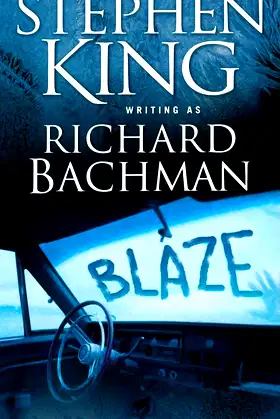
The last of the Richard Bachman novels, recently recovered and published for the first time. Stephen King's "dark half" may have saved the best for last.A fellow named Richard Bachman wrote Blaze in 1973 on an Olivetti typewriter, then turned the machine over to Stephen King, who used it to write Carrie. Bachman died in 1985 ("cancer of the pseudonym"), but in late 2006 King found the original typescript of Blaze among his papers at the University of Maine's Fogler Library ("How did this get here?!"), and decided that with a little revision it ought to be published.Blaze is the story of Clayton Blaisdell, Jr. -- of the crimes committed against him and the crimes he commits, including his last, the kidnapping of a baby heir worth millions. Blaze has been a slow thinker since childhood, when his father threw him down the stairs -- and then threw him down again. After escaping an abusive institution for boys when he was a teenager, Blaze hooks up with George, a seasoned criminal who thinks he has all the answers. But then George is killed, and Blaze, though haunted by his partner, is on his own. He becomes one of the most sympathetic criminals in all of literature. This is a crime story of surprising strength and sadness, with a suspenseful current sustained by the classic workings of fate and character -- as taut and riveting as Stephen King's The Girl Who Loved Tom Gordon.
Written circa 1973, this trunk novel, as Bachman's double (aka Stephen King) refers to it in his self-deprecating foreword, lacks the drama and intensity of Carrie and the horror opuses that followed it. Still, this fifth Bachman book (after 1996's The Regulators) shows King fine-tuning his skill at making memorable characters out of simple salt-of-the-earth types. Clayton Blaze Blaisdell has fallen into a life of delinquency ever since his father's brutal abuse rendered him feebleminded. King alternates chapters recounting Blaze's past mistreatment at a series of Maine orphanages and foster homes with Blaze's current plans to follow through on a kidnapping scheme plotted by his recently murdered partner in crime, George Rackley. Blaze talks to George as though he's still there, and the conversations give the tale tension, with Blaze coming across as a pitiable and surprisingly sympathetic contrast to prickly George. Despite its predictability, this diverting soft-boiled crime novel reflects influences ranging from John Steinbeck to James M. Cain. Also included is a previously uncollected story, Memory, the seed of King's forthcoming novel Duma Key. (June) Copyright © Reed Business Information, a division of Reed Elsevier Inc. All rights reserved.
*Starred Review* Blaze—Clayton Blaisdell Jr.—is a big dummy, very big: six-seven, 270. But not exactly very dumb. He was a smart little boy until his drunken father threw him downstairs three times in a row. He relearned to read a bit, mostly comic books, but was thereafter an otherwise learning-challenged ward of the state with a horrendous dent in his forehead. Now a mid-twenties adult, he has just lost his bosom buddy and partner in petty cons, George, who still speaks to him somehow, especially about the big score, the one to retire on. Blaze realizes that George isn't really haunting him; in fact, Blaze possesses an excellent, though highly selective, memory. In honor of George, he decides to do the big one, the kidnapping of a wealthy couple's baby. He succeeds, albeit imperfectly enough that the state cops and FBI know whodunit within a day, and he surprises himself by bonding with the infant, which for readers makes the hunt for Blaze an Alfred Hitchcocklike exercise in moral ambivalence. It's impossible not to root for Blaze, especially since Bachman flashes back copiously and with maximal sympathy to the damaged man's past. Stephen King, who "buried" Bachman in 1985, here revamps a 1973 manuscript by his alter ego that he says is something of an homage to James T. Farrell, Jim Thompson, and Steinbeck's Of Mice and Men. Powerful and moving, it's a worthy tribute, especially to Steinbeck. Olson, Ray Copyright © American Library Association. All rights reserved
Blaze by Richard BachmanForeword by Stephen KingFull DisclosureDear Constant Reader,This is a trunk novel, okay? I want you to know that while you've still got your sales slip and before you drip something like gravy or ice cream on it, and thus make it difficult or impossible to return. It's a revised and updated trunk novel, but that doesn't change the basic fact. The Bachman name is on it because it's the last novel from 1966-1973, which was that gentleman's period of greatest productivity. During those years I was actually two men. It was Stephen King who wrote (and sold) horror stories to raunchy skin-mags like Cavalier and Adam, but it was Bachman who wrote a series of novels that didn't sell to anybody. These included Rage, The Long Walk, Roadwork, and The Running Man. All four were published as paperback originals.Blaze was the last of those early novels?the fifth quarter, if you like. Or just another well-known writer's trunk novel, if you insist. It was written in late 1972 and early 1973. I thought it was great while I was writing it, and crap when I read it over. My recollection is that I never showed it to a single publisher -- not even Doubleday, where I had made a friend named William G. Thompson. Bill was the guy who would later discover John Grisham, and it was Bill who contracted for the book following Blaze, a twisted but fairly entertaining tale of prom-night in central Maine. I forgot about Blaze for a few years. Then, after the other early Bachmans had been published, I took it out and looked it over. After reading the first twenty pages or so, I decided my first judgment had been correct, and returned it to purdah. I thought the writing was okay, but the story reminded me of something Oscar Wilde once said. He claimed it was impossible to read "The Old Curiosity Shop" without weeping copious tears of laughter. So Blaze was forgotten, but never really lost. It was only stuffed in some corner of the Fogler Library at the University of Maine with the rest of their Stephen King/Richard Bachman stuff.Blaze ended up spending the next thirty years in the dark. And then I published a slim paperback original called The Colorado Kid with an imprint called Hard Case Crime. This line of books, the brainchild of a very smart and very cool fellow named Charles Ardai, was dedicated to reviving old "noir" and hardboiled paperback crime novels, and publishing new ones. The Kid was decidedly softboiled, but Charles decided to publish it anyway, with one of those great old paperback covers. The whole project was a blast?except for the slow royalty payments. About a year later, I thought maybe I'd like to go the Hard Case route again, possibly with something that had a harder edge. My thoughts turned to Blaze for the first time in years, but trailing along behind came that damned Oscar Wilde quote about "The Old Curiosity Shop." The Blaze I remembered wasn't hardboiled noir, but a three-handkerchief weepie. Still, I decided it wouldn't hurt to look. If, that was, the book could even be found. I remembered the carton, and I remembered the squarish type-face (my wife Tabitha's old college typewriter, an impossible-to-kill Olivetti portable), but I had no idea what had become of the manuscript that was supposedly inside the carton. For all I knew, it was gone, baby, gone. It wasn't. Marsha, one of my two valuable assistants, found it in the Fogler Library. She would not trust me with the original manuscript (I, uh, lose things), but she made a Xerox. I must have been using a next-door-to-dead typewriter ribbon when I composed Blaze, because the copy was barely legible, and the notes in the margins were little more than blurs. Still, I sat down with it and began to read, ready to suffer the pangs of embarrassment only one's younger, smart-assier self can provide.But I thought it was pretty good -- certainly better than Roadwork, which I had, at the time, considered mainstream American fiction. It just wasn't a noir novel. It was, rather, a stab at the sort of naturalism-with-crime that James M. Cain and Horace McCoy practiced in the thirties. I thought the flashbacks were actually better than the front-story. They reminded me of James T. Farrell's Young Lonigan trilogy and the forgotten (but tasty) Gas-House McGinty. Sure, it was the three Ps in places, but it had been written by a young man (I was twenty-five) who was convinced he was WRITING FOR THE AGES.I thought Blaze could be re-written and published without too much embarrassment, but it was probably wrong for Hard Case Crime. It was, in a sense, not a crime novel at all. I thought it could be a minor tragedy of the underclass, if the re-writing was ruthless. To that end, I adopted the flat, dry tones which the best noir fiction seems to have, even using a type-font called American Typewriter to remind myself of what I was up to. I worked fast, never looking ahead or back, wanting also to capture the headlong drive of those books (I'm thinking more of Jim Thompson and Richard Stark here than I am of Cain, McCoy, or Farrell). I thought I would do my revisions at the end, with a pencil, rather than editing in the computer, as is now fashionable. If the book was going to be a throwback, I wanted to play into that rather than shying away from it. I also determined to strip all the sentiment I could from the writing itself, wanted the finished book to be as stark as an empty house without even a rug on the floor. My mother would have said "I wanted its bare face hanging out." Only the reader will be able to judge if I succeeded.If it matters to you (it shouldn't -- hopefully you came for a good story, and hopefully you will get one), any royalties or subsidiary income generated by Blaze will go to The Haven Foundation, which was created to help freelance artists who are down on their luck. One other thing, I guess, while I've got you by the lapel. I tried to keep the Blaze time-frame as vague as possible, so it wouldn't seem too dated. It was impossible to take out all the dated material, however; keeping some of it was important to the plot. If you think of this story's time-frame as "America, Not All That Long Ago," I think you'll be okay.May I close by circling back to where I started? This is an old novel, but I believe I was wrong in my initial assessment that it was a bad novel. You may disagree?but "The Old Curiosity Shop" it ain't. As always, Constant Reader, I wish you well, I thank you for reading this story, and I hope you enjoy it. I won't say I hope you mist up a little, but -- Yeah. Yeah, I will say that. Just as long as they're not tears of laughter.Stephen King (for Richard Bachman)Sarasota, FloridaJanuary 30th, 2007
Find it on
AmazonNo videos available yet.
No news articles linked to this title yet.

Overall
Overall rating of the media
Atmosphere
How immersive and tense is the atmosphere
Gore
Level and quality of gore/violence
Story
Quality of the storyline and plot
Writing
Quality of the written content
Character Development
Depth and growth of characters
Pacing
Flow and timing of the narrative