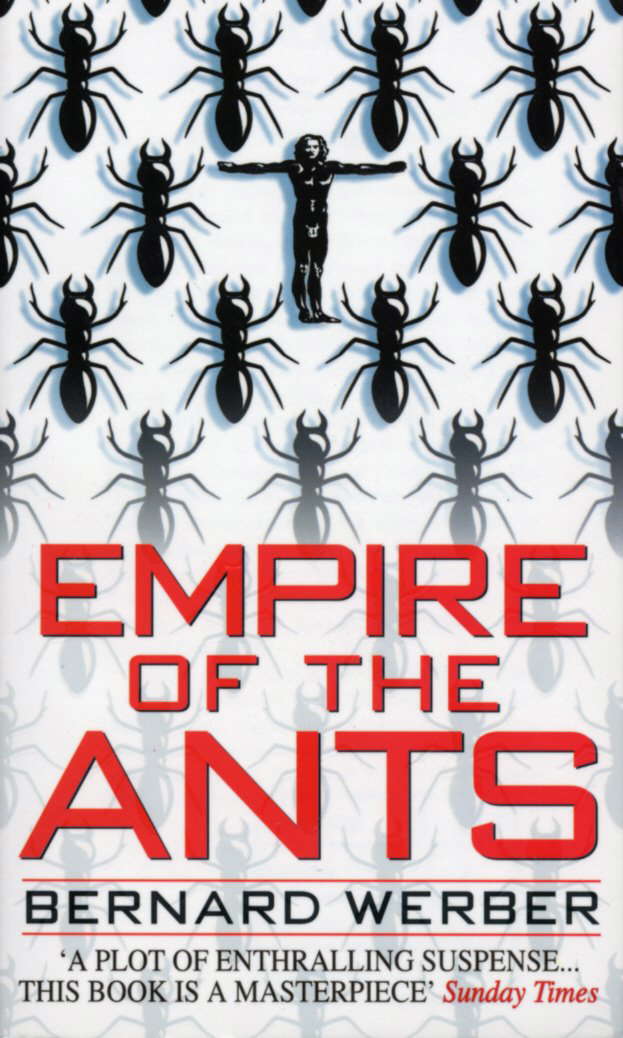
Ants came to this planet long before man. Since then they have developed one of the most intricate civilizations imaginable – a civilization of great richness and technological brilliance. During the few seconds it takes you to read this sentence, some 700 milli0on ants will be born on earth…Edmond Wells had studied ants for years: he knew of the power which existed in their hidden world. On his death, he leaves his apartment to his nephew Jonathan with one proviso: that he must not descend beyond the cellar door. But when the family’s dog escapes down the cellar steps, Jonathan has little alternative but to follow. Innocently he enters the world of the ant, whose struggle for existence forces him to reassess man’s place in the cycle of nature. It is an experience that will alter his life for ever…Empire of the Ants is an extraordinary achievement. It takes you inside the ants’ universe and reveals it to be a highly organised world, as complex and relentless as human society and even more brutal.
Amazon.com Review
In the early 21st century, in a Paris rapidly turning tropical thanks to global warming, Jonathan Wells tries to get to the bottom (as it turns out, quite literally) of his Uncle Edmond's obsession with ants. Jonathan and his family have been left Edmond's basement apartment; their benefactor's sole request is, "ABOVE ALL, NEVER GO DOWN INTO THE CELLAR." Meanwhile, in the great city of Bel-o-kan, a reproductive ant, the 327th male, is fighting for survival, having had his olfactory Identikit stripped by traitors of his own tribe. Both males--human and ant--are determined to solve their separate quandaries, and Bernard Werber cleverly juxtaposes their adventures and those of their survivors. Their stories must somehow be linked, but it will be hundreds of imaginative and educational pages before we come upon the solution. Empire of the Ants was first published in France in 1991 and eventually in England in 1996 in Margaret Rocques's spryly formal translation. ("Ants are not especially well-known for their conviviality, especially when advancing in formation, armed to the antennae.") Werber has studied formic civilization for 15 years, and his observations more than pay off. We knew they were industrious little things, but why did no one ever tell us about their powers of invention, accommodation (in both senses of the word!), communication, and above all determination? In fact, as the narrative makes increasingly clear, ants seem to have a lot more going on than the pale pink things stomping around above them, who seem doltish in comparison. Of course, as far as the creepy crawlies are concerned, humans are "so strange you could neither see nor smell them. They appeared suddenly out of the sky and everyone died." Empire of the Ants is by turns frightening and very funny. As more and more humans disappear down the cellar of 3, rue des Sybarites, we come to identify with the six-legged of the world. Werber, too, must have tired of his Homo sapiens, since the ant sections increase in length as the human ones decrease. No matter. Who would miss the perils of the young queen who tries to found her colony on a strange impervious hill--which turns out to be a tortoise--or the hilarious scene in which a spider swathes the 56th female in inescapable silk, only to be distracted first by a mayfly (they have shorter shelf lives than ants, who can be eaten slowly alive over an entire week) and then by a younger arachnid: "Her way of vibrating was the most erotic thing the male had ever felt. Tap tap taptaptap tap tap taptap. Ah, he could no longer resist her charms and ran to his beloved (a mere slip of a thing only four moults old, whereas he was already twelve). She was three times as big as he, but then he liked his females big."
From Library Journal
"Don't go into the cellar" is the warning given the Wells family as they move into the dingy Paris flat inherited from Jonathan's Uncle Edmund. But when the family dog disappears down the basement steps, the Wellses follow, one by one, into the mysterious darkness below. Uncle Edmund was an eccentric author and scientist whose particular passion was ants. Thus, it must follow that the mystery of the Wells's basement lies in the parallel universe of an exotic ant kingdom. Struggling to rebuild what was once a vast empire in the face of the terrors of contemporary human society, the ants are compelled to deal with cars, tools, and other technopredators. The sf movies of the 1950s are immediately brought to mind here. The one-dimensional humans definitely take back seat to the anthropomorphized ants as characters in this novel of survival. Werber tells us much more about the intelligent and highly structured world of the ant than we may care to know. Readers captivated by Richard Adam's Watership Down might be attracted by this premise but will quickly tire of the novel's uneven characterization and didactic style. Not recommended.?Susan Gene Clifford, Aerospace Corp., El Segundo, Cal.Copyright 1998 Reed Business Information, Inc.
From Booklist
What if 007 were an ant? He would be 103,683rd, the hero of this book, named for her birth order. She battles and escapes, using creative weapons and fighting theory true to ant nature. 103,683rd and other ants are investigating a secret weapon that smells strangely like rocks and is only known about by ants. Along the way, they survive wars between neighboring anthills, birds, frogs, and other insects trying to eat or enslave them. Set in a less satisfying story about humans discovering a mysterious basement laboratory that their reclusive uncle built to contact ants, the ants' story is fascinating for its ant facts, ant's-eye perspective, and the brave assumption that ant's lives are as attention-grabbing as any action movie. Like Watership Down or The Hobbit, Werber's book creates another world so like ours and so finely detailed that the reader feels a part of it. Keep your antennae out for this one. Kevin Grandfield
From the Publisher
"This book, to put the matter quite simply, is a masterpiece. . . .Exhilaratingly thought-provoking."--The Sunday Times (London)"A marvel of warped imagination and offbeat suspense."--British Esquire"Like Watership Down, to which it will inevitably be compared, Werber's astonishing first novel invites readers into a highly imagined animal world."--Publishers Weekly(starred review)
From the Inside Flap
stunning international bestseller in the tradition of Watership Down but with a dark, original twist. Unique, daring, and unforgettable, it tells the story of an ordinary family who accidentally threaten the security of a hidden civilization as intelligent as our own--a colony of ants determined to survive at any cost....Jonathan Wells and his young family have come to the Paris flat at 3, rue des Sybarites through the bequest of his eccentric late uncle Edmond. Inheriting the dusty apartment, the Wells family are left with only one warning: Never go down into the cellar.But when the family dog disappears down the basement steps, Jonathan follows--and soon his wife, his son, and various would-be rescuers vanish into its mysterious depths.Meanwhile, in a pine stump in a nearby park, a vast civilization is in turmoil. Here a young female from the russet ant nation of Bel-o-kan learns that a strange new weapon has been killing off her co
From the Back Cover
Here is the stunning international bestseller in the tradition of "Watership Down but with a dark, original twist. Unique, daring, and unforgettable, it tells the story of an ordinary family who accidentally threaten the security of a hidden civilization as intelligent as our own--a colony of ants determined to survive at any cost.... Jonathan Wells and his young family have come to the Paris flat at 3, rue des Sybarites through the bequest of his eccentric late uncle Edmond. Inheriting the dusty apartment, the Wells family are left with only one warning: "Never go down into the cellar. But when the family dog disappears down the basement steps, Jonathan follows--and soon his wife, his son, and various would-be rescuers vanish into its mysterious depths. Meanwhile, in a pine stump in a nearby park, a vast civilization is in turmoil. Here a young female from the russet ant nation of Bel-o-kan learns that a strange new weapon has been killing off her comrades. To find out why, she enlists the help of a warrior ant, and the two set off on separate journeys into a harsh and violent world. It is a world where death takes many forms--savage birds and voracious lizards, warlike dwarf ants and rapacious termites, poisonous beetles and, most bizarre of all, the swift, murderous, giant guardians of the edge of the world: cars. Yet the end of the female's desperate quest will be the eerie secret in the cellar at 3, rue des Sybarites--a mystery she must solve in order to fulfill her special destiny as the new queen of her own great empire. But to do so she must first make unthinkable communion with the most barbaric creatures of all. "Empire of the Ants is a brilliant evocationof a hidden civilization as complex as our own and far more ancient. It is a fascinating realm where boats are built of leaves and greenflies are domesticated and milked like cows, where citizens lock antennae in "absolute communication" and fight wars with precisely coordinated armies using sprays of glue and acids that can dissolve a snail. Not since "Watership Down has a novel so vividly captured the lives and struggles of a fellow species and the valuable lessons they have to teach us. "From the Hardcover edition.
Excerpt. © Reprinted by permission. All rights reserved.
On the thirty-fifth floor, the fine covering of twigs produced a stained-glass window effect. The sun's rays sparkled as they passed through it, then fell like a rain of stars on the ground. This was the city's solarium, the "factory" producing Belokanian citizens. It was baking hot there, 38 C, as was only to be expected. The solarium faced due south to catch the heat of the sun for as long as possible. Sometimes, under the catalytic effect of the twigs, the temperature rose to as high as 50 C. Hundreds of legs were busying themselves. Nurses, the most numerous caste here, were piling up the eggs Mother laid. Twenty-four piles formed a heap and twelve heaps made a row. The rows stretched away into the distance. When a cloud cast a shadow, the nurses moved the piles of eggs. The youngest had to be kept nice and warm. "Moist heat for eggs, dry heat for cocoons" was an old ant recipe for healthy babies. On the left, workers responsible for maintaining the temperature were piling up pieces of black wood to accumulate heat and fermented humus to produce it. Thanks to these two "radiators," the solarium remained at a constant temperature of between 25 C and 40 C, even when it was only 15 C outside. Gunners were patrolling the area. If a woodpecker messed with them, there'd be trouble. . . . On the right were older eggs, further advanced in the long metamorphosis from egg to adult. With time and the nurses' licking, the little eggs grew bigger and turned yellow. After one to seven weeks, they turned into golden-haired larvae. That, too, depended on the weather. The nurses were concentrating hard, sparing neither antibiotic saliva nor attention. Not a speck of dirt must be allowed to sully the larvae. They were so fragile. Even conversational pheromones were kept to a strict minimum. Help me carry them into the corner...Look out, your pile's going to fall over... A nurse was moving a larva twice her length, a gunner for sure. She put the "weapon" down in a corner and licked it. At the center of this vast incubator were heaps of larvae on whose bodies the ten segments were beginning to show. They were howling to be fed, waving their heads and legs about and stretching their necks until the nurses let them have a little honeydew or insect meat. After three weeks, when they had "matured" nicely, the larvae stopped eating and moving. They used this lethargic phase to prepare for the coming effort, gathering their energies to secrete the cocoons that would transform them into nymphs. The nurses then carted the big bundles off to a nearby room filled with dry sand to absorb the moisture from the air. "Moist heat for eggs, dry heat for cocoons" could never be repeated often enough. Inside this incubator, the cocoons turned from bluish-white to yellow to gray to brown, like the philosopher's stone but in reverse, while a miracle took place inside the shells. Everything changed, the nervous system, respiratory and digestive apparatus, sense organs and shell. Once inside the incubator, the nymphs swelled within a few days as the eggs cooked and the big moment drew near. When a nymph was on the point of hatching, it was pulled aside, along with others in the same state. Nurses carefully pierced the veil of the cocoon, releasing an antenna or leg, until a kind of white ant was freed to tremble and sway. Its soft, clear chitin turned red after a few days, like that of all the Belokanians. In the midst of this whirlwind of activity, 327th was unsure whom to address. He threw out a little scent to a nurse who was helping a newborn ant take its first steps. Something serious is happening. The nurse did not even turn her head in his direction. She gave off a barely perceptible scent sentence: Hush. Nothing is more serious than birth. A gunner jostled him, hitting him gently with the clubs at the end of her antennae. Tap, tap, tap. Stop bothering people. Move on. His energy level was all wrong, the messages he emitted unconvincing. If only he had 56th's gift for communication! He tried again anyway with other nurses, but they ignored him completely. He ended up wondering whether his mission was really as important as he thought. Perhaps Mother had been right. Other tasks had priority. Perpetuating life rather than starting a war, for example. While he was thinking this strange thought, a jet of formic acid grazed his antennae. A nurse had dropped the cocoon she was carrying and fired at him. Fortunately, she had not aimed properly. He rushed to catch up with the terrorist but she had already darted off into the first nursery, knocking over a pile of eggs to block his way. The shells broke, letting out a transparent liquid. She had destroyed some eggs! What had gotten into her? There was panic, with nurses running in all directions, anxious to protect the gestating generation. Realizing he could not catch up with the fugitive, the 327th male tipped his abdomen under his thorax and took aim, but before he could fire she was struck down by a gunner who had seen her knock over the eggs. A crowd formed around the charred body. When 327th bent his antennae over it, he was no longer in any doubt. It smelled of rock.
About the Author
Bernard Werber is a scientific journalist who has studied ants for fifteen years as an avocation. He lives in Paris.
News
Horror Society
•
3 months ago
Eureka Entertainment announces the UK Blu-ray debut of EMPIRE OF THE ANTS, a cult 1970s eco-horror inspired by H.G. Wells and starring Joan Collins. A...
Activity
No activity on this title yet.
Log in or create an account to rate it, mark it observed, and post scary scenes.