

BOOK
0
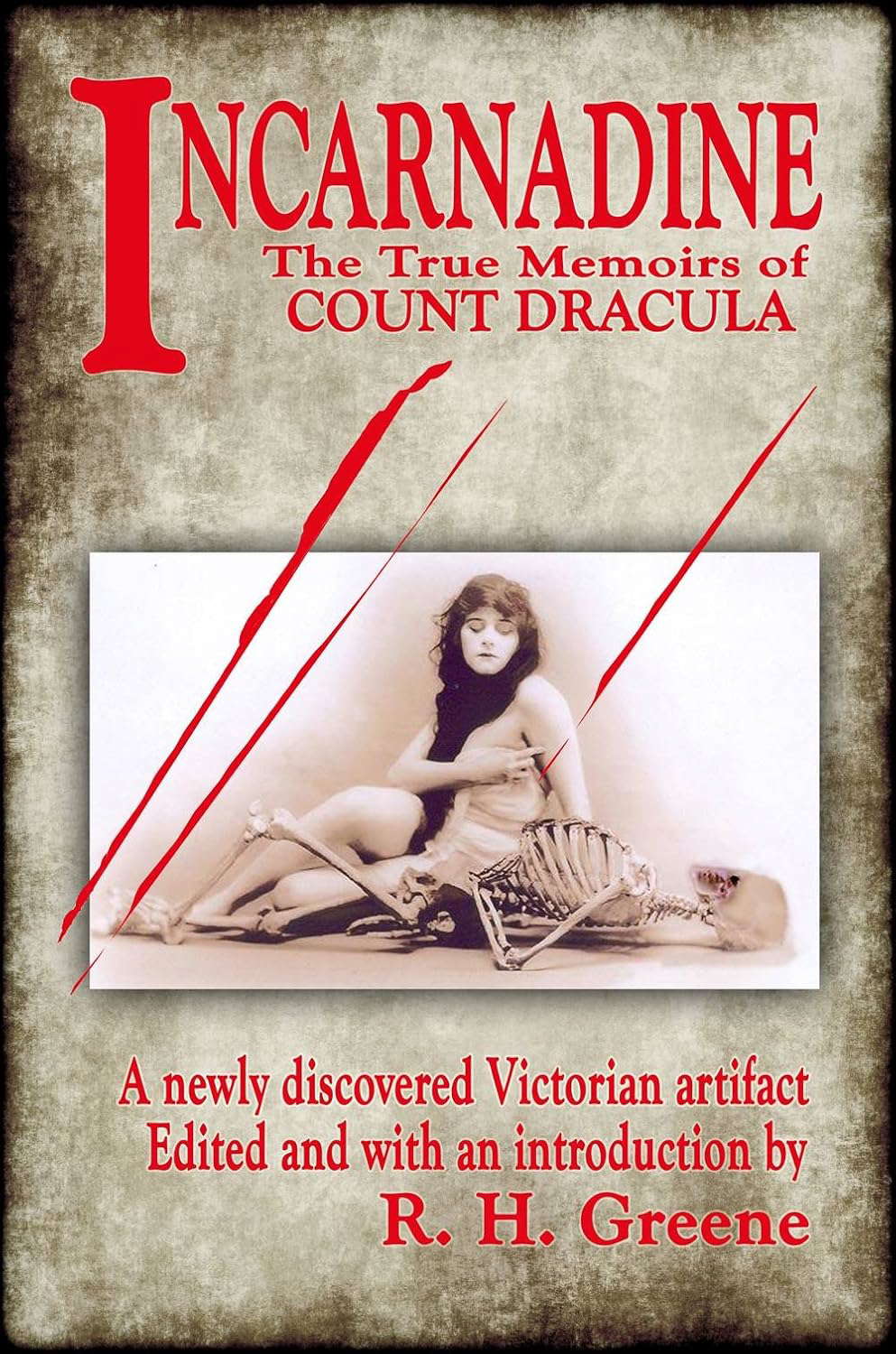
Bram Stoker's most terrifying creation tells his own story in Incarnadine: The True Memoirs of Count Dracula. Author R. H. Greene vividly reimagines the harrowing and sensual Dracula mythos as a first person memoir written by Dracula himself. In this first of two volumes, the Medieval origins of Dracula and his three brides are chronicled using elements drawn from Slavic and pre-Christian religious traditions. Horror, wonder, violence and romance combine to reinvent one of literature's most fascinating characters for the modern era.Equally a historical adventure and a rumination on mortality and religion, Incarnadine offers a vibrant, picaresque view of the broad social tapestry of Eastern Europe in the late Middle Ages. The novel concludes with the first meeting between Dracula and Stoker protagonist Jonathan Harker, setting the stage for a lively reinvention of Stoker's Victorian classic in Memoirs, Volume Two.http://www.draculamemoirs.blogspot.com
INCARNADINE: The True Memoirs of COUNT DRACULAVOLUME ONEiUniverse, Inc.Copyright © 2009 R. H. GreeneAll right reserved.ISBN: 978-1-4401-5945-9Chapter One Of my amoral start in life, there are many things I could say. I, who have been called monstrous and a voluptuary on the basis of my latter-day repute, was far more blemished and far more of an affront to the Divine Order of things as they actually are in those, my earliest days of worldliness and carnality. But it was not worldliness or carnality that separated me from the vast and invisible connections between all things, for to live within the body given us is no sin. I lived inside that skin, drew breaths that tasted of grass, air, and mud, and was in every sensual aspect fully human, as you are. But I was thoughtless also, callow and selfish, a man of brisk violence and squalid pleasure, without shade or gradation or concern for any other than myself. Such is the life of a soldier. In those days, the Ottoman Yoke was only partly fastened, and so the war launched at Constantinople on a fateful Tuesday in 1453 continued to rage everywhere, unslaked and unabated. As a condottiere, I served whoever paid me best or whoever allowed me to set my own wage in pillage from the spoils of war-my preferred form of salary. I sacked for the Turk and the Bulgar, looted for the Rumanian and the Goth, and made friends and slew enemies on either side of the battlefield, on one frenzied occasion even managing to take up opposing colors within a single day. In my cynicism, I had few close acquaintances, all of my associations being opportunistic and therefore changeable. But there was one man from my own village who had been close to me in childhood, and whom I valued as a friend. This was Malaga, a bluff and laughing giant of fearsome mien in battle and passionate religious devotion away from it. Had we not formed our relationship in childhood before time worked its changes on our personalities, I doubt either of us would have felt the fealty we did. Where my loyalties were a product of the marketplace, Malaga's were immutably dedicated to a single flag and the One True Cross. But despite this schism in our thinking, our love was like brother for brother, unchanging and true. As we were sometimes on the same side in the hostilities, we would generally seek each other's company where we could. We also had a standing agreement that, if possible, neither of us would die by the other man's hand. Malaga was appalled and fascinated by the Turks and wanted to know my personal impressions of them from my time in their service. Was the God they worshipped the same as the Christian one? I told him that, in my understanding, it was. If that was so, how could they justify consuming the flesh of Christian babies? I told him that, to my knowledge, this was rumor and conjecture created to rally public sentiment, with no basis in fact. Aside from aversions to mead and pig meat, they had no dietary irregularities. "Well," said Malaga, "if not to keep themselves supplied with Christian children, why do they make war on us, so far from their home?" As one who has known war at close quarters, I should here interject some statement as to my idea of its theory and practice, for no subject in all of human discourse has been treated to so much distortion and false romanticism. This is understandable, since it is a very unnatural thing to ask a man to put himself into a context where his death or mutilation is almost a certainty; so his eyes must be wrapped in waving banners and his ears deafened by applause and trumpets lest his knees buckle at the first clear indication of just how completely he has put his foot wrong. More than a few knees buckle anyway, despite the circuses put on in their honor, and the men attached to them are given the defamatory label of coward for their trouble, instead of a sobriquet more reflective of their instinctive wisdom. What passes for bravery on the battlefield is often actually a lack of imagination, for the bravest soldier is one who cannot imagine himself dead. He can imagine his loved ones praying over his corpse, and the lamentation of women who have passed too quickly through his hands. If ethereal, he can imagine himself as a poem; if patriotic, he can imagine some dim monument with a flag fluttering over it where he will live on as a figure of stone. But in this context his lifeless form becomes a sort of stage prop allowing him, while still alive, to savor the regret and remorse that will afflict others in the unlikely event that his personal drama terminates in the heroic tragedy he has been instructed to both avert his eyes from and to anticipate. All this is a way for the soldier to imagine a story that continues to include him after he has left the stage. What he cannot imagine-and I say this as one even more familiar with death than with war-is the dead's total unresponsiveness, their unyielding disinterest. To die is not just to cease to be, but to un-become. So why make war, an activity whose most immediate by-product is an un-becoming of a massive type? It would be too facile to simply cite the obvious motivations of greed and a scarcity of resources, though these certainly have their part in the deliberations that occur in the unbreathable air where nations make decisions of polity. The real allure of warfare, at least to the warrior in the field, is that it grants him an unholy dispensation, a residency in another country where everything proscribed by the crimping standards of goodness becomes not just permissible but desirable. The soldier metes out murder as casually as you or I might shop for vegetables. If he helps take a city, everything it contains, including its inhabitants, becomes his to do with as he will, and so rape and casual sadism are added to his fearsome repertoire. He may steal as long as it's from his foe, or set whole villages to the torch merely to warm his hands. That scaly atavism in every human heart, so thwarted by the cautious and deliberate tempo of ordinariness, is taken out of its box and poked with a stick until it roars and lunges and he himself becomes that monster in its most vivid and enlivened form. The warrior gets all this and the circuses besides, telling him in endless repetition that his actions are righteous and good, and that his many sins and slaughters are heroisms. I could not have delivered such a sermon to Malaga, of course, but as one who has been maligned down the long years as a fiend and an ogre, I find it appropriate to place it here. For you, gentle Reader, will bear witness to my centuries of wantonness, and though my story is indeed steeped in horrors, I promise you they will not amount to the despoiling work of one middling squadron on an indolent day in the field. To Malaga's question of Turkish motivation, I merely said, "Treasure and a greater access to the sea," and then we said our goodnights and went to sleep. Chapter Two It was hard not to notice the change in Malaga the next time we raised our swords on the same side of the field, for he was thinner, more sadistic in his battlefield actions, and far less jovial at camp. The source of the change was easy to trace. Not only had we been steeped for years in daily brutalities, but also the general tendency of the war was unavoidable: the Turks were going to win. This left Malaga with a conundrum. On the one hand, he was a Christian and a patriot, and could not deviate from these commitments without stripping the patina of nobility from his previous actions and revealing them as the cruelties they were. Understandably, this was something he was unprepared to do. On the other hand, the noble Turks had an unpleasant tendency to execute every Christian they captured, in the nasty but prudent belief this would prohibit the prisoners from taking up further arms against them. And while Malaga was unshakable in the belief that he would one day see God and lift his voice with the Choir Eternal, he was in no hurry to commit their songs to memory. It did not help his pessimistic mood that I had told him as a courtesy this might be our last collaboration in slaughter, as I would most likely spend the rest of the war on the Ottoman side, where the looting and pillaging was becoming distinctly more reliable as a source of livelihood. You must here consider the mindset of the medieval peasant, which may be alien to you. It is as unsubtle and tactile as the hundred daily chores it takes to tease a crop out of even the smallest plot of land-the product of a closed process where things are placed in the ground, are attended to regularly, flourish, and are cut down. So preoccupied is the peasant by the actual he has no space in him for the reflective, and so even philosophical abstractions are rendered in his outlook as completely tangible-fungible goods to be marketed in the event of a pressing necessity. It was therefore not especially extraordinary when Malaga queried me about my religious standing under the Turks (I swore an insincere oath to their Prophet whenever I fought on that side) and then suggested that we temporarily swap our religions. This was an actual custom of the time, and it illustrates perfectly the literal-mindedness of peasant thinking. When I fought with the Turks, I was a Muslim and thereby sheltered from their religious slaughters when the battle was decided for their side. I was also a member of their army and thereby due my portion of glory and treasure in the event of a victory. In the peasant mind, I had two forms of protection against the Ottoman scimitar, and was only in need of one. This was an ideal situation for a mutually beneficial bit of barter. Malaga recommended a temporary transaction, whereby he would become a covert Islamist for the duration of the war and I would be the clandestine carrier of his rather more burnished and habituated Christianity. This would also extend some small protections to me as well, for in the increasingly unlikely event of my capture by Malaga's side, I would face a ragged and depleted but still well-armed foe that had proved no less inventive than the Turks in his religious butcheries. I asked Malaga to describe his theology for me so I could see what kind of bargain he was offering. "Well," he said, "there's this big fellow and a little one, and they are one thing, because to worship more than one thing the way our grandfathers did is wrong. The little fellow is a magician-he can make wine without grapes, I remember that, and wouldn't we all like to know the secret there, ho? "In the end, things get good and bloody, and the little fellow won't raise a hand over it, being small and therefore meek. So the big fellow builds a great oven, and they stuff all their enemies in it and build a good fire. Ho! Oh yes, and there's a white bird comes into it somewhere-he's also one thing. I wish I could say more of him but being a bird he never held my interest." After so learned a discourse, there was no other choice. I told Malaga I would gladly make the trade and that such an intelligible creed would be a bargain at twice the price. Then, in what I recognize now as both a provincial travesty of Christian ritual and a strange foreshadowing of my future path, we got out our knives and a dirty wooden bowl and sealed the bargain with the accepted ceremony: We drank each other's blood. In this way I took Malaga's faith and draped it over my shoulders as lightly as a widow puts on her evening shawl. And the arrangement felt weightless, as all spiritual transactions should. Chapter Three If the scales tip far enough in one direction, the fun goes out of a war. Soon the towns are depleted, offering little in the way of proceeds that aren't scraggly, diseased, and thin. Instead of defending themselves, villages shower you with gratitude for taking them, and then ask you for provisions. The armies pitted against you start to run out of men, and one fine morning you find yourself wielding your axe without enthusiasm against little boys and grandfathers. And where's the sport in that? It was toward the end of one of these depressing days late in the struggle that we on the Ottoman side took what surely had to be the last substantial force that would ever be arrayed against us: some thousands of ill-kempt warriors who, though starving and without a visible command structure, gave every appearance of being battle-hardened men. The Pasha in command of our legions had long since grown bored with butchery. He barely looked up as he gave the command for us to form up for the obligatory post-victory slaughter of the Christian forces. But some unscripted business rekindled his interest, for from the captured enemy hordes, a brassy rumble issued forth, shouting, "Ho! You can't kill me! I'm an Islamist-er!" It was unquestionably Malaga. The Pasha's eyes brightened, for here at a minimum would be some low comedy to leaven the high tedium of his grisly post. "What's that you say?" he called. "Step forward." He made a sign to the guard, and Malaga was permitted to come to him. "Excuse me, your Muslim-ness. But I've had a bit of barter with one of your men, and swapped his religion against mine as a protection against just this outcome. If you kill me, you'll be killing one of your own." Despite the look of disbelief on the Pasha's face, and the treacherous shoals we'd begun navigating, I felt obligated to jump in. "It's true, Effendi. He made the swap with me." The Pasha's eyes gleamed with mirth then, although he maintained his inflexible attitude of command. "Ah!" he said to Malaga. "So it's this devout and pious defender of the faith you've made common cause with, is it?" He looked me over, his appraisal as dispassionate as a farmer appraising a horse at auction. "And here I took this man for a lowly mercenary-a condottiere. Well, Prisoner, let's gauge what sort of enterprise you've invested in, shall we?" His eyes weren't smiling anymore, and I could feel sweat building on my scalp and over my lip. The Pasha turned to me. "What is the holiest city of our faith?" he asked. "I'm sorry, Effendi, I-" "Answer please!" Though there was no oath or magistrate, I was all of a sudden on trial as surely as any prisoner in the dock. The Pasha was certain I had joined Malaga in making mock of the Muslim faith, and he was going to prove the point and let me face the presumably dire consequences. And while I trusted my good right arm in most situations, the Pasha of course had an entire army at his back. Despite years of military campaigns, I'd never really prayed before, which made me something of a battlefield anomaly to be sure. But I prayed then, as fervently as any nun in her cloister. My flustering entreaties flew to God like a flock of drunken doves, pleading for His mercy and assistance. There are friars and bishops who wear holes in their knees with their daily devotions and never hear anything but silence. Call it beginner's luck, but amazingly, in an instant, I had His answer! For suddenly my agitated brain was aflame with specialized knowledge of things never before revealed to me. The gentle wisdom of the Prophet. The fierce demands of his law. Places, dates, and concepts of Islam. Arcane passages of Koranic scripture. A wealth of information I could not have come by through any other means than divine revelation. It was all suddenly available to me, the way another person might remember his mother's face or his own name. Tranquil with the self-confidence that flows from such a miraculous occurrence, I was ready for the Pasha when he asked again, "What is the holiest city of our faith?" Upright and untroubled, I gave him the answer that had come unbidden into my receptive mind. "Constantinople," I said. The Pasha nodded approvingly. Then, with a benevolent smile, he reached down and removed a fat calfskin purse from his kaftan. He threw the well-filled pocketbook to Malaga, who grinned as the coins in it jingled against his hand. "My friend," the Pasha said to Malaga. "May I introduce you to the one god the condottiere is on intimate terms with." Malaga was so delighted to hold a purse full of gold he did not realize the turn things were taking. "I thought that you should hold this undeniably potent deity a moment," the Pasha continued, "seeing as you were swindled in your original dealings." He turned to me. "Condottiere, retrieve my purse from this man." I went to Malaga who, still grinning, handed me the purse. "Well done," said the Pasha. "And now Condottiere, kindly draw your sword and remove this feeble-minded gentleman's empty head from his thick neck." (Continues...) Excerpted from INCARNADINE: The True Memoirs of COUNT DRACULA Copyright © 2009 by R. H. Greene. Excerpted by permission. All rights reserved. No part of this excerpt may be reproduced or reprinted without permission in writing from the publisher.Excerpts are provided by Dial-A-Book Inc. solely for the personal use of visitors to this web site.
Find it on
AmazonNo videos available yet.
No news articles linked to this title yet.

Overall
Overall rating of the media
Atmosphere
How immersive and tense is the atmosphere
Gore
Level and quality of gore/violence
Story
Quality of the storyline and plot
Writing
Quality of the written content
Character Development
Depth and growth of characters
Pacing
Flow and timing of the narrative