

BOOK
0
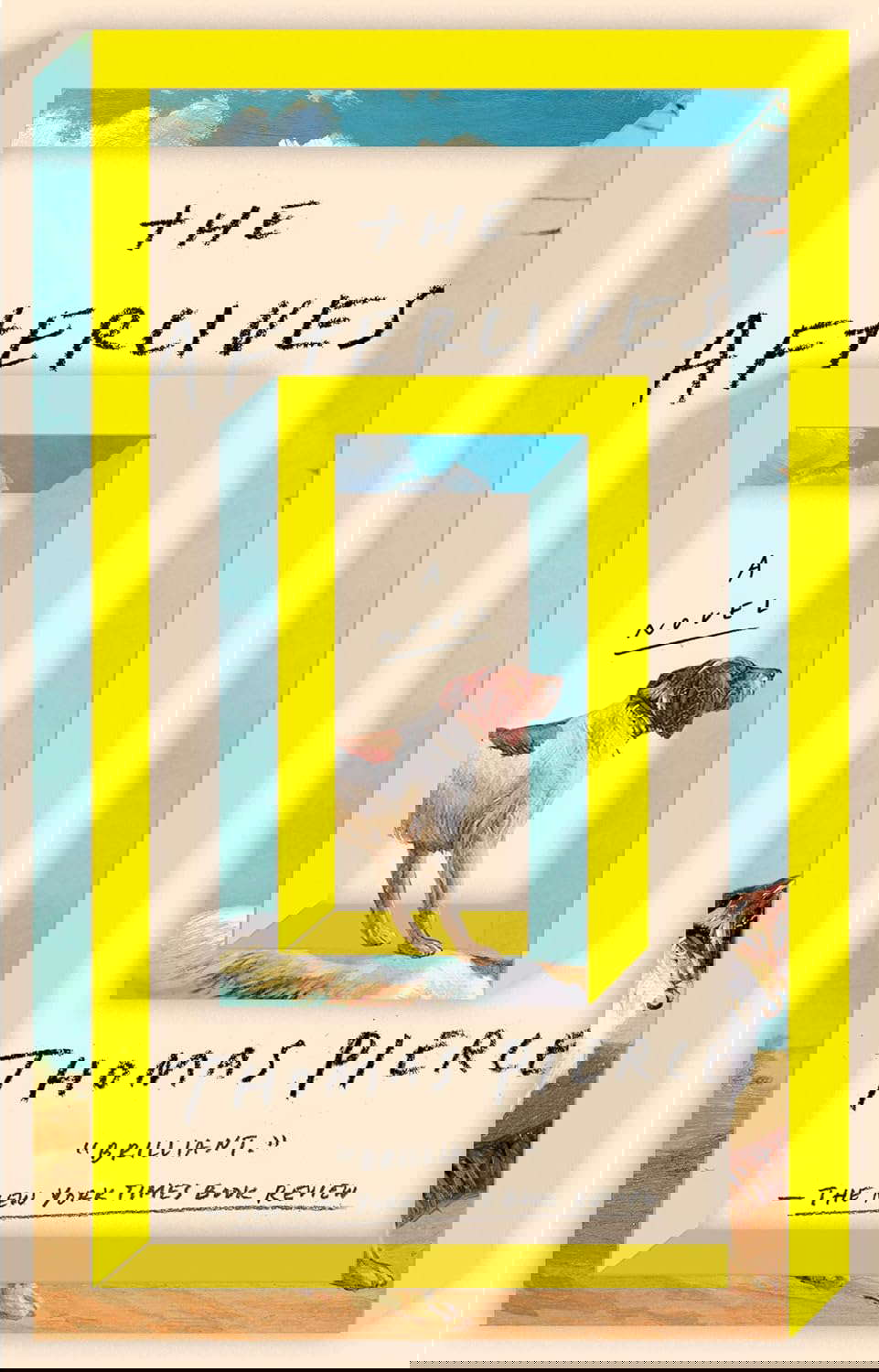
“Ridiculously good” (The New York Times) author Thomas Pierce's debut novel is a funny, poignant love story that answers the question: What happens after we die? (Lots of stuff, it turns out).Jim Byrd died. Technically. For a few minutes. The diagnosis: heart attack at age thirty. Revived with no memory of any tunnels, lights, or angels, Jim wonders what--if anything--awaits us on the other side. Then a ghost shows up. Maybe. Jim and his new wife, Annie, find themselves tangling with holograms, psychics, messages from the beyond, and a machine that connects the living and the dead. As Jim and Annie journey through history and fumble through faith, they confront the specter of loss that looms for anyone who dares to fall in love. Funny, fiercely original, and gracefully moving, The Afterlives will haunt you. In a good way.
"In Thomas Pierce’s warm and inventive debut novel, The Afterlives, reality is slippery, time is out of joint and profound disorientation is a feature of daily existence. In other words, pretty much how the world feels to a lot of us right now... Pierce is brilliant at painting an entire life
“[A] touching, thought-provoking debut novel… Part love story and part speculative sci-fi, it’s a meandering, albeit meaningful, look at marriage, technology and ghosts.”
"Fascinating... [Pierce’s] work has a quirky sensibility that recalls Lorrie Moore or George Saunders, an ability to bring the unquestionably weird into the path of daily life without ever seeming forced.… A fluid, funny writer."
“Like his previous book, the short story collection Hall of Small Mammals, it's richly imaginative, quirky but not twee, and the work of an author who's determined to find the surreal behind the ordinary… [A] deeply generous, compassionate book that asks its readers to open their hearts and treat one another with understanding, even as the world grows more complicated, and more unknowable, every day.”
“Excellent… The Afterlives is sprinkled with ‘Black Mirror’-style futuristic touches... The Afterlives is as much a dialogue and an attempt at reconciliation between faith and science as it is a contemplation of the opportunities of second chances.”
“I was enchanted by [Pierce’s] thoughtful ruminations and wry comments about church and spirituality. Intercalary chapters about the haunted house’s original residents vibrate with ectoplastic energy."
“Thomas Pierce's humorous yet heartfelt debut novel The Afterlives is one man's journey to discover what happens after death… A unique and thought-provoking read.”
"Quirky, hilarious, and heartrending."
“[W]ill both haunt you and make you laugh.”
“[U]tterly human (and hilarious), prodding some of life’s biggest mysteries to see what truths shake loose.”
“This tender debut novel from Thomas Pierce explores what awaits us in the afterlife… This thought-provoking debut will make readers think about love, loss, and what happens after we die.”
“Thomas Pierce's debut novel, The Afterlives, is a pleasant case of a ghost story… it delivers a satisfying rendering of what that supernatural world might be like, while preserving the sense of mystery that draws us to such yarns in the first place… Pierce, like every ghost-story writer, knows we crave an unreality to match the humdrum real world we're stuck in. Unlike many, though, he grasps that we chase that tension not to cross into some "other side" but to feel steadier on this one.”
“A bracingly intelligent, beautifully rendered meditation on ghosts, technology, marriage, and the afterlife. This is a remarkable novel.”
“Inventive, romantic, and unsettling, The Afterlives is a story of two people who take extraordinary measures to answer the Big Questions: What is the soul? Do we ever really die? Flabbergastingly original and sublimely satisfying.”
“Thomas Pierce’s fine new novel is often humorous, but Jim Byrd’s search to find out what might lie beyond this life makes The Afterlives much more: a poignant inquiry into our human desire for permanence.”
“[T]his dazzlingly original novel tackles a timeless question
“Told with sharp humor and big questions, it will make you laugh while simultaneously urging you think deeply about technology, loss, faith, and life.”
“Pierce’s first novel is a fascinating and beautifully rendered meditation on ghosts, technology, marriage, and the afterlife.”
"[W]eird and charming… The Afterlives feels big and warm and inviting, an intelligent book that also lets itself be goofy, a serious book that doesn’t take life too seriously. After all, none of us are getting out of it alive.”
"Pierce has a gift for probing the limits of the psychic realm to uncover the benevolence that manifests from metaphysical insight. Truly remarkable."
"Ridiculously good... These stories never drift vaguely off into the ether. They are beautifully built, and their author has an especially deft way of finding just the right final flourish.... [There's a] feeling of being inside a bubble while reading Mr. Pierce, and it is a bubble you won't want to leave. This is such a fine collection that there's not a stinker in the bunch.... Mr. Pierce's originality, inventiveness, questing spiritual intelligence and animal fixation aren't easy to do justice to in the limited space here. But they're irrefutably good reasons to discover him for yourself."
"It's thrilling to find a writer with an imagination as wild and wonderful as Thomas Pierce."
"It will be tempting, but hard, for readers to choose a favorite among the stories here... Rich and complicated... These stories have that merry, postmodern humor, but also a classical love of real human emotion."
"A debut collection that reads like the work of a much older, established fiction master. The stories in Pierce's book explore the ordinary in the otherworldly, the surreal in the mundane, and the results are stunning and unexpected.... Pierce is an endlessly incisive and engaging writer. It's a book full of wisdom and emotion, with stories that explore what it means to live and die in a world filled with invisible things."
"Pierce mines the mysterious rift between fantasy and reality with the intricate skill of an archaeologist and the sheer wonder of an imaginative child."
"Pierce's stories are beautifully written and suffused with mystery."
Exit heartbeat. Exit breath. Exit every mood, every memory. Exit you. To where? First, their voices-the nurse's, the doctor's, my parents'. "He looks so puffy," I could hear my mother saying. "Is it normal he looks so puffy?" I was a rabbit pulled from the black hole of a magician's top hat. The doctor pointed to the television on the opposite wall and asked me if I knew what it was for. I thought he was joking. Next he asked me for my full name. This question frightened me more than it probably should have. I was Jim Byrd, wasn't I? Didn't he know I was Jim Byrd? My chest was incredibly sore and bruised. Days would pass before I'd recall my collapse in the parking garage down the street from my office. A gash in my forehead had already been sutured. One of the nurses, a young girl with henna tattoos all over her hands and wrists, explained that the gentleman who'd discovered me at the base of the stairs leading up to P2 had administered CPR until the paramedics arrived with their defibrillators. "If not for him," she said, "you'd probably still be dead." "Dead?" The nurse blushed. To have mentioned the fact of my death, I gathered, had been a slipup. She backtracked: Not an actual death, more like a figurative one, or, rather, a technical one. An almost-death. Sudden cardiac arrest was the diagnosis. I had a long history of passing out, though until now I'd always understood these episodes to be a symptom of a simple fainting disorder. Childhood doctors had advised me to eat more to keep up my blood pressure. But new tests revealed my true condition, which amounted to a vast electrical problem in my body. A misfire, my cardiologist called it. "But was I really dead?" "Clinically." Dying, he clarified, was a process, not a single event. It was like a wave pulling back from the shore, the sand shifting color, dark to light, as the water leached out of it. Even where the sand appeared dry, sometimes you could dig down a few inches and find more water. You died, and then you died a little more, and then just a little bit more until you were all the way completely dead—or not, depending. "For how long was I?" I asked. "Well, that's difficult to say. Given that you seem to have suffered no brain damage, I'm guessing not more than five minutes. You're very lucky." "I saw nothing," I said. "I'm sorry?" "While I was dead. I saw nothing. No lights, no tunnels, no angels. I was just gone. I don't remember anything." The doctor arched his eyebrows but was silent. "What does that indicate to you?" I asked. "I wouldn't read too much into it." "Read too much into it?" "I wouldn't give it too much thought, is what I mean. Look on the bright side. You're back. You're only thirty-three. Still a young man. You have more life ahead of you, Mr. Byrd." To help guarantee this, he recommended that I have a device installed in my chest that would regulate this electrical problem, and soon thereafter I became one of the earliest recipients of a HeartNet, a very advanced implantable defibrillator that looks a little bit like a small onion bag only with tighter mesh. The bag wraps tightly around the heart, squeezing it, fusing with it. Located at its top is a little shrunken head-a node, its brain. I'm told it's practically an artificial intelligence, that's how smart this technology is. If never powered down, HeartNet will keep my heart beating for as long as its battery allows. About two hundred years, apparently. Due to the longevity of its batteries, the device has actually created confusion in some cases. I understand that there've been instances where HeartNet has failed to recognize that a body has already given up on itself and so continued pumping blood, undeterred. Hospitals have been forced to store bodies in their morgues with still-beating hearts. My HeartNet is in constant communication with its manufacturer in Sheldrick, California, and I have the ability to monitor the diagnostics it provides in real time on my phone. A few taps on the screen, and an image of my own heart appears there, pumping and quaking. Blood flow through the four chambers is mapped as a staticky blue and red, outtake and intake. Beats per minute, electrocardiographic charts, echocardiographs, blood pool scans. It's all there at my fingertips. If you select a certain option, the device will even alert you every time it saves your life—which is to say, every time your heart fails to beat properly of its own accord. I experienced this for the first time about two weeks after the procedure. I wasn't running or lifting weights or having sex. I wasn't involved in any sort of strenuous activity whatsoever. I was simply sitting on the couch watching television. Receiving the alert—three delicate chimes, like a call to meditation in a Buddhist temple—I immediately shut off the TV and dressed. I was wasting my life! I desperately needed to be out of the house—but where to go? I wasn't sure. This was a Friday night, about nine o'clock, and I had nowhere to be. I walked up and down the road a few times, then came back home and read three pages of a book on the later Roman emperors before sitting down on the couch for more television. For weeks after that I worried that I wasn't making the time count. I'd been given a second chance, and I needed to take advantage. One morning I got in my car and just started driving. West, naturally. Maybe I'd go all the way to the Pacific, I wasn't sure. I didn't have a plan. Crossing the North Carolina border and entering Tennessee, I felt alive, but by the time I reached Kentucky, the monotony of the drive had settled in, and I'd lost interest. I spent one night in a nice hotel in Louisville, toured the famous bat factory there, drank some whiskey, and then drove back east. Not long after that I bought a plane ticket and flew to Ireland. I drank beers alone in a pub in Cork and listened to some decent music. Then I flew to Munich to see an old friend who'd settled there after graduate school, and one night I went home with one of his coworkers, a German girl who spoke very little English. Seeing my scar, she ran her fingers along it gently, a look of concern and pity on her face, and insisted, via hand signals and broken English, that she be on top lest I overexert myself. I tried to explain that the problem wasn't the plumbing but the electrical, but this only further confused matters. She showed me her toilet and held up her fingers: One or two? A few days later I returned home—to Shula, North Carolina. ¥ The White Hairs, we called them, the old geezers who'd flooded into Shula over the last twenty years and seized control of our local government and civic groups and boards. You sometimes got the feeling there'd been a convention—a gathering of all the nation's old people—and together they'd voted Shula as their new home. You couldn't really fault them for it. Shula was beautiful after all, quaint but busy, the Blue Ridge Mountains visible in most directions. The White Hairs, really, had become the backbone of our town's economy. Businesses thrived downtown—the antique stores and folk-art galleries and sandwich shops. Most restaurants were successful as long as they offered early seating. Large gated communities had sprung up to accommodate them—clusters of condominiums and townhouses with shared shuffleboard courts and swimming pools. To address their many medical needs and conditions, we'd added a second hospital, not to mention the various rehab centers and private practices. I'd had a front-row seat to many of these changes in my capacity as a commercial loan officer. My uncle, a soft-looking man with a hint of a British accent acquired after only two years of graduate school in London, was an executive with a national bank, and it was with his assistance that I'd finagled my way after college into a leadership development program designed to train promising new employees for careers in credit analysis and commercial lending. I'd been grateful for his help but also surprised by it. My uncle and my father had never been particularly close. I can recall only two childhood visits to my uncle's home in Connecticut, a mansion with a horizon pool and a wine cellar. "All hat, no cattle" was how my father used to describe his brother, and I will admit that my uncle did put a premium on appearances. If he was bound soon for a vacation on a fancy coast, for instance, you better believe he'd find a way to worm that tidbit into the conversation. Still, when he'd offered me his help, I'd accepted it gratefully. What did I care if he was only intervening as a way of lording his good fortune and connections over my father? A leg up was a leg up. After completing the program I'd taken a job at a branch in my hometown. Shula was not a particularly old city, though we celebrated its heritage and culture regularly with parades and photographic displays at the public library. A lake at the edge of town—now not much more than a neighborhood runoff pond at the center of a weedy meadow—had once been a popular tourist destination. There'd been dances in the pavilion there—parties, vacations. There'd been a small amusement park with roller coasters and merry-go-rounds in the adjacent field. People had been happy there once. You saw these people in photographs in their full-body bathing suits, their swim caps. Women with coiffured dogs in their laps; men with slick hair on water skis. Their bright, untroubled faces, their voices rising up like so many clanging, noiseless bells—what had their lives been like? They were gone now, all of them, disappeared into the blue haze that surrounded the town. Some mornings the fog was so thick and impenetrable you'd forget the rest of the world was out there. Other cities, other countries, other lives. The mountains—blue, soft, ethereal—were more like suggestions of geological features than actual ones. Always they lingered in the distance. You could never seem to reach them. They had no edge, no sure boundary or beginning. Science confirmed their ancientness. The landscape was wild but intensely familiar. We were living in the ruins of mega-continents, on rolling hills ground down by millions of years of erosion. Crust. Thrusting sheets. Bedrock. I found it somewhat comforting to think of my limited time here on the ground in the context of that larger, deeper history.
Find it on
AmazonNo videos available yet.
No news articles linked to this title yet.

Overall
Overall rating of the media
Atmosphere
How immersive and tense is the atmosphere
Gore
Level and quality of gore/violence
Story
Quality of the storyline and plot
Writing
Quality of the written content
Character Development
Depth and growth of characters
Pacing
Flow and timing of the narrative