

BOOK
0
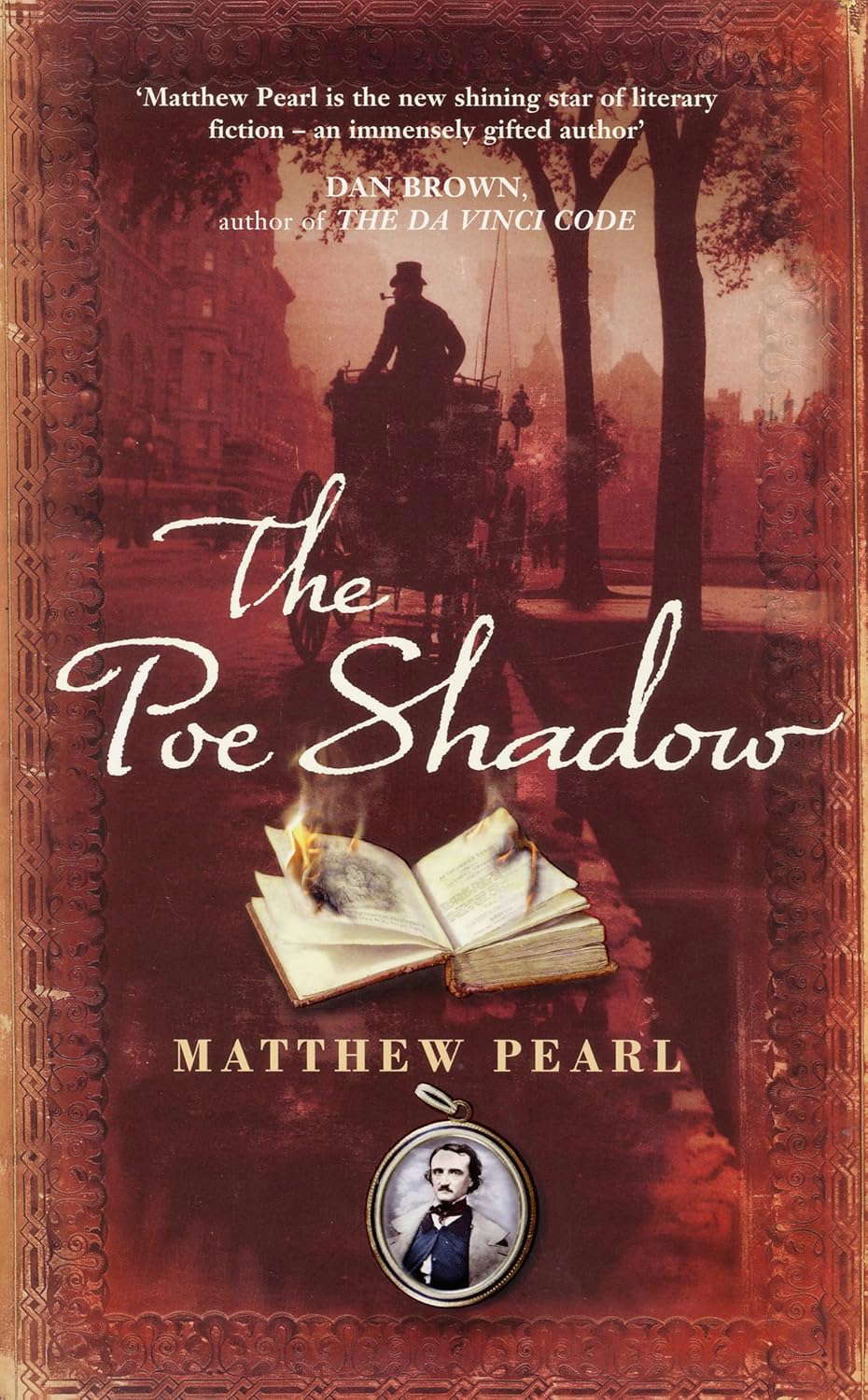
Baltimore, 1849. The body of Edgar Allan Poe has been buried in an unmarked grave. The conclusion that Poe was a second-rate writer who died a drunkard is accepted by all. But none of this deters Quentin Clark, an ardent admirer who risks his own career and reputation in a passionate crusade to salvage Poe's. Clark discovers that Poe's last days are riddled with vital unanswered questions. But just when Poe's death looks destined to remain a mystery, Quentin seeks out the one person who can solve this strange case: the real-life model for Poe's brilliant fictional detective character, C. Auguste Dupin. Having successfully recruited the man he believes to have inspired Poe's Dupin, Clarke is confronted by another claiming to be the true model. The two master detectives each seek to prove he is the real 'Dupin' by solving the mystery of Poe's death. Clark finds himself enmeshed in sinister machinations involving international political agents, a female assassin, the corrupt Baltimore slave trade and the lost secrets of Poe's final hours. With his own future hanging in the balance, he must turn master investigator himself to unchain his now imperilled fate from that of Poe.
Fans of Pearl's bestselling debut, The Dante Club (2003), will eagerly embrace his second novel, a compelling thriller centered on the mysterious end of Edgar Allan Poe, who perished in Baltimore in 1849. Poe's ignominious funeral catches the notice of Quentin Clark, a young, idealistic attorney, who finds himself obsessed with rescuing Poe's reputation amid rumors that the writer died from an excess of drink. Clark's preoccupation soon becomes all-consuming, imperiling his practice and his engagement, especially after he learns that Poe's legendary master sleuth, the Chevalier Auguste Dupin, was modeled after a real person. The lawyer journeys to France to track down the real Dupin, in the hopes that the detective can help him solve the puzzle of Poe's death. Pearl masterfully combines fact with fiction and presents some genuinely new historical clues that help reconstruct Poe's final days. While Clark remains a little enigmatic, the exciting plot, numerous twists and convincing period detail could help land this on bestseller lists as well. Copyright © Reed Business Information, a division of Reed Elsevier Inc. All rights reserved. --This text refers to an alternate paperback edition.
The strange circumstances surrounding the death of Edgar Allan Poe, intriguing to fans and scholars alike, provide the basis for this literary historical mystery. In late 1849, Poe, traveling from his home in Virginia to Philadelphia for a lucrative editing job, went missing; however, he was found several days later, apparently drunk in a Baltimore tavern; he died after several days of delirium in a hospital and was buried unceremoniously. Press reports that Poe would be little missed so disturb Quentin Hobson Clark, a young Baltimore lawyer of independent means and a Poe admirer, that he vows to represent Poe's interests. To solve the mysterious death, Clark seeks in Paris the real-life model for Poe's fictitious detective, C. Auguste Dupin, selecting crime solver Auguste Dupont over lawyer Baron Claude Dupin. But the baron, still claiming to be Poe's model, follows Clark and Dupont to Baltimore, starting a cat-and-mouse game of detection that, because of French political implications, turns deadly. This is similar to Pearl's Dante Club (2002), which portrayed renowned authors trailing a serial killer, in its masterful blend of historical and fictional figures, meticulous research, and nineteenth-century literary style. Whether interest in Poe will make this book equally popular remains to be seen. Michele LeberCopyright © American Library Association. All rights reserved --This text refers to an alternate paperback edition.
Matthew Pearl's best-selling The Dante Club (2003) successfully meshed history, literature, and mystery. Though he tries to duplicate this formula and honor a great American writer, The Poe Shadow fails to garner similar interest. First, Pearl's attempt to echo 19th-century prose is fusty and verbose. Second, Clark, though he has his eccentricities, is rather "poor company" (Wall Street Journal). Third, while the subplots offer intrigue, they rarely advance the plot and never attain the macabre tone of Poe's tales. The historical context, however (though weighed down by ponderous if meticulous research), provides new insights into Poe's personal life and literary career. The verdict: for Poe (or Pearl) fans only.Copyright © 2004 Phillips & Nelson Media, Inc. --This text refers to an alternate paperback edition.
There's a mystery surrounding Edgar Allan Poe's death. Quentin Clark, lawyer and Poe devotee, risks his legal practice and his engagement to solve it, hoping to reverse the author's reputation for drinking and debauching. Clark discovers that C. Auguste Dupin, Poe's detective creation, is modeled after a real person, so he's off to Paris to find him. Erik Singer's understated performance resonates with credibility. Villains are thwarted and the truth uncovered using ratiocination, and Singer makes the first-person account completely plausible. He reads Matthew Pearl's blend of history and fiction with assurance. His phrasing and pronunciation reflect an excellent grasp of period diction, and his accents--American, British, and French--ring true. S.J.H. © AudioFile 2006, Portland, Maine-- Copyright © AudioFile, Portland, Maine --This text refers to an alternate paperback edition.
I remember the day it began because I was impatient for an important letter to arrive. Also, because it was meant to be the day of my engagement to Hattie Blum. And, of course, it was the day I saw him dead. The Blums were near neighbors of my family. Hattie was the youngest and most affable of four sisters who were considered nearly the prettiest four sisters in Baltimore. Hattie and I had been acquainted from our very infancies, as we were told often enough through the years. And each time we were told how long we'd known each other, I think the words were meant also to say, "and you shall know each other evermore, depend upon it." And in spite of such pressure as might easily have pushed us apart, even at eleven years old I became like a little husband toward my playfellow. I never made outward professions of love to Hattie, but I devoted myself to her happiness in small ways while she entertained me with her talk. There was something hushed about her voice, which often sounded to me like a lullaby. My own nature while in society as it developed was markedly quiet and tranquil, to the degree that I was often asked at any given moment if I had only just then been stirred awake. In quieter company, though, I had the habit of turning unaccountably loquacious and even rambling in my speech. Therefore, I savored the stretches of Hattie's animated conversation. I believe I depended upon them. I felt no need to call attention to myself when I was with her; I felt happy and modest and, above all, easy. Now, I should note that I did not know that I was expected to propose marriage on the afternoon with which we begin this narration. I was on my way to the post office from the nearby chambers of our law practice when I crossed paths with a woman of good Baltimore society, Mrs. Blum--Hattie's aunt. She pointed out immediately that the errands of retrieving waiting mail should be assigned to one of my lesser and less occupied legal clerks. "You are a specimen, aren't you, Quentin Clark!" Mrs. Blum said. "You wander the streets when you are working, and when you're not working, you have a look upon your face as though you were!" She was your genuine Baltimorean; she suffered no man without proper commercial interests any more than she would tolerate a girl who was not beautiful. This was Baltimore, and whether in fine weather or in this day's fog it was a very red-brick type of place, where the movements of the people on well-paved streets and marble steps were quick and boisterous but without gaiety. There was not much of that last quality in supply in our go-ahead city, where large houses stood elevated over a crowded trading bay. Coffee and sugar came in from South America and the West India Islands on great clipper ships, and the barrels of oysters and family flour moved out on the multiplying railway tracks toward Philadelphia and Washington. Nobody looked poor then in Baltimore, even those who were, and every other awning seemed to be a daguerreotype establishment ready to record that fact for posterity. Mrs. Blum on this occasion smiled and took my arm as we walked through the thoroughfare. "Well, everything is quite perfectly arranged for this evening." "This evening," I replied, trying to guess what she could be referring to. Peter Stuart, my law partner, had mentioned a supper party at the home of a mutual acquaintance. I had been thinking so much of the letter I anticipated retrieving, I had until then forgotten completely. "This evening, of course, Mrs. Blum! How I've looked forward to it." "Do you know," she continued, "do you know, Mr. Clark, that only yesterday I heard dear Miss Hattie spoken of on Market Street"--this generation of Baltimoreans still called Baltimore Street by its former name--"yes, talked about as the loveliest unmarried beauty in all Baltimore!" "One could argue the loveliest above all, married or not," I said. "Well, isn't that clever!" she replied. "Oh, it won't do at all, twenty-seven and still living bachelor and--now don't interrupt, dear Quentin! A proper young man doesn't . . ." I had trouble hearing what she said next because a loud rumble of two carriages grew behind us. "If it is a hackney approaching," I thought to myself, "I shall put her into it, and offer double the fare." But as they passed I could see both were private carriages, and the one in front was a sleek, shiny hearse. Its horses kept their heads low, as if in deference to the honorable cargo. No one else turned to look. Leaving behind my walking companion with a parting promise of seeing her at the evening's gathering, I found myself crossing the next avenue. A herd of swine swarmed past with belligerent shrieks, and my detour ran along Greene Street and across to Fayette, where hearse and mourning-carriage were parked together. In a quiet burial ground there, a ceremony began and ended abruptly. I strained through the fog at the figures in attendance. It was like standing in a dream--everything blurred into silhouettes, and I swallowed down the vague feeling that I should not be there. The minister's oration sounded muffled from where I stood at the gates. The small gathering, I suppose, did not demand much effort from his voice. It was the saddest funeral ever seen. It was the weather. No: the mere four or five men in attendance--the minimum needed to lift an adult coffin. Or perhaps the melancholy quality came chiefly from that brisk, callous completion of the ceremony. Not even the most impoverished pauper's funeral that I had observed before this day, nor the funerals of the poor Jewish cemetery nearby, not even those exhibited such unchristian indifference. There wasn't one flower, wasn't one tear. Afterward, I retraced my steps only to find the post office had bolted its doors. I could not know whether there was a letter waiting for me inside or not--but I returned to our office chambers and reassured myself. Soon, I'd hear more from him soon. That evening at the social gathering, I found myself on a private stroll with Hattie Blum along a field of berries, dormant for the season but shadowed with summer remembrances of Champagne and Strawberry Parties. As ever, I could speak comfortably to Hattie. "Our practice is awfully interesting at times," I said. "Yet I think I should like to choose the cases with more discrimination. A lawyer in ancient Rome, you know, swore never to defend a cause unless he thought it was just. We take cases if their pay is just." "You can change your office, Quentin. It is your name and your character hanging on the shingle too, after all. Make it more like yourself, rather than make yourself more suited to it." "Do you believe so, Miss Hattie?" Twilight was settling and Hattie became uncharacteristically quiet, which I fear meant that I became insufferably talkative. I examined her expression but found no clues to the source of her distant bearing. "You laughed for me," Hattie said absently, almost as though I would not hear her. "Miss Hattie?" She looked up at me. "I was only thinking of when we were children. Do you know at first I thought you were a fool?" "Appreciated," I chuckled. "My father would take my mother away during her different sicknesses, and you would come to play when my aunt was minding me. You were the only one to know just how to make me smile until my parents returned, because you were always laughing at the strangest things!" She said this wistfully, while lifting the bottom of her long skirts to avoid the muddy ground. Later, when we were inside warming ourselves, Hattie talked quietly with her aunt, whose entire countenance had stiffened from earlier in the day. Auntie Blum asked what should be arranged for Hattie's birthday. "It is coming, I suppose," Hattie said. "I should hardly think of it, typically, Auntie. But this year . . ." She trailed off into a cheerless hum. At supper, she hardly touched the food. I did not like this at all. I felt myself turn into an eleven-year-old boy again, an anxious protector of the girl across the way. Hattie had been such a reliable presence in my life that any discomfort on her part upset me. Thus it was perhaps from a selfish motivation I tried to cure her mood, but at all events I did wish her to be genuinely happy. Others of the party, like my law partner, Peter, joined in attempting to raise her spirits, and I studied each of them vigilantly in the event that one of them had been responsible for bringing Hattie Blum into a fit of blues. Something was hindering my own role in cheering her on this day: that funeral I had seen. I cannot properly explain why, but it had thoroughly exploded my peace. I tried to call to mind a picture of it again. There had been only the four men in attendance to listen to the minister. One, taller than the others, stood toward the rear, his gaze floating off, as though the most anxious of all to be somewhere else. Then, as they came toward the road, there were their grim mouths. The faces were not known to me but also not forgotten. Only one member delayed, staying his steps regretfully, as though overhearing my private thoughts. The event seemed to speak of a terrible loss and yet to do it no honor. It was, in a word, Wrong. Under this vague cloud of distraction, my efforts exhausted themselves without rescuing Hattie's spirits. I could only bow and exp... --This text refers to an alternate paperback edition.
Find it on
AmazonNo videos available yet.
No news articles linked to this title yet.
No tags available.

Overall
Overall rating of the media
Atmosphere
How immersive and tense is the atmosphere
Gore
Level and quality of gore/violence
Story
Quality of the storyline and plot
Writing
Quality of the written content
Character Development
Depth and growth of characters
Pacing
Flow and timing of the narrative