BOOK
0
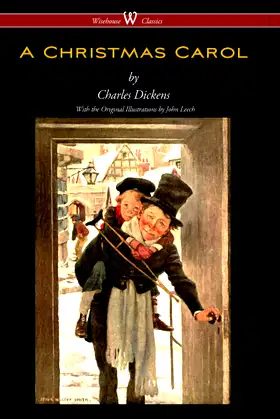
A CHRISTMAS CAROL is a novella by Charles Dickens, first published in London on December 1843. The novella met with instant success and critical acclaim. A Christmas Carol tells the story of a bitter old miser named Ebenezer Scrooge and his transformation into a gentler, kindlier man after visitations by the ghost of his former business partner Jacob Marley and the Ghosts of Christmas Past, Present and Yet to Come. The book was written at a time when the British were examining and exploring Christmas traditions from the past as well as new customs such as Christmas cards and Christmas trees. Carol singing took a new lease on life during this time. Dickens' sources for the tale appear to be many and varied, but are, principally, the humiliating experiences of his childhood, his sympathy for the poor, and various Christmas stories and fairy tales.Dickens was not the first author to celebrate the Christmas season in literature, but it was he who superimposed his humanitarian vision of the holiday upon the public, an idea that has been termed as Dickens' "Carol Philosophy". Dickens believed the best way to reach the broadest segment of the population regarding his concerns about poverty and social injustice was to write a deeply felt Christmas story rather than polemical pamphlets and essays. Dickens' career as a best-selling author was on the wane, and the writer felt he needed to produce a tale that would prove both profitable and popular. Dickens' visit to the work-worn industrial city of Manchester was the "spark" that fired the author to produce a story about the poor, a repentant miser, and redemption that would become A Christmas Carol. The forces that inspired Dickens to create a powerful, impressive and enduring tale were the profoundly humiliating experiences of his childhood, the plight of the poor and their children during the boom decades of the 1830s and 1840s, and Washington Irving's essays on old English Christmas traditions published in his Sketch Book (1820); and fairy tales and nursery stories, as well as satirical essays and religious tracts.
Starred Review. Dickens's classic holiday tale, like many cultural touchstones, often falls into the trap of perennial reinterpretation. First aired in 1990 but only now available on CD, NPR's presentation serves to place the familiar story back in its historical context. NPR News anchor Susan Stamberg's introduction, along with background information in the liner notes, offers valuable insights regarding both Dickens's gritty backdrop and his role in reviving Christmas traditions otherwise forgotten amid rapid urban industrialization. The script being performed is the same one Dickens used to use at readings. Comedy legend Winters, who serves as narrator while also performing all of the male roles, juggles his duties seamlessly and demonstrates remarkable dramatic range. His portrayal of Scrooge before the ghostly visitations evokes discernable pain and loss beyond the over-the-top antics of an ogre figure. Veteran actress Mimi Kennedy voices the female parts with gusto. With its quality production, attractive price and one-hour length, this release offers the perfect gift and establishes a festive new annual ritual for families to share. (Sept.) Copyright © Reed Business Information, a division of Reed Elsevier Inc. All rights reserved.
"Bah!" said Scrooge. "Humbug!" With those famous words unfolds a tale that renews the joy and caring that are Christmas. Whether we read it aloud with our family and friends or open the pages on a chill winter evening to savor the story in solitiude. Charles Dickens's A Christmas Carol is a very special holiday experience.
he first publication of A Christmas Carol in 1843, the tale of stingy Ebenezer Scrooge, humble Bob Crachit, and beloved Tiny Tim has taken a special place in the heart of our Christmas tradition. The most famous celebration of Christmas--and family love--in the English language shows us the nature of true charity, the power of tenderness and the wisdom of innocence in a cold-hearted world.Now, Sir John Gielgud's dramatic reading of an abridgment of this holiday classic brings Dickens's memorable characters to life in your home. The story of Scrooge's transformation is a fable of hope and the true meaning of sharing that will be enjoyed over and over again. A timeless delight for young and old alike, this recording of A Christmas Carol will become part of your family's holiday traditions.
"Marley was dead to begin with. There is no doubt whatever about that. Old Marley was as dead as a doornail." So begins A Christmas Carol by Charles Dickens. Some say this short story, first published in 1843, transformed Christmas into a major holiday. Before A Christmas Carol, there was surprisingly little celebration during the Christmas season. After its publication, the holiday became a high point of the year. Master comedian Jonathan Winters channels all of Dickens's unforgettable characters in a tour de force performance of this holiday classic. Using a special edition prepared by Dickens for his own presentations, he re-creates Ebenezer Scrooge, Bog Cratchit, Tiny Tim, Jacob Marley's spirit and the three Christmas ghosts, Past, Present, and Future. Mimi Kennedy also performs.
MARLEY was dead: to begin with. There is no doubt whatever about that. The register of his burial was signed by the clergyman, the clerk, the undertaker, and the chief mourner. Scrooge signed it: and Scrooge's name was good upon 'Change, for anything he chose to put his hand to. Old Marley was as dead as a door-nail. Mind! I don't mean to say that I know, of my own knowledge, what there is particularly dead about a door-nail. I might have been inclined, myself, to regard a coffin-nail as the deadest piece of ironmongery in the trade. But the wisdom of our ancestors is in the simile; and my unhallowed hands shall not disturb it, or the Country's done for. You will therefore permit me to repeat, emphatically, that Marley was as dead as a door-nail. Scrooge knew he was dead? Of course he did. How could it be otherwise? Scrooge and he were partners for I don't know how many years. Scrooge was his sole executor, his sole administrator, his sole assign, his sole residuary legatee, his sole friend and sole mourner. And even Scrooge was not so dreadfully cut up by the sad event, but that he was an excellent man of business on the very day of the funeral, and solemnised it with an undoubted bargain. The mention of Marley's funeral brings me back to the point I started from. There is no doubt that Marley was dead. This must be distinctly understood, or nothing wonderful can come of the story I am going to relate. If we were not perfectly convinced that Hamlet's Father died before the play began, there would be nothing more remarkable in his taking a stroll at night, in an easterly wind, upon his own ramparts, than there would be in any other middle-aged gentleman rashly turning out after dark in a breezy spot—say Saint Paul's Churchyard for instance—literally to astonish his son's weak mind. Scrooge never painted out Old Marley's name. There it stood, years afterwards, above the warehouse door: Scrooge and Marley. The firm was known as Scrooge and Marley. Sometimes people new to the business called Scrooge Scrooge, and sometimes Marley, but he answered to both names: it was all the same to him.Oh! but he was a tight-fisted hand at the grindstone, Scrooge! a squeezing, wrenching, grasping, scraping, clutching, covetous old sinner! Hard and sharp as flint, from which no steel had ever struck out generous fire; secret, and self-contained, and solitary as an oyster. The cold within him froze his old features, nipped his pointed nose, shrivelled his cheek, stiffened his gait; made his eyes red, his thin lips blue; and spoke out shrewdly in his grating voice. A frosty rime was on his head, and on his eyebrows, and his wiry chin. He carried his own low temperature always about with him; he iced his office in the dog-days; and didn't thaw it one degree at Christmas.External heat and cold had little influence on Scrooge. No warmth could warm, nor wintry weather chill him. No wind that blew was bitterer than he, no falling snow was more intent upon its purpose, no pelting rain less open to entreaty. Foul weather didn't know where to have him. The heaviest rain, and snow, and hail, and sleet, could boast of the advantage over him in only one respect. They often 'came down' handsomely, and Scrooge never did.Nobody ever stopped him in the street to say, with gladsome looks, 'My dear Scrooge, how are you? when will you come to see me?' No beggars implored him to bestow a trifle, no children asked him what it was 'oclock, no man or woman ever once in all his life inquired the way to such and such a place, of Scrooge. Even the blindmen's dogs appeared to know him; and when they saw him coming on, would tug their owners into doorways and up courts; and then would wag their tails as though they said, 'no eye at all is better than an evil eye, dark master!'But what did Scrooge care? It was the very thing he liked. To edge his way along the crowded paths of life, warning all human sympathy to keep its distance, was what the knowing ones call 'nuts' to Scrooge. Once upon a time—of all the good days in the year, on Christmas Eve—old Scrooge sat busy in his counting-house. It was cold, bleak, biting weather: foggy withal: and he could hear the people in the court outside, go wheezing up and down, beating their hands upon their breasts, and stamping their feet upon the pavement-stones to warm them. The city clocks had only just gone three, but it was quite dark already: it had not been light all day: and candles were flaring in the windows of the neighbouring offices, like ruddy smears upon the palpable brown air. The fog came pouring in at every chink and keyhole, and was so dense without, that although the court was of the narrowest, the houses opposite were mere phantoms. To see the dingy cloud come drooping down, obscuring everything, one might have thought that Nature lived hard by, and was brewing on a large scale. The door of Scrooge's counting-house was open that he might keep his eye upon his clerk, who in a dismal little cell beyond, a sort of tank, was copying letters. Scrooge had a very small fire, but the clerk's fire was so very much smaller that it looked like one coal. But he couldn't replenish it, for Scrooge kept the coal-box in his own room; and so surely as the clerk came in with the shovel, the master predicted that it would be necessary for them to part. Wherefore the clerk put on his white comforter, and tried to warm himself at the candle; in which effort, not being a man of a strong imagination, he failed.
Find it on
AmazonNo videos available yet.
No news articles linked to this title yet.

Overall
Overall rating of the media
Atmosphere
How immersive and tense is the atmosphere
Gore
Level and quality of gore/violence
Story
Quality of the storyline and plot
Writing
Quality of the written content
Character Development
Depth and growth of characters
Pacing
Flow and timing of the narrative