
BOOK
0
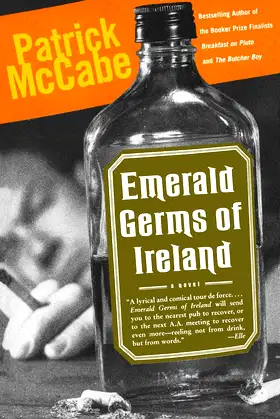
"There is something specialabout the relationship we all havewith our mothers..."Meet Pat McNab, forty-five years old, and about to embark on a homicidal rampage sparked by matricide. Or is he?Pat spent endless hours chain-smoking and propping up the counter of Sullivan's Select Bar (not that Mrs. McNab knew anything about it -- she and Timmy the barman didn't get along at all) or sitting on his mother's knee singing away together like some ridiculous two-headed human jukebox. But that was all before the story really began -- Emerald Germs of Ireland is in essence Pat McNab's post-matricide year.Pat, who now spends many of his waking hours sitting by the window in his old dark house, watching videos and nibbling abstractedly on pieces of toast, reflects on those long-gone days with Mommy, while fending off the persistent interferences of his small-town neighbors: the puritanical Mrs. Tubridy; that irascible seller of turf, the Turf Man; Sgt. "Kojak" Foley, and other unwanted snoops who could soon come to regret their inquisitive, nose-poking ways.This is Patrick McCabe at his fiendish best. Dark, emotionally powerful, and surreal, Emerald Germs of Ireland is also his funniest work to date, masterfully displaying the anarchic twists and turns that are the hallmarks of his comic genius.
McCabe's jokey verbosity and energetic narrative voice are on full display in this messy but manically vibrant novel. Pat McNab's social position in the dully parochial Irish village of Gullytown ranks above village idiot but below town drunk. Few of his fellow citizens would suspect the wild tales he tells are true, much less entertain the idea that he could be a serial killer. Norman Bates, however, has nothing on the middle-aged, reclusive Pat, who enjoys a beyond-Oedipal relationship with his mother (she recurrently appears long after he has dispatched her with a frying pan) and tallies up a final body count estimated "around the fifty, fifty-five mark." Over the course of McCabe's fluctuating, episodic novel, Pat's victims number fewer than two dozen, but each is linked with the popular songs and traditional ballads that reflect Pat's pathetic dreams of becoming a pop singer. The teetotaling, intrusive Mrs. Tubridy is downed with alcohol to the tune of "Whiskey on a Sunday," and a land-swindling neighbor is burned in Pat's barn with "Old Flames" for background music. At other times, Pat's hallucinatory fantasies transform his mundane life into a spaghetti western, sci-fi epic or gangster movie. While Pat bears more than a casual resemblance to Francie Brady, the sympathetic, psychotic hero of The Butcher Boy, this novel's heavy irony, mock verbosity and genre-juggling are more reminiscent of McCabe's recent "serial novel," Mondo Desperado. Although the Grand Guignol humor wears thin after the first several deaths, McCabe gives occasional revealing glimpses into Pat's damaged psyche and the stifling mindset of village life. The mixed results are a thoroughly Irish stew of pathos and bathos, deep melancholy and wild humor, cutting observation and pure blarney. 8-city author tour. (Mar.) Copyright 2001 Reed Business Information, Inc.
Potential readers of the two-time Booker Prize finalist's latest novel are advised first to eat a big bowl of Lucky Charms laced with psychedelics; doing so may be the only way to swallow this jarring musical tragicomedy. In it, our hero/villain, aspiring actor/singer Pat McNab, 45, of Gullytown, Ireland, commits matricide and other heinous murders, each fitted with a theme song (e.g., in "The Turfman from Ardee," the turfman from Ardee bites it). However, the point of all the bloodshed is unclear. Violence for violence's sake doesn't make for great literature or gut-splitting comedy. Because Pat is such a surreal concoction, it is also difficult to gauge how much empathy and sympathy he deserves, if any. McCabe has a gift for creating bent-brained yet fiendishly human outcasts ? la Francie Brady in The Butcher Boy (LJ 5/1/93) and Patrick "Pussy" Brady in Breakfast on Pluto (LJ 12/15/98), but with this Pat he falls short. An optional purchase.-AHeather McCormack, "Library Journal" Copyright 2001 Reed Business Information, Inc.
Is it politically correct to still describe Irish writers as having the gift of gab? At the risk of being un-p.c., let it be said that McCabe is full of blarney, and it couldn't be more entertaining. Here he tells the story of poor Pat McNab, a grown man, 45 years old, who still lives with his mother. Ma rules the roost, even to the point of snarling at Pat when he adjourns down the road for a bit of liquid refreshment. Pat's pa left years ago, and Pat's mother still shakes her fist in the direction in which he took off. One day, Pat can't take her voice, her tone, her anything, and he conks her on the head and kills her. Poor pent-up Pat, now let loose without the constraints of his mother's control and criticism, embarks on a year of rage. Pat's neighbors in the small town where he lives stick their much-resented noses into Pat's business, but we're never quite sure how much of the mayhem Pat appears to cause after his mother's death is real and how much takes place in Pat's increasingly addled mind. Either way, this is a deliciously humorous tour through small-town life and its deeply idiosyncratic cast of characters. And poor Pat--how we do come to care about his pathetic self. With a great ear for language, McCabe spins a yarn all fiction readers should enjoy. Brad HooperCopyright © American Library Association. All rights reserved
"There is something specialabout the relationship we all havewith our mothers..."Meet Pat McNab, forty-five years old, and about to embark on a homicidal rampage sparked by matricide. Or is he?Pat spent endless hours chain-smoking and propping up the counter of Sullivan's Select Bar (not that Mrs. McNab knew anything about it -- she and Timmy the barman didn't get along at all) or sitting on his mother's knee singing away together like some ridiculous two-headed human jukebox. But that was all before the story really began -- Emerald Germs of Ireland is in essence Pat McNab's post-matricide year.Pat, who now spends many of his waking hours sitting by the window in his old dark house, watching videos and nibbling abstractedly on pieces of toast, reflects on those long-gone days with Mommy, while fending off the persistent interferences of his small-town neighbors: the puritanical Mrs. Tubridy; that irascible seller of turf, the Turf Man; Sgt. "Kojak" Foley, and other unwanted snoops who could soon come to regret their inquisitive, nose-poking ways.This is Patrick McCabe at his fiendish best. Dark, emotionally powerful, and surreal, Emerald Germs of Ireland is also his funniest work to date, masterfully displaying the anarchic twists and turns that are the hallmarks of his comic genius.
Find it on
AmazonNo videos available yet.
No news articles linked to this title yet.

Overall
Overall rating of the media
Atmosphere
How immersive and tense is the atmosphere
Gore
Level and quality of gore/violence
Story
Quality of the storyline and plot
Writing
Quality of the written content
Character Development
Depth and growth of characters
Pacing
Flow and timing of the narrative