
BOOK
0
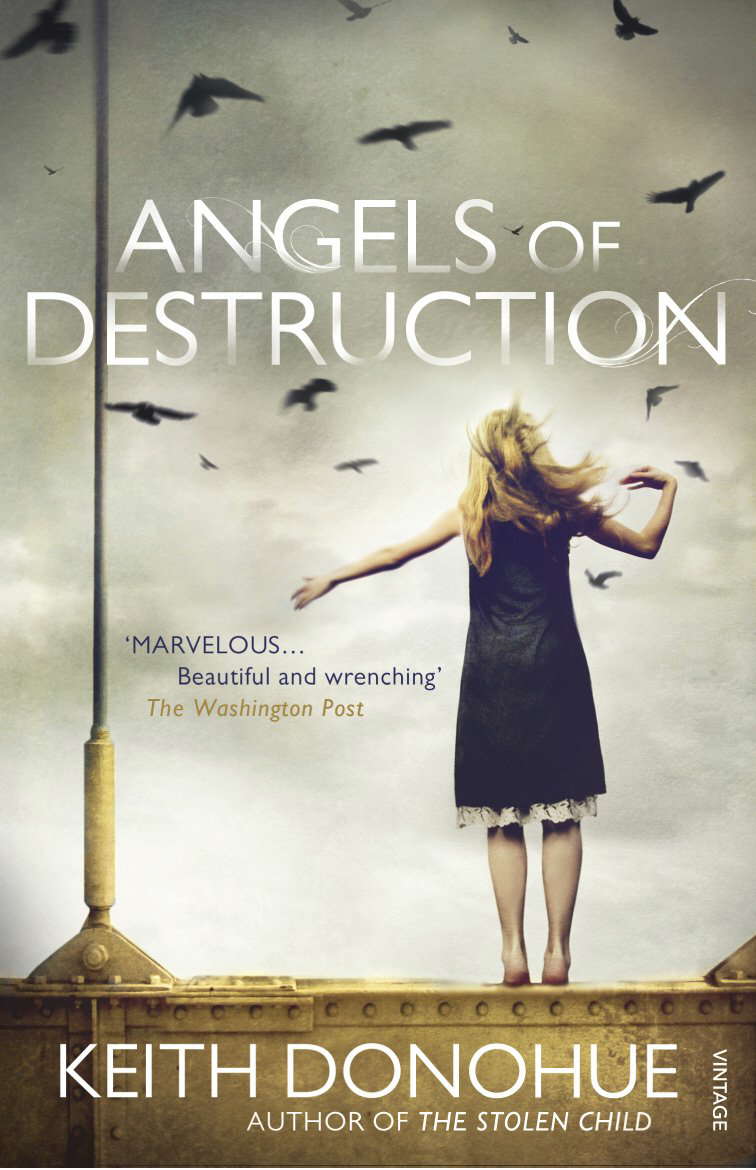
Angels of Destruction is the mesmerising story of Norah, a nine-year-old girl who seems to materialise out of thin air when she arrives one bitterly cold night on the doorstep of Margaret Quinn. A widow who lives alone, Margaret has never got over the loss of her own child, a runaway called Erica who fled with her high school sweetheart, Wiley, to join a '60s-style band of West Coast revolutionaries known as Angels of Destruction. Norah becomes Margaret's secret, a child possessed of magical qualities. But who is she really? And what is her purpose here? And what is this strange child's connection to Margaret's missing daughter?
Tweaking some thematic elements of his previous novel, The Stolen Child, Donohoe now tells the story of Norah, a nine-year-old who appears on the doorstep of Margaret Quinn, a widow living a solitary existence in a small Pennsylvania town in 1985. Margaret eagerly takes in Norah to make up for the loss of her own daughter, Erica, who disappeared 10 years earlier after running away to join the Angels of Destruction, a West Coast revolutionary group. Margaret passes off Norah as her granddaughter and enrolls her in school, where Norah becomes friendly with a boy who's been abandoned by his father. Complications ensue when Margaret's sister arrives and has to be convinced that Norah is Erica's daughter. Sandwiched between the story of Margaret and Norah's unusual relationship is the flashback narrative of teenage Erica's road adventures with her boyfriend on their way to join the Angels of Destruction. Norah's unexplained origins form the enigmatic core of this story, and though she comes across as more of a novelistic conceit than a flesh and blood character, the novel movingly illustrates the quest for connection hardwired into every human heart. (Mar.) Copyright © Reed Business Information, a division of Reed Elsevier Inc. All rights reserved.
“Norah’s unexplained origins form the enigmatic core of this story . . . the novel movingly illustrates the quest for connection hardwired into every human heart.”
“[A] strange and finely written novel. Donohue has a talent for using small details to draw his characters, and the result is a dark and unsettling story that takes hold of the reader.”
“Fused with spectral imagery and magnetic characters, Donohue’s ethereal foray into the unexpected consequences of love, impenetrable depths of loss, and infinite possibilities of faith is a chilling yet affirmative experience.”
“[A] beguiling tale of those who love well, but not wisely, unspooling like a poem embroidered on the heart
“Angels of Destruction is replete with ghostly presences, harbingers of doom, angels good and bad. Surveys indicate that more than half of us believe in angels, so this otherworldly novel should find a ready audience.”
“Donohue never quite reveals the mystery at the heart of Norah's sudden appearance, and that makes Angels of Destruction all the more satisfying and, yes, believable. Literary and historical clues are scattered throughout: references to the atomic bomb; a spectral man in fedora and camel-hair coat who pursues Norah and haunts Margaret; and an oblique nod to the Liber Juratus, a 14th-century manuscript containing a roll call of angels. The talisman that both Norah and Una pass on to those they love is a child's teacup with a chip in it, which invokes Auden's great poem As I Walked Out One Evening: ‘The crack in the tea-cup opens/A lane to the land of the dead.’ Angels of Destruction doesn't shrink from the tragedies and inevitable separations that dog us. The book's coda is beautiful and wrenching, yet still leaves its protagonists and readers open to the possibility that the miraculous, once glimpsed, might recur. ‘Love is not consolation, it is light,’ wrote Simone Weil. In these bleak times, we can thank Donohue for opening a door in a darkened room.”
“With ‘Angels,’ Donohue delivers a magical tale of love and redemption that is as wonderfully written as it is captivating. . . . Donohue is delightfully descriptive in his writing. His word choices are carefully considered . . . and his pacing rivets you to page after page. . . . ‘Angels’ earns its wings.”
“Angels of Destruction is charming, suspenseful, and even touching.”
“A captivating tale . . . poignant and beautifully told.”
“A wonderful, fantasy-laden debut . . . so spare and unsentimental that it’s impossible not to be moved.”
“Utterly absorbing . . . a luminous and thrilling novel about our humanity.”
“The book’s emotional impact is as fierce as the imagination behind it. The result is magical.”
“An ingenious, spirited allegory for adolescent angst, aging, the purpose of art.”
“Unusual and engaging . . . puts flesh to the bones of old fears.”
From The Washington Post's Book World/washingtonpost.com Reviewed by Elizabeth Hand By day, Keith Donohue is the consummate Washington bureaucrat, toiling away in the National Archives. But when he's not approving grants for the National Historical Publications and Records Commission, he's summoning strange, fey creatures for his marvelous novels. Donohue's first book, "The Stolen Child" (2006), was a surprise bestseller that recast Irish folklore in a mid-20th-century American setting. His new work, "Angels of Destruction," similarly finds the miraculous in the everyday by exploring the fissures that grief leaves in the life of Margaret Quinn, whose only child, Erica, left home at 17 and has not been seen since. The novel opens on a bitterly cold night in 1985, when the now-widowed Margaret hears a knock at the door of her suburban home. She opens it to find a bespectacled girl in a ragged coat, half-frozen, a battered suitcase between her legs. The girl identifies herself as Norah, an orphan; but Margaret immediately imagines a different identity for her. "On her fingertips, she calculated the years, thinking all the while of the possibilities. Her daughter had been gone for a decade, and the girl appeared to be just shy of nine. Old enough to be her own granddaughter, had such a child ever existed." Almost immediately, Margaret decides to pass the child off as Erica's, sent to live with her grandmother. Sean Fallon, a boy bereft by his father's abandonment, befriends the peculiar new student in his third-grade class and agrees to keep secret that she is not really Margaret's grandchild. His devotion to Norah blooms into the perplexed, grateful adoration of a lonely 9-year-old boy, at once dogged and heartbreaking. But Sean soon witnesses strange manifestations of Norah's distinctly unchildlike talents: She folds origami cranes, then makes them fly; she blows smoke rings that would make Gandalf envious. More disturbingly, one night Sean glances into her mouth and sees a galaxy of stars. Their brief winter idyll is shattered when Norah begins speaking of -- and even demonstrating -- signs and wonders to her classmates. The second part of "Angels of Destruction" flashes back to 1975. It shows the dissolution of the Quinn family as Erica falls in love with her high school sweetheart, Wiley. Erica's father (and Margaret's husband), Paul, steps from the shadows here. A doctor who served in the Army Medical Corps during World War II, Paul grows increasingly estranged from his daughter. Aflame with adolescent self-righteousness at what she perceives as her father's betrayal of his Hippocratic oath, Erica is drawn into an obsessive relationship with Wiley, and then into Wiley's own obsession with the Angels of Destruction, a group of West Coast radicals who fall somewhere between the Weathermen and the Symbionese Liberation Army. When Wiley decides to join the revolution, Erica goes with him on a surreal, violent journey reminiscent of David Lynch's "Wild at Heart." During a dreamy interlude along the Natchez Trace in Tennessee, the runaway lovers take refuge in a woodland cottage occupied by a grief-wracked, perhaps mad, old woman and her granddaughter, an otherworldly, bespectacled child named Una. Echoes and presentiments of Norah's relationship to Margaret and Sean unfold. Part 3 returns to 1985, where the subtle linkings between past and future, grief and acceptance and, most of all, love in its myriad manifestations -- parental, sororal, sexual, divine -- converge and multiply in a remarkable, kaleidoscopic ending. In its depiction of a modern world where the inexplicable coexists with the commonplace, "Angels of Destruction" evokes many other works: Tony Kushner's "Angels in America"; films like Wim Wenders's "Wings of Desire" and Nancy Savoca's "Household Saints"; John Crowley's "Aegypt" tetralogy; Rilke's "Duino Elegies." Like the characters in these works, Margaret, Erica and Sean all entertain angels unawares. Or do they? Donohue never quite reveals the mystery at the heart of Norah's sudden appearance, and that makes "Angels of Destruction" all the more satisfying and, yes, believable. Literary and historical clues are scattered throughout: references to the atomic bomb; a spectral man in fedora and camel-hair coat who pursues Norah and haunts Margaret; and an oblique nod to the Liber Juratus, a 14th-century manuscript containing a roll call of angels. The talisman that both Norah and Una pass on to those they love is a child's teacup with a chip in it, which invokes Auden's great poem "As I Walked Out One Evening": "The crack in the tea-cup opens / A lane to the land of the dead." "Angels of Destruction" doesn't shrink from the tragedies and inevitable separations that dog us. The book's coda is beautiful and wrenching, yet still leaves its protagonists and readers open to the possibility that the miraculous, once glimpsed, might recur. "Love is not consolation, it is light," wrote Simone Weil. In these bleak times, we can thank Donohue for opening a door in a darkened room. Copyright 2009, The Washington Post. All Rights Reserved.
Cassandra Campbell has a difficult mission. She must convince listeners to suspend their disbelief and accept a world that darts between the real and the otherworldly. Nine-year-old Norah arrives in the middle of the night at the home of the lonely Mrs. Quinn. Mrs. Quinn's daughter, Erica, ran away ten years earlier, and she willingly takes in the child and makes up a story to explain her presence. Campbell's narration during this section of the story is whispery. Is she conveying secrecy, Norah's mysterious nature, or the questionable traits of the precocious child? Campbell's reading is more substantial when the character of Erica re-enters the story. She is more solidly developed than the angelic Norah, whose enigmatic, ethereal qualities may or may not hook the listener. S.W. © AudioFile 2009, Portland, Maine
Find it on
AmazonNo videos available yet.
No news articles linked to this title yet.

Overall
Overall rating of the media
Atmosphere
How immersive and tense is the atmosphere
Gore
Level and quality of gore/violence
Story
Quality of the storyline and plot
Writing
Quality of the written content
Character Development
Depth and growth of characters
Pacing
Flow and timing of the narrative