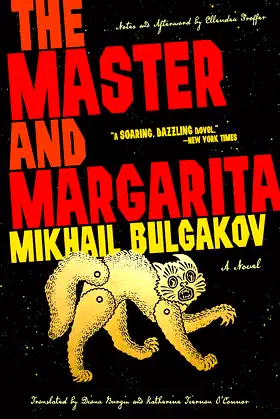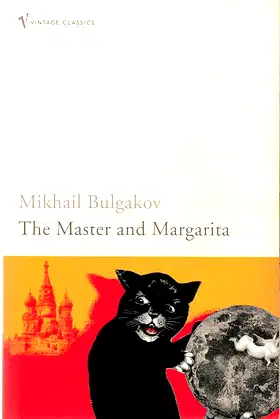
BOOK
0
in Bulgakov's allegorical masterpiece of Stalin’s regime the devil is making a personal appearance in Moscow.He is accompanied by various demons, including a naked girl and a huge black cat. When he leaves, the asylums are full and the forces of law and order are in disarray. Only the Master, a writer and a man devoted to truth, and Margarita, the woman he loves, can resist the devil’s onslaught.‘Stunning, superb...Bulgakov is one of the greatest Russian writers, perhaps the greatest’ Independent‘A masterpiece – a classic of twentieth-century fiction’ New York TimesTRANSLATED BY MICHAEL GLENNY, INTRODUCED BY WILL SELF
Surely no stranger work exists in the annals of protest literature than The Master and Margarita. Written during the Soviet crackdown of the 1930s, when Mikhail Bulgakov's works were effectively banned, it wraps its anti-Stalinist message in a complex allegory of good and evil. Or would that be the other way around? The book's chief character is Satan, who appears in the guise of a foreigner and self-proclaimed black magician named Woland. Accompanied by a talking black tomcat and a "translator" wearing a jockey's cap and cracked pince-nez, Woland wreaks havoc throughout literary Moscow. First he predicts that the head of noted editor Berlioz will be cut off; when it is, he appropriates Berlioz's apartment. (A puzzled relative receives the following telegram: "Have just been run over by streetcar at Patriarch's Ponds funeral Friday three afternoon come Berlioz.") Woland and his minions transport one bureaucrat to Yalta, make another one disappear entirely except for his suit, and frighten several others so badly that they end up in a psychiatric hospital. In fact, it seems half of Moscow shows up in the bin, demanding to be placed in a locked cell for protection. Meanwhile, a few doors down in the hospital lives the true object of Woland's visit: the author of an unpublished novel about Pontius Pilate. This Master--as he calls himself--has been driven mad by rejection, broken not only by editors' harsh criticism of his novel but, Bulgakov suggests, by political persecution as well. Yet Pilate's story becomes a kind of parallel narrative, appearing in different forms throughout Bulgakov's novel: as a manuscript read by the Master's indefatigable love, Margarita, as a scene dreamed by the poet--and fellow lunatic--Ivan Homeless, and even as a story told by Woland himself. Since we see this narrative from so many different points of view, who is truly its author? Given that the Master's novel and this one end the same way, are they in fact the same book? These are only a few of the many questions Bulgakov provokes, in a novel that reads like a set of infinitely nested Russian dolls: inside one narrative there is another, and then another, and yet another. His devil is not only entertaining, he is necessary: "What would your good be doing if there were no evil, and what would the earth look like if shadows disappeared from it?" Unsurprisingly--in view of its frequent, scarcely disguised references to interrogation and terror--Bulgakov's masterwork was not published until 1967, almost three decades after his death. Yet one wonders if the world was really ready for this book in the late 1930s, if, indeed, we are ready for it now. Shocking, touching, and scathingly funny, it is a novel like no other. Woland may reattach heads or produce 10-ruble notes from the air, but Bulgakov proves the true magician here. The Master and Margarita is a different book each time it is opened. --Mary Park
Bulgakov's satire of the greed and corruption of Soviet authorities illustrates the redemptive nature of art and faith, and Julian Rhind-Tutt's superb interpretation does the classic full justice. With a dramatic flair and a deep, multilayered voice, he pulls off a host of fantastical characters including Professor Woland (Satan) and several of his associates, Pontius Pilate and Jesus Christ, witches and madmen and a variety of early 20th-century Moscow literary and theater types. Two minor caveats: a few characterizations are too nasal, and his cockney accents for low-class Russian characters are a bit disconcerting. (June) Copyright © Reed Business Information, a division of Reed Elsevier Inc. All rights reserved.
“One of the truly great Russian novels of [the twentieth] century.”
“The book is by turns hilarious, mysterious, contemplative, and poignant . . . A great work.”
“Bulgakov’s The Master and Margarita is a soaring, dazzling novel; an extraordinary fusion of wildly disparate elements. It is a concerto played simultaneously on the organ, the bagpipes, and a pennywhistle, while someone sets off fireworks between the players’ feet.”
“Fine, funny, imaginative . . . The Master and Margarita stands squarely in the great Gogolesque tradition of satiric narrative.”
“A wild surrealistic romp . . . Brilliantly flamboyant and outrageous.”
“Sparkling, enchanting, funny, deeply serious and sometimes baffling . . . [The Master and Margarita is] a liberating, exuberant social and political satire combined with a profound moral and political allegory . . . A bravura performance of truly heroic virtuosity, a carnival of the imagination.”
Introduction by Simon Franklin; Translation by Michael Glenny
The devil, disguised as a magician, descends upon Moscow in the 1930s with his riotous band, which includes a talking cat and an expert assassin. Together they succeed in comically befuddling a population which denies the devil's existence, even as it is confronted with the diabolic results of a magic act gone wrong. This visit to the capital of world atheism has several aims, one of which concerns the fate of the Master, a writer who has written a novel about Pontius Pilate, and is now in a mental hospital. Margarita, the despairing and daring heroine, becomes a witch in an effort to save the Master, and agrees to become the devil's hostess at his annual spring ball. By turns acidly satiric, fantastic, and ironically philosophical, this work constantly surprises and entertains, as the action switches back and forth between the Moscow of the 1930s and first-century Jerusalem.
How this posthumously published satire got written in Stalinist Russia and survived is as fascinating a story as the one it tells. Upon finally being printed, it became an international sensation that literati still acclaim as a modern classic. This complex, multilayered, and Rabelaisian novel is impossible to summarize. Suffice it to say that when Satan incognito brings a hellish gang to the officially atheist USSR, mayhem ensues, in the course of which the author verbally skewers the Soviet literary, social, and political establishments. Incongruously for the American ear, Julian Rhind-Tutt gives a decidedly Cockney spin to his narration. But he also gives it mischief, invention, and unflagging energy. Thus, he makes even the more obscure passages enjoyable listening. A fine reading of an important book. Y.R. Winner of AudioFile Earphones Award © AudioFile 2009, Portland, Maine
Find it on
AmazonNo videos available yet.
No news articles linked to this title yet.

Overall
Overall rating of the media
Atmosphere
How immersive and tense is the atmosphere
Gore
Level and quality of gore/violence
Story
Quality of the storyline and plot
Writing
Quality of the written content
Character Development
Depth and growth of characters
Pacing
Flow and timing of the narrative