
BOOK
0
In a story of good and evil, a gentle doctor's experiment into the duality of the soul goes awry and he is transformed into a hideous monster at night.
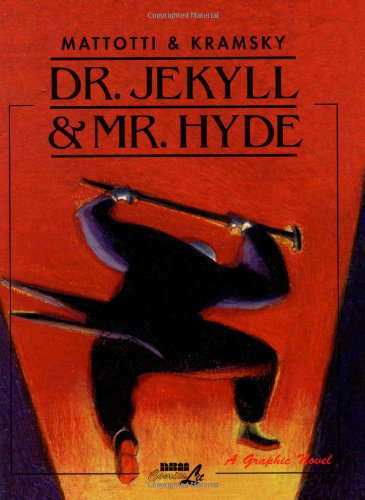
Mattotti and his longtime collaborator Kramsky return to the comix world with an interpretation of Robert Louis Stevenson's tale of gothic horror. While the story is set in Victorian England, Mattotti's artwork evokes the masterful expressionism of Berlin of the 1930s and such influences as Max Beckman, George Grosz and Giorgio de Chirico. Dr. Jekyll's obsession with the duality of the human personality-the good and evil that reside within-leads him to concoct the potion that brings out his purely evil side. Depicting this transformation, Mattotti's art becomes even more expressive, reminiscent of the later paintings of Francis Bacon. Jekyll's assertion that with his potion "Life would be relieved of all that is horrible" proves wrong. Indeed, he has distilled life's horrors in the person of the brutal Mr. Hyde, who haunts the nightclubs, parties, darkened streets and brothels of London, a perfect vehicle for Mattotti's masterful command of color, composition and mood. An accomplished colorist, Mattotti saturates the book's pages with a rich palette, and each panel is beautiful and expressive. Kramsky's adept condensation of Stevenson's book appropriates snatches of the original text verbatim, maintaining the power of Stevenson's prose while using a minimum amount of text. This is an impressive and vivid interpretation of Stevenson's timeless tale of the human spirit. Copyright 2003 Reed Business Information, Inc.
The comic book has been a foremost medium of literary adaptation since the 1940s success of Classics Illustrated. Comics adaptations have been notably truer to their sources than their principal rival, the movies, though often less than graphically distinguished. Stevenson's great evil-doppelganger tale achieved its horrific effects by inference, but visual adaptations have made its violence explicit. Arnold L. Hicks' lurid expressionist cover for the first Classics Illustrated version of it provoked protest and was suppressed. Mattotti's virtuosic realization appears to have taken a cue from Hicks'. This is a visualization of intense colors, among which blood red predominates, deployed in the sweeping curves of dynamically drawn bodies, objects, and light effects. Faces and gestures recall the decadence-drenched caricatures of George Grosz, as do the settings on the evening streets and in the brothels and lower-class haunts of London. Odd angles of vision and psychologically resonant details deepen the aura of terror and corruption as they echo the paintings of Edvard Munch and the classic film of expressionist horror, The Cabinet of Dr. Caligari. Despite updating the story from the 1880s to the 1920s, Mattotti makes every other Jekyll-and-Hyde visualization seem inadequate. Ray OlsonCopyright © American Library Association. All rights reserved
Find it on
AmazonNo videos available yet.
No news articles linked to this title yet.

Overall
Overall rating of the media
Atmosphere
How immersive and tense is the atmosphere
Gore
Level and quality of gore/violence
Story
Quality of the storyline and plot
Writing
Quality of the written content
Character Development
Depth and growth of characters
Pacing
Flow and timing of the narrative