
BOOK
0
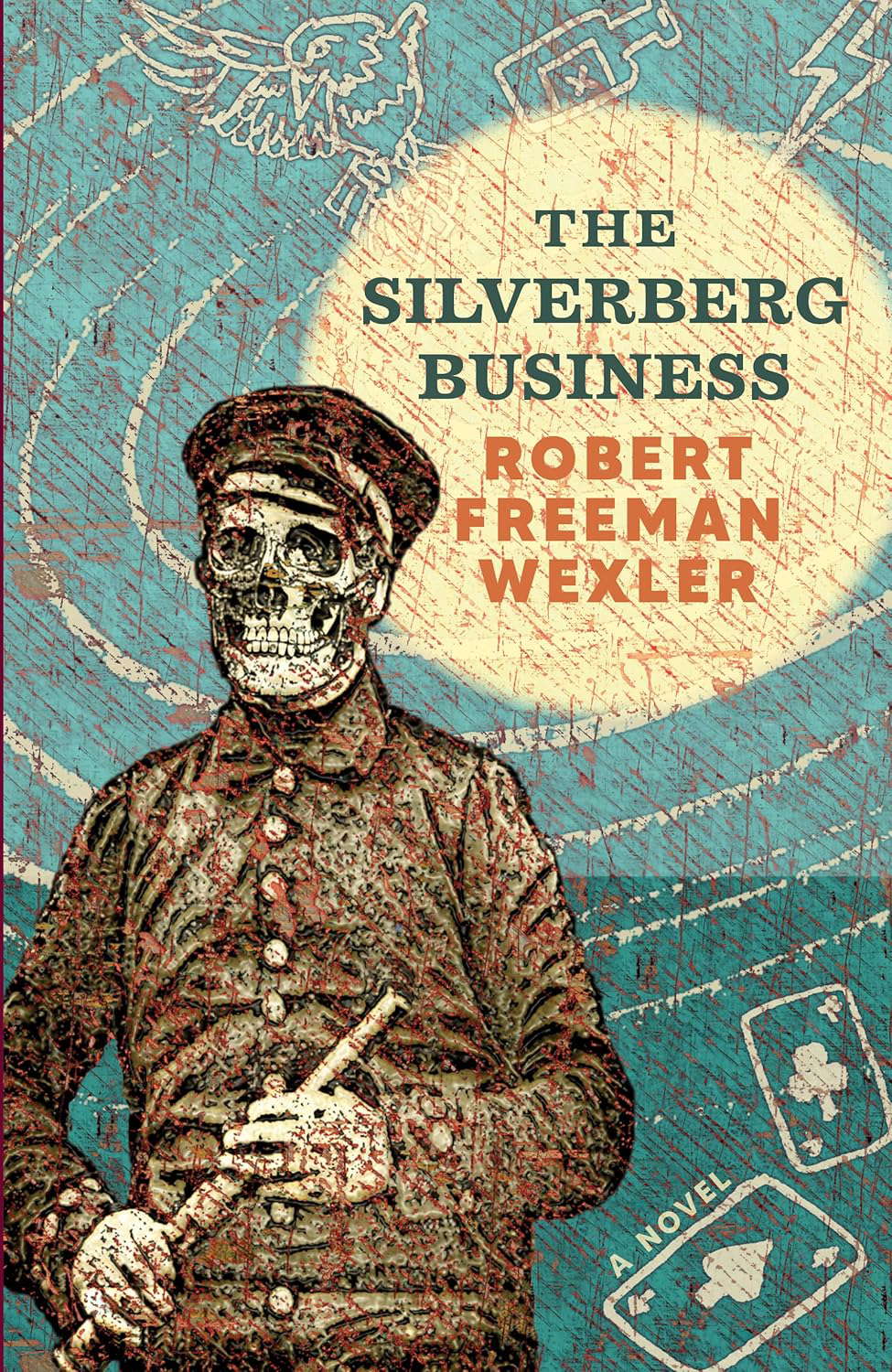
In 1888 in Victoria, Texas, for a simple job, a Chicago private eye gets caught up in the poker game to end all poker games.Shannon, a Chicago private detective, returns home to Galveston, Texas for a wedding. Galveston’s new rabbi asks Shannon to find Nathan Silverberg, gone missing along with a group of swindlers who claim to be soliciting money for a future colony of Romanian Jewish refugees. What seems to be a simple job soon pushes Shannon into stranger territory. His investigations lead him to a malevolent white-haired gambler, monstrous sand dune totems, and a group of skull-headed poker players trapped in an endless loop of cards and alcohol, who may be his only means to survive the business. With The Silverberg Business, Robert Freeman Wexler has delivered a gloriously strange hard-boiled tale that crosses genres and defies expectations.
"By subverting expectations in both genre and character, Wexler’s writing continually asked me to look closely, beyond initial expectations and surface observations
"Shannon isn’t planning to become embroiled in a case while visiting his family in Galveston, but when his old rabbi asks him to look into a group of men who might be swindling Jewish refugees, he can’t say no. . . . In this effective, creeping, weird-western novel, time slips, hands fold, and something ancient brews. Wexler refuses to give the reader all of the answers, instead leaving them with a slight, satisfying shiver and visions of stormy seas."
“A haunting novel that traverses an American West inhabited by nightmarish characters, human and otherwise, The Silverberg Business evokes the unease of classic weird fiction with a contemporary gloss: William Hope Hodgson’s The Night Land by way of Jim Jarmusch and Cormac McCarthy. Unnerving and unforgettable.”
"Robert Freeman Wexler never fails to knock me out, and The Silverberg Business hits like a hurricane
An excerpt from Chapter 1 of The Silverberg Business The Business I woke from another of those swimming on land dreams. Those are the ones where I’m on my way to wherever I have to be until somehow...I can’t remember how to walk. I sink to my knees, shuffle along like that for a while. Then I’m on my stomach. I squirm, crawl, try to crawl--anything to keep moving, flopping on grass or pavement. Eventually, I stop trying. At least it hadn’t been the other kind of dream, the chasing dream, where I’m after someone, or someone is after me--or some Thing, some creature, and it’s almost on me. I can’t shoot my gun--no, that’s not it: shooting is complicated. No trigger--I have to scream the bullets out, but miss or have no effect. They don’t stop what’s after me. I always wake up yelling. Embarrassing when you’re not alone. The morning sun banged against the windowpane. I had gone to sleep without closing the curtains. Not that they would have helped much. I rolled away from the glare, but sleep wouldn’t return. I looked around, working to recall where I was. Floral wallpaper, chipped washbasin--the room I took last night in the Delmonico Hotel, Victoria, Texas. I got out of bed, bent over the washbasin to splash my face, pissed in the pot, and put on my clothes, ending with a brown cotton sack-coat to cover the Bulldog revolver in its shoulder harness. I carried my hat, a brown derby, down to the hotel’s restaurant. From the doorway, I studied the room--one quick glance--as I’ve done in many rooms for the last ten years. Single diner, man, dressed for town, dark vest over white shirt with detachable collar. He wasn’t heavy and he wasn’t thin. The shirt looked new. I didn’t need to examine him, or anyone in the hotel, but that’s what I do. Studying a room is a practice I can’t stop. Because there are times when doing it keeps me alive. The waitress was small, with dark hair and a smile that told me nothing except that she was awake and doing what she needed to do. Which at this moment was to take me to a table. As I passed the man we exchanged nods. The waitress sat me near a window; I watched the flow of pedestrians: an old man covered in soot, a smiling young redheaded woman with a man who had the weathered face of a rancher, a stout woman and two children. A man glanced in; he wasn’t old, but his eyebrows and hair were bone-white. His rusted eyes stared into mine--I froze, helpless, unable to act, unable to save myself...a wave crashed the shore, then another, waves that towered, that smote the sand with unknowable force. I tried to run, couldn’t, tried to crawl, couldn’t. The hammer of wave crushed my shell...millions of tiny crystal shards mixed with spray-clouded air. Daylight faded. The spent wave departed, leaving sand sculpted into fantastic whorls and ridges, and...a stench...rot...the kind of rot you get after a storm passes and the sun bakes whatever the waves dredged from the depths. Another scent came to me...earthy, earthy and pleasing--my hand touched warmth. A mug. The blessed waitress had brought coffee. I drank. Unease receded, waves subsided to harmless foam. The dining room was clean and dry. Outside the windows, sunshine and no white-haired man. I drank more coffee. Stupidity began to lift. The waitress returned to refill my cup and take my order. My stomach reminded me that yesterday I had eaten little. I hadn’t meant to drink whiskey, not so much anyway. The problem was Galveston--childhood home left long ago. I had been there for a cousin’s wedding, also attended by ghosts from the past, particularly one in a green dress. Seeing her had made me wistful, made me reflect on my life in Chicago, the crime investigations and frequent travel to towns where people often resented my presence. She looked happy enough with her husband and three children. To her, my life no doubt appeared adventuresome. Which enforced her belief that she had made the correct decision--women may have romantic notions about adventure, but they choose domestic stability. I can’t blame her for being sensible. The waitress had also brought the local paper, Victoria Advocate, dated Saturday, October 27, 1888. Today was Monday the 29th. I perused the section called “The Outside World, An Interesting Jumble of Both Foreign and Domestic News for Victoria Readers,” in which I discovered that the champion boxer John L. Sullivan, at twenty-nine years of age, has made and spent $300,000 in the last three years but is now broke and incapable of fighting; the many dog farms of frozen Manchuria provide us with splendid fur to make our coats, and: L. Herman, a New York money changer and banker, has disappeared with $5,000 belonging to Polish Jews. The money had been entrusted to his care and was to have been sent to England. That last item...I had been hired to investigate a similar crime. Sometimes, fraud is so apparent yet unrecognized that the intelligence of the whole of humanity becomes questionable. And yet, humanity somehow continues to advance, inventing and creating, as if there’s a wall between intelligence and gullibility, so that no matter how educated or experienced a man might be, there’s a fraud to which he will fall victim. By that logic, I would have to be included as one of the eventually gullible, but I haven’t fallen yet. Unless I was so unaware that I didn’t recognize it at the time and still don’t. This is the thinking that keeps a detective awake at night. I ate my eggs and beef and flapjacks. The other man, his breakfast over, lingered to roll a smoke. A family entered, a man and woman accompanied by miniature versions of themselves. The fraud that brought me to Victoria involved a group calling themselves the Romania-America Relocation Movement. They solicited donations from East Coast Jews to pay for moving Romanian Jews to a new colony on the Texas coast. Money accumulated in an account in New York. Nathan Silverberg, the representative who had met with donors, was sent by train to Victoria, carrying a bank draft. On arrival, Silverberg was to open an account at Sibley and Sons Bank, then look at property with local representatives and purchase land for the colony. The settlement was a sham. My job was to find Silverberg and the money. Silverberg was a well-known and respected member of the Jewish community in New York. Which didn’t mean he wasn’t part of the swindle, but it was more likely that the swindlers had used him as a way to get the money. Either way, I would have to find him. My client was Rabbi Henry Cohen, of Galveston. I met him at the wedding and agreed to the job. I had things I wanted to get back to in Chicago, but I didn’t think this Silverberg business would take me long. Breakfast over, I got up, leaving the newspaper for the next diner. I set the derby on my head and went outside. Steady rainfall had accompanied my train, and the morning sun steamed the puddled residue. I can’t say I enjoy Chicago winter, but I do like a pleasant autumn. I like that there is an autumn. Growing up on the Gulf, I hadn’t known such a thing existed. I crossed the street, avoiding puddles and the swarm of horses and wagons. Victoria’s population, I’ve been told, is approaching 4,000, but it still has the feel of a frontier town. Seeing the sign for a barber’s, I stopped and went in for a shave and a moustache trim. Next stop was Sibley and Sons, partway down the next block. I entered and approached the clerk, a thin man with gray eyes and beard, and gave him my Llewelyn Detective Agency card. “I sent a telegram that I would be coming,” I said. “You sure don’t look Irish, Mr. Shannon,” he said. He went to find the manager. I’ve been told I don’t look Jewish either. No doubt some people can see the secret marks on my forehead, but most take me as a regular American. I don’t feel like one; I doubt Jews will ever feel they belong with the regular Americans. No matter how much freedom there may be here, compared to most of Europe, someone will eventually come along to force us back into our ghetto. The family name was Chanun. Changed for convenience by the bilge rats in charge of immigration when my grandparents arrived in New York.
Find it on
AmazonNo videos available yet.
No news articles linked to this title yet.

Overall
Overall rating of the media
Atmosphere
How immersive and tense is the atmosphere
Gore
Level and quality of gore/violence
Story
Quality of the storyline and plot
Writing
Quality of the written content
Character Development
Depth and growth of characters
Pacing
Flow and timing of the narrative