BOOK
0
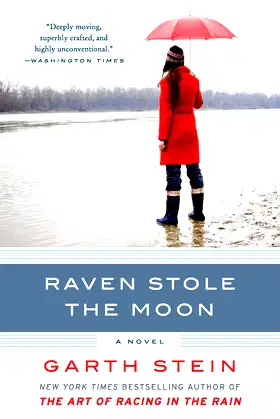
“Deeply moving, superbly crafted, and highly unconventional.” —Washington TimesRaven Stole the Moon is the stunning first novel from Garth Stein, author of the phenomenal New York Times bestseller The Art of Racing in the Rain.A profoundly poignant and unforgettable story of a grieving mother’s return to a remote Alaskan town to make peace with the loss of her young son, Raven Stole the Moon combines intense emotion with Native American mysticism and a timeless and terrifying mystery, and earned raves for a young writer and his uniquely captivating imagination. When Jenna Rosen abandons her comfortable Seattle life to visit Wrangell, Alaska, it’s a wrenching return to her past. The old home of her Native American grandmother, Wrangell is located near the Thunder Bay resort, where Jenna’s young son Bobby disappeared two years before. His body was never recovered, and Jenna is determined to lay to rest the aching mystery of his death.But whispers of ancient legends begin to suggest a frightening new possibility about Bobby’s fate, and Jenna must sift through the beliefs of her ancestors, the Tlingit -- who still tell of powerful, menacing forces at work in the Alaskan wilderness. Jenna is desperate for answers, and she appeals to a Tlingit shaman to help her sort fact from myth, and face the unthinkable possibilities head-on. Armed with nothing but a mother’s ferocious protective instincts, Jenna’s quest for the truth about her son -- and the strength of her beliefs -- is about to pull her into a terrifying and life-changing abyss....
On impulse, Jenna Rosen leaves the party she and her real estate developer husband, Robert, are attending in Seattle, takes his BMW and drives north to Bellingham. Again on impulse, she hops on the ferry to the Alaskan town where her Tlingit Indian grandmother lived and died. But there's more than impulse at work here: Jenna and Robert's 5-year-old son, Bobby, drowned in Alaska just two years ago, and something is drawing Jenna back to the scene. On the ferry, she's given a carved silver charm of a Tlingit spirit called a kushtaka, a stealer of souls. "Tlingits don't have good and evil," a local shaman explains, telling the story of how the spirit known as Raven gave the world the sun, moon, and stars by stealing them from someone else. As Jenna learns more about the kushtakas, helped by this very sophisticated shaman and an understanding fisherman, she begins to believe that her son's soul is being held captive by these spirits, as revenge for her husband's greed. Garth Stein's persuasive prose draws us into a book that mixes fantasy with tragedy and the natural human desire for closure.
Her upscale Seattle lifestyle lost meaning for Jenna Rosen when her young son drowned in Alaska. On the second anniversary of his death, she impulsively takes a ferry to Wrangell, where she grew up and which is not far from the drowning site. Once there, Jenna often feels menaced; even as a dog appears to protect her, shape-changing kushtaka (Indian spirits) repeatedly threaten her life?corporal and eternal. Her husband, Robert, arrives in Wrangell after he learns from a private investigator that she is living with a young fisherman. Only when a shaman risks his life to save Jenna and to help put their son's soul to rest are the Rosens able to resolve their grief. Stein's richly textured first novel, drawing on his Tlingit heritage and award-winning filmmaking experience, is layered with vivid descriptions and characters. Recommended for all fiction collections.?V. Louise Saylor, Eastern Washington Univ. Libs., CheneyCopyright 1998 Reed Business Information, Inc.
Still grieving two years after the death of Bobby, her five-year-old son, Jenna Rosen takes off one day, leaving her husband behind. Heading north from Seattle, she finds herself on a ferry to Wrangell, Alaska, where her grandmother, a Tlingit Indian, lived. Wrangell is also near Thunder Bay, the fishing resort where Bobby drowned. On the ferry, Jenna is given a necklace with a charm representing a kushtaka, and an old women tells her the Tlingit legend--that the kushtaka are shape-shifting soul stealers who inhabit a kind of twilight region between the living and the dead. In Wrangell, Jenna finds some solace in her friendship with a local fisherman. At the same time, strange events help convince her that Bobby has been adopted by the kushtaka, and she tracks down anyone, including a shaman, who can lead her to him. Her efforts culminate in a terrifying encounter. Though the novel has some elements of a supernatural thriller, it is actually stronger as a story about grieving and coming to terms with loss. Mary Ellen Quinn
Ingratiating, mildly spooky thriller debut about feckless yuppies whose mythic escapades with creepy Tlingit bogeymen lead to romance and redemption. Two years after her four-year-old son drowns beneath the dark waters off the Alaskan coastal town of Wrangell, Jenna Rosen is still tortured by feelings of guilt and loss. Fleeing her boorishly insensitive husband, Robert, a thriving Seattle real- estate broker, she drives his prized BMW aimlessly throughout the night. Eventually, she ditches the car and, after a few carefree swipes of her credit card, acquires a new wardrobe from Banana Republic and a ticket on an Alaskan ferry that takes her back to Wrangell and the boarded-up house where her part-Tlingit grandmother died. Meanwhile, in another part of Wrangell, professional Tlingit shaman Dr. David Livingstone (who quietly endures numerous ``I presume'' greetings) encounters many ``stolen souls'' haunting a new tourist hunting lodge. Hired at the behest of Japanese investors by the resort's disbelieving project manager, Livingstone finds the area filled with kushtaka- -mythological, otterlike shape-changers that snatch the souls of people who've died without being cremated, or who've merely become lost in a dank, woodsy never-never land where these souls are rapidly transformed into even more kushtaka. Back in Seattle, Robert is suddenly terrified to be without his wife and hires Joey, a repugnant private detective, to find her. Joey does find Jenna--in the arms of twentysomething Alaskan slacker/fisherman, a new romantic interest that'll give her the courage to join up with Oscar, the friendly spirit dog, and the (literally) presumptuous Dr. Livingstone, to snatch back her dead son's soul. A supernatural thriller with an alternately satiric and solemn take on New Age spirituality. At best, more pleasing than profound. -- Copyright ©1998, Kirkus Associates, LP. All rights reserved.
From the author of the acclaimed New York Times bestseller The Art of Racing in the Rain comes an extraordinary tale of grief, devotion, redemption, and timeless mystery.When Jenna Rosen abandons her comfortable Seattle life to visit Wrangell, Alaska, it's a wrenching return to her past. The hometown of her Native American grandmother, Wrangell is located near the Thunder Bay Resort, where Jenna's young son, Bobby, disappeared two years before. His body was never recovered, and Jenna is determined to lay to rest the aching mystery of his death. But whispers of ancient legends begin to suggest a frightening new possibility about Bobby's fate, and Jenna must sift through the beliefs of her ancestors, the Tlingit, who still tell of powerful, menacing forces at work in the Alaskan wilderness. Armed with nothing but a mother's protective instincts, Jenna's quest for the truth behind her son's disappearance is about to pull her into a terrifying and life-changing abyss.
Chapter OneJohn Ferguson stood on the dock next to the seaplane and watched as the small figure in the Boston Whaler approached. The blue boat got closer and the sound of its big outboard engine tore into the peaceful Alaskan morning, forcing a cluster of geese to take to the air in retreat. Fergie had to laugh to himself. He was paying some Indian specialist five grand to come and check the place out. At a community board meeting in the neighboring town of Klawock, people suggested that he call Dr. David Livingstone, because he's the best around. Fergie jokingly said, "I didn't know witch doctors got to use the title 'doctor,'" and he found that he had offended almost everyone in the room. Turns out the guy is a shaman and a Ph.D. Go figure. The boat was within twenty yards now, and Fergie was surprised to see that Dr. Livingstone was a young, good-looking man, not the old, shriveled-up Indian in a canoe he had expected. He waved at the boat and received an acknowledging wave in return. The boat pulled up and the young man hopped out. "Ferguson?" the young man asked, tying the boat to the dock. "Dr. Livingstone, I presume." Fergie had been working on that line for about a week. He had been dying to say it, but he was desperately afraid it would offend. It didn't seem to. Dr. Livingstone smiled. "David." David reached into the boat and pulled out several old burlap bundles. He arranged them in a row on the dock. Fergie didn't know if he should offer to help or if the bundles were Indian magic and he would taint them by touching them. He uncomfortably shifted from foot to foot, watching. "Well, what do you think? Do you have any first impressions?" he asked hopefully. "Any spirits of Tlingit past haunting the place?" Fergie tried to pronounce the Indian name correctly, so as not to sound ill-informed. Klink-it. Having heard a real Indian pronounce it, he knew that it was actually supposed to sound more guttural, like a big bite being taken out of an apple. David finished unloading his bundles and stood upright. He was not tall, about five-six or so, with black hair that grew down to his waist and a soft-featured round face. His open brown eyes seemed to celebrate vision, and when he turned to Fergie, he appeared to draw closer. "How much do you know about the Tlingits, Ferguson?" "Oh, I don't know," Ferguson hedged. He had figured he would be in for a pop quiz, so he studied the entry in The Encyclopedia of the American Indian. "I know that the Tlingits and the Haida were the two biggest tribes in this area. Their main economy was fishing and trapping. They traded with the Russians and the British. In the late 1800s the government outlawed native languages and potlatches, but that's over now." "Well, that's not exactly true," Livingstone corrected. "You understand the spirit of the law but not the letter of it." Ferguson's sigh was a bit louder than he had intended. He closed his mouth and looked past Livingstone's shoulder at the white-peaked blue mountains in the distance. "The government didn't actually outlaw native languages and potlatches," David explained. "What they did is define civilized Indians as those who didn't associate with any other Indians. Indians who did associate with other Indians were considered uncivilized and were sent to reservations or Indian schools. So the effect of the law, as you correctly deduced, was to eliminate native languages and potlatches. But that wasn't the law itself." "I didn't know that." "The white man is far too clever to do anything with the outward appearance of impropriety." Ferguson nodded slowly. He had just met Livingstone, but already he wasn't sure he liked him. There was something appealing about him, but it was buried under a cockiness and arrogance that turned Ferguson off. David knelt down and unrolled one of the bundles. Inside were strings of beads and animal claws. "Do you know anything about our beliefs?" David asked. "Our legends?" Ferguson decided to play it safe. No more stupid answers. Not another possibility for an embarrassing reply. Sometimes silence is your best defense. He shook his head. "I see. But you think this place is haunted by our ghosts?" Ferguson swallowed hard. Caught again. He wanted to tell David what he really thought, that this was all a big pain in his ass. That he was just doing it because a group of Japanese investors were going to put up a lot of money, but they insisted that the resort be "spiritually cleansed" before the deal was finalized. But Fergie knew better than to say something like that. That would be too straightforward. "Look, Doctor, as much as I would have loved to study all about the Tlingit culture, my hands are real full trying to get this place up and running for some prospective investors in July. I apologize, but I just haven't had the time." "Don't be defensive, Ferguson, it was just a simple question. I wanted to know where we stood. Now I know." David's innocent and sincere look made Fergie even more uncomfortable. He desperately wanted to fill the void between them, so he spoke. "The general partners have made a commitment to being as sensitive as possible to the history of the area and the culture of the Tlingit peoples," Ferguson said. "We don't want to move ahead and find out later on that we have a...uh, you know...a situation." "A lawsuit-type situation, or The Shining-type situation?" Fergie squirmed. Damn, this guy really knew how to put a guy on the spot. "Uh, well, I would say, definitely, well, both." David smiled at him with his big, warm eyes, and Fergie settled down. He hated talking with these people because he always managed to say something offensive. You can't use your normal language with minorities. You start worrying about what words you can use, and then you sound uncomfortable, and then they take that as your being racist, and then it's all messed up. "I tell you what, Ferguson," David started. "You have your lawyers use their magic to take care of the lawsuit situations, and I'll use my magic to take care of the ghost situations. How's that sound?" Ferguson exhaled deeply and grinned. "Sounds good to me, Doctor. After all, you're the doctor." David unrolled another bundle. Ferguson could see a part of a deer antler. "What exactly are you going to do to take care of the ghost situations? Just out of curiosity." David looked up. "I'm gonna dress up in feathers, shake a rattle, and throw some magic dust around. I'm an Indian, what do you think I'm gonna do?" David laughed. And Ferguson, surprised but pleased, laughed, too. Copyright © 1998 by Garth Stein
Find it on
AmazonNo videos available yet.
No news articles linked to this title yet.

Overall
Overall rating of the media
Atmosphere
How immersive and tense is the atmosphere
Gore
Level and quality of gore/violence
Story
Quality of the storyline and plot
Writing
Quality of the written content
Character Development
Depth and growth of characters
Pacing
Flow and timing of the narrative