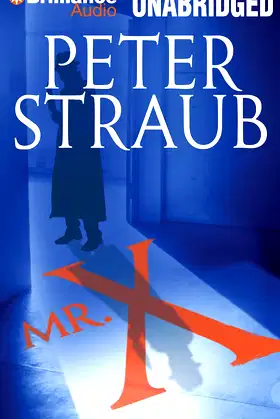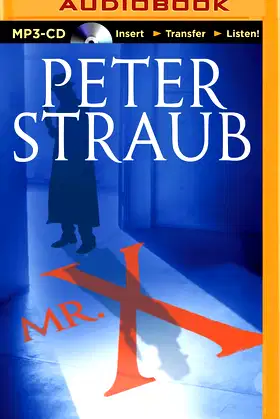
BOOK
0
The award-winning supernatural thriller from the acclaimed author of Ghost Story, Koko, The Throat and The Talisman.Every year on his birthday, Ned Dunstan has a paralysing seizure in which he is forced to witness scenes of ruthless slaughter perpetrated by a mysterious figure in black whom he calls Mr X. Now, with his birthday fast approaching, Ned has been drawn back to his home town of Edgerton, Illinois, by a premonition that his mother is dying. On her deathbed, she imparts to him the name of his long-absent father and warns him that he is in grave danger. Despite her foreboding, he embarks on a search through Edgerton’s past for the truth behind his own identity and that of his entirely fantastic family. But when Ned becomes the lead suspect in three violent deaths, he begins to realise that he is not the only one who has come home…
Peter Straub's Mr. X is an enthralling, complex tale of a decent young man troubled since childhood by barely understood flashes of precognition and an awareness of a shadowy "other." Ned Dunstan returns home to Edgerton, Illinois, a raffish and atmospheric Mississippi River city, as his mother, Star Dunstan, lies dying. Impelled to trace his tangled paternal lineage after Star's death, Ned finds himself caught up in a web of murder and other heinous crimes, not only in the present but also in a past that his elderly great aunts Nettie, May, and Joy would prefer remained undisturbed. The aunts, whose remarkable gifts include teleportation and telekinesis, frustrate his search for knowledge, partly to protect their own secrets and also to shield Ned from the mysterious and omnipresent force that seems to dodge his every step. He is aided in his efforts to discover the mysteries of his birth by a doppleganger who may or may not be his twin, and also by a lovely young woman, Laurie Hatch. She is the estranged wife of Stewart Hatch, an Edgerton scion whose own history is inexorably linked with Ned's and with the entire Dunstan family. The secondary characters, from the elderly aunts to a lawyer named Creech who is the essence of the small-town "fixer," are deftly drawn. --Jane Adams
Since the publication of Koko in 1988, Straub has specialized in macabre mysteries dense with the details of small-town life and cast with ordinary people who find that the extraordinary crimes they investigate raise doubts about their own moral integrity. In this bravura new outing, he returns to his horror roots, lacing an ingenious whodunit with an intoxicating shot of the supernatural. From childhood, Ned Dunstan has experienced precognitive visions, a recurring dream of being tethered to a shadow and "the sense that something crucially significant, something without which I could never be whole, was missing." Summoned home to Edgerton, Ill., by a premonition of his mother's death on the eve of his 35th birthday, Ned finds himself implicated in a tangle of felonies and murders, all of which point to someone strenuously manipulating events to frame him. Digging into local history, he finds reason to believe that the mysterious father he never knew, or possibly a malignant doppelg?nger, are pulling the strings. Meanwhile, Mr. X, a homicidal misanthrope who reads H.P. Lovecraft's otherworldly horror fiction as gospel, cuts a swath of supernatural destruction across the country, en route to a showdown with his son, the "shadow-self" whom he must annihilate. Discerning readers will recognize this surprise-filled tale of tortuous family relationships as a modern variation on Lovecraft's classic shocker "The Dunwich Horror." But Straub turns his pulp model inside out, transforming its vast cosmic mystery into an ingrown odyssey of self-discovery and a probing study of human nature. His evocative prose, a seamless splice of clipped hard-boiled banter and poetic reflection, contributes to the thick atmosphere of apprehension that makes this one of the most invigorating horror reads of the year. BOMC main selection. (Aug.) FYI: This spring, Subterranean Press published a chapbook, Peter and PTR: Two Discarded Prefaces and an Introduction, that includes framing material that Straub wrote for, and then cut from, Mr. X. Copyright 1999 Reed Business Information, Inc.
The "Mr. X" of the title is the shade that seems to follow Ned Dunstan through life. Ned is the only son of Star, a part-time lounge singer and itinerant artist who comes from an unusually talented family. As Ned states early on in the book, he was always looking for his shadow. He doesn't know his father growing up but learns the truth about him in the course of the book. What Ned eventually finds is the crux of the plotAsuffice it to say that his discoveries are unsettling. Mr. X proves that Straub (The Hellfire Club) is worthy of his reputation as a master of horror. Compelling writing and well-drawn characters make this novel very readable, but the labyrinthine plot seems forced; it does include some sexual situations and some violence. Recommended for all suspense/ horror collections.-AAlicia Graybill, Lincoln City Libs., NE Copyright 1999 Reed Business Information, Inc.
Ned Dunstan goes home to Edgerton, Illinois, because he feels certain his mother is going to die there. Star Dunstan, a drifting jazz singer, left after Ned's early childhood, yet there she is, in an ICU with a stroke. Before she dies, she tells Ned the name of his father and another name, Robert. It turns out, in Straub's lumbering, ramshackle thriller, that Robert is Ned's twin, whom Star was sure she was bearing but who didn't turn up after labor. Robert is a shadow, a doppelganger, who has mastered the Dunstan family trick of self-teleportation. Unfortunately, so has their daddy, a psychopath who believes H. P. Lovecraft's horror stories are not fiction. He is Mr. X, capable of lethally materializing and dematerializing to leave only the splashed blood of his eviscerated victims behind. He means to destroy Ned before, he believes, Ned somehow destroys him. Ned first has to find him, which involves much family secret-divulging, amateur shamusing, and sack-time for Ned with the book's best-lookin' babes. As frosting on the cake, Ned eventually learns the other Dunstan family trick, willed time-travel or, as they call it, eating time. Self-important small-town millionaires, cops corrupt and honest, the crusty elder Dunstans, and red-light district lowlifes join the aforementioned babes in the crowded cast of what is essentially a spooky detective yarn, the sort of thing 1950s genre hands like Fredric Brown and Robert Bloch could turn into a crackerjack 192-page paperback. Straub's treatment still amuses, but someone should send him a blue pencil for Christmas. Ray Olson
Admirers of H.P. Lovecraft's classic supernatural tales will find much of interest in this intricately contrived horror story. The protagonist, Ned Dunstan, a computer programmer whose 35th birthday is fast approaching, in fact ``enters'' a world specifically inspired by Lovecraft's demon-infested ``Cthulha Mythos'' as he returns to his Illinois hometown for the funeral of his mother Valerie (a.k.a. ``Star,'' an itinerant jazz singer whose rootless life made her almost as much a stranger to Ned as was the father he never knew). Almost immediately, inexplicable things begin to happen: Ned is accused of crimes he couldn't possibly have committed; the dream that has troubled him since childhoodof his shadow pursuing and threatening himedges ever closer to reality; and reunions with his Illinois relatives turn up evidence that he may have been the son of Edward Rinehart, a mad writer of supernatural fiction himself descended from a family cursed for its dalliance in slave-trading and witchcraft. Straub (The Hellfire Club, 1996, etc.) pulls several tangled narrative strings adroitly, as Ned discovers his facility for levitation and time travel, among other dark arts. Intermittent chapters presented from the viewpoint of the self-styled ``Mr. X'' offer teasing glimpses of the truths Ned labors to uncover, as the story moves right along, lifting plot elements here and there from Stephen King and Shirley Jackson as well as Lovecraftand, incidentally, featuring several dead-on parodies of the latters notoriously purplish prose. Twins separated at birth, antiquarians and poltergeists, a plucky love interest whose own family harbors dark secrets, a fiery climax straight out of the early Frankenstein movies, and a denouement offering no fewer than three turns of the screw: Straub doesn't miss a trick, or omit a clich peculiar to the genre. Overlong and sometimes embarrassingly lurid, though more often than not quite entertaining. Not by any means Straub's most accomplished work, but one of his more interesting recent books all the same. (Book-of-the-Month Club main selection) -- Copyright ©1999, Kirkus Associates, LP. All rights reserved.
n his birthday, Ned Dunstan is cursed with visions of horror committed by a savage figure he calls "Mr. X." This year, Ned's visions will become flesh and blood. A dreadful premonition brings Ned home to find his mother on her deathbed. She reveals the never-before-disclosed name of his father and warns him of grave danger. Driven by a desperate sense of need, Ned explores his dark past and the astonishing legacy of his kin. Accused of violent crimes he has not committed and pursued by a shadowy twin, Ned enters a hidden world of ominous mysteries, where he must confront his deepest nightmares. . . .
"Ghastly, hide-your-eyes horror; when Peter Straub turns on all jets, no one in the scream factory can equal him."--STEPHEN KING "STRAUB IS TERRIFYINGLY ACCOMPLISHED IN THE ART OF HORROR."--Entertainment Weekly
Stupid me--I fell right into the old pattern and spent a week pretending I was a moving target. All along, a part of me knew that I was hitching toward southern Illinois because my mother was passing. When your mother's checking out, you get yourself back home.She had been living in East Cicero with two elderly brothers above their club, the Panorama. On weekends she sang two nightly sets with the house trio. She was doing what she had always done, living without worrying about consequences, which tends to make the consequences come harder and faster than they do for other people. When she could no longer ignore her sense of fatality, my mother kissed the old brothers goodbye and went back to the only place I'd be able to find her.Star had been eighteen when I was born, a generous, large-souled girl with no more notion of a settled life than a one-eyed cat, and after I turned four I bounced back and forth between Edgerton and a parade of foster homes. My mother was one of those people who are artists without a specific art. She apprenticed herself sequentially and many times over to painting, writing, pottery, and other crafts as well as to the men she thought embodied these skills. She cared least about the one thing she was best at, so when she stood up and sang she communicated a laid-back, good-humored ease her audiences found charming. Until the last few years of her life she had a soft, melting prettiness that was girlish and knowing, feline and earthy, all at once.I lived with six different couples in four different towns, but it wasn't as bad as it sounds. The best of my six couples, Phil and Laura Grant, the Ozzie and Harriet of Naperville, Illinois, were almost saintly in their straightforward goodness. One other couple would have given them a run for their money if they hadn't taken in so many kids they wore themselves out, and two others were nice enough, in a this-is-our-house-and-these-are-the-rules way.Before I went to Naperville, now and then I did go back to Cherry Street, where the Dunstans lived in their various old houses. Aunt Nettie and Uncle Clark took me in as though I were an extra piece of luggage Star had brought along. For a month, maybe six weeks, I shared a room with my mother, holding my breath and waiting for the next earthquake. After I moved in with the Grants, this pattern changed, and Star visited me in Naperville. She and I had come to an agreement: one of those deep agreements people don't need words to strike.The core of our agreement, around which everything else wrapped itself, was that my mother loved me and I loved her. But no matter how much she loved me, Star didn't have it in her to stay in one place longer than a year or two. She was my mother, but she couldn't be a mother. Which meant that she couldn't help me deal with the besetting problem that frightened, distressed, or angered the foster parents I had before the Grants. The Grants accompanied me on a procession through doctors' offices, radiology departments, blood tests, urine tests, brain tests, I can't even remember them all.Boiled down to essentials, it comes out this way: even though Star loved me, she could not care for me as well as the Grants could. On those days when Star came to Naperville, we put our arms around each other and we cried, but we both knew the deal. She usually showed up just after Christmas and almost always right at the start of summer, after I got out of school. But she never came on my birthdays, and she never sent me anything more than a card. Birthdays were when my problem came down on me, and my problem made her feel so rotten she didn't want to think about it.I think I always understood this, but it didn't make conscious sense, a sense I could use, until two days after my fifteenth birthday. I came home from school to find waiting on the hall table an envelope addressed in my mother's back-slanted handwriting. It had been mailed from Peoria on my birthday, June 25. I took the envelope into my room, dropped it on my desk, put Gene Ammons's Groove Blues on the turntable, and, once the music began flowing into the air, opened the envelope and looked at the card my mother had sent me.Balloons, streamers, and lighted candles floated above an idealized suburban house. Inside, beneath the printed Happy Birthday!, she had written the only message she ever put on one of her cards:My beautiful boy--I hope . . .I hope . . .Lots o love,StarI knew that her wishes weren't for a happy birthday but an untroubled one, which would have been happiness enough. A half second after this insight opened the door, the first adult recognition of my life slammed into me, and I saw that my mother slighted my birthdays because she blamed herself for what befell me then. She thought I got it from her; she could not bear to think about my birthdays because they made her feel guilty, and guilt was the emotion free spirits like Star could least handle.The sound of Gene Ammons playing "It Might as Well Be Spring" soared out of the speakers and passed straight into the center of my body. In khaki shorts and polo shirts, the Grants were monitoring the progress of herbs and vegetables in their garden. In the moment before they noticed me, I experienced the first in about a month of those What's wrong with this picture? moments, an animal awareness of my incongruity in this sweet suburban landscape. Danger; shame; isolation: exposure. Me and my shadow, there we were. Laura turned her head, and the bad feeling vanished even before her face warmed and somehow deepened, as if she knew everything going on inside me."Action Jackson," Phil said.Laura glanced at the card, then back into my eyes. "Star could never forget your birthday. Can I see it?"Both Grants liked my mother, though they liked her in different ways. When Star came to Naperville, Phil turned on an old-fashioned courtliness he thought was suave but Laura and I found hilarious, and Laura made room to talk by going out with her for an hour's shopping. I think she usually slipped her fifty or sixty bucks, too.Laura smiled at the elegant white house and birthday-party froufrou on the front of the card and looked up at me. The second grown-up recognition of my life flew between us like a spark. Star had chosen this card for a reason. Laura did not evade the issue. "Wouldn't it be nice if we had dormer windows and a wraparound porch? If I lived in a place like that, I'd impress myself."Phil moved closer, and she opened the card. Her eyebrows contracted as she read the message. " 'I hope . . .' ""I hope for that, too," I said."Of course you do," she said, getting it.Phil squeezed my shoulder, getting into executive mode. He was a products manager at 3M. "I don't care what these clowns say, it's a physical problem. Once we find the right doctor, we're going to lick that thing.""These clowns" were my pediatrician, the Grant's GP, and the half dozen specialists who had failed to diagnose my condition. The specialists had concluded that my problem was "not of organic origin," another way of saying that it was all in my head."Do you think I got it from her?" I asked Laura."I don't think you got it from anybody," Laura said. "But if you're asking me does she feel terrible about it, sure she does.""Star?" Phil said. "Star would have to be nuts to blame herself."Laura was watching to see how much I understood. "Mothers want to take on anything that could hurt their kids, even the things they can't do anything about. What happens to you makes me feel terrible, and I can't even imagine what it does to Star. At least I get to see you every day. If I were your real mother, and my only chance to end world hunger for the next thousand years meant I had to go out of town on your birthday, I'd still feel awful about letting you down. I'd feel awful anyway, real mother or not.""Like you weren't doing the right thing," I said."Your mother loves you so much that sometimes she can't stand not being Betty Crocker."The idea of Star Dunstan being anything like Betty Crocker made me laugh out loud.Laura said, "Doing the right thing doesn't always make you feel good, no matter what anybody says. Doing the right thing can hurt like the dickens! If you want my opinion, you have a great mom."I would have laughed again, this time at her Girl Scout's notion of cursing, but my eyes stung and a thick obstruction filled my throat. A little while ago, I said that two days after my fifteenth birthday I came to understand my mother's feelings in a way I could use, and this is what I meant. I learned to ask questions about the things that scare you; that doing right could make you hurt too bad to think straight; that once you are you that's who you are, and you have to pay the price.
Ned Dunstan has had blackouts, seizures, and visions of a brutal murder on every one of his 36 birthdays. Right before his 37th, he returns to his hometown of Edgerton, Illinois, where, in a creepy investigation, he finally learns why. Keith Szarabajka dives into the complex plot surrounding Ned's heritage, including insanity, violence, and the deep love of a family for its "underblessed" members. He shifts from terror to amusement effortlessly, as Ned searches for his deranged and murderous father, while visiting eccentric aunts. Szarabajka's vocalizations of Ned and his father, as each tells his own story, present totally different voices and speech patterns. Saxophone interludes underline, introduce, and conclude chapters with chilling propriety. R.P.L. © AudioFile 2001, Portland, Maine-- Copyright © AudioFile, Portland, Maine
Find it on
AmazonNo videos available yet.
No news articles linked to this title yet.

Overall
Overall rating of the media
Atmosphere
How immersive and tense is the atmosphere
Gore
Level and quality of gore/violence
Story
Quality of the storyline and plot
Writing
Quality of the written content
Character Development
Depth and growth of characters
Pacing
Flow and timing of the narrative