
BOOK
0
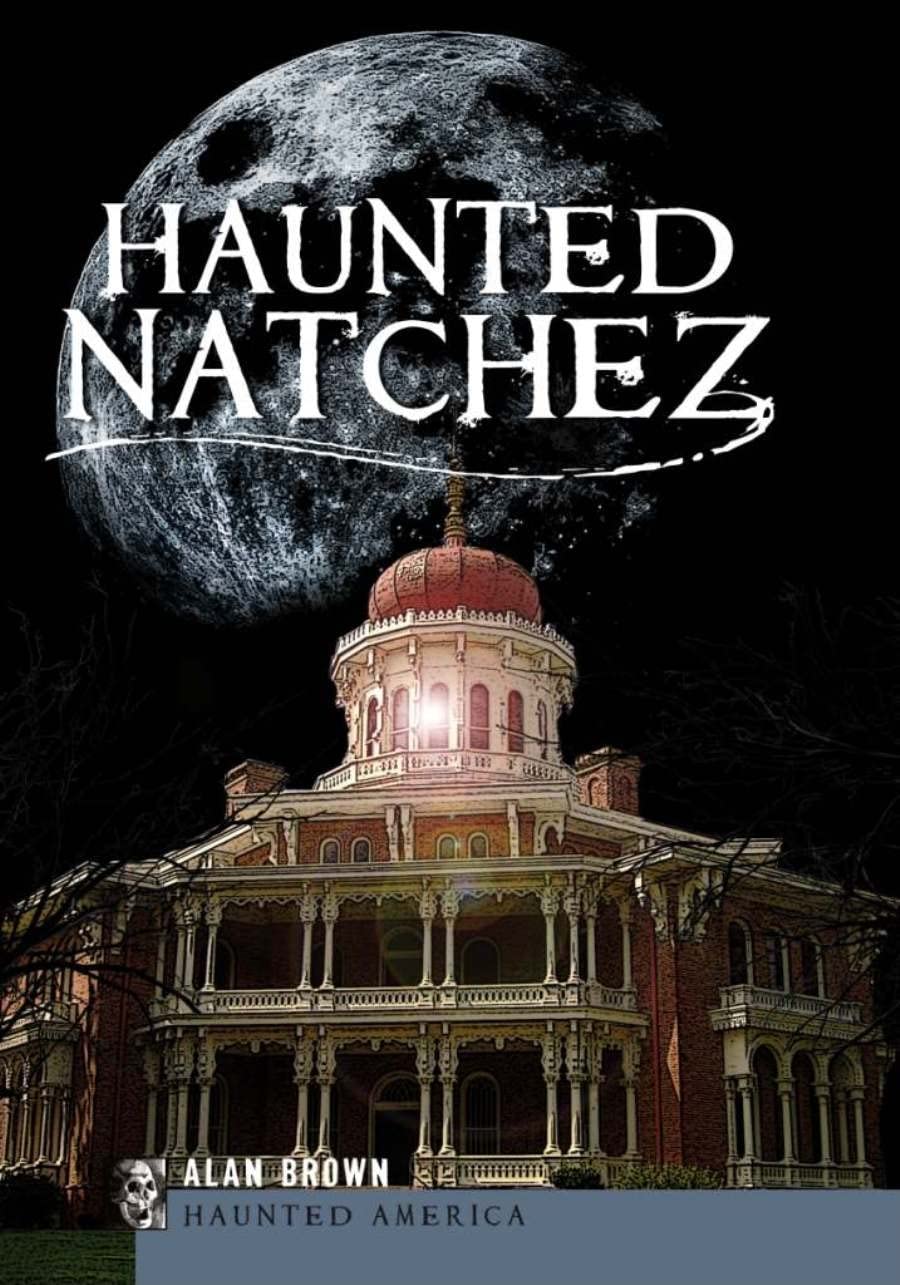
Though a charming, small Mississippi town full of all the southern appeal that Dixie has to offer, there is more to Natchez than its pristine exterior suggests. Much more. Just beneath the unassuming placid gentility of classic southern mansions and estates, ghosts and spirits pervade Natchez. From the old Adams County Jail to the Natchez City Cemetery, spirits from generations past remain in Natchez. Join Alan Brown, experienced Mississippi author and expert on all things haunted, as he surveys the historic haunts of Natcheza town as rich in history as it is in ghostly activity.
Haunted NatchezBy Alan BrownThe History PressCopyright © 2010 Alan BrownAll rights reserved.ISBN: 978-1-59629-928-3ContentsAcknowledgements, Arlington, Dunleith, Glenburnie, Longwood, Natchez City Cemetery, Natchez-Under-the Hill, The Eola Hotel, King's Tavern, Linden, Monmouth, The Old Adams County Jail, Stanton Hall, Springfield, The Burn, The Devil's Punchbowl, The Gardens, The Bank & Trust Company, The Towers, Bibliography, About the Author, CHAPTER 1ARLINGTONOne of the most prominent of Natchez's pioneering families was the Surget family. Pierre Surget was born in 1731 in Rochelle, France. As a young man, Pierre worked as a ship's captain. In the 1780s, he received a Spanish land grant of twenty-five hundred acres southeast of Natchez, Mississippi. At the same time, he moved his wife, Catherine, and their eleven children from Louisiana to Mississippi, which became their permanent home. Three of his children — Captain Francis Surget, James Surget and Jane Surget White — became prominent landowners and citizens of Natchez. Pierre went on to acquire large landholdings in Arkansas, Louisiana and Mississippi. He and his other family members owned hundreds of slaves, who worked in the cotton and cornfields.The Surget family sold their cotton through agents in Liverpool, England, and New Orleans. They also held bank accounts in New York and New Orleans and loaned money to landowners in the Natchez area.In the years prior to the Civil War, members of the Surget family eventually intermarried with other landowning families in the area. Many people living in Natchez today remember Pierre Surget primarily because of his connection to one of the city's most significant — and legendary — antebellum homes.In 1816, construction began on a home for Pierre Surget's eldest daughter, Mrs. Jane White. In 1820, Mrs. White moved into her beautiful Federal-style villa. Tragically, she died after spending only one night in her beautiful home. Her sister, Mrs. Bingaman, inherited the house, the property and all of the furnishings. Five generations of the Surget family lived at Arlington and added to its store of luxurious furnishings. By 1977, Arlington still contained a three-hundred-year-old spinet piano, objets d'art and a library consisting of thousands of books.Even though Arlington was designated a National Historic Landmark in 1974, it was an abandoned wreck by the late 1990s. In 2001, a devastating fire destroyed the rear gallery, which had been added after the home was first constructed. The roof was destroyed as well, but the rooms in the main house were undamaged. The owner of the old mansion, the Historic Natchez Foundation (HNF), installed a new roof and rafters and took additional measures to stabilize the house. Still, Arlington is a sad shadow of its former self. All of the windows are broken, and much of the exterior and interior has been marred by spray-painted graffiti. At the time of this writing, the HNF was in the process of installing an alarm system to protect the house from further vandalism.The ghost story that members of the Surget family passed down from one generation to the next has become as faded as the house itself. For years, people said that every night at the stroke of midnight, a ghostly carriage drove up the long drive and pulled up at the main entrance of Arlington. The door opened, and a beautiful woman climbed out, walked up the steps and passed through the unopened front door. Most people believe that the specter was the ghost of Jane White, who never had the opportunity to spend much time in her beautiful home while she was alive. One can only hope that after Arlington has been fully restored, its signature ghost story will be revived as well.DUNLEITHIn 1777, a Welsh immigrant named Jeremiah Routh moved his wife and four children to Spanish West Florida in the Natchez District, where he had received a land grant of five hundred acres. In 1791, Routh traveled to Ohio to buy lumber for a two-story frame house. The flatboat on which the lumber had been loaded arrived at Natchez-Under-the-Hill just as a storm was brewing. The next morning, the flatboat and its cargo were gone.Routh reported the theft to the governor of the post of Natchez. A scoundrel named Olivarez said that the flatboat had come loose from its moorings during the storm, and he claimed the craft and its cargo by right of salvage. Apparently, the stress proved to be too much for Jeremiah Routh. He died in 1791, and the estate was left to his two sons, Job and Jeremiah R., who divided up the property.Several years later, a judge ordered Olivarez to reimburse Job Routh for the cost of the stolen lumber. Following his marriage to Anne Madeline Miller on May 30, 1792, Job purchased additional acreage with the intention of growing cotton on it. He also acquired a seventeen-hundred-acre land grant south of the center of Natchez. Over the years, Job sold off most of his landholdings, except for the fifty acres on which he had built Routhland. John Routh died of debility on December 12, 1834. His property, including his slaves, was divided among his nine children.Routh's daughter Mary, who had married a wealthy planter named Thomas Ellis in 1829, when she was sixteen, inherited Routhland. After Thomas Ellis died in 1839, Mary married a Natchez banker named Charles Dahlgren. Dahlgren immediately took control of Job Routh's holdings in Mississippi and Louisiana and settled all of his father-in-law's debts. On August 18, 1855, the Dahlgrens' fortunes, which had been steadily rising since their marriage, were drastically reversed when their home, Routhland, burned down while they were vacationing in Beersheba Springs, Tennessee.Dahlgren decided to start all over by building an entirely new mansion where Routhland once stood. He used a plan for a Greek Revival mansion that appeared in the book The Architecture of Country Houses (1856) by Alexander Jackson Davis and Andrew Jackson Downing. The mansion was constructed between 1856 and 1857. The exterior was lined with twenty-six Doric columns. The five-story mansion included a cellar, two parlors, four bedrooms, a library, a dining room and an attic with dormer windows. The kitchen, laundry and slaves' quarters were located in a building in the back. In a cruel twist of fate, Mary Dahlgren spent only three months in her new home before dying of heart trouble in March 1858. She was forty-five years old. Charles Dahlgren put the new Routhland up for sale in March 1858.On January 4, 1858, Alfred Vidal Davis purchased Routhland from Charles Dahlgren. He immediately renamed his new home Dunleith. After the Civil War broke out in 1861, Davis formed a volunteer infantry company called the Natchez Rifles. His troop later became part of the Fourteenth Louisiana Infantry. Davis's wife, Sarah, joined up with her husband's regiment on the way to Richmond. She left one of her household slaves, Catherine White, in charge of Dunleith in her absence. When Davis returned to Dunleith in 1863, Natchez was under the control of the Yankees. His wife Sarah died two years later.Dunleith had a number of different owners after the Civil War. Alfred Vidal Davis sold the mansion to Hiram M. Baldwin in 1866. Following Baldwin's sudden death in 1868, Dunleith was sold to John R. Stockton. In 1886, Dunleith was sold once again, this time to Joseph Neibert Carpenter for $20,000. Carpenter made a fortune by investing in a hardware store, a grocery store, railroad and steamboat lines and cottonseed oil mills. He and his family made generous donations to Natchez schools over the years. The Carpenter family owned Dunleith until 1976.Dunleith has been on the National Register of Historic Places since 1935. In 1976, Dunleith was purchased by William Heins and converted into a bed-and-breakfast. In 1999, Mrs. Edward Worley and her son, Michael Worley, spent a considerable amount of time and money renovating the old mansion. The antebellum mansion's signature ghost story focuses on a harp that once stood in the front parlor.Dunleith is haunted by a relative of Mrs. Charles Dahlgren, remembered today only as "Miss Percy." In her book, 13 Mississippi Ghosts and Jeffrey, writer Kathryn Tucker says that Miss Percy fell in love with a dashing young Frenchman. Some people say that he was a count; others believe that he was a high-ranking French officer. The two were inseparable, and many people believed that a wedding was in the planning stages. One day, the Frenchman professed his undying love for Miss Percy, but the smile on her face immediately turned into a frown when he said that he was going to have to return to France on business. Promising that he would return to her soon, he kissed her and disappeared into the night.Months passed without a word from her lover. Finally, Miss Percy decided to travel to France to find out why she had not received any letters from her paramour. Several weeks later, Miss Percy returned from Europe, her head bowed in shame. Her lover had fallen in love with someone else in France but did not have the heart to tell Miss Percy. She returned to Dunleith and lived in an upstairs bedroom. Every afternoon, she walked downstairs to the front parlor and strummed melancholy songs on the harp. For years, she repeated this sad ritual before finally dying in Dunleith.For over a century, people staying at Dunleith claim to have heard the faint tones of harp music coming from the front parlor. When I stayed at Dunleith in August 2009, a tour guide told me that one morning in 2008, a guest complained that she had been awakened in the middle of the night by someone playing a harp in the parlor. The harp is not the one owned by the Dahlgren family. The Worley family purchased it in about 2000. The tour guide showed the harp to the guest, who realized that it was in such poor condition that no one would have been able to play it. The tour guide then related the tragic tale of Miss Percy, the lonely woman who continues to drown her sorrows in music.GLENBURNIEBefore the development of the surrounding subdivision, Glenburnie was located in the middle of a sprawling plantation. Nearby was another impressive antebellum home called Glenwood. The incredible story of these two houses rivals any of the southern gothic works of Flannery O'Connor, Carson McCullers or Tennessee Williams. On August 4, 1932, the lives of the two families who lived in these houses converged in a memorable but ultimately tragic way.Jane Surget Merrill — or Jennie, as she preferred to be called — was born in 1864 to Ayres Merrill and Jane Surget Merrill. Jennie was the granddaughter of one of the first settlers in the Natchez area, Pierre Surget. She was also the granddaughter of William Dunbar, a Natchez planter, scientist and inventor. Jennie's father had shown hospitality to Ulysses S. Grant and his soldiers during the Civil War. Grant returned the favor after he became president by appointing Ayers Merrill ambassador to Belgium. Jennie, who was educated in Brussels by private tutors, was the darling of high society in Europe. She was even presented to Queen Victoria at the Court of St. James. After her father became ill, he and his family returned to their home, Elms Court, in Natchez.Following the death of her father in 1883, Jennie moved from Elms Court to a series of antebellum mansions, including Glenwood, before finally settling in at Glenburnie in 1904. Built in 1834, Glenburnie was a multiroom mansion located on forty-five acres of land. Some people say that Jennie moved to Glenburnie to be close to her second cousin, Duncan Minor. They were said to have been in love, but they could never marry because the Surgets and the Minors had been feuding since the Civil War. Duncan's mother threatened to disinherit him if he married Jennie, so he rode out to Glenburnie each night on horseback but returned home the next morning before breakfast. Over time, Jennie became a recluse, seeing no one except Duncan.Jennie's closest neighbor was Richard Dana, son of an Episcopalian minister. He was an accomplished pianist with a promising career as a concert pianist in his future. Tragically, his hopes of achieving fame were dashed forever when a window sash fell on his hand, permanently disabling his fingers. As a young man, "Dick" Dana became close friends with Jennie and Duncan. In the 1890s, Dick fell in love with a ravishing redhead named Octavia Dockery, who was an accomplished poet and author. Her works were published in the New York World newspaper and in various magazines. She was also the first woman in Natchez to ride astride a horse like a man. After the death of her parents, she moved in with Dick Dana at Glenwood.As time passed, Octavia and Dick became increasingly eccentric. Octavia cooked their meals over the fireplace and made clothes for them out of gunnysacks. She devoted most of her time to feeding the goats and chickens that wandered at will in and out of Glenwood. Dick sank into depression. With his long hair and beard, he soon became the target of pranks by local children. One day, a group of rowdy boys chased him through the woods. Dick climbed up onto the roof of Glenwood and stayed there for two days without food or water. Afterward, Dick refused to admit to people that he was Dick Dana. People began referring to Dick as "Wild Man" and Octavia as "Goat Woman." Their once beautiful mansion became a dilapidated wreck. Curtains hung in tatters from the windows. Expensive rugs were stained and threadbare. Locals jokingly referred to the house as "Goat Castle."Relations between Jennie Merrill and Dick and Octavia soon deteriorated. In 1917, Jennie attempted to purchase Glenwood by paying the delinquent taxes, but Octavia thwarted her scheme by having Dick declared legally insane. She was appointed Dick's legal guardian. As a result of her clever legal maneuvering, Dick could not be removed from his home because he was insane. The bad blood between the three people escalated in the late 1920s, when Jennie shot several goats that had been eating her rosebushes. The case went to trial, but charges were ultimately dropped.On August 4, 1932, Dick Dana and Octavia Dockery were catapulted onto a list of suspects when Duncan rode out to Glenburnie for his nightly visit and discovered the front room in shambles. Blood was splattered on the walls. A trail of blood led out to the driveway. Duncan contacted the sheriff. All night, the sheriff and his posse combed the woods for Jennie Merrill. Sometime around dawn, they discovered her body hidden behind some bushes. She was barefoot and had been shot repeatedly by a .32-caliber pistol.The next morning, Dick and Octavia were questioned; both were released a few days later. The lurid story was published in newspapers across the United States. Readers were enthralled by the photographs of the squalor in which Dick and Octavia lived. While Dick and Octavia were in jail, souvenir hunters plundered Glenwood. A few weeks later, Sheriff Roberts was notified by the police chief of Pine Bluff, Arkansas, that a man named George Pearls had been shot and killed by a policeman. Pearls had pulled a .32-caliber pistol on the policeman. Detectives soon uncovered Pearls's connection to Emily Burns, who ran a boardinghouse in Natchez. Emily later admitted that she and Pearls had tried to rob Jennie Merrill, but Jennie was shot when she tried to wrest the gun away from Pearls. Bloody fingerprints found at the scene matched those of Pearls. Emily Burns was later pardoned by the governor of Mississippi.Aside from the damage wrought by vandals, Dick and Octavia actually benefited from their notoriety. They began charging people fifty cents a head to tour Goat Castle. On September 11, 1932, a train delivered six hundred people to Glenwood from Hattiesburg. Many more people came after that. Even though they were making money, Dick and Octavia neglected to pay the mortgage on the house. The mortgage holder tried to evict them, but Dick Dana died in 1948 of pneumonia and asthma before the case was settled. Octavia followed him in death in April 1949.In his book Dead Men Do Tell Tales, author Troy Taylor recounts some of the ghost stories that began circulating around Natchez not long after Jennie Merrill's murder. Locals began avoiding the woods around Glenburnie at night because of the sightings of Jennie's ghost. People reported seeing a barefoot woman in a bloody blue dress running through the trees. Some people claimed that Dick Dana played the piano at night to drown out the moans and cries that echoed through the woods. After Dick and Octavia died, Octavia's ghost was seen wandering around the old house. Some people described her as an elderly lady wearing a calico dress. Others said they saw a lovely redheaded woman in a fine Paris gown inside the house. The eerie strains of Dick Dana's piano music were also heard resounding through the house.Glenburnie itself was the subject of some of the ghost stories. When the old house was being restored in the 1980s, one of the owners said she heard a ghostly voice calling her name. She also said that every time an electrical cord was plugged in, invisible hands pulled it right back out again.Glenwood is nothing more than a memory now. Octavia Dockery's cousins auctioned off the furnishings in the house soon after her death. The auction netted her family $15,000. In 1955, Glenwood was torn down to make room for a subdivision. Nothing remains of the old mansion but the strange stories of the wraith that is still sighted lurking in the woods near Glenburnie. (Continues...)Excerpted from Haunted Natchez by Alan Brown. Copyright © 2010 Alan Brown. Excerpted by permission of The History Press. All rights reserved. No part of this excerpt may be reproduced or reprinted without permission in writing from the publisher.Excerpts are provided by Dial-A-Book Inc. solely for the personal use of visitors to this web site.
Find it on
AmazonNo videos available yet.
No news articles linked to this title yet.

Overall
Overall rating of the media
Atmosphere
How immersive and tense is the atmosphere
Gore
Level and quality of gore/violence
Story
Quality of the storyline and plot
Writing
Quality of the written content
Character Development
Depth and growth of characters
Pacing
Flow and timing of the narrative