
BOOK
0
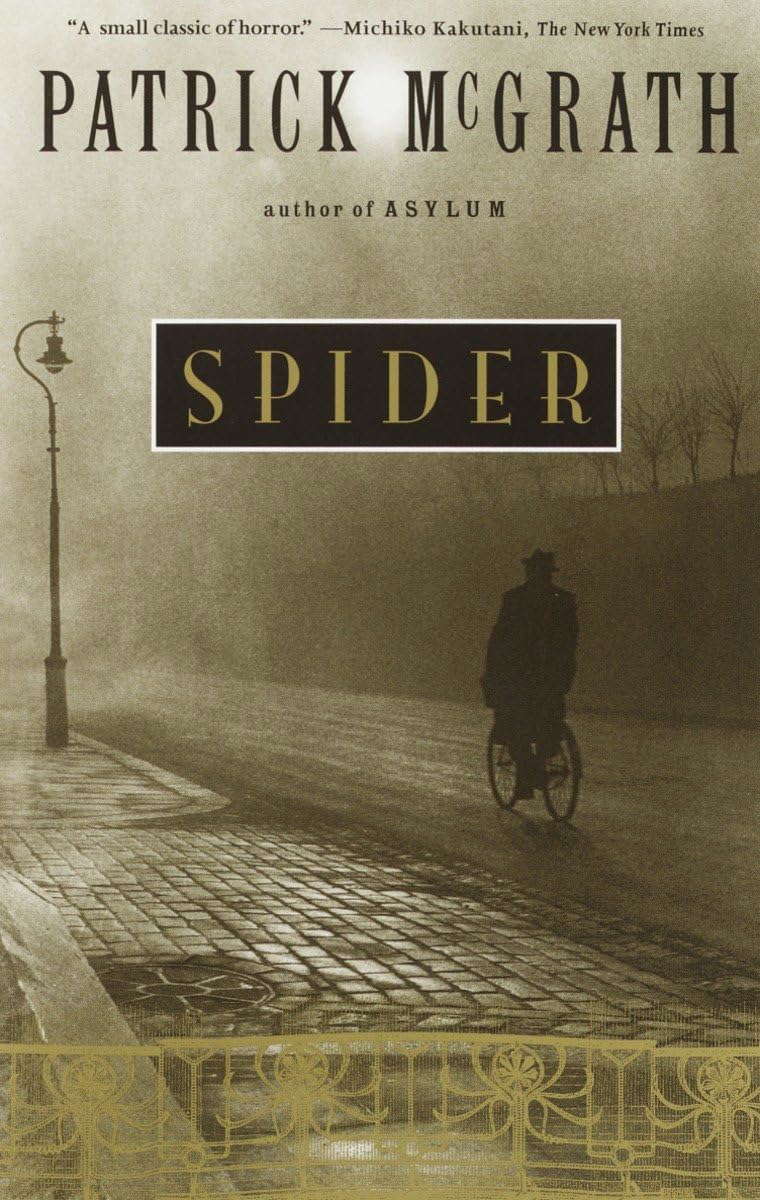
Spider is gaunt, threadbare, unnerved by everything from his landlady to the smell of gas. He tells us his story in a storm of beautiful language that slowly reveals itself as a fiendishly layered construction of truth and illusion. With echoes of Beckett, Poe, and Paul Bowles, Spider is a tale of horror and madness, storytelling and skepticism, a novel whose dizzying style lays bare the deepest layers of subconscious terror.
I cut into my potato, and dead in the middle of the halved potato there was a . . . thick, slow discharge I recognized as blood. A wry, mesmerizing tale of madness in a London suffused with the smells of jellied eels, leaking gas, outdoor lavatories and furry feet. Spider obsesses about wetness and fire and sexuality, about "this business of the thought patterns" and "the dead eyes" of his father and a woman named Hilda. Somewhere inside Spider's internal web of illusions lurks the truth about his mother's death.
In this "closely observed study of madness, memory and storytelling" the delusional Dennis Clegg, aka Spider, returns to his London neighborhood after 20 years in a mental hospital and insists that his father, not he, murdered his mother. "An admixture of Poe and the comic vulnerabilities of Beckett, this tale lingers long and disturbingly in the mind," said PW. Copyright 1991 Reed Business Information, Inc.
"A small classic of horror."
"Brilliant. . . . The sensuous world that McGrath creates is intense in its beauty. . . mesmerizing."
"Disturbing, wholly absorbing. . . a combination murder mystery/dark-night-of-the-soul. . . touchingly, menacingly brilliant."
"A gorgeous, painful howl of madness, shockingly perfect."
"Has the compelling quality of felt reality [that] feels like the inevitable truth. Spider is a thriller of sorts, as well as a psychological case study. . . a gem."
"McGrath especially excels at evoking the latent horro in commonplace sights. . . . [He] has created a manifestly untrustworthy storyteller without sacrificing suspense or sympathy for his characters."
"[Spider] is as creepy as a fleshy incarnation of an Edward Gorey drawing. . . . McGrath's a shrewd performer. You're fascinated; you're enthralled. . . it's a pleasure to be mesmerized."
"Truly outstanding. . . evocative. . . Accomplished in the sinister and macabre, McGrath transcends his already solid reputation with a powerfully realized character who simply won't let you go."
"The strength of Spider is in the character of the deeply human, if mad, protagonist who emerges as a formidable sufferer among the Gothic trappings. . . . McGrath is a sly literate who. . . has talent
Spider is gaunt, threadbare, unnerved by everything from his landlady to the smell of gas. He tells us his story in a storm of beautiful language that slowly reveals itself as a fiendishly layered construction of truth and illusion. With echoes of Beckett, Poe, and Paul Bowles, Spider is a tale of horror and madness, storytelling and skepticism, a novel whose dizzying style lays bare the deepest layers of subconscious terror.
Spider is gaunt, threadbare, unnerved by everything from his landlady to the smell of gas. He tells us his story in a storm of beautiful language that slowly reveals itself as a fiendishly layered construction of truth and illusion.
Find it on
AmazonNo videos available yet.
No news articles linked to this title yet.

Overall
Overall rating of the media
Atmosphere
How immersive and tense is the atmosphere
Gore
Level and quality of gore/violence
Story
Quality of the storyline and plot
Writing
Quality of the written content
Character Development
Depth and growth of characters
Pacing
Flow and timing of the narrative