

BOOK
0
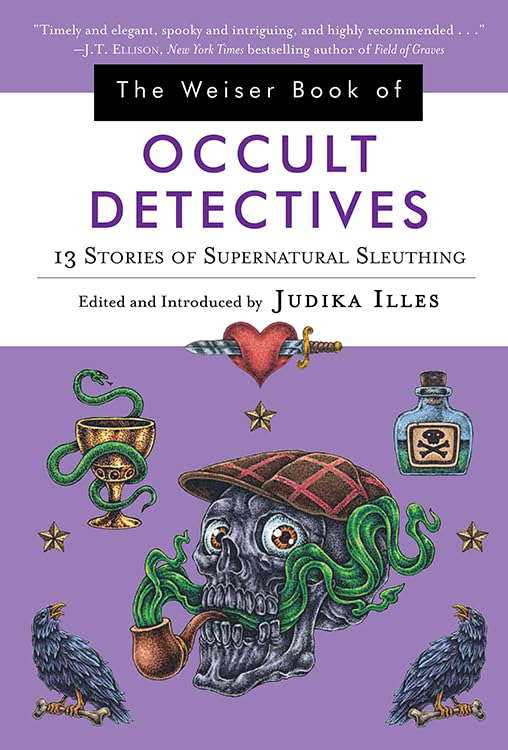
"Timely and elegant; spooky and intriguing; and highly recommended..." --J.T. Ellison, New York Times bestselling author of Field of Graves and Lie To MeThe Weiser Book of Occult Detectives: 13 Stories of Supernatural Sleuthing is a compilation of vintage occult detective stories, written by masters of the genre including Arthur Conan Doyle, Algernon Blackwood, Dion Fortune, J. Sheridan Le Fanu, and Helena Blavatsky. Occult detectives explore paranormal mysteries or use their own supernatural gifts to solve crimes. The book features the original authors and stories that inspired what is now a bestsellilng genre in movies, TV, books, and video games. The stories in The Weiser Book of Occult Detectives star both female and male sleuths. The mysteries they tackle include murder, missing funds, demons, ghosts, vampires, and more. Among the ranks of occult detectives featured in this book are beloved favorites such as Dr. Hesselius, Dr. Taverner, Thomas Carnacki, and John Silence but also the unjustly forgotten and obscure sleuths Shiela Crerar and Diana Marburg. Techniques utilized by the various detectives include palmistry, clairvoyance, psychometry, mesmerism, dreams, and good old deductive reasoning. The book is edited and introduced by leading occult author and scholar Judika Illes.
The Weiser Book of Occult Detectives13 Stories of Supernatural SleuthingBy Judika IllesRed Wheel/Weiser, LLCCopyright © 2017 Judika IllesAll rights reserved.ISBN: 978-1-57863-624-2ContentsIntroduction, by JUDIKA ILLES, The Stories, The Pot of Tulips, by FITZ-JAMES O'BRIEN, featuring Harry Escott (1855), Green Tea, by J. SHERIDAN LE FANU, featuring Dr. Martin Hesselius (1872), The Cave of the Echoes, by HELENA PETROVNA BLAVATSKY, featuring a mysterious, anonymous occult detective (1892), The Story of Yand Manor House, by KATE AND HESKETH PRICHARD (H. HERON AND E. HERON), featuring Flaxman Low (1899), The Leather Funnel, by SIR ARTHUR CONAN DOYLE, featuring Lionel Dacre (1902), The Dead Hand, by L. T. MEADE AND ROBERT EUSTACE, featuring Diana Marburg (1902), The Horse of the Invisible, by WILLIAM HOPE HODGSON, featuring Thomas Carnacki (1910), Case of the Veil of Isis, by SAX ROHMER, featuring Moris Klaw (1914), The Vampire, by ALICE AND CLAUDE ASKEW, featuring Aylmer Vance (1914), A Victim of Higher Space, by ALGERNON BLACKWOOD, featuring Dr. John Silence (1914), The Witness in the Wood, by ROSE CHAMPION DE CRESPIGNY, featuring Norton Vyse (1919), The Eyes of Doom, by ELLA M. SCRYMSOUR, featuring Shiela Crerar (1920), The Return of the Ritual, by DION FORTUNE, featuring Dr. John Richard Taverner (1922), CHAPTER 1THE POT OF TULIPSFitz-James O'BrienKnown as the "Celtic Poe," author, playwright, and soldier, Fitz-James O'Brien is now considered among the most significant forerunners of modern science fiction. "The Diamond Lens" — his most famous short story, first published in 1858 — ranks among H. P. Lovecraft's favorite tales. O'Brien is also considered among the pioneers of occult detective fiction. Tim Prasil, editor of Giving Up the Ghosts: Short-Lived Occult Detective Series by Six Renowned Authors, suggests that O'Brien's creation, Harry Escott, might be considered "modern horror literature's first full-fledged occult detective." It is tempting to consider what O'Brien's literary output might have been, if only he had lived longer.Michael Fitz-James O'Brien was born in County Cork, Ireland, on December 31, 1828. Little is known of his early life. After graduating from the University of Dublin, O'Brien moved to London, where he became a journalist and blew through an £8,000 inheritance in four years. He immigrated to the United States in approximately 1852. Within a year, he was writing for Harper's Magazine. In the ten years O'Brien lived in New York City, he wrote almost three hundred magazine and newspaper pieces while maintaining a lively social life. He was considered a member of the Bohemians, a loosely organized group of artists, writers, and creative people that included Walt Whitman as one of its members.A social activist, O'Brien volunteered for the Union Army in January 1861, joining the Seventh Regiment of the New York National Guard with the rank of captain. One year later, O'Brien was appointed to the staff of General Frederick W. Lander. Wounded in a skirmish on February 26, 1862, O'Brien never recovered. The wound itself was not serious, but treatment was delayed and initially inadequate. He developed tetanus and died, aged thirty-three, on April 6, 1862, in Cumberland, Maryland.A lavish funeral was held at Green-Wood Cemetery in Brooklyn, New York, where his coffin was placed in a receiving vault. The plan may originally have been to return his body to Ireland, where his mother survived him, but this did not occur. After twelve years in Green-Wood's receiving vault, Fitz-James O'Brien was buried in Public Lot 17263, Section 15, Grave 1183.Harry Escott, O'Brien's occult detective, appears in only two stories: "A Pot of Tulips" and "What Was It? A Mystery." The latter story, published in 1859, is the more famous of the two. Among the earliest known depictions of invisibility in fiction, "What Was It? A Mystery" predates "The Horla," by Guy de Maupassant, and "The Damned Thing," by Ambrose Bierce, as well as H. G. Wells's novella, The Invisible Man."A Pot of Tulips," first published in the November 1855 issue of Harper's New Monthly Magazine, shows the young detective first learning his craft. It's also one of my own personal favorite stories because of its depictions of country life in 19th-century midtown Manhattan, an area extremely familiar to me in its modern and less bucolic incarnation.Harry Escott displays no supernatural aptitude of his own, although he describes himself as sufficiently "sensitive" to apprehend occult phenomena. He earned the steel nerves required of an occult detective via his extensive esoteric studies.A Pot of TulipsTWENTY-EIGHT years ago I went to spend the summer at an old Dutch villa which then lifted its head from the wild country that, in present days, has been tamed down into a site for a Crystal Palace. Madison Square was then a wilderness of fields and scrub oak, here and there diversified with tall and stately elms. Worthy citizens who could afford two establishments rusticated in the groves that then flourished where ranks of brown-stone porticos now form the landscape; and the locality of Fortieth Street, where my summer palace stood, was justly looked upon as at an enterprising distance from the city.I had an imperious desire to live in this house ever since I can remember. I had often seen it when a boy, and its cool verandas and quaint garden seemed, whenever I passed, to attract me irresistibly. In after years, when I grew up to man's estate, I was not sorry, therefore, when one summer, fatigued with the labors of my business, I beheld a notice in the papers intimating that it was to be let furnished. I hastened to my dear friend, Jasper Joye, painted the delights of this rural retreat in the most glowing colors, easily obtained his assent to share the enjoyments and the expense with me, and a month afterward we were taking our ease in this new paradise.Independent of early associations, other interests attached me to this house. It was somewhat historical, and had given shelter to George Washington on the occasion of one of his visits to the city. Furthermore, I knew the descendants of the family to whom it had originally belonged. Their history was strange and mournful, and it seemed to me as if their individuality was somehow shared by the edifice. It had been built by a Mr. Van Koeren, a gentleman of Holland, the younger son of a rich mercantile firm at the Hague, who had emigrated to this country in order to establish a branch of his father's business in New York, which even then gave indications of the prosperity it has since reached with such marvellous rapidity. He had brought with him a fair young Belgian wife; a loving girl, if I may believe her portrait, with soft brown eyes, chestnut hair, and a deep, placid contentment spreading over her fresh and innocent features. Her son, Alain Van Koeren, had her picture an old miniature in a red gold frame as well as that of his father, and in truth, when looking on the two, one could not conceive a greater contrast than must have existed between husband and wife. Mr. Van Koeren must have been a man of terrible will and gloomy temperament. His face in the picture is dark and austere, his eyes deep-sunken, and burning as if with a slow, inward fire. The lips are thin and compressed, with much determination of purpose; and his chin, boldly salient, is brimful of power and resolution. When first I saw those two pictures I sighed inwardly and thought, "Poor child! you must often have sighed for the sunny meadows of Brussels, in the long, gloomy nights spent in the company of that terrible man!"I was not far wrong, as I afterward discovered. Mr. and Mrs. Van Koeren were very unhappy. Jealousy was his monomania, and he had scarcely been married before his girl-wife began to feel the oppression of a gloomy and ceaseless tyranny. Every man under fifty, whose hair was not white and whose form was erect, was an object of suspicion to this Dutch Bluebeard. Not that he was vulgarly jealous. He did not frown at his wife before strangers, or attack her with reproaches in the midst of her festivities. He was too well-bred a man to bare his private woes to the world. But at night, when the guests had departed and the dull light of the quaint old Flemish lamps but half illuminated the nuptial chamber, then it was that with monotonous invective Mr. Van Koeren crushed his wife. And Marie, weeping and silent, would sit on the edge of the bed listening to the cold, trenchant irony of her husband, who, pacing up and down the room, would now and then stop in his walk to gaze with his burning eyes upon the pallid face of his victim. Even the evidences that Marie gave of becoming a mother did not check him. He saw in that coming event, which most husbands anticipate with mingled joy and fear, only an approaching incarnation of his dishonor. He watched with a horrible refinement of suspicion for the arrival of that being in whose features he madly believed he should but too surely trace the evidences of his wife's crime.Whether it was that these ceaseless attacks wore out her strength, or that Providence wished to add another chastening misery to her burden of woe, I dare not speculate; but it is certain that one luckless night Mr. Van Koeren learned with fury that he had become a father two months before the allotted time. During his first paroxysm of rage, on the receipt of intelligence which seemed to confirm all his previous suspicions, it was, I believe, with difficulty that he was prevented from slaying both the innocent causes of his resentment. The caution of his race and the presence of the physicians induced him, however, to put a curb upon his furious will until reflection suggested quite as criminal, if not as dangerous, a vengeance. As soon as his poor wife had recovered from her illness, unnaturally prolonged by the delicacy of constitution induced by previous mental suffering, she was astonished to find, instead of increasing his persecutions, that her husband had changed his tactics and treated her with studied neglect. He rarely spoke to her except on occasions when the decencies of society demanded that he should address her. He avoided her presence, and no longer inhabited the same apartments. He seemed, in short, to strive as much as possible to forget her existence. But if she did not suffer from personal ill-treatment it was because a punishment more acute was in store for her. If Mr. Van Koeren had chosen to affect to consider her beneath his vengeance, it was because his hate had taken another direction, and seemed to have derived increased intensity from the alteration.It was upon the unhappy boy, the cause of all this misery, that the father lavished a terrible hatred. Mr. Van Koeren seemed determined, that, if this child sprang from other loins than his, the mournful destiny which he forced upon him should amply avenge his own existence and the infidelity of his mother. While the child was an infant his plan seemed to have been formed. Ignorance and neglect were the two deadly influences with which he sought to assassinate the moral nature of this boy; and his terrible campaign against the virtue of his own son was, as he grew up, carried into execution with the most consummate generalship. He gave him money, but debarred him from education. He allowed him liberty of action, but withheld advice.It was in vain that his mother, who foresaw the frightful consequences of such a training, sought in secret by every means in her power to nullify her husband's attempts. She strove in vain to seduce her son into an ambition to be educated. She beheld with horror all her agonized efforts frustrated, and saw her son and only child becoming, even in his youth, a drunkard and a libertine. In the end it proved too much for her strength; she sickened, and went home to her sunny Belgian plains. There she lingered for a few months in a calm but rapid decay, whose calmness was broken but by the one grief; until one autumn day, when the leaves were falling from the limes, she made a little prayer for her son to the good God — and died.Vain orison! Spendthrift, gamester, libertine, and drunkard by turns, Alain Van Koeren's earthly destiny was unchangeable. The father, who should have been his guide, looked on each fresh depravity of his son's with a species of grim delight. Even the death of his wronged wife had no effect upon his fatal purpose. He still permitted the young man to run blindly to destruction by the course into which he himself had led him.As years rolled by, and Mr. Van Koeren himself approached to that time of life when he might soon expect to follow his persecuted wife, he relieved himself of the hateful presence of his son altogether. Even the link of a systematic vengeance, which had hitherto united them, was severed, and Alain was cast adrift without either money or principle. The occasion of this final separation between father and son was the marriage of the latter with a girl of humble, though honest extraction. This was a good excuse for the remorseless Van Koeren, so he availed himself of it by turning his son out of doors.From that time forth they never met. Alain lived a life of meagre dissipation, and soon died, leaving behind him one child, a daughter. By a coincidence natural enough, Mr. Van Koeren's death followed his son's almost immediately. He died as he had lived, sternly. But those who were around his couch in his last moments mentioned some singular facts connected with the manner of his death. A few moments before he expired, he raised himself in the bed, and seemed as if conversing with some person invisible to the spectators. His lips moved as if in speech, and immediately afterward he sank back, bathed in a flood of tears. "Wrong! wrong!" he was heard to mutter, feebly; then he implored passionately the forgiveness of some one who, he said, was present. The death struggle ensued almost immediately, and in the midst of his agony he seemed wrestling for speech. All that could be heard, however, were a few broken words. "I was wrong. My — unfounded — For God's sake, look in — You will find —" Having uttered these fragmentary sentences, he seemed to feel that the power of speech had passed away forever. He fixed his eyes piteously on those around him, and, with a great sigh of grief, expired. I gathered these facts from his granddaughter and Alain's daughter, Alice Van Koeren, who had been summoned by some friend to her grandfather's dying couch when it was too late. It was the first time she had seen him, and then she saw him die.The results of Mr. Van Koeren's death were a nine days' wonder to all the merchants in New York. Beyond a small sum in the bank, and the house in which he lived, which was mortgaged for its full value, Mr. Van Koeren had died a pauper! To those who knew him and knew his affairs, this seemed inexplicable. Five or six years before his death he had retired from business with a fortune of over a hundred thousand dollars. He had lived quietly since then, was known not to have speculated, and could not have gambled. The question then was, where had his wealth vanished to. Search was made in every secretary, in every bureau, for some document which might throw a light on the mysterious disposition that he had made of his property. None was found. Neither will, nor certificates of stock, nor title deeds, nor bank accounts, were anywhere discernible. Inquiries were made at the offices of companies in which Mr. Van Koeren was known to be largely interested; he had sold out his stock years ago. Real estate that had been believed to be his was found on investigation to have passed into other hands. There could be no doubt that for some years past Mr. Van Koeren had been steadily converting all his property into money, and what he had done with that money no one knew. Alice Van Koeren and her mother, who at the old gentleman's death were at first looked on as millionnaires, discovered, when all was over, that they were no better off than before. It was evident that the old man had made away with his fortune before his death, determined that one who, though bearing his name, he believed not to be of his blood should never inherit his wealth or any share of it — a posthumous vengeance, which was the only one by which the laws of the State of New York relative to inheritance could be successfully extracted.I took a peculiar interest in the case, and even helped to make some researches after the lost property, not so much, I confess, from a spirit of general philanthropy, as from certain feelings which I experienced toward Alice Van Koeren, the heir to this invisible estate. I had long known both her and her mother, when they were living in honest poverty and earning a scanty subsistence by their own labor; Mrs. Van Koeren worked as an embroideress, and Alice turned to account, as a preparatory governess, the education which her good mother, spite of her limited means, had bestowed on her.In a few words, then, I loved Alice Van Koeren, and was determined to make her my wife as soon as my means would allow me to support a fitting establishment. My passion had never been declared. I was content for the time with the secret consciousness of my own love, and the no less grateful certainty that Alice returned it, all unuttered as it was. I had, therefore, a double interest in passing the summer at the old Dutch villa, for I felt it to be connected somehow with Alice, and I could not forget the singular desire to inhabit it which I had so often experienced as a boy.It was a lovely day in June when Jasper Joye and myself took up our abode in our new residence; and as we smoked our cigars on the piazza in the evening we felt for the first time the unalloyed pleasure with which a townsman breathes the pure air of the country. (Continues...)Excerpted from The Weiser Book of Occult Detectives by Judika Illes. Copyright © 2017 Judika Illes. Excerpted by permission of Red Wheel/Weiser, LLC. All rights reserved. No part of this excerpt may be reproduced or reprinted without permission in writing from the publisher.Excerpts are provided by Dial-A-Book Inc. solely for the personal use of visitors to this web site.
Find it on
AmazonNo videos available yet.
No news articles linked to this title yet.

Overall
Overall rating of the media
Atmosphere
How immersive and tense is the atmosphere
Gore
Level and quality of gore/violence
Story
Quality of the storyline and plot
Writing
Quality of the written content
Character Development
Depth and growth of characters
Pacing
Flow and timing of the narrative