
BOOK
0
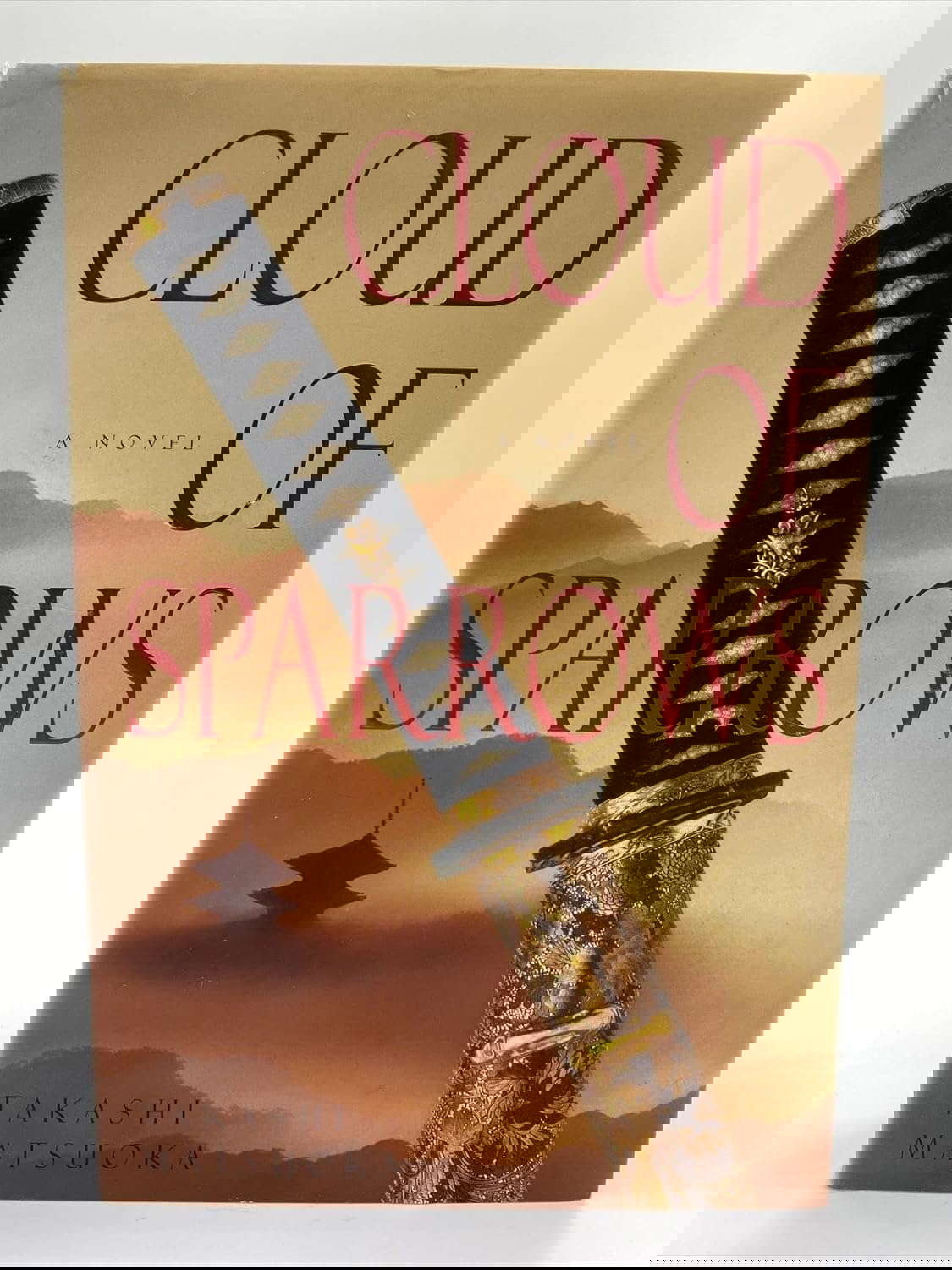
Once in a great while a new novelist comes along who dazzles us with rare eloquence and humanity, with flawless storytelling and a unique understanding of another place and time. Takashi Matsuoka is just such a writer. His magnificent new novel, set amid the violence and beauty of nineteenth-century Japan, takes us beyond the epic tradition of James Clavell’s Shogun and into a majestic realm of samurai and geishas, ninjas and Zen masters. Brilliantly imagined, gloriously written, Cloud of Sparrows is at once a sweeping historical adventure and a love story of almost unbearable poignancy. It is storytelling on the grand scale from a novelist of astounding depth and grace.Cloud of SparrowsIt is the dawn of the New Year, 1861. After two centuries of isolation, Japan has been forced to open its doors to the West, igniting a clash of cultures and generations. And as foreign ships threaten to rain destruction on the Shogun’s castle in Edo, a small group of American missionaries has chosen this time to spread the word of their God. Among them, Emily Gibson, a woman seeking redemption from a tormented past, and Matthew Stark, a cold-eyed killer with one more death on his mind. Neither realizes that their future in Japan has already been foreseen. For a young nobleman, Lord Genji, has dreamt that his life will be saved by an outsider in the New Year. Widely reviled as a dilettante, Lord Genji has one weapon with which to inspire awe. In his family, one in every generation is said to have the gift of prophecy. And what Lord Genji sees has struck fear in many around him. As the Shogun’s secret police chief plots Genji’s death--and the utter destruction of his entire clan--the young and untried lord must prove that he is more than the handsome womanizer of legend, famed lover of Edo’s most celebrated geisha, Lady Heiko, and that his prophetic powers are no mere fairy tale. Forced to escape from Edo and flee to his ancestral stronghold, the spectacular Cloud of Sparrows Castle, Genji joins his fate with Emily and Stark, unaware of the dark forces that drive them. Together with Genji’s uncle, Lord Shigeru, a legendary swordsman knee-deep in the blood of his own kin, and the enigmatic Lady Heiko, the unlikely band embarks on a harrowing journey through a landscape bristling with danger--to prepare for a final battle.Here, on a snowscape stained with blood, horror will mix with wonder, secrets will unravel, and love will duel with vengeance--as East and West, flesh and spirit, past and future, collide in ways no one--least of all Genji--could have imagined.
Following in the substantial footsteps of filmmaker Akiro Kurosawa and Shogun author James Clavell is Takashi Matsuoka, whose action-packed debut novel, Cloud of Sparrows, unfolds as the age of the samurai warrior starts to wane. The year is 1861, and Lord Genji of Akaoka, last in line of the Okamichi clan, welcomes missionaries Emily, Matthew, and Zephaniah to Japan. Cut off from the West for more than 2,000 years, Japan is as completely unprepared for these outsiders as the missionaries are for geishas and honor killings. Genji, his geisha love Heiko, and the missionaries suddenly find themselves in the middle of several nefarious plots to overthrow the Okamichi leader from as far away as the shogun's palace and as close as Genji's own henchmen. Genji and his visitors journey together across treacherous terrain to seek refuge at the faraway Cloud of Sparrows palace. Although it's a rip-roaring yarn full of ambushes, swordfights, cross-cultural friction, love, and prophetic visions, the book does read a bit like a screenplay, cutting quickly from one scene to another. But the frequent shifts in the story's tempo succeed in making the novel all the more vivid, allowing simultaneous action and contemplation to deepen the story and its inhabitants. --Emily Russin
Matsuoka's ambitious first novel is an epic saga of clashing personalities and ideologies in the tradition of Shogun, yet it distinguishes itself from its wide-eyed predecessor with a grimmer perspective on Japan's military culture. Set in Edo in 1861, the book chronicles the arrival of a group of American missionaries (two men and a woman, each hiding secrets) into a land bristling with feudal clans nursing ancient grudges and a central shogunate trying to maintain control in the face of corrosive Western influences (like Christianity). The young Lord Genji, a modern heir to the embittered Okumichi clan and its rulers' gift of prophetic vision, receives the missionaries as his guests. Their visit coincides with an effort by the Shogun's secret-police chief to destroy Genji, which leads to the accidental killing of one of the missionaries. In response, Genji, his mad uncle Shigeru (tortured with visions of "swarms of metallic insects," which presage the devastation of WWII), and Genji's lover, the devastatingly beautiful geisha Heiko, join forces with innocent American missionary Emily Gibson and Matt Stark, also an American, who is hiding under the mission's aegis while he hunts down a man who wronged him long ago, to stave off the imperial assassins and restore the honor of the clan. The novel boasts plenty of Edo-era pomp and pageantry, as well as some nicely convoluted court intrigue and lightly handled romance. But the author's central message appears to be a rebuke of the narrow-mindedness of the isolationist feudal tradition in Japan and its bloody track record: "It is our duty to ensure that all looting, murdering, and enslaving in Japan is done by us alone. Otherwise, how can we call ourselves Great Lords?" Copyright 2002 Cahners Business Information, Inc.
In 1861, as Japan is pried open by the West, Lord Genji has a vision that compels him to flee to his ancestral home, the Cloud of Sparrows Castle. Like Lord Genji, the publisher would seem to be blessed with the gift of prophecy: this first novel has been sold to seven countries and has been bought by Universal. Copyright 2002 Reed Business Information, Inc.
Matsuoka lyrically evokes the Japan of 1861, a country at a pivotal juncture in its history. Isolated for centuries, Japan is now both an economic and a political target for Western nations seeking profit and geographical advantage. In Edo, Genii, the prophetic Great Lord of Akaoka, has foreseen the destruction of his own line, as well as the dissolution of the ancient feudal system regulated by shoguns and samurai warriors. When three American missionaries arrive determined to spread the word of God and to build a mission house, Genii alone realizes their significance in the scheme of things to come. Under attack by both foreigners and native rivals conspiring against him, Genii, the missionaries, and Heiko, a delectable geisha with questionable loyalties, flee to Cloud of Sparrows Castle, where each must face the demons of the past, the treachery of the present, and the uncertainties of the future. Straddling a yawning cultural divide, these disparate characters manage to achieve mutual respect and understanding during a journey of great physical and emotional peril. Like James Clavell in Shogun (1983) and Arthur Golden in Memoirs of a Geisha (1997), Matsuoka effortlessly introduces the reader to mysterious Japanese customs, rituals, and traditions. Elements of romance, history, and suspense combine to fashion a compelling debut. Margaret FlanaganCopyright © American Library Association. All rights reserved
Once in a great while a new novelist comes along who dazzles us with rare eloquence and humanity, with flawless storytelling and a unique understanding of another place and time. Takashi Matsuoka is just such a writer. His magnificent new novel, set amid the violence and beauty of nineteenth-century Japan, takes us beyond the epic tradition of James Clavell s Shogun and into a majestic realm of samurai and geishas, ninjas and Zen masters. Brilliantly imagined, gloriously written, Cloud of Sparrows is at once a sweeping historical adventure and a love story of almost unbearable poignancy. It is storytelling on the grand scale from a novelist of astounding depth and grace.Cloud of SparrowsIt is the dawn of the New Year, 1861. After two centuries of isolation, Japan has been forced to open its doors to the West, igniting a clash of cultures and generations. And as foreign ships threaten to rain destruction on the Shogun s castle in Edo, a small group of American missionaries has chosen this time to spread the word of their God. Among them, Emily Gibson, a woman seeking redemption from a tormented past, and Matthew Stark, a cold-eyed killer with one more death on his mind. Neither realizes that their future in Japan has already been foreseen. For a young nobleman, Lord Genji, has dreamt that his life will be saved by an outsider in the New Year. Widely reviled as a dilettante, Lord Genji has one weapon with which to inspire awe. In his family, one in every generation is said to have the gift of prophecy. And what Lord Genji sees has struck fear in many around him. As the Shogun s secret police chief plots Genji s death--and the utter destruction of his entire clan--the young and untried lord must prove that he is more than the handsome womanizer of legend, famed lover of Edo s most celebrated geisha, Lady Heiko, and that his prophetic powers are no mere fairy tale. Forced to escape from Edo and flee to his ancestral stronghold, the spectacular Cloud of Sparrows Castle, Genji joins his fate with Emily and Stark, unaware of the dark forces that drive them. Together with Genji s uncle, Lord Shigeru, a legendary swordsman knee-deep in the blood of his own kin, and the enigmatic Lady Heiko, the unlikely band embarks on a harrowing journey through a landscape bristling with danger--to prepare for a final battle.Here, on a snowscape stained with blood, horror will mix with wonder, secrets will unravel, and love will duel with vengeance--as East and West, flesh and spirit, past and future, collide in ways no one--least of all Genji--could have imagined.
"The book seizes you from start to finish."--The Washington Post"Adventure-filled." --Entertainment WeeklyFrom the Paperback edition.
The Star of BethlehemCrossing an unknown river far from your domain, observe the surface turbulence, and note the clarity of the water. Heed the demeanor of the horses. Beware of massed ambush.At a familiar ford near home, look deep into the shadows on the far bank, and watch the movement of the tall grass. Listen to the breathing of your nearest companions. Beware of the lone assassin.--SUZUME-NO-KUMO (1491)Heiko, feigning sleep, kept her breathing deep and slow, her muscles relaxed but not slack, her lips closed, at the very edge of parting, her eyes soft beneath unfluttering eyelids, her hooded gaze turned within, to the calm place at the center of her being. She sensed rather than felt him awaken beside her.When he turned to look at her, she hoped he would see:Her hair: the utter dark of starless night spilling across the blue silk undersheet.Her face: pale as spring snow, glowing, with light stolen from the moon.Her body: suggestive curvatures beneath the coverlet, also of silk, emblazoned with a finely embroidered pair of white cranes, their throats crimson with mating frenzy, dancing and dueling in midair, against a field of gold.She was confident of starless night. Her hair--dark, lustrous, fine--was one of her best attributes.Spring snow might be too far a stretch, even with generous metaphorical license. She had spent her early childhood in a fishing village in Tosa Domain. Those happy hours in the sun so long ago could never be completely erased. Her cheeks were ever so slightly freckled. Spring snow was not freckled. Still there was that moonlight glow to make up for it. He insisted she had it. Who was she to disagree with him?She hoped he was looking at her. She was an elegant sleeper, even when she was actually asleep. When she was performing, as she was now, the effect on men was usually devastating. What will he do? Will he remove the concealment, lightly, discreetly, and look upon her unconscious nakedness? Or will he smile, lean down, and wake her with a soft caress? Or will he watch, patient as always, and wait for her eyes to flutter open on their own?Such conjecture would not have troubled her with any other man, would not even have entered her thoughts. This one was different. With him, she often found herself indulging in such reveries. Was it because he was truly unlike the others, she wondered, or was it simply because this was the one to whom she had so foolishly lost her heart?Genji did nothing that she had anticipated. Instead he rose and went to the window overlooking Edo Bay. He stood there naked, in the dawn chill, and watched whatever he was watching with close attention. Occasionally, he shivered, but he made no move to dress himself. Heiko knew that in his youth he had undergone rigorous training with Tendai monks atop Mount Hiei. Those austere mystics were said to be masters of internal heat generation, able to stand naked beneath icy waterfalls for hours at a time. Genji prided himself on having once been their disciple. She sighed and moved, as if shifting slightly in her sleep, to stifle the giggle that almost escaped her. Obviously, he had not mastered the technique as well as he might have hoped.Her sigh, as beguiling as she knew it was, did not distract Genji from his observation. Without so much as a glance in her direction, he picked up the ancient Portuguese telescope, opened it to its full extension, and focused again on the bay. Heiko permitted herself to feel disappointment. She had hoped . . . What had she hoped? Hope, small or large, was an indulgence, was it not, and nothing more.She pictured him standing there by the window. She did so without actually looking again. Genji would not fail to notice her awareness if she pressed too much. She wasn't entirely sure he hadn't already. That would explain why he had ignored her earlier when he arose, and again when she sighed. He was teasing. Or perhaps not. It was hard to say. So she gave up thinking and pictured him.He was rather too pretty for a man. That, and the way he habitually carried himself in an excessively casual and unsamurai-like manner, made him seem frivolous, fragile, even effeminate. External appearances were deceiving. Without clothing, the visible striations of his musculature testified to the seriousness of his martial dedication. The discipline of war was a near neighbor to the abandon of love. She felt herself warming with remembrance and sighed, this time involuntarily. It was too difficult now to maintain any pretense of sleep. She allowed her eyes to open. She looked at him and saw what she had pictured. Whatever was on the other end of that telescope must be truly fascinating. It held his full attention.After a time, she said in a sleepy voice, "My lord, you are shivering."He continued watching the bay, but he smiled and said, "A foul lie. I am immune to cold."Heiko slipped from the bed and donned Genji's underkimono. She wrapped it close around her body, warming as much of it as she could, while she knelt and tied her hair loosely with a silk ribbon. It would take her maid, Sachiko, hours to restore her elaborate courtesan's coif. For now, this would have to do. She stood and walked toward him with the short, shuffling steps required of gracious women, then went to her knees and bowed when she was a few feet away. She held the bow for several moments, not expecting any acknowledgment from him, and not receiving any. Then she rose, took off the underkimono, warm now with the heat of her body and redolent with her scent, and put it around his shoulders.Genji grunted and shrugged himself into the garment. "Here, look."She took the offered telescope and scanned the bay. Last night, there had been six ships at anchor, all warships from Russia, Britain, and America. Now there was a seventh, a three-masted schooner. The new arrival was smaller than the naval vessels, and lacked their paddle wheels and tall black smokestacks. There were no gun ports along her sides and no cannon visible on deck. As insignificant as it looked beside the warships, it was still twice the size of any Japanese ship. Where had it come from? West, from a Chinese port? South, from the Indies? East, from America?She said, "The merchant ship wasn't there when we went to bed.""It just dropped anchor.""Is it the one you've been waiting for?""Perhaps."Heiko bowed and returned the telescope to Genji. He hadn't told her what ship he was waiting for, or why, and of course she hadn't asked. In all likelihood, Genji himself wouldn't know the answer to those questions. He was, she assumed, awaiting the fulfillment of a prophecy, and prophecies were notoriously incomplete. Wherever her thoughts went, she kept her eyes on the ships in the bay. "Why were the outsiders making so much noise last night?""They were celebrating New Year's Eve.""New Year's Eve is three weeks away.""It is for us. The first new moon after the winter solstice, in the fifteenth year of the Emperor Komei. But for them, the New Year is already here." He said in English, "January 1, 1861," then shifted back to Japanese. "Time is more rapid for them. That's why they are so far ahead of us. Here it is, their New Year's Day, while we remain mired three weeks in the past." He looked at her and smiled. "You shame me, Heiko. Don't you feel the cold?""I am a mere woman, my lord. Where you are muscular, I am fat. That flaw keeps me warm a little longer." In fact, she was using all her discipline not to react to the chilly air. Warming the kimono, then giving it to him, was a moderately attractive gesture. If she trembled, she would be putting too much emphasis on what she had done, and all grace would be lost.Genji looked at the ships again. "Steam engines that propel them whether the wind blows or the seas are becalmed. Cannon that can hurl destruction miles away. A handheld firearm for every soldier. For three hundred years, we have deluded ourselves with the cult of the sword, while they have been busy being efficient. Even their languages are more efficient. Because of that, so is their thinking. We are so vague. We rely too much on the implied and unspoken.""Is efficiency so important?" Heiko said."It is in war, and war is coming.""Is that prophecy?""No, only common sense. Everywhere they have gone, the outsiders have taken all they could take. Lives, treasure, land. They have seized the better part of three-quarters of the world from its rightful rulers, looted, murdered, and enslaved."Heiko said, "How unlike our own Great Lords."Genji laughed brightly. "It is our duty to ensure that all looting, murdering, and enslaving in Japan is done by us alone. Otherwise, how can we call ourselves Great Lords?"Heiko bowed. "I am secure in the knowledge of such profound protection. May I draw a bath for you, my lord?""Thank you.""For us, this is the hour of the dragon. What time is it for them?"Genji looked at the Swiss clock on the table. He said in English, "Four minutes after seven a.m.""Would you prefer to bathe, my lord, at four minutes after seven a.m., or in the hour of the dragon?"Genji laughed again his free and easy laugh, and bowed, conceding her point. It was said among his many detractors that he laughed too frequently. This was, they said, evidence of a critical lack of seriousness in these perilous times. Perhaps this was true. Heiko wasn't sure. But she was sure that she loved to hear him laugh.She returned his bow, took three backward steps, then turned to walk away. She was naked in her lover's bedroom, but her walk could not have been more graceful if she had been in ...
Find it on
AmazonNo videos available yet.
No news articles linked to this title yet.

Overall
Overall rating of the media
Atmosphere
How immersive and tense is the atmosphere
Gore
Level and quality of gore/violence
Story
Quality of the storyline and plot
Writing
Quality of the written content
Character Development
Depth and growth of characters
Pacing
Flow and timing of the narrative