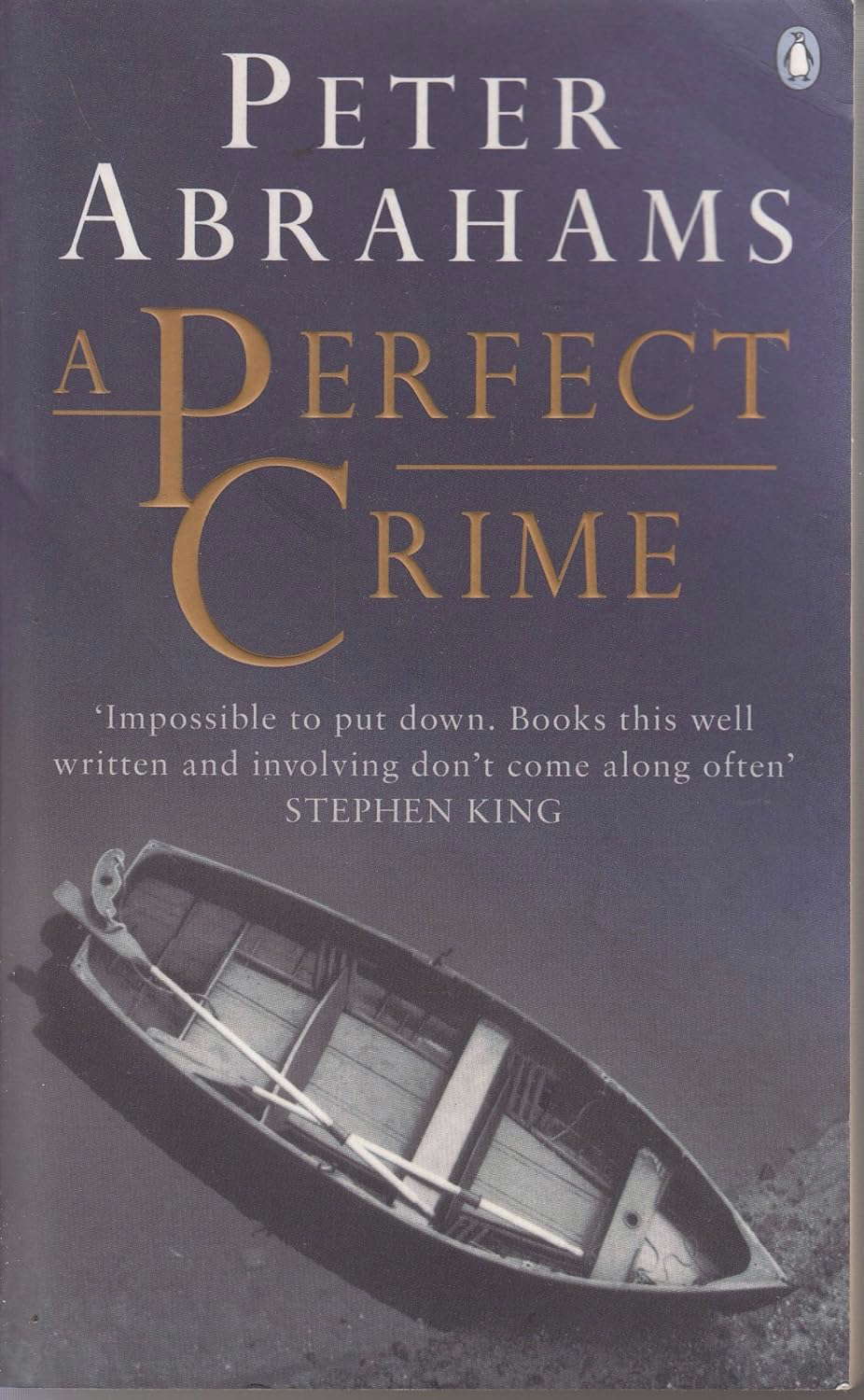


BOOK
0
The unfaithful wife. With her no-nonsense business savvy and exquisite eye for acquisition, Francie is a rising star in the Boston art world. But her personal life is about to take a decidedly dark turn. . . The cheating lover. A virile and charismatic radio psychologist, Ned hosts a popular show poised on the brink of syndication. Though married and successful, he has one fatal weakness. . . The loyal friend. Anne, a vulnerable and trusting wife and mother, desperately needs to confide in someone. Unfortunately, some secrets aren't meant to be shared. . . The jealous husband. Exeter, first in his class, Harvard, summa in economics. Now out of work and falling fast, Roger conceives a brilliant, violent plan that could put him back on top. . .
Proper Bostonian Roger Cullingwood thinks the good life is his birthright. He has an IQ of 181, a Harvard pedigree, a tony Beacon Hill home, and a beautiful wife named Francie who buys art for a foundation and plays a mean game of tennis. His Kevlar ego is barely scratched by a year's unemployment and the fact that he and Francie are just going through the motions. But when he learns that Francie is having an affair, he begins to create a calculus for a perfect, and perfectly brutal, crime. Needing to indulge his heroically outsized ego, that calculus inevitably requires the manipulation of a lesser being as his instrument of revenge. This literary thriller has a great deal going for it. The characters are as acutely realized as if painted by a photo-realist--not just Roger and Francie but also Whitey Truax, Roger's stupidly cunning psychopathic tool; Anne Franklin, the lovely but vulnerable wife of Francie's lover; and Joe Savard, a rural New Hampshire police chief who sculpts with a chainsaw. The plotting, and the plot twists, are complex and compelling. The dialogue is sharp and almost flawless, exposing facets of character without need for narrative that might slow the pace. And it's satisfying: there's sex and violence, but there's also a subtle sense of the mathematical certainty to the denouement. Thomas Gaughan --This text refers to the audio_download edition.
Though he is a very smart man (his IQ is 181, "on a bad day"), Roger Cullingwood is remarkably unperceptive. It takes months for him to realize that his wife Francie is involved with another man. But once he recognizes the affair, he hatches a plot to kill her--the perfect crime of the title--in less time than it takes him to finish the London Times crossword puzzle. It makes perfect sense that Roger wouldn't dream of doing the dirty deed himself; there's a paroled killer conveniently on hand, an easily manipulated psychotic named Whitey Truax. It's when Anne Franklin, the wife of Francie's lover, blunders into the murder scene Roger has so carefully contrived that the novel begins to get interesting. There are a few diversions to entertain the reader en route to the bloody denouement, including a couple of lively tennis matches. In one of the book's many coincidences, Francie ends up partnered with her lover's wife in a championship tournament. The sex is better than the violence, but what Abrahams excels at is pace; you could start and finish A Perfect Crime on the New York to Los Angeles redeye and still have time for a nap before the plane lands. --Jane Adams --This text refers to the audio_download edition.
A Boston woman's ill-advised affair with a talk-show host leads to murder and mayhem in this initially absorbing but somewhat contrived thriller from the author of The Fan and Lights Out. Art critic Francie Cullingwood is the beautiful, sophisticated and dissatisfied protagonist who seeks sexual satisfaction outside her stale marriage. Her lover is Ned DeMarco, a handsome, touchy-feely psychiatrist who hosts a radio show for the emotionally forlorn. Their passionate arrangement begins to unravel when Roger, Francie's brilliant but angry husband (a Harvard summa who's been fired from his job as a securities analyst), suspects her adultery and hires a hit man, Whitey Truax, to exact revenge on his spouse. Truax, it turns out, is a serial killer with a very short fuse. The tension rises as Abrahams cuts between the plot participants: Ned's wife, Anne, becomes Francie's tennis partner, making Francie aware of the damage the affair is causing, while Ned desperately clings to their involvement and Roger plots his bizarre campaign of retribution. The initial showdown between Whitey and his potential victims takes place at the adulterous couple's love nest, a New Hampshire cottage that quickly becomes a house of horrors when Whitey suspects Roger of double-crossing him, and runs amok on a killing spree that eventually leads back to Boston. Abrahams does his best work in a series of well-crafted early scenes that effectively convey the different levels of emotional duplicity among the protagonists, but the actual murders are strictly formulaic. While Francie, Ned and Anne are well-drawn, Abrahams's portrayals of both Roger and his minion lack dimension; they are both plot devices whose ludicrous partnership never carries the ring of credibility. Even so, as he explores Francie's emotional terrain in the wake of tragedy, Abrahams will keep readers very much engaged. Agent, Molly Friedrich; 100,000 first printing. Copyright 1998 Reed Business Information, Inc. --This text refers to the audio_download edition.
The discovery of an adulterous affair leads a brilliant but unstable man to plot the perfect murder. Francie and Ned, both married to others, meet illicitly at a cabin in the New Hampshire woods. Francie decides to end the affair when she discovers that her new tennis partner is Ned's wife, who suspects Ned of being unfaithful but is unaware of Francie's involvement. Francie's husband, Roger, suspects, too?and plots a deadly trap for the lovers at their remote hideaway. Edgar-nominee Abrahams (The Fan, LJ 2/1/95) weaves a tight web of deception and intrigue involving the two couples, a sheriff whose wife was brutally murdered years ago, and a desperate ex-con who becomes Roger's pawn in his murderous game. A Perfect Crime is fast-paced, tense, even witty as it careens to its bloody conclusion. Recommended for all public libraries.?Karen Anderson, Arizona State Univ. West Lib., PhoenixCopyright 1998 Reed Business Information, Inc. --This text refers to the audio_download edition.
Shock is available to us because Abrahams has written more than a crime story here. His prose is elegant by any literary standard, and the other characters in "A Perfect Crime", the nonvillains, whose flaws lie within the ordinary human range, are engaging and fully rounded, especially the women...Abrahams grips us so closely, line by line, making everything hyper-real...in this case the conventions of the genre have packaged not only the expected thrills but the always unexpected bonus: good writing --This text refers to the audio_download edition.
In this gripping novel of suspense, acclaimed author Peter Abrahams gives us an explosive thriller of lust and retribution, desire and accountability, murder and reckoning--set in motion by an illicit love that ticks like a time bomb. A master at creating menacing intrigue and shocking reversals, Abrahams has indeed devised A Perfect Crime.When an adulterous affair is revealed, a devious mind begins to construct the perfect, flawless crime. No loose ends. Everything considered: motive, means, opportunity, evidence, suspects, alibis. The perpetrator must remain an invisible presence, seeing the plot through to its chilling conclusion, manipulating the players like chess pieces in an intricate, deadly game.The unfaithful wife.With her no-nonsense business savvy and exquisite eye for acquisition, Francie is a rising star in the Boston art world. But her personal life is about to take a decidedly dark turn. . . .The cheating lover.A virile and charismatic radio psychologist, Ned hosts a popular show poised on the brink of syndication. Though married and successful, he has one fatal weakness. . . .The loyal friend.Anne, a vulnerable and trusting wife and mother, desperately needs to confide in someone. Unfortunately, some secrets aren't meant to be shared. . . .The jealous husband.Exeter, first in his class. Harvard, summa in economics. Now out of work and falling fast, Roger conceives a brilliant, violent plan that could put him back on top. . . .The ultimate act of revenge. In Peter Abrahams's stunning new thriller, four lives hang in precarious balance--as a cunning mastermind prepares their roles in A Perfect Crime. --This text refers to the audio_download edition.
"A perfect page-turner . . . Books this well written and involving don't come along often. . . . Peter Abrahams is my favorite American suspense novelist, better even than Elmore Leonard and Nelson DeMille. "--Stephen King"A Perfect Crime is a perfect read--a novel of malice and retribution that crackles from page one like a live wire. Peter Abrahams is as gifted as anyone writing suspense today. For proof, readers need look no further than A Perfect Crime."--Michael PalmerNew York Times bestselling author of Flash Back and Side Effects"Peter Abrahams has crafted a thoroughly absorbing novel of the decline and fall of a modern marriage--in which murder replaces divorce. The characters ring true, the suspense keeps the pages turning, and the ending is a shocker. A Perfect Crime is a perfect thriller."--Lisa ScottolineEdgar Award-winning author of Rough Justice and Legal Tender --This text refers to the audio_download edition.
Thursday, the best day of the week--the day of all days that Francie was predisposed to say yes. But here in the artist's studio, with its view of the Dorchester gas tank superimposed on the harbor beyond, she couldn't bring herself to do it. The problem was she hated the paintings. The medium was ink, the tool airbrush, the style photorealist, the subject slack-faced people in art galleries viewing installations; the installations, when she looked more closely, were neon messages fenced in with blood-tipped barbed wire, messages that though tiny could be read, when she looked more closely still. Francie, her nose almost touching the canvases, read them dutifully: name that tune; do you swear to tell the truth?; we will have these moments to remember."World within world," she said, a neutral phrase that might be taken optimistically."I'm sorry?" said the artist, following her nervously around the studio.Francie smiled at him--gaunt, hollow-eyed, twitchy, unkempt--Raskolnikov on amphetamines. She'd seen paintings of slack-faced people looking at paintings; she'd seen neon messages; she'd seen barbed wire, blood-tipped, pink, red-white-and-blue; seen art feeding on itself with an appetite that grew sharper every day."Anything else you'd like to show me?" she said."Anything else?" said the artist. "I'm not sure exactly what you . . ."Francie kept her smile in place; artists lived uneasy lives. "Other work," she explained, gently as she could.But not gently enough. He flung out his arm in a dramatic sweep. "This is my work."Francie nodded. Some of her colleagues would now say "I love it" and let him learn the bad news in a letter from the foundation, but Francie couldn't. Silence followed, long and uncomfortable. Time slowed down, much too soon. On Thursdays, Francie wanted time to behave as it might in some Einsteinian thought experiment, hurrying by until dark, then almost coming to a stop. The artist gazed at his shoes, red canvas basketball sneakers, paint-spattered. Francie gazed at them, too. Do you swear to tell the truth? Even bad art could get to you, or at least to her. She saw something from the corner of her eye--a small unframed canvas, leaning against the jamb of a doorless closet, went closer, to end the shoe-gazing if nothing else."What's this?" An oil painting of a plinth, cracked, crumbling, classical, bearing a bunch of grapes, wine-dark, overripe, even rotting. And in the middle ground, not hidden, not flaunted, simply there, was a lovely figure of a girl on a skateboard, all poise, balance, speed."That?" said the painter. "That's from years ago.""Tell me about it.""What's to tell? It was a dead end.""You didn't do any more like it?" Francie knelt, turned the painting around, read the writing on the back: oh garden, my garden."By the dozen," said the artist. "But I painted over them whenever I needed canvas."Francie kept herself from glancing at the busy pieces on the wall."That's the last one, in fact. Why do you ask?""It has a kind of . . ." Something. It had that something she was always looking for, so hard to put in words. To sound professional, Francie said, ". . . resonance.""It does?""In my opinion.""No one liked them at the time.""Maybe I'm just a sucker for overripe fruit," Francie said, although she already knew it wasn't that. It was the girl. "Caravaggio, and all that," she explained."Caravaggio?""You know," she said, her heart sinking."A kind of grape?""He said that? A kind of grape?" Nora, having finished her lunch--a very late lunch, eaten on their feet at a coffee place in the North End--helped herself to Francie's. "Soon the past will be completely forgotten.""And life can begin," said Francie.Nora paused in midbite. "You feeling okay?""Why do you ask?""How's Jolly Roger these days?""Why do you ask?"Nora laughed, choked slightly, wiped her mouth. "Can you play for me tonight?"Nora meant tennis: they belonged to the same club, had played together since eighth grade. "Not on Th--no," Francie said."I hate to cancel on her.""Who?""Anne? Anita? New member. Shy little Frau, but she has a nice game. You should meet her.""Not tonight.""You said that. What's tonight?""Work," Francie said, not without a twinge inside. "And you?""Got a date. He called me this morning.""For tonight? And you said yes?""He already knows I've been married twice--do I have to simper like a virgin for the rest of my life?""Who's the lucky guy?""Bernie something."Francie picked up the check--Nora's settlement from marriage one had gone the other way the second time--and got her car from the parking garage. She turned on the radio, found Ned, drove out of the city."And we're back. I'm Ned Demarco, the program is Intimately Yours, our beat marriage, love, family in this increasingly complex world. It's Thursday, and as our regular listeners know, Thursday is our free-form day, open-forum time, no studio guests, no set topics. We talk about what you out there want to talk about. Welcome to the program, Marlene from Watertown.""Dr. Demarco?""Ned, please.""Ned. Hi. I really enjoy your show.""Thank you, Marlene. What's on your mind?""First can I ask you something?""Shoot.""That voice of yours. Do they do anything to, like, enhance it?"Ned laughed. "Lucy, in the control room: Doing anything to enhance my voice?" He laughed again, easy and natural. More relaxed with every show, Francie thought. "Lucy says she's doing all that science possibly can. Anything else, Marlene?""It's about my husband, I guess." The woman paused."Go on.""He--he's a wonderful father, an excellent provider. Even helps out around the house.""Sounds ideal.""I know. Which is why I feel so guilty for saying this, even having it in my mind.""Having what in your mind, Marlene?"She took a breath, deep and troubled, audible down her phone line, over the air, through the speakers in Francie's car. "Lately I've been daydreaming a lot about this boy I went with back in high school. And nightdreaming. I'm talking about all the time, Dr.--Ned. And my question is, Would there be any harm in looking him up?"Ned paused. Francie could feel him thinking. She drove into a tunnel and lost him before the answer came.The city dwindled in her rearview mirror until there was nothing left but the tops of the two big towers that gave downtown its distinctive look, intruding on a cold, silvery sky. Francie crossed the New Hampshire line, drove north on roads of less and less importance, entered the wilderness beyond the last bed-and-breakfast, and came to Brenda's gate at dusk. She got out of the car, unlocked the gate, drove through, leaving the gate closed but unlocked, as she always did. The rutted track, thick with dead leaves, led up over a hill, then down through rocky meadows to the river. Most of the light had drained from the sky, but the river held on to what was left, in odd blurred streaks of red, orange, and gold: like an autumnal Turner seen through a fingerprint-smeared lens. Francie stopped in front of the little stone jetty, where two dinghies--red Prosciutto and green Melóne-- were fastened to the lee side. Climbing into one, she discovered the cause of the odd blurring--a skin of ice lay on the river. So soon? She rowed out to the island, oar blades slicing through the fiery glaze, sheared ice scratching against her bows.Brenda's island, two or three hundred feet across the river, almost halfway, was a fat oval with flattened ends, no bigger than an acre. It had a floating dock, five huge elms, isolated from disease, thick brush that hadn't been cleared in years, and a flagstone path leading up to the cottage. Francie unlocked the door and went inside, closing the door and leaving it unlocked, as she always did.The cottage: pine-floored, pine-walled; all that old, deep-polished wood made it almost a living thing, like a fairy-tale tree house. There was a south-facing kitchen, looking down the river; an L-shaped dining and living room facing the far shore; and upstairs two square bedrooms, each with a brass bed, one unmade, the other covered with pillows and a down comforter. A perfect little cottage that had been in Brenda's family for more than a hundred years; but Brenda, Francie's former college roommate, was the last survivor, and she lived in Rome. She'd asked Francie to keep an eye on it for her, using it whenever she wanted, and Francie had agreed, long before anything ulterior came along.Francie switched on the generator, lit the woodstove, poured herself a glass of red wine, sat at the kitchen table, and watched night swallow everything--riverbanks, river, floating dock, great bare elms--leaving only the stars above, like holes pierced through to some luminous beyond. The skateboard painting--oh garden, my garden-- drifted into her mind. Could she properly buy it for herself if the price was right? The artist would probably be glad of the money, but a sale to the foundation would do more for his career. Francie debated with herself for a while. The answer was no.She threw another log... --This text refers to the audio_download edition.
Francie Cullingwood's ill-advised affair with a radio talk show host leads to murder when her husband, Roger, hires convicted killer Whitey Truax to exact revenge. Sharon Williams's suitably unnerving yet matter-of-fact reading reflects Roger's anger, Whitey's paranoia, and Francie's shock and grief in the wake of tragedy. Williams keeps listeners engaged as she enhances the palpable tension of the plot. Depicting males and females equally well, she also makes characters seem well drawn and realistic. Even though listeners will guess what's coming, Williams's performance is as impressive as the grace with which the plot unfolds. This psychological thriller translates well to audio. S.C.A. Winner of AudioFile Earphones Award © AudioFile 2009, Portland, Maine --This text refers to the audio_download edition.
Find it on
AmazonNo videos available yet.
No news articles linked to this title yet.

Overall
Overall rating of the media
Atmosphere
How immersive and tense is the atmosphere
Gore
Level and quality of gore/violence
Story
Quality of the storyline and plot
Writing
Quality of the written content
Character Development
Depth and growth of characters
Pacing
Flow and timing of the narrative