
BOOK
0
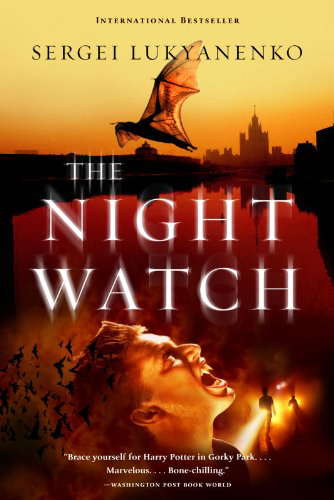
The phenomenal Russian bestseller. A vampire novel set in a richly realized post-Soviet Moscow, The Night Watch has sold across Europe and to 20th Century Fox for huge advances.In The Night Watch, the first of a trilogy, and reminiscent of Philip Pullman’s His Dark Materials in its ambitions and achievement, the setting is contemporary Moscow. A small number of Muscovites with supernatural powers — those who are Other, owing allegiance either to the Dark or the Light — co-exist in an uneasy truce, each side keeping a close eye on the other’s activities around the city.Anton, an Other on the side of the Light, is a night-watchman, patrolling the streets and Metro of the city as he protects ordinary people from the vampires of the Dark. On his rounds, Anton comes across a young woman, Svetlana, whom he realizes is under a curse that threatens the entire city, and a boy, Igor, a young Other, as yet unaware of his own enormous power. Partnered by Olga, an Other who is in the form of an owl, he struggles to remove the curse and thereby save the city, while at the same time prevent Igor from falling into the clutches of the Dark. The Night Watch explores the nature of good and evil and the tensions between the individual and the collective in a gripping narrative that owes as much to The Master and Margarita as it is does to the richly realized worlds of Philip Pullman and Tolkien.
Starred Review. Set in contemporary Moscow, Lukyanenko's fantastic American debut—the first in a series about an epic struggle between good and evil—charts the adventures of a race of supernaturally gifted Others, who serve either the Light or Dark Side. The Others slip in and out of an eerie parallel world where they coexist in an uneasy peace that a terrible revolution may soon disrupt. Philosophical Anton Gorodetsky, an earnest Night Watch agent, falls in love with 24-year-old Svetlana Nazarova, a troubled young doctor under a Dark Magician's curse. While Anton endeavors to undo the curse, he discovers Egor, a gifted boy unwilling to choose between his Light or Dark abilities. As humankind's fate hangs in the balance, Anton is forced to re-examine his allegiance, and Svetlana is drawn deeper into the exotic, vivid universe of dueling magicians, shape-shifters, witches and vampires. Potent as a shot of vodka, this compelling urban fantasy was adapted to a Russian blockbuster movie in 2004. (July) Copyright © Reed Business Information, a division of Reed Elsevier Inc. All rights reserved.
“Night Watch is an epic of extraordinary power.”
“Star Wars meets the Vampires in Moscow . . . it bursts with a sick, carnivorous glee in its fiendish games.”
“The Night Watchis inventive, sardonic and imbued with a surprising sense that, for this author and his audience, much of this stuff is new-minted.”
“This modern day mythical fantasy is Anne Rice on an epic scale, a hugely imagined world. A chiller thriller from cold of Russia, this one's been selling like hot cakes around the world.”
They are the "Others," an ancient race of supernatural beings—magicians, shape-shifters, vampires, and healers—who live among us. Human born, they must choose a side to swear allegiance to—the Dark or the Light—when they come of age.For a millennium, these opponents have coexisted in an uneasy peace, enforced by defenders like the Night Watch, forces of the Light who guard against the Dark. But prophecy decrees that one supreme "Other" will arise to spark a cataclysmic war.Anton Gorodetsky, an untested mid-level Light magician with the Night Watch, discovers a cursed young woman—an Other of tremendous potential unallied with either side—who can shift the balance of power. With the battle lines between Light and Dark drawn, the magician must move carefully, for one wrong step could mean the beginning of annihilation.
Brace yourself for Harry Potter in Gorky Park. Sergei Lukyanenko's Night Watch is the beginning of a sprawling fantasy series set in modern-day Moscow about a young man and his owl, who belong to a magical police force that protects humanity from "vampires, werewolves, incubuses and succubuses, active witches, all sorts of troublesome riffraff from the lower levels." The first volume (Nochnoi Dozor) appeared in Russia in 1998, and so far the trilogy has sold more than 3 million copies abroad. Director Timur Bekmambetov originally planned a television series based on the books but instead produced a lush, violent and baffling movie (with lots of product placement) that was hailed as post-Soviet Russia's first blockbuster. Fox Searchlight released it in the United States this spring with enough magic to trick fantasy-thriller fans into seeing a movie with subtitles (the DVD, dubbed in English, went on sale this summer), and two more installments are already headed our way. Till then, you can play the "Night Watch" video game from CDV Software ($39.99). Action figures at McDonald's can't be far behind.But what about the book -- just published in America -- at the center of this international vortex of spin-offs? The key to its wild popularity in Mother Russia may be the way Lukyanenko recasts Russia from a bankrupt, has-been world power to a place where the forces of Good and Evil will finish their long battle. Communism, you see, was just an experiment that went awry in a land where experiments can still take place. The Moscow of Night Watch may look gritty and grim, but within its murky new freedom anything might happen. "The potential of Europe and North America has already been exhausted," Lukyanenko writes. "Everything that was possible has already been tried there. . . . All those countries are already half asleep. A healthy retiree in shorts with a digital camera -- that's the prosperous countries of the West. We need to experiment with the young ones." But for Muggles who live outside that land of grand potential, say, in one of those exhausted, prosperous countries of the West, this fantasy novel's appeal will have to rest on its characters, its suspense and its themes. At the risk of being cursed by a Dark Magician, I have to say that's a long shot. Night Watch suffers from the pretentiousness and humorlessness that frequently weigh down stories that capitalize the words Good and Evil, as in "Evil has no need to bother with eliminating Good. It's far simpler to let Good fight against itself." I must remember this the next time my wife claims the car is making a funny noise. The story involves a race of super-humans called the "Others," who live and work alongside us, feeding off the negative or positive mental energy that ordinary human beings produce. They fade in and out of a gray fourth dimension known as the Twilight that overlays our natural world. These Others are born to regular human parents, but when each Other comes of age, he or she must choose to join the Light or the Dark side: "If you always put yourself and your own interests first, then your path leads through the Darkness. If you think about others, it leads toward the Light." If you've studied the Gospel According to George Lucas, you'll recognize the sappy metaphysics of Night Watch, but Lukyanenko lays on a heavy gloss of realpolitik: The forces of Light and Dark are locked in a thousand-year-old Cold War, bound by an ancient truce that keeps the world from being destroyed. Each side maintains a Watch to ensure that the opposite side is not violating the terms of the peace treaty by interfering illegally with the direction of human history. Large sections of the novel sound like Henry Kissinger channeling Obi-Wan Kenobi on the importance of maintaining this balance of power, even if innocent individuals must be sacrificed along the way. Anton, the narrator, is a low-level member of the Night Watch, the officers who keep track of the Dark Others. Like any good young hero, he's just an ordinary guy (with superpowers) who is told at the crucial moment: "Now you're our only hope." He's deeply conflicted about the nature of his work, he's frustrated by the wrong-headed orders that come down from on high, and, of course, he falls in love with the woman he's sent to protect. She's a beautiful doctor named Svetlana, who doesn't initially realize she's an Other with enormous magical power (which makes you wonder how good a doctor she is). The overarching plot of the novel concerns Anton's reluctant participation in Svetlana's recruitment, training and preparation for a dangerous interference in the Destiny of mankind: a little boy, whom both sides hope to claim as their Great One. In each of the novel's three sections, Anton struggles through a torturous crisis of faith that leads up to a climactic confrontation with the forces of Evil, only to realize in the final paragraphs that his boss, a Great Magician of the Light, has planned the whole thing as a decoy to distract everyone (including us) from some secret plan off-stage. The trick ending of the first section was fairly clever; the trick ending of the second section was a little annoying; and by the end of the third, I wanted to shove somebody's magic wand up the Dark Place.This is a shame because the novel contains some captivating scenes and all kinds of marvelous, inventive detail: The vampires' seduction of a teenage boy is bone-chilling; every time Lukyanenko described the Other-worldly Twilight, I felt lured into it; and the fantastical powers exercised by Anton and his colleagues range from delightful to awesome: changing the weather in the living room, transforming into animals, "remoralizing" whole blocks of people. But the clunky language of Night Watch in translation constantly shatters its magic: As a girl-vampire moves in for the kill, for instance, Anton says, "Things were looking really bad now." A few pages later, he tells us, "This was getting really interesting!" When he gets rescued by a passing car, he says, "Things like this just didn't happen! Heroes only got rescued by passing cars in cheap action movies." Say, there's an idea. Or maybe a TV show. Or a sequel. And a video game. Use the Force, Luk. Reviewed by Ron Charles Copyright 2006, The Washington Post. All Rights Reserved.
PROLOGUEThe escalator strained slowly upward. In an old station like this, what else would you expect? But the wind swirled like a wild thing inside the concrete pipe — ruffling his hair, tugging the hood off his head, sneaking in under his scarf, pressing him downward.The wind didn’t want Egor to go up.The wind was pushing him back.Strange, but no one else seemed to notice the wind. There was hardly anyone around — it was midnight and the station was already emptying. Only a few people riding down towards Egor and hardly anyone on the up escalator either. One ahead of him, two or three behind.That was it.Except, of course, for the wind.Egor stuck his hands in his pockets and turned to look back. For a couple of minutes already, from the moment he stepped off the train, he’d had the feeling he was being watched. It wasn’t a frightening kind of feeling at all, it felt interesting, a sudden, pricking sensation.Down at the bottom of the escalator there was a tall man in uniform. Not police, a soldier.Then there was a woman with a sleepy little child, clutching her hand. And another man, young, wearing a bright orange jacket, with a walkman. He looked just about dead on his feet too.Nothing suspicious. Not even for a boy going home so late. Egor looked up again, at the policeman lounging against the gleaming handrails, dejectedly trying to spot some easy prey in this sparse stream of passengers.Nothing to be afraid of.The wind gave Egor one last nudge and suddenly dropped away, apparently resigned that the struggle was pointless.The boy glanced back once more and started running up the moving steps as they flattened out under his feet. He had to hurry. He didn’t know why, but he had to. Again he felt a pricking sensation of senseless anxiety and a cold shudder ran through his body.It was the wind again.Egor slipped out through the half-opened doors and the piercing cold assailed him with renewed fury. His hair, still wet from the pool — the dryer was broken again — was instantly stiff with ice. Egor pulled the hood back over his head, darted past the vendor kiosks without stopping and hurried into the underpass. Up on the surface there were far more people, but he still had the feeling of alarm. He glanced back now, without slowing down, but there was no one following him. The woman with the small child was walking towards a trolleybus stop, the man with the walkman had paused in front of a kiosk, inspecting the bottles, the soldier still hadn’t come out of the subway.The boy speeded up through the underpass.There was music coming from somewhere, so quiet he could hardly hear it, but it was incredibly soothing. The delicate trill of a flute, the strum of guitar strings, the chime of a xylophone.The music was calling to him, telling him to hurry. Egor dodged past a group of people hurrying towards him, overtook a happy little drunk who was barely staggering forward. All thought seemed to have been blown out of his head, he was almost running now.The music was calling.And now there were words weaving themselves into it . . . not clearly, still too quiet to make out, but just as alluring. Egor bounded out of the underpass and stopped for a moment, gulping in the cold air. A trolleybus was just rolling up to the stop. He could ride just one stop, almost all the way to his house . . .The boy set off towards the trolleybus, walking slowly, as if his legs had suddenly become numb. It halted for a few seconds with its doors open, then the hinged flaps swung together and it moved away. Egor watched it go with dull, glazed eyes, the music getting louder all the time, filling the whole world, from the semicircular lobby of the high-rise hotel to the ‘box on stilts’ — his own building — that he could see not far away. The music was prompting him to walk.Along the wide, brightly lit avenue, where there were still plenty of people around at this hour. His home was only five minutes away.But the music was even closer . . .When Egor had walked about a hundred metres, the hotel was suddenly no longer sheltering him from the wind.The icy blast stung his face, almost drowning out the music that was calling to him. The boy began to stagger, nearly coming to a stop.The enchantment was shattered, but the feeling of being watched was back, this time with a strong undercurrent of fear.He glanced back. Another trolleybus was approaching the stop. And he caught a glimpse of an orange jacket in the light of the streetlamps.The man who had ridden up the escalator with him was walking behind him. Still with his eyes half closed in the same way, but with surprising speed and purpose, as if he could see Egor.The boy started to run.The music began again louder than ever, breaking through the curtain of the wind. He could now make out words . . . he could, but he didn’t want to.The right thing to do now was to walk along the avenue, past the shops, which were closed but still brightly lit, alongside the late-nighters on the pavement, in full view of the cars rushing by.But Egor turned into an alleyway. To where the music was calling him.It was almost completely dark, the only things moving were two shadows by the wall. Egor seemed to see them through a dense haze, as if they were lit up by some ghastly bluish glow.A young man and a girl, very lightly dressed, as if the night air wasn’t twenty degrees below zero.The music rose to a final, crashing, triumphant crescendo.And stopped.The boy felt his body go limp. He was covered in sweat, his legs giving way, he wanted to sit down on the slippery, ice-covered pavement.‘A pretty one . . .’ said the girl in a quiet voice. She had a thin face, with sunken cheeks and a pale complexion. Only her eyes seemed to be alive: black, huge, magnetic.‘You can leave . . . just a little bit . . .’ the young man said with a smile. They were as alike as brother and sister, not in their features, but in some indefinable quality that they shared, as if their faces were covered by a dusty, semi-transparent gauze.‘For you?’ For a moment the girl turned her gaze away from Egor.The numbness eased slightly and terror flooded his mind.The boy opened his mouth, but his eyes met the young man’s and he couldn’t shout.As if he was suddenly wrapped in some cold, elastic membrane.‘Yes.You hold him!’The girl gave a mocking snort. Turning her gaze back to Egor, she stretched out her lips as if she were blowing a kiss. In a quiet voice she pronounced those familiar words, the ones that had been woven into the alluring music.‘Come, come . . . come to me . . .’Egor stood without moving. He had no strength to run, despite the horror, despite the scream that had burst from his lungs and stuck in his throat. But at least he could simply stand.A woman walked past the end of the alley with two huge German shepherds on leads. Walking in slow motion, as if she were moving underwater, as if she were part of his terrible dream. Out of the corner of his eye, Egor saw the dogs turn sharply towards the alley, tugging at their leads, and for a moment an insane hope flared up in his soul. The German shepherds started growling uncertainly, with loathing and fear. The woman stopped for a moment and glanced suspiciously into the alley. Egor caught her glance — indifferent, as if she was looking into empty space.‘Come on!’ She tugged at the leads and the dogs gladly moved back to her side.The young man laughed quietly.The woman quickened her step and disappeared from view.‘He’s not coming to me!’ the girl exclaimed petulantly.‘Look, will you, look, he’s not coming!’‘Try harder,’ the young man said curtly. He frowned. ‘Learn.’‘Come! Come to me!’ the girl said, emphasising each word. Egor was less than two metres away, but it seemed to be important to her that he came over to her.Egor realised that he had no more strength to resist. The girl’s gaze held him, as if binding him with an invisible elastic tether, the words summoned him and he could not help himself. He knew that he should not move, but still he took a step forward.The girl smiled, and he saw her white, even teeth. She said:‘Take off your scarf.’He couldn’t hold out any longer. His hands trembled as he threw back his hood and pulled off his scarf without unwinding it. He stepped towards those alluring black eyes.Something was happening to the girl’s face. Her lower jaw was stretching down, her teeth were moving, curving. He saw the flash of long fangs that were not human.Egor took another step.
Find it on
AmazonNo videos available yet.
No news articles linked to this title yet.

Overall
Overall rating of the media
Atmosphere
How immersive and tense is the atmosphere
Gore
Level and quality of gore/violence
Story
Quality of the storyline and plot
Writing
Quality of the written content
Character Development
Depth and growth of characters
Pacing
Flow and timing of the narrative