

BOOK
0
Hailed as a "writer of subtlety and depth," Hilary Mantel turns her dark genius on the world of psychics in this smart, unsettling novel (Joyce Carol Oates)A paragon of efficiency, Colette took the next natural step after finishing secretarial school by marrying a man who would do just fine. After a sobering, do-it-yourself divorce, Colette is at a loss for what to do next. Convinced that she is due an out-of-hand, life-affirming revelation, she strays into the realm of psychics and clairvoyants, hungry for a whisper to set her off in the right direction. At a psychic fair in Windsor she meets the charismatic Alison.Alison, the daughter of a prostitute, beleaguered during her childhood by the pressures of her connection to the spiritual world, lives in a different kind of solitude. She cannot escape the dead who speak to her, least of all the constant presence of Morris, her low-life spiritual guide. An expansive presence onstage, Alison at once feels her bond with Colette, inviting her to join her on the road as her personal assistant and companion.Troubles spiral out of control when the pair moves to a suburban wasteland in what was once the English countryside and take up with a spirit guide and his drowned therapist. It is not long before Alison's connection to the place beyond black threatens to uproot their lives forever. This is Hilary Mantel at her finest- insightful, darkly comic, unorthodox, and thrilling to read.
Instead of celebrating the mystical side of "sensitives," the people who travel England's contemporary psychic "fayre" circuit, Mantel (A Change of Climate, etc.) concentrates on the potential banality of spiritualism in her latest novel, a no-nonsense exploration of the world of public and private clairvoyance. Colette is a down-on-her-luck event planner fresh from a divorce when she attends a two-day Psychic Extravaganza, her "introduction to the metaphorical side of life." There, Alison, a true clairvoyant, "reads" Colette, sees her need for a new life—as well as her potential—and hires her as a Girl Friday. As Colette's responsibilities grow, and the line between the professional and the personal blurs, Colette takes over Alison's marketing, builds her Web site, plans for a book and buys a house with her. Colette also serves as a sort of buffer between Alison and the multitude of spirits who beleaguer her. (Alison's spirit guide, Morris, "a little bouncing circus clown," proves especially troublesome.) Mantel's portraits of the two leading characters as well as those of the supporting cast—both on and off this mortal coil—are sharply drawn. This witty, matter-of-fact look at the psychic milieu reveals a supernatural world that can be as mundane as the world of carpet salesmen and shopkeepers. (May) Copyright © Reed Business Information, a division of Reed Elsevier Inc. All rights reserved.
Beyond Black is just thatso black it reaches beyond the dark and makes the unbelievable believable. A story that normalizes clairvoyance shouldnt work this well, but it does. Mantel discussed her own experiences with illness and ghosts in her memoir Giving Up the Ghost (2003), but this novel is pure fiction. A seedy sideshow of ghosts (at turns helpful, annoying, and evil), all-too-human characters, a British brand of humor, shrewd commentary on the state of the world, and rich prose make for convincing, if not always agreeable, reading. Although Alisons flashbacks never emerge clearly, they create some of the novels most painful scenes.Copyright © 2004 Phillips & Nelson Media, Inc.
Fans of Mantel's 2003 memoir, Giving Up the Ghost (2003), will recognize aspects of the author in the sympathetic heroine of her tenth book, a darkly funny novel about the odd relationships formed among the living and the dead. Alison Hart, nearing 40, overweight and happily single, is a spiritual seer by trade. She reads palms and tarot cards; in villages throughout England, she performs in front of packed crowds, her stage act a combination of fortune-telling and "communications" with the other side. In an age of celebrity deaths and terrorist attacks, Alison's authentic spiritual gifts are highly prized, but her personal life is in shambles, physically, emotionally, and financially. Help arrives in the form of Colette, a recently divorced, no-nonsense professional, who sees Alison's predicament as an opportunity to reinvent both women's lives. Obstacles to Colette's ambitious plans include nosy neighbors, competing psychics, even adversaries from beyond--especially a gang of menacing thugs from Alison's childhood. A contemporary ghost story told with humor and heart, this novel is sure to conjure up new readers for Mantel. James KliseCopyright © American Library Association. All rights reserved
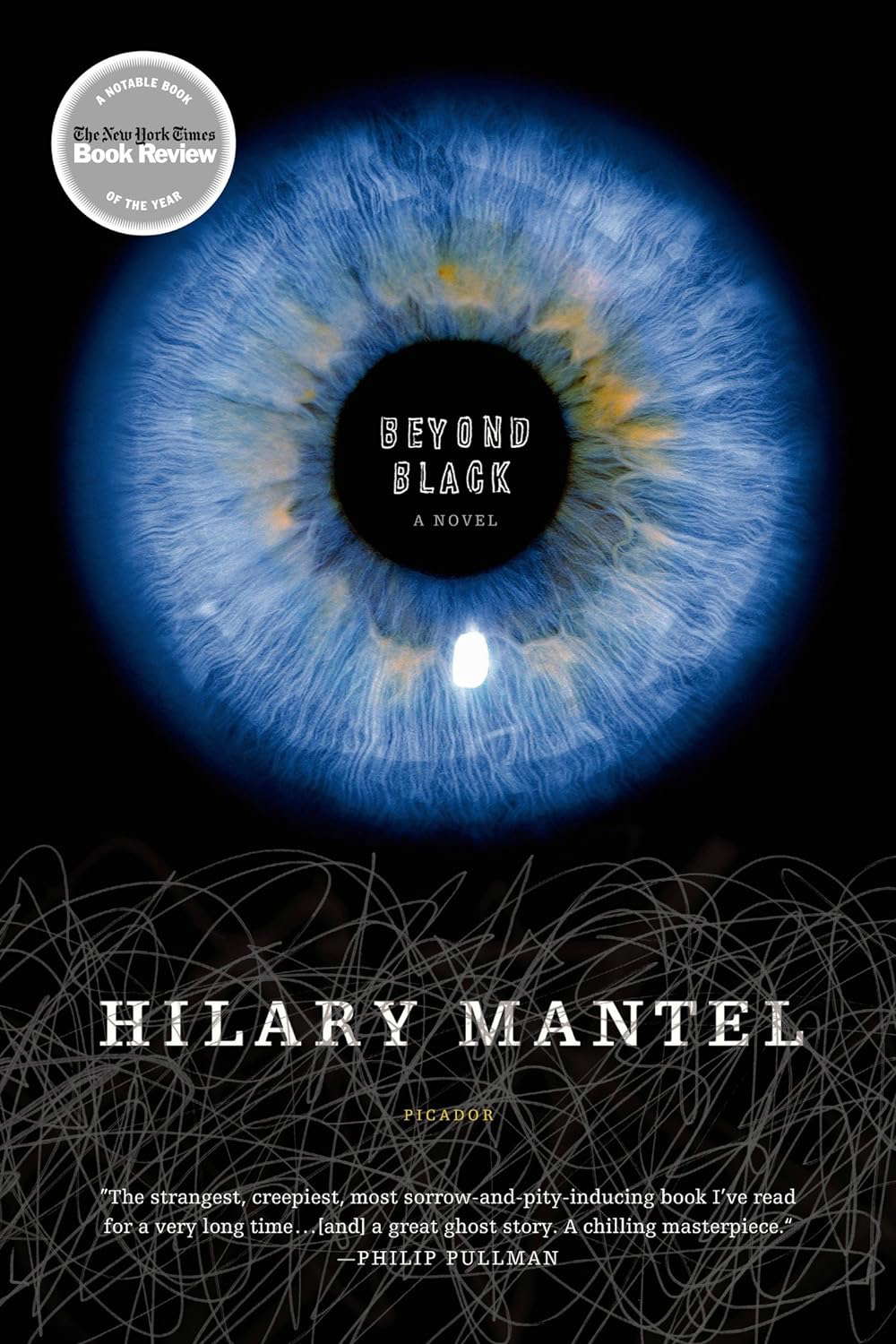
“The strangest, creepiest, most sorrow-and-pity-inducing book I've read for a very long time . . . [and] a great ghost story. A chilling masterpiece.”
“A terrible and swirling horror-comedy about a very fat medium on the perimeter of the M25, haunted by mean and nasty spirits, veering between damnation and the trivial.”
“Funny and harrowing. . . A great comic novel. Hilary Mantel's humor, like Flannery O'Connor's, is so far beyond black it becomes a kind of light.”
“Beautifully written . . . Strange, funny, and affecting . . . Mantel is . . . the possessor of a peerless prose style.”
“Spooky, smart, and deep.”
“[One of] my favourite [books] of the year . . . More people really need to get with the concept that Mantel is one of the best writers in England.”
“Her finest [novel] . . . Mantel's writing is so exact and brilliant that, in itself, it seems an act of survival, even redemption.”
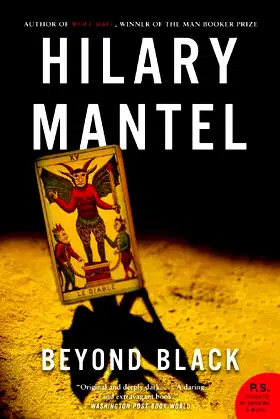
“Original and deeply dark . . . New and compelling . . . With Beyond Black [Mantel] shows us how fiction can lift us into the extraordinary.”
“Grimly seductive [work from] a writer of dark extremities. [Mantel] performs as if from the depths of a well, her prolonged bleakness pierced by splinters of beauty and treacherous wit. . . . Imperceptibly, artfully, Mantel has elevated her material monsters into metaphysical monsters.”
“Inventive, delightful, subversive [and] dead serious . . . Hilary Mantel has taken . . . those moments between sleep and waking, when we hardly know who we are, or why, and turned them into a novel that makes the unbelievable believable. . . . This is a book out of the unconscious, where the best novels come from.”
Hilary Mantel's Beyond Black is an acquired taste, and I have acquired it. The novel is original and deeply dark, but as one interpretation of its title suggests, the author tries hard to push herself past the stark grimness of the world she describes and take the reader somewhere new and compelling.The book explores the relationship between a genuine-article psychic named Alison and her assistant, Colette, as they travel through England, along with Alison's spirit guide, a lowlife figure from the past called Morris, who is forever sprawled in doorways and lounging on chairs, playing with his genitals or muttering. The obese, tormented Alison and the singularly repellent Morris are characters who (as you might expect) can be hard to take and (as you might not) still harder to turn away from. Mantel sets them into relief by including the lost Colette, who enters Alison's oddball orbit fresh from a failed marriage. Colette loosely represents the "normal" world of ordinary human unhappiness and disappointment. About her and her husband Gavin, Mantel writes: "They got married. People did. It was the tag end of the Thatcher/Major years and people held a wedding to show off. They didn't have friends, so they invited everybody they knew." Mantel's indictments of English life are planted with shrewdness and subtlety. She is particularly adept at rendering Alison's onstage conversations with audience members whose desire for knowledge of the dead is equivalent only to their desire to be important: " 'Gill, you're the sort of woman -- well -- ' She gives a little laugh and a shake of her head -- 'well, you're a bit of a human dynamo. I mean that's how your friends describe you, isn't it? Always on the go, morning, noon and night, you're the sort of person, am I right, who can keep all the plates spinning? But if there's one thing, if there's one thing, you know, all your friends say, it's that you don't give enough time to yourself.' . . . Gillian has of course been nodding since the first time Al paused for breath. In Alison's experience there's not a woman alive who, once past her youth, doesn't recognize this as a true and fair assessment of her character and potential." Alison's audience also longs for a sunny view of the afterlife, which has to be better than what they're living in now: "In Spirit World, she said, people were healthy and in their prime. 'They've all got their bits and whatsits. Whenever they were at their happiest, whenever they were at their healthiest, that's how you'll find them in Spirit World.' " There's piquant irony in her description, for no one in this book is particularly happy or healthy; the entire novel has a dissolute, seedy quality that Mantel works hard to attain. Some people here are about to die; they don't know it yet, but Alison does. Here, memorably, she foresees the imminent death of Princess Diana:" 'It's Diana,' Al said. 'Dead.' . . . " 'Suicide?' " 'Or accident. She won't tell me. Teasing to the last.' . . . " 'I'm sure it will be clearer,' Al said, 'when it actually happens.' " 'What do you mean? You mean it hasn't happened yet?. . . Al, we must do something!' " 'Like?' " 'Warn somebody! Call the police! Telephone the queen?' "Al raised a hand. 'Quiet, please. She's getting in the car. She's putting her seat belt -- no, no, she isn't.' "Alison plays the "abnormal" to Colette's "normal," or at any rate the "paranormal." She is a complicated figure, rendered both powerful and forlorn by her natural and overwhelming gifts. Beside her, Colette appears vaguer and more generic, and the marriage that the assistant has escaped from has the gritty, mumbled cadences of a BBC TV show.Most vivid are the impressionistic details of Alison's childhood, which was a Gothic horror show of grotesquerie and abuse. Alison's psychic gifts were already on display when she was young, but in her adulthood they serve as a durable outlet for the various traumas she experienced. I'm reminded of multiple-personality disorder, in which survivors of sexual abuse sometimes create fully fleshed-out characters inside themselves -- complete with names, distinct preferences and entire histories -- as a way to compensate for the burden of carrying around their own unbearable cargo of suffering. Like all good writers, Mantel understands that experience changes people, and terrible experience changes people terribly. Trauma, she tells us, doesn't just go away but is absorbed into the fabric of the self, either destroying it or becoming expelled from the psyche in some creative, shocking way. Beyond Black is a daring and extravagant book, filled with as much wit as darkness. Sometimes, wit can't really replace light, and I found myself longing once in a while for the novel to take a sudden sharp turn and leave the paranormal and the traumatic far, far behind. I never got my wish, of course, which is probably just as well. Mantel's books are boldly different from one another; her novels have taken place among missionaries returning from Africa, in France during the Revolution, and in present-day Saudi Arabia. This, her 10th, is expansive and ambitious. It is not an entirely loveable novel, nor does it seem to aspire to be. She reminds me a little of an English Margaret Atwood, going anywhere and everywhere she likes as a writer, while never losing her finely honed sensibility and ear for the way people really talk to each other.Contemporary American audiences remain captivated by TV psychic John Edward and his ilk, indulging him as he "struggles" to pull a name of a dead loved one from the air, recount a trip, or describe a lost trinket. His admirers, like people the world over, want to believe in something beyond the very ordinary confines of their lives. Readers of fiction want something different: They long for writers to pull fully formed characters from the air and animate them, to dredge up entire histories and futures with a conjurer's panache. They will be satisfied by Hilary Mantel's abilities to perform these feats, and to imbue her writing with a unique combination of exhilaration and dread. With Beyond Black, she shows us how fiction can lift us into the extraordinary. Reviewed by Meg Wolitzer Copyright 2005, The Washington Post Co. All Rights Reserved.
Beyond BlackoneTravelling: the dank oily days after Christmas. The motorway, its wastes looping London: the margin's scrub grass flaring orange in the lights, and the leaves of the poisoned shrubs striped yellow-green like a cantaloupe melon. Four o'clock: light sinking over the orbital road. Teatime in Enfield, night falling on Potter's Bar. There are nights when you don't want to do it, but you have to do it anyway. Nights when you look down from the stage and see closed stupid faces. Messages from the dead arrive at random. You don't want them and you can't send them back. The dead won't be coaxed and they won't be coerced. But the public has paid its money and it wants results.A sea-green sky: lamps blossoming white. This is marginal land: fields of strung wire, of treadless tyres in ditches, fridges dead on their backs, and starving ponies cropping the mud. It is a landscape running with outcasts and escapees, with Afghans, Turks and Kurds: with scapegoats, scarred with bottle and burn marks, limping from the cities with broken ribs. The life forms here are rejects, or anomalies: the cats tipped from speeding cars, and the Heathrow sheep, their fleece clotted with the stench of aviation fuel.Beside her, in profile against the fogged window, the driver's face is set. In the back seat, something dead stirs, and begins to grunt and breathe. The car flees across the junctions, and the space the road encloses is the space insideher: the arena of combat, the wasteland, the place of civil strife behind her ribs. A heart beats, taillights wink. Dim lights shine from tower blocks, from passing helicopters, from fixed stars. Night closes in on the perjured ministers and burnt-out pedophiles, on the unloved viaducts and graffitied bridges, on ditches beneath mouldering hedgerows and railings never warmed by human touch.Night and winter: but in the rotten nests and empty setts, she can feel the signs of growth, intimations of spring. This is the time of Le Pendu, the Hanged Man, swinging by his foot from the living tree. It is a time of suspension, of hesitation, of the indrawn breath. It is a time to let go of expectation, yet not abandon hope; to anticipate the turn of the Wheel of Fortune. This is our life and we have to lead it. Think of the alternative.A static cloud bank, like an ink smudge. Darkening air.It's no good asking me whether I'd choose to be like this, because I've never had a choice. I don't know about anything else. I've never been any other way.And darker still. Colour has run out from the land. Only form is left: the clumped treetops like a dragon's back. The sky deepens to midnight blue. The orange of the streetlights is blotted to a fondant cerise; in pastureland, the pylons lift their skirts in a ferrous gavotte.Copyright © 2005 by Hilary Mantel
Find it on
AmazonNo videos available yet.
No news articles linked to this title yet.

Overall
Overall rating of the media
Atmosphere
How immersive and tense is the atmosphere
Gore
Level and quality of gore/violence
Story
Quality of the storyline and plot
Writing
Quality of the written content
Character Development
Depth and growth of characters
Pacing
Flow and timing of the narrative