

BOOK
0
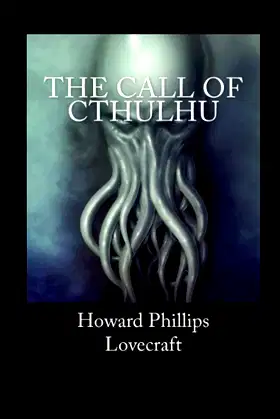
The Call of Cthulhu is an internationally renowned horror masterpiece by H. P. Lovecraft. Three independent narratives linked together by the device of a narrator discovering notes left by a deceased relative. Piecing together the whole truth and disturbing significance of the information he possesses, the narrator's final line is ''The most merciful thing in the world, I think, is the inability of the human mind to correlate all its contents.'' The narrator, Francis Wayland Thurston, recounts his discovery of notes left behind by his grand-uncle, Brown University linguistic professor George Gammell Angell, after his death in the winter of 1926–27. Among the notes is a small bas-relief sculpture of a scaly creature which yields "simultaneous pictures of an octopus, a dragon, and a human caricature." The sculptor, a Rhode Island art student named Henry Anthony Wilcox, based the work on delirious dreams of "great Cyclopean cities of titan blocks and sky-flung monoliths." Frequent references to Cthulhu are found in Wilcox's papers. Angell also discovers reports of mass hysteria around the world. Lovecraft regarded the short story as "rather middling—not as bad as the worst, but full of cheap and cumbrous touches". Weird Tales editor Farnsworth Wright first rejected the story, and only accepted it after writer Donald Wandrei, a friend of Lovecraft's, falsely claimed that Lovecraft was thinking of submitting it elsewhere.[11] The published story was regarded by Robert E. Howard (the creator of Conan) as "a masterpiece, which I am sure will live as one of the highest achievements of literature. Mr. Lovecraft holds a unique position in the literary world; he has grasped, to all intents, the worlds outside our paltry ken." Lovecraft scholar Peter Cannon regarded the story as "ambitious and complex...a dense and subtle narrative in which the horror gradually builds to cosmic proportions", adding "one of [Lovecraft's] bleakest fictional expressions of man's insignificant place in the universe." French novelist Michel Houellebecq, in his book H. P. Lovecraft: Against the World, Against Life (1991), described the story as the first of Lovecraft's "great texts".[14] Canadian mathematician Benjamin K. Tippett noted that the phenomena described in Johansen's journal may be interpreted as "observable consequences of a localized bubble of spacetime curvature", and proposed a suitable mathematical model.E. F. Bleiler has referred to "The Call of Cthulhu" as "a fragmented essay with narrative inclusions"
Find it on
AmazonNo videos available yet.
No news articles linked to this title yet.

Overall
Overall rating of the media
Atmosphere
How immersive and tense is the atmosphere
Gore
Level and quality of gore/violence
Story
Quality of the storyline and plot
Writing
Quality of the written content
Character Development
Depth and growth of characters
Pacing
Flow and timing of the narrative