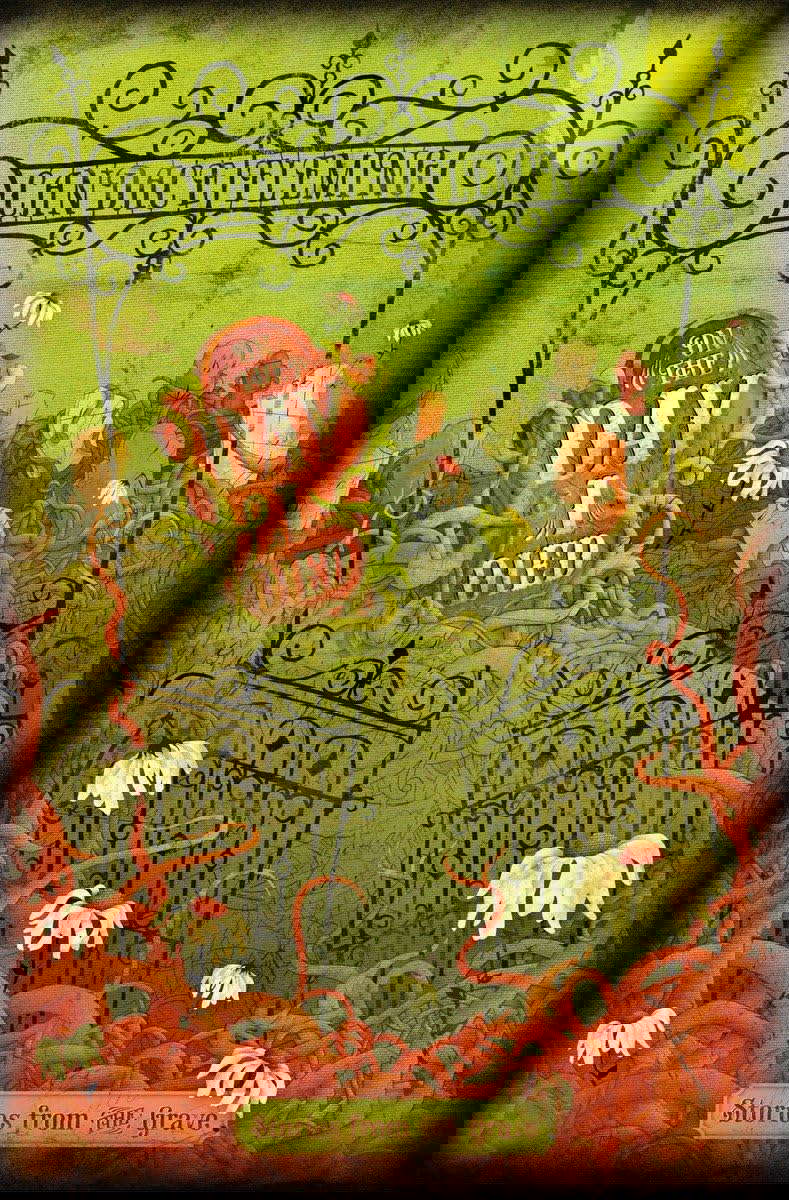


BOOK
0
"Positively tailor-made for reading—or reading aloud—by flashlight," declares Kirkus Reviews in a starred review. The phenomenally versatile, award-winning author Candace Fleming gives teen and older tween readers ten ghost stories sure to send chills up their spines. Set in White Cemetery, an actual graveyard outside Chicago, each story takes place during a different time period from the 1860s to the present, and ends with the narrator's death. Some teens die heroically, others ironically, but all due to supernatural causes. Readers will meet walking corpses and witness demonic posession, all against the backdrop of Chicago's rich history—the Great Depression, the World's Fair, Al Capone and his fellow gangsters.
Gr 6-9-On a foggy Chicago night, Mike Kowalski finds himself in a forgotten graveyard dedicated to teenagers whose lives were cut short. Thinking he's going to die, he soon learns that the ghostly specters closing in on him only want to tell him how they met their demises. So begins this collection of stories, each ghost stepping up to relay his or her journey from life to death. According to the author's notes, some of the stories are loosely based on old tales, like W. W. Jacobs's "The Monkey's Paw," while others are original creations. Some are realistic and tragic, while others are steeped in fantasy and colorful embellishment. Fleming's writing style is effective as she switches from character to character, volleying from the 1800s to the present, giving each ghost its own unique voice in its own historically accurate setting. However, the execution is unsuccessful. As Mike listens to each story, he is utterly uninvolved. Each one ends repetitively with the next ghost stepping up basically saying, "You think that's bad; Just listen to my story!" trying to top the previous tale. This gets monotonous, and since Mike is so passive, readers begin to lose focus about the point of the stories. The book ends with Mike driving home late at night, having supposedly learned a big life lesson. The problem is, knowing virtually nothing about him, who's to say he needed to learn a lesson anyway? This collection feels empty; it's unfortunate that some of the more interesting tales, like Evelyn's story of living in her twin's shadow during the time of the Chicago World's Fair, weren't more fully fleshed out, with some substance and depth.-Lauren Newman, Northern Burlington County Regional Middle School, Columbus, NJα(c) Copyright 2011. Library Journals LLC, a wholly owned subsidiary of Media Source, Inc. No redistribution permitted.
MIKEIt was after midnight, and Mike Kowalski was driving fast--too fast--down County Line Road. He glanced at the dashboard clock and groaned.He was late.Again.His phone rang. It didn’t take ESP to know it was his mother. “She probably wants to get a jump start on her griping,” Mike muttered to himself.Earlier that evening, she’d told him to be in by midnight “or else.”“Midnight?” Mike had complained. “But I’m a junior!”His mother had rolled her eyes. “After the stunt you pulled this week, you’re lucky to be allowed out at all, so I’ll reiterate--midnight, or else.”Mike didn’t even want to think about what “or else” meant.Ignoring the call, he mashed down the accelerator. Maybe if he was only a little late . . .That was when the girl appeared in his headlights.One minute there was nothing but country road flanked by the thick woods of the Cook County Forest Preserve, with its one-lane bridge over Salt Creek just ahead; the next minute there she was, stumbling down the center line.Mike slammed on the brakes. The tires squealed as the car skidded.But the girl never flinched. Eyes wide, unblinking even in the glare of the headlights, she raised her hands palms up, pleading . . . but for what?Mike stuck his head out the driver’s-side window. The girl’s skin glowed marble white, and her long, dark hair, soaked, lay plastered against her skull. Her simple cotton dress was wet, too. Mike saw water dripping from the hem. “Are you okay?” he asked.“I’m cold.” Her voice was a whisper. “I need a ride home.”Mike glanced at the clock again and grimaced. He’d rather have a root canal than experience the torture his mother was sure to have in store for him. Then again, what difference would a few more minutes make? He was already in trouble. Besides, he couldn’t leave her out here alone, could he? He leaned across the front seat and opened the passenger door. “Climb in.”Wordlessly, the girl settled into the seat, and the car filled with the smell of lavender and wet leaves. Mike watched as she slipped off her shoes--a pair of old-fashioned black-and-white saddle shoes--and neatly laid them side by side on the floor of the car. “They’re brand-new,” she said. Then she folded her hands in her lap and waited.“Where to?” asked Mike. The girl’s strange behavior was beginning to freak him out a little. Was she sick, or suffering from a concussion, or amnesia, or something? “Do you need a doctor?”She pointed behind them.Mike turned the car around, driving more slowly this time. “What’s your name?”She looked straight ahead. “Carol Anne.”“I’m Mike. Mike Kowalski.” Eyes still on the road, he extended his right hand.She didn’t acknowledge the introduction, didn’t even look at him.Mike drummed his fingers on the steering wheel, curiosity getting the best of him. “So, what happened back there?”She let several long minutes pass before answering. “I was canoeing. On Hawthorn Lake.”“After midnight? In October?”She acted as if she hadn’t heard his question. “My canoe tipped. I couldn’t right it, and it was a long way to shore, too far to swim. All I could do was cling to the side and pray someone would find me. No one did.”“So how’d you finally get to shore?”She looked at him then, and in the green glow of the dashboard she appeared even paler, her skin almost translucent in its whiteness. “The current carried me in,” she answered, her voice sounding colder than the October lake. “I was in the water for a long, long time.”Mike swallowed hard. “That’s awful.”“Yes,” she said. Then she pointed. “Turn here.”Mike made a left onto a narrow gravel road. The car bumped along for a few miles, tree branches scratching at its paint, rocks skittering beneath its tires. It never ceased to amaze him how rural some parts of the Chicago area could be. It was like cruising through the Wisconsin wilderness or someplace.His phone rang again.He ignored it.They drove deeper and deeper into the woods.“Here,” said Carol Anne at last. “Stop here.”Mike braked. In the darkness, his headlights picked out a mailbox. It read MORRISSEY. Beside it he could just make out the start of a dirt driveway.“Is this where you live? Is that your last name? Morrissey?”“I’ll get out here,” said the girl. She opened the passenger door.“But why?” argued Mike. “It’s dark. Let me drive you down to your house, make sure you get in all right.”“You know my story now,” she said, climbing from the car. “But it’s not the only one. There are many of us.”“What’s that supposed to mean?” asked Mike.But she had already vanished.“Carol Anne?” he called into the darkness. “Hey, Carol Anne?”No one answered.Reluctantly, he headed for home.He was already back on County Line Road when he noticed her shoes--that perfect pair of saddle shoes--sitting in a puddle on the floor mat.Impulsively, he turned the car around and raced back toward the narrow gravel road and the even narrower dirt driveway with the mailbox marked MORRISSEY.He found himself in front of a tired-looking farmhouse with a sagging front porch and peeling paint. In his headlights, long shadows from the surrounding trees gripped the colorless house. Every window was a dark hole, the family obviously asleep.
Find it on
AmazonNo videos available yet.
No news articles linked to this title yet.

Overall
Overall rating of the media
Atmosphere
How immersive and tense is the atmosphere
Gore
Level and quality of gore/violence
Story
Quality of the storyline and plot
Writing
Quality of the written content
Character Development
Depth and growth of characters
Pacing
Flow and timing of the narrative