BOOK
0
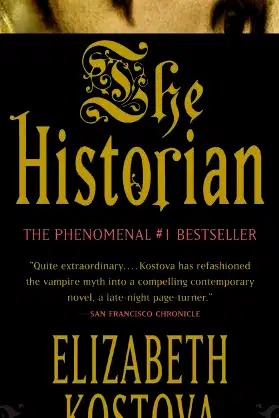
To you, perceptive reader, I bequeath my history....Late one night, exploring her father's library, a young woman finds an ancient book and a cache of yellowing letters. The letters are all addressed to "My dear and unfortunate successor," and they plunge her into a world she never dreamed of-a labyrinth where the secrets of her father's past and her mother's mysterious fate connect to an inconceivable evil hidden in the depths of history. The letters provide links to one of the darkest powers that humanity has ever known-and to a centuries-long quest to find the source of that darkness and wipe it out. It is a quest for the truth about Vlad the Impaler, the medieval ruler whose barbarous reign formed the basis of the legend of Dracula. Generations of historians have risked their reputations, their sanity, and even their lives to learn the truth about Vlad the Impaler and Dracula. Now one young woman must decide whether to take up this quest herself-to follow her father in a hunt that nearly brought him to ruin years ago, when he was a vibrant young scholar and her mother was still alive. What does the legend of Vlad the Impaler have to do with the modern world? Is it possible that the Dracula of myth truly existed-and that he has lived on, century after century, pursuing his own unknowable ends? The answers to these questions cross time and borders, as first the father and then the daughter search for clues, from dusty Ivy League libraries to Istanbul, Budapest, and the depths of Eastern Europe. In city after city, in monasteries and archives, in letters and in secret conversations, the horrible truth emerges about Vlad the Impaler's dark reign-and about a time-defying pact that may have kept his awful work alive down through the ages.Parsing obscure signs and hidden texts, reading codes worked into the fabric of medieval monastic traditions-and evading the unknown adversaries who will go to any lengths to conceal and protect Vlad's ancient powers-one woman comes ever closer to the secret of her own past and a confrontation with the very definition of evil. Elizabeth Kostova's debut novel is an adventure of monumental proportions, a relentless tale that blends fact and fantasy, history and the present, with an assurance that is almost unbearably suspenseful-and utterly unforgettable.
If your pulse flutters at the thought of castle ruins and descents into crypts by moonlight, you will savor every creepy page of Elizabeth Kostova's long but beautifully structured thriller The Historian. The story opens in Amsterdam in 1972, when a teenage girl discovers a medieval book and a cache of yellowed letters in her diplomat father's library. The pages of the book are empty except for a woodcut of a dragon. The letters are addressed to: "My dear and unfortunate successor." When the girl confronts her father, he reluctantly confesses an unsettling story: his involvement, twenty years earlier, in a search for his graduate school mentor, who disappeared from his office only moments after confiding to Paul his certainty that Dracula--Vlad the Impaler, an inventively cruel ruler of Wallachia in the mid-15th century--was still alive. The story turns out to concern our narrator directly because Paul's collaborator in the search was a fellow student named Helen Rossi (the unacknowledged daughter of his mentor) and our narrator's long-dead mother, about whom she knows almost nothing. And then her father, leaving just a note, disappears also. As well as numerous settings, both in and out of the East Bloc, Kostova has three basic story lines to keep straight--one from 1930, when Professor Bartolomew Rossi begins his dangerous research into Dracula, one from 1950, when Professor Rossi's student Paul takes up the scent, and the main narrative from 1972. The criss-crossing story lines mirror the political advances, retreats, triumphs, and losses that shaped Dracula's beleaguered homeland--sometimes with the Byzantines on top, sometimes the Ottomans, sometimes the rag-tag local tribes, or the Orthodox church, and sometimes a fresh conqueror like the Soviet Union. Although the book is appropriately suspenseful and a delight to read--even the minor characters are distinctive and vividly seen--its most powerful moments are those that describe real horrors. Our narrator recalls that after reading descriptions of Vlad burning young boys or impaling "a large family," she tried to forget the words: "For all his attention to my historical education, my father had neglected to tell me this: history's terrible moments were real. I understand now, decades later, that he could never have told me. Only history itself can convince you of such a truth." The reader, although given a satisfying ending, gets a strong enough dose of European history to temper the usual comforts of the closing words. --Regina Marler
Starred Review. Considering the recent rush of door-stopping historical novels, first-timer Kostova is getting a big launch—fortunately, a lot here lives up to the hype. In 1972, a 16-year-old American living in Amsterdam finds a mysterious book in her diplomat father's library. The book is ancient, blank except for a sinister woodcut of a dragon and the word "Drakulya," but it's the letters tucked inside, dated 1930 and addressed to "My dear and unfortunate successor," that really pique her curiosity. Her widowed father, Paul, reluctantly provides pieces of a chilling story; it seems this ominous little book has a way of forcing itself on its owners, with terrifying results. Paul's former adviser at Oxford, Professor Rossi, became obsessed with researching Dracula and was convinced that he remained alive. When Rossi disappeared, Paul continued his quest with the help of another scholar, Helen, who had her own reasons for seeking the truth. As Paul relates these stories to his daughter, she secretly begins her own research. Kostova builds suspense by revealing the threads of her story as the narrator discovers them: what she's told, what she reads in old letters and, of course, what she discovers directly when the legendary threat of Dracula looms. Along with all the fascinating historical information, there's also a mounting casualty count, and the big showdown amps up the drama by pulling at the heartstrings at the same time it revels in the gruesome. Exotic locales, tantalizing history, a family legacy and a love of the bloodthirsty: it's hard to imagine that readers won't be bitten, too. Copyright © Reed Business Information, a division of Reed Elsevier Inc. All rights reserved.
Adult/High School–A motherless 16-year-old girl stumbles upon a mysterious book and papers dating back to her father's student days at Oxford. She asks him to explain her find but he disappears before she can learn everything. Reading the salutation of the letters, My dear and unfortunate successor, the unnamed heroine uncovers an academic quest that begins with her father's mentor's first research into the history of Vlad Tepes (Dracula) and reaches a kind of conclusion many years later. Kostova's debut book unfolds across Europe, through three main narrators, and back and forth in time, as the story of two families' connections to and search for the true Vlad the Impaler is unveiled. The historian of the title could refer to any of the novel's central characters or even to Vlad Tepes himself. While teens may gain a feeling for Cold War Europe and some respect for the Internet-less scholars of 40 years ago, Historian is an eerie thriller, an atmospheric mystery, and an appealing romance. Teen fascination with vampires has been keen since Bram Stoker popularized the legend of Dracula, right up through Buffy. This complex, convoluted, and well-written novel will appeal to teens who love a story on a grand scale that is as engrossing as it is entertaining.–Jane Halsall, McHenry Public Library District, IL Copyright © Reed Business Information, a division of Reed Elsevier Inc. All rights reserved.
In this smart retelling of the Dracula story, a young girl's discovery of a mysterious book, blank save for a sinister woodcut of a dragon, impels her father to divulge, reluctantly, details of his vampire-hunting days back in grad school. Halfway through his tale, which is told over several sessions in various atmospheric European locations, he vanishes. His daughter's quest to find him is interwoven with letters that reveal the past in full. Kostova's knowledge of occult arcana is impressive, and she packages her erudition in a graceful narrative that only occasionally lapses into melodrama. The structure—a story within a letter within a flashback—is an innovative complication, but it is soon shaken off by the swift-moving plot. Kostova never strays far from the conventions of the genre, and her historical thriller feels somewhat indebted to best-sellers of the recent past; there are Christian heresies, scholarly sleuths, and a malaprop-prone Eastern European guide. Copyright © 2005 The New Yorker
As almost every review of Kostovas debut novel points out, The Historian was ten years in the makingten years and a $2 million advance. Theres already a movie deal, and sales of translation rights into almost every imaginable language. But reviewers disagree about whether Kostova deserves all the hoopla. While some critics are clearly riveted and cant put the book down, others insist that the book is too long by half and that the shifting narrationfrom the unnamed daughter, to epistles, to snatches of memoir, and back againis ham-handed. The bottom line? The book has been slightly over-hyped; its too long, too convoluted, but is full of adventures (and books) in beautiful places.Copyright © 2004 Phillips & Nelson Media, Inc.
*Starred Review* Readers who think the legend of Dracula has become a trite staple of schlock fiction will find this atmospheric page-turner by first-time author Kostova a bloodthirsty delight. A teenage American girl, living in1972 Amsterdam, comes across an ancient book in the library of her widower father, a former historian and now a diplomat. The book, blank save for an illustration of a dragon and the word Drakulya, contains a cache of faded letters all addressed to "My dear and unfortunate reader." Thus begins a search for the truth behind the myth of Dracula, a search that crosses continents as well as generations. Told through narratives, flashbacks, and letters, the plot unfolds at a rapid pace but never gives away too many clues at once. The cast of colorful characters even includes a creepy librarian who takes on the Renfield role of crazed vampire groupie. Both literary and scary, this one is guaranteed to keep one reading into the wee hours--preferably sitting in a brightly lit room and wearing a garlic necklace. Highly recommended for all collections and just in time to enthrall the summer-vacation crowd. Michael GannonCopyright © American Library Association. All rights reserved
"In this smart retelling of the Dracula story, a young girl's discovery of a mysterious book, blank save for a sinister woodcut of a dragon, impels her father to divulge, reluctantly, details of his vampire-hunting days back in grad school. Halfway through his tale, which is told over several sessions in various atmospheric European locations, he vanishes. His daughter's quest to find him is interwoven with letters that reveal the past in full. Kostova's knowledge of occult arcana is impressive, and she packages her erudition in a graceful narrative that only occasionally lapses into melodrama. The structure-a story within a letter within a flashback-is an innovative complication, but it is soon shaken off by the swift-moving plot. Kostova never strays far from the conventions of the genre, and her historical thriller feels somewhat indebted to best-sellers of the recent past; there are Christian heresies, scholarly sleuths, and a malaprop-prone Eastern European guide. "
"Quite extraordinary...Kostova is a natural storyteller...She has refashioned the vampire myth into a compelling contemporary novel, a late-night page-turner."
"Part thriller, part history, part romance....Kostova has a keen sense of storytelling and she has a marvelous tale to tell."
"Kostova's vampire is no campy Lugosi knockoff....Blending history and myth, Kostova has fashioned a version so fresh that when a stake is finally driven through a heart, it inspires the tragic shock of something happening for the very first time."
A specter is haunting Europe, the specter of . . . communism? Christian-Muslim conflict? Ancient evil? As so often, the answer is all of the above, for The Historian -- an ambitious, albeit overlong suspense-horror novel -- takes up our enduring fascination with Dracula and inserts the immortal fiend into the political history of the second half of the 20th century. Elizabeth Kostova, who worked on this book for 10 years, focuses her narrative on three generations of a single family repeatedly sucked into battle against the master of the Undead. Like Bram Stoker's Dracula, The Historian takes the form of a dossier, mixing memoir, letters and archival materials. Such an approach unobtrusively persuades the reader to believe in the facticity of what follows, that -- in Diderot's celebrated phrase -- "this is not a story." More cleverly still, Kostova manages to present nearly 650 tightly packed pages without ever revealing the full names of her two principal characters, a historian (who is called Paul from time to time) and his daughter, the latter our main source for these hideous revelations. Given the book's dedication ("For my father, who first told me some of these stories"), we are subtly being urged to identify the heroine with the author herself. Obviously, then, the unsettling and heart-rending events of The Historian must be all too personally and horribly true. A sequence of harrowing disclosures takes place over more than 50 years, or -- from another point of view -- 500 years. In the main story, set in 1954, a young graduate student studying 17th-century Dutch trade discovers that someone has left a strange book in his library carrel. All the leaves are blank, except for the center double-page spread, which bears the woodcut of a dragon with a looping tail and the single word "Drakulya." When Paul goes to his adviser, the distinguished Professor Bartholomew Rossi, he learns that the older scholar once received a similar book and has spent years trying to blot out its evil meaning. For, as Rossi finally confesses, "Dracula -- Vlad Tepes -- is still alive." At which point, with a melodramatic chutzpah that even the old pulp writers might hesitate to employ, Kostova breaks off: " 'Good Lord,' my father said suddenly, looking at his watch. 'Why didn't you tell me? It's almost seven o'clock.' " He has been reluctantly telling his 16-year-old daughter about this evil period of his earlier life. But since Kostova doesn't want to reveal too much too soon, and because she aims to generate ever-increasing anxiety in the reader, she periodically stops and shifts to a complementary and (seemingly) secondary series of adventures set in 1972. Kostova will keep the reader shuttling back and forth between the 1950s and the 1970s, with occasional comments that look ahead to the 21st century (when she is thinking back over the entire story). This may sound confusing but is actually fairly simple -- and its intent all too obvious. Anytime one has multiple plot lines, they will inevitably converge in the end. The buckle must be buckled. The basic engine of the adventure novel is the quest. When Professor Rossi suddenly disappears, Paul goes in search of him, eventually enlisting the aid of a stern but attractive Romanian anthropologist called Helen Rossi. (It takes our hero a while to ask about that last name.) When Paul disappears 18 years later, his daughter duly goes in search of him, accompanied by a young English historian named Barley. The two quests result in a Grand (Guignol) tour of Europe. Ancient documents, enigmatic legends and poems, saints' lives, folk songs and uncannily timed coincidences lead to hurried visits to Oxford, Istanbul, Romania, Hungary, Bulgaria and France, with occasional layovers in Italy, Greece and Switzerland. We are served up heaps of local color. To keep the pace lively, both couples are tracked by various forces of evil, most notably a gray-fleshed vampire librarian. This plays as slightly comic, inadvertently bolstering the stereotype that most librarians already belong among the undead.In each place that our heroes visit, they seek out or encounter scholars and antiquarians who supply pieces to the great puzzle: Where is Dracula's secret tomb? At the same time, Kostova works hard to add a contemporary political resonance. In Istanbul, she stresses how much the original Vlad, back in the mid-16th century, hated the Ottomans and made holy war upon these infidels, thus reinforcing a sad pattern in Middle Eastern relations. In the former Eastern-bloc countries, she keeps us guessing whether the sinister figures shadowing Paul and Helen are secret police straight out of J. Edgar Hoover's Cold War dreams or Dracula's robotic and relentless minions. Or possibly both. For at one climax, Dracula himself appears from the shadows to explain how much the 20th century's horrors owe to his covert machinations. The more sanguinary and predatory the world, the better he likes it. And of course, he holds out some really high hopes that the future will be exponentially more gruesome, cruel and deliciously bloodthirsty than the past. Here, it's hard not to believe that Kostova may be onto something: Most of history's worst nightmares result from an unthinking obedience to authority, high-minded zealotry seductively overriding our mere humanity. After all, the horror we feel for vampires is different from that provoked by, say, ghosts, werewolves or Frankenstein's misunderstood monster. These we simply find frightening and perhaps life-threatening. But our fear of Dracula lies in the fear of losing ourselves, of relinquishing our very identities as human beings. In the vampire's embrace, we discard our most cherished values and submerge our will to obey his (or her) commands, no matter how transgressive. What's truly disturbing about the thrice-bitten is not that they become blood-sucking fiends but that they take so completely to the lifestyle. In exchange for our bodies and souls, Dracula grants us our darkest, most repressed wishes. As Kostova writes, "It is a fact that we historians are interested in what is partly a reflection of ourselves, perhaps a part of ourselves we would rather not examine except through the medium of scholarship; it is also true that as we steep ourselves in our interests, they become more and more a part of us." The original Vlad Tepes, we are reminded, revered books and scholarship, and it proves no accident that the key figures of this novel are all historians, nor that love -- between man and wife, parent and child, student and teacher -- is the one force than can sometimes overcome the dark lord's obscene allure. A novel like The Historian depends on the systole and diastole of its narrative -- the breakneck pace of action and horror will regularly give way to some musty detective work, a leisurely tour of an exotic city or the human drama of two people falling in love. Fans of the antiquarian romance -- in which personable modern scholars encounter ancient conspiracies -- will compare this novel to such books as Umberto Eco's Foucault's Pendulum, Lawrence Norfolk's Lemprière's Dictionary and, inevitably, Dan Brown's The Da Vinci Code. It also works variations on motifs known from such films as "Indiana Jones and the Last Crusade" and "Van Helsing." Nonetheless, I found myself most often calling to mind Susanna Clarke's Jonathan Strange & Mr. Norrell. That fantasy saga -- about two magicians in the late 18th century -- first appeared about this time last year and was also the product of a decade's work, an amalgam of history and imagination, much heralded by its publisher. It was also, sorry to say, slow-moving and a little dull. Similarly, The Historian is artfully constructed and atmospheric, yet nothing that happens in it is really all that surprising. Still, Elizabeth Kostova has produced an honorable summer book, reasonably well written and enjoyable and, most important of all, very, very long: One can tote The Historian to the beach, to the mountains, to Europe or to grandmother's house and still be reading its 21st-century coda when Labor Day finally rolls around. Copyright 2005, The Washington Post Co. All Rights Reserved.
Find it on
AmazonNo videos available yet.
No news articles linked to this title yet.

Overall
Overall rating of the media
Atmosphere
How immersive and tense is the atmosphere
Gore
Level and quality of gore/violence
Story
Quality of the storyline and plot
Writing
Quality of the written content
Character Development
Depth and growth of characters
Pacing
Flow and timing of the narrative