
BOOK
0
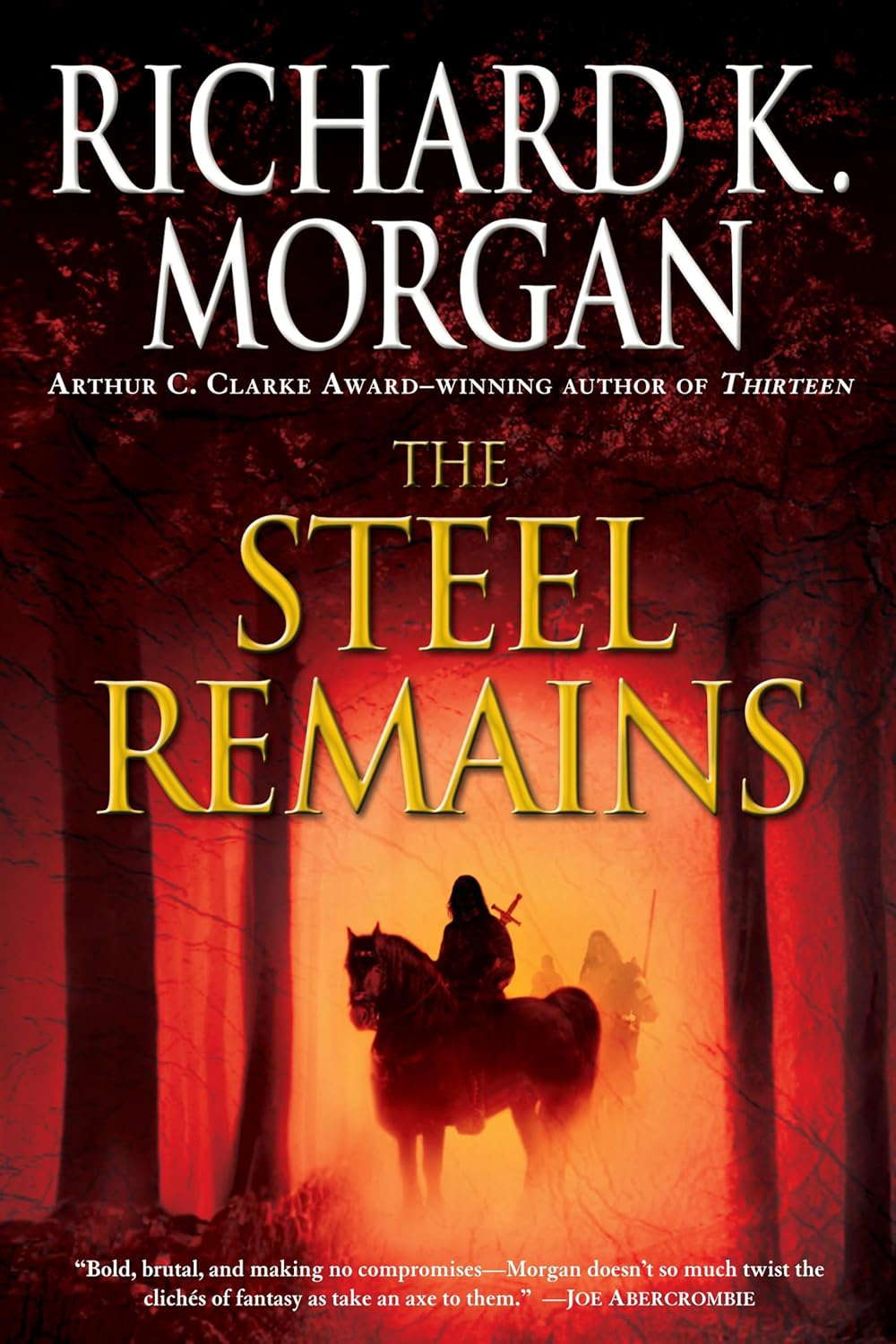
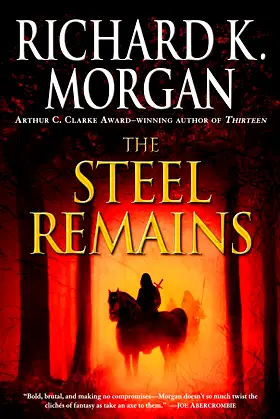
“Bold, brutal, and making no compromises—Morgan doesn’t so much twist the clichés of fantasy as take an axe to them.”—Joe AbercrombieA dark lord will rise. Such is the prophecy that dogs Ringil Eskiath—Gil, for short—a washed-up mercenary and onetime war hero whose cynicism is surpassed only by the speed of his sword. Gil is estranged from his aristocratic family, but when his mother enlists his help in freeing a cousin sold into slavery, Gil sets out to track her down. But it soon becomes apparent that more is at stake than the fate of one young woman. Grim sorceries are awakening in the land. Some speak in whispers of the return of the Aldrain, a race of widely feared, cruel yet beautiful demons. Now Gil and two old comrades are all that stand in the way of a prophecy whose fulfillment will drown an entire world in blood. But with heroes like these, the cure is likely to be worse than the disease. Praise for The Steel Remains“The award-winning author of Altered Carbon and Market Forces brings the same iconoclastic approach to his fantasy debut as he did to his sf technothrillers. . . . [Richard K.] Morgan’s storytelling talent and his atmospheric, hard-hitting prose make this a strong addition to mature fantasy collections.”—Library Journal “Spellbinding . . . There’s so much to like about the adventure.”—The Star-Ledger “Morgan has taken traditional sword and sorcery tropes and given them a hard, contemporary kick. The antithesis of the cosy fairytale, this one is for big boys.”—The Times (London) “[A] dark, gritty tale . . . The well-developed characters and realistic battle scenes ring true.”—Publishers Weekly
"Bold, brutal, and making no compromises
"The award-winning author of Altered Carbon and Market Forces brings the same iconoclastic approach to his fantasy debut as he did to his sf technothrillers. . . . [Richard K.] Morgan's storytelling talent and his atmospheric, hard-hitting prose make this a strong addition to mature fantasy collections."
"Spellbinding . . . There's so much to like about the adventure."
"Morgan has taken traditional sword and sorcery tropes and given them a hard, contemporary kick. The antithesis of the cosy fairytale, this one is for big boys."
"[A] dark, gritty tale . . . The well-developed characters and realistic battle scenes ring true."
Chapter OneWhen a man you know to be of sound mind tells you his recently deceased mother has just tried to climb in his bedroom window and eat him, you only have two basic options. You can smell his breath, take his pulse, and check his pupils to see if he's ingested anything nasty, or you can believe him. Ringil had already tried the first course of action with Bashka the Schoolmaster and to no avail, so he put down his pint with an elaborate sigh and went to get his broadsword."Not this again," he was heard to mutter as he pushed through intothe residents' bar.A yard and a half of tempered Kiriath steel, Ringil's broadswordhung above the fireplace in a scabbard woven from alloys that men hadno names for, though any Kiriath child could have identified them fromage five upward. The sword itself also had a name in the Kiriath tongue,as did all Kiriath- forged weapons, but it was an ornate title that lost a lotin translation. "Welcomed in the Home of Ravens and Other Scavengersin the Wake of Warriors" was about as close as Archeth had been able torender it, so Ringil had settled on calling it the Ravensfriend. He didn'tlike the name especially, but it had the sort of ring people expected of afamous sword—and his landlord, a shrewd man with money and thepotential for making it, had renamed the inn the same way, setting aneternal seal on the thing. A local artist had painted a passable image ofRingil wielding the Ravensfriend at Gallows Gap and now it hungoutside for all the passing world to see. In return, Ringil got bed andboard and the opportunity to sell tales of his exploits to tourists in theresidents' bar for whatever was dropped into his cap.All that, Ringil once remarked ironically in a letter to Archeth, and a blind eye turned to certain bedroom practices that would doubtless earn Yours Truly a slow death by impaling in Trelayne or Yhelteth. Heroic status in Gallows Water, it seems, includes a special dispensation not available to the average citizen in these righteous times. Plus, he supposed, you don't go queer baiting when your quarry has a reputation for rendering trained swordsmen into dogmeat at the drop of a gauntlet. Fame, Ringil scribbled, has its uses after all.Mounting the sword over the fireplace had been a nice touch, andalso the landlord's idea. The man was now trying to persuade hisresident celebrity to offer dueling lessons out back in the stable yards.Cross blades with the hero of Gallows Gap for three Empire- mintedelementals the half hour. Ringil didn't know if he felt that hard up yet.He'd seen what teaching had done to Bashka.Anyway, he dragged the Ravensfriend from the scabbard with asingle grating clang, slung it casually over his shoulder, and walked outinto the street, ignoring the stares from the audience he had beenregaling with tales of valor about an hour ago. He guessed they'd followhim at least part of the way to the schoolmaster's house. It couldn't doany harm, if his suspicions about what was going on were correct, butthey'd probably all cut and run at the first sign of trouble. You couldn'tblame them really. They were peasants and merchants, and they had nobond with him. About a third of them he'd never even seen beforetonight.Introductory comment from the treatise on skirmish warfare that the Trelayne Military Academy had politely declined to publish under his name: If you don't know the men at your back by name, don't besurprised if they won't follow you into battle. On the other hand, don't be surprised if they will, either, because there are countless other factors you must take into account. Leadership is a slippery commodity, not easily manufactured or understood. It was simple truth, as gleaned in the bloody forefront of some of the nastiest fighting the free cities had seen in living memory. It was, however, the Lieutenant Editor in Trelayne had written kindly, just too vague for the Academy to consider as viabletraining material. It is this ambivalence as much as any other that leads us to decline your submission. Ringil looked at that last sentence on the parchment and suspected a kindred spirit.It was cold out in the street. Above the waist he wore only a leatherjerkin with loose half- length sailcloth sleeves, and there was an unseasonalearly chill sloping down the spine of the country from theMajak uplands. The peaks of the mountains that the town nestled underwere already capped with snow, and it was reckoned that Gallows Gapwould be impassable before Padrow's Eve. People were talking againabout an Aldrain winter. There had been stories circulating for weeksnow, of high- pasture livestock taken by wolves and other, less naturalpredators, of chilling encounters and sightings in the mountain passes.Not all of them could be put down to fanciful talk. This,Ringil suspected,was going to be the source of the problem. Bashka the Schoolmaster'scottage was at the end of one of the town's cross streets and backed ontothe local graveyard.As by far the most educated man in the tiny townshipof Gallows Water— its resident hero excluded— Bashka had been handedthe role of temple officiator by default, and the house went with thepriest's robes.And in bad weather, graveyards were a fine source of meatfor scavengers.You will be a great hero, a Yhelteth fortune- teller had once read inRingil's spittle. You will carry many battles and best many foes.Nothing about being a municipal exterminator in a border- townsettlement not much bigger than one of Trelayne's estuary slums.There were torches fixed in brackets along the main streets and riverfrontage of Gallows Water but the rest of the town must make do withbandlight, of which there wasn't much on a night this clouded. True toRingil's expectations, the crowd thinned out as soon as he stepped ontoan unlit thoroughfare. When it became apparent where he was headedspecifically, his escort dropped by more than half. He reached the cornerof Bashka's street still trailing a loose group of about six or eight, but bythe time he drew level with the schoolmaster's cottage— the door stillgaping open, the way its owner had left it when he fled in his nightshirt—he was alone. He cocked his head back to where the rubberneckershovered at the far end of the street. A wry grin twitched his lips."Stand well back now," he called.From among the graves, something uttered a low droning cry.Ringil's skin goosefleshed with the sound of it. He unshipped theRavensfriend from his shoulder and, holding it warily before him,stepped around the corner of the little house.The rows of graves marched up the hill where the town petered outagainst outcroppings of mountain granite. Most of the markers weresimple slabs hewn from the self- same stone as the mountain, reflectingthe locals' phlegmatic attitude to the business of dying. But here andthere could be seen the more ornately carved structure of a Yheltethtomb, or one of the cairns the northerners buried their dead under,hung with shamanistic iron talismans and daubed in the colors of thedeceased's clan ancestry. As a rule, Ringil tried not to come out here toooften; he remembered too many of the names on the stones, could putfaces to too many of the foreign- sounding dead. It was a mixed bag thathad died under his command at Gallows Gap that sweltering summerafternoon nine years ago, and few of the outlanders had family with themoney to bring their sons home for burial. The cemeteries up anddown this stretch of the mountains were littered with their lonelytestimony.Ringil advanced into the graveyard, one bent- kneed step at a time.Clouds broke apart overhead, and the Kiriath blade glinted in thesudden smear of bandlight. The cry was not repeated, but now he couldmake out smaller, more furtive sounds. The sounds, he reckonedunenthusiastically, of someone digging.You will be a great hero.Yeah, right.He found Bashka's mother, as it seemed, grubbing around in the dirtat the base of a recent headstone. Her burial shroud was torn and soiled,revealing rotted flesh that he could smell from a dozen paces upwindeven in the cold. Her deathgrown nails made an unpleasant rakingsound as they struggled with the casket she had partially unearthed.Ringil grimaced.In life, this woman had never liked him. As temple officiator andpriest, her son was supposed to despise Ringil for a worthless degenerateand a corruptor of youth. Instead, as a schoolmaster and man of someeducation himself, Bashka turned out to be far too enlightened for hisown good. His easygoing attitude to Ringil and the late- night phil -osophical debates they occasionally got into at the tavern earned himvitriolic reprimands from visiting senior priests. Worse still, his lack ofcondemnatory zeal gave him a reputation in the religious hierarchy thatensured he would always remain a humble teacher in a backwater town.The mother, naturally enough, blamed the degenerate Ringil and hisevil influence for her son's lack of advancement, and he was notwelcome in the schoolmaster's house while she drew breath. This latteractivity had come to an abrupt halt the previous month, following aswift and unquenchable fever, sent presumably by some preoccupiedgod who had overlooked her great righteousness in religious matters.Trying not to breathe through his nose, Ringil tapped the flat of theRavensfriend on a convenient grave to get her attention. At first shedidn't seem to hear the noise it made, but then the body twistedwrenchingly around and he found himself looking into a face whoseeyes had long ago been eaten by whichever small creatures took care ofthat sort of thing. The jaw hung slack, most of the nose was gone, andthe flesh of the cheeks was mottled and holed. It was remarkable thatBashka had even recognized her."Come on out of there," said Ringil, readying his sword.It did.It came through the dead woman's rib cage with a cracking, suckingsound, a corpsemite fully a yard long not counting the tendril appendagesit had used to puppet the corpse's limbs. It was gray in hue, not unlikesome species of smooth- skinned maggot, which its body in many waysresembled. The blunt snout of the thing ended in chomping jaws set withhorny ridges that could shatter bone, and Ringil knew that the tail endlooked much the same. Corpsemites didn't excrete their waste, they oozedit from pores along the slug- like body, a substance that, like their saliva,was lethally corrosive.No one knew where they came from. Folklore had it that they wereoriginally lumps of witch's snot, hawked up and animated to voraciouslife by their evil owners for reasons most of the tales were rather vagueon. Authorized religion insisted variously that they were either ordinaryslugs or maggots, possessed by the souls of the evil dead, or demonicvisitations from some cemetery hell where the spiritually unworthyrotted, fully conscious, in their graves. Archeth had had a slightly sanertheory: that the mites were a mutation produced by the Kiriath'sexperiments with lower life- forms centuries before, a creature designedto dispose of the dead more efficiently than conventional scavengerswould.Whatever the truth, no one was quite sure what level of intelligencethe corpsemites had. But somewhere in their evolution, natural orotherwise, they'd learned to use the carcases they fed upon for a wholehost of other purposes. A body could serve them as a hiding place or anincubation bed for their eggs; if not too badly decayed, it might becomea means of rapid motion or disguise; and, in the case of humans orwolves, it could be a digging tool. It was the use of human corpses thattriggered the spate of zombie sightings throughout the northwestwhenever the winters were hard.Ringil had occasionally wondered whether the corpsemites didn'talso manipulate carcasses as a form of play. It was entirely his ownmacabre idea, conjured up when he first read about the creatures inaccounts by travelers to the Kiriath wastes. After all, he reasoned to hisfather' s librarian, a corpsemite's own secretions would eat through awooden casket nearly as fast as a corpse's decaying hands could open it,so why else would they bother? The opinion of the librarian, and later ofhis father, was that Ringil was a very sick young man who ought toconcern himself, as his elder brothers already did, with more naturalpursuits like riding, hunting, and bedding the local wenches. Hismother, who no doubt already had her suspicions, said nothing.From his one or two previous encounters with these creatures,Ringil also knew that they could be very—The corpsemite flexed its body free of the encaging ribs, leaptstraight at him.—fast.He hacked sideways, rather inelegantly, and succeeded in batting thething away to the left. It hit a headstone and dropped to the groundwrithing, sliced almost in half by the stroke. Ringil brought the sworddown again and finished the job, mouth pursed with distaste. The twosevered halves of the creature twisted and trembled and then lay still.Demons and the souls of the evil dead were not, it seemed, up torepairing that kind of damage.Ringil also knew that corpsemites moved in groups. As the slimyfiligree of a tendril appendage touched his cheek, he was alreadyspinning around to face the next one. The drops of secretion burned.No time to wipe it off. He spotted the creature, coiled on top of aYhelteth tomb, skewered it on reflex. The tendrils recoiled and the thingmade angry chittering noises as it died. Ringil heard a clatter ofresponse from the other side of the tomb and saw movement. Hestepped wide around the worked stone slab, saw the two smaller miteshauling themselves up out of the wreckage of a rotted coffin and itsequally far- gone contents. A single downward blow sliced them bothirreparably open, body fluids gushing like pale oil from the wounds. Hedid it again, just to be sure.The fifth mite landed on his back.He didn't think at all. In retrospect, he guessed it must have beenpure revulsion that drove him. He dropped the sword with a yell,reached down to the fastenings of his jerkin, and tore them open withboth hands. In the same motion he shrugged himself halfway out of thegarment while the corpsemite was still finding out that the leather wasnot his real skin. The jerkin sagged under the creature's weight, helpedhim to pull clear. The tendrils around his waist and over his shoulderswere still creeping toward each other and they didn't have time totighten against the movement. His left arm came free and he whirledlike a discus thrower, hurling the bundle of jerkin and mite off his rightsleeve and away among the headstones. He heard it hit something solid.Tendrils had touched him on the chest and back— later he wouldfind the weals. Now he snatched up the Ravensfriend and stalked afterhis jerkin, eyes and ears open for any remaining members of the group.He found the garment, partially dissolved, at the base of an ancientmoss- grown slab near the back of the cemetery. Not a bad throw, that,from a standing start. The corpsemite was still trying to disentangle itselffrom the leather and flapped confusedly at him as he approached. Itsjaws were bared and it was hissing like a new sword in the coolingtrough."Yeah, yeah," he muttered and plunged the Ravensfriend downpoint- first, impaling the mite on the earth. He watched with sombersatisfaction as it died. "That was clean on today, you little shit."He stayed among the graves long enough to start feeling the coldagain, and to take a brooding interest in the slight but unmistakablepaunch that was beginning to threaten the aesthetics of his narrowhippedwaist. No further corpsemites showed themselves. He took anuncontaminated shred of his jerkin as a rag and cleaned the body fluidsoff the Ravensfriend's bluish surfaces with fastidious care. Archeth hadinsisted the Kiriath blade was proof against all and any corrosivesubstances, but she had been wrong about things before.The final outcome of the war, to name but one.Then, finally, Ringil remembered that the creatures had touchedhim and, as if on cue, the blisters they'd left began to burn. He rubbed atthe one on his cheek until it burst, deriving a certain brutal amusementfrom the thin pain he got out of it. Not what you'd call a heroic wound,but it was all he'd have to show for the evening's exertions. No onewould be coming out here to check on the carnage until it got safelylight.Oh well, maybe you can narrate it into a couple of pints and a fowl platter. Maybe Bashka'll buy you a replacement jerkin out of sheer gratitude, if he can afford it after he's paid to rebury his mother. Maybe that towheaded lad from the stables will listen in and be impressed enough to overlook this gut you're so intent on developing.Yeah, and maybe your father's written you back into his testament.Maybe the Yhelteth Emperor is a queer.That last was worth a grin. Ringil Angeleyes, scarred hero of GallowsGap, chuckled to himself a little in the chill of the graveyard, andglanced around at the silent markers as if his long- fallen comradesmight share the joke. The quiet and the cold gave him nothing back.The dead stayed stonily unmoved, just the way they'd been now for nineyears, and slowly Ringil's smile faded away. A shiver clung at his back.He shook it off.Then he slung the Ravensfriend back across his shoulder and wentin search of a clean shirt, some food, and a sympathetic audience.
Find it on
AmazonNo videos available yet.
No news articles linked to this title yet.

Overall
Overall rating of the media
Atmosphere
How immersive and tense is the atmosphere
Gore
Level and quality of gore/violence
Story
Quality of the storyline and plot
Writing
Quality of the written content
Character Development
Depth and growth of characters
Pacing
Flow and timing of the narrative