
BOOK
0
Poplar Street is just an ordinary street in an ordinary town, except there's something strange about Audrey Wyler's nephew. When the strange-looking vans arrive a surreal nightmare begins which threatens to turn the familiar street into a wasteland of devastation and desperation.
The Regulators Postcard from William Garin to his sister, Audrey Wyler: --This text refers to an out of print or unavailable edition of this title.
Do NOT listen to this book alone at night, at least not beyond the first half-hour of tape. After that pleasant, scene-setting portrait of summer in suburbia, The Regulators turns terrifying, and the horror doesn't let up until the very last sentence. Kate Nelligan resists the temptation to dramatize the many characters in this complex story, and her unemotional telling contributes even more to the terror of the tale. Nelligan's detached, professional narration is well supplemented by chilling special effects at the beginnings and ends of some chapters. These effects, including music mutations; storm sounds; and chilling, almost-animal cries, elevate the book to a near-movie experience. R.P.L. Winner of AUDIOFILE's Earphones Award (c)AudioFile, Portland, Maine --This text refers to an out of print or unavailable edition of this title.
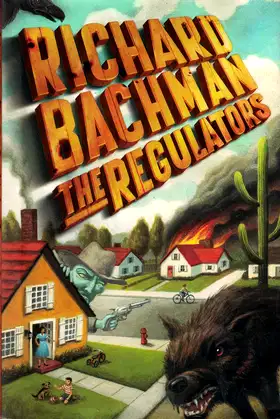
It is a summer afternoon on Poplar Street in Wentworth, Ohio, and the 14-year-old who delivers the local shopper is biking his route. A weird-looking red van waits, motor running, at one end of the block. When the vehicle coasts down the street, the "fun" begins. Its windows roll down to let shotgun barrels protrude. The boy is blasted off his bike, the first of many victims of a wave of assaults by a strange company of cartoonish, futuristic shock troopers and western-movie cowboys. What's more, telephones, electricity, and wristwatches are dead all up and down the block; nobody from the next street over in either direction seems to notice the gunfire and burning buildings; and when some of the besieged neighbors try to get to an adjacent street, they discover their surroundings transformed from suburbia to a western desert landscape resembling a child's drawing. What in hell is going on? Actually, as the "documentary" interstices between chapters gradually illuminate, something from close to hell, if you identify hell with the earth's molten interior, is what's going on in this variation upon the old Twilight Zone episode in which a little boy with psychokinetic powers terrorizes his family. Stephen King revives his alter ego Bachman, who "died" in 1985, for a rip-roaringly violent thriller whose main action takes place in little more than an hour and a half. Whew! Ray Olson --This text refers to an out of print or unavailable edition of this title.
Why revive the Bachman byline more than a decade after Stephen King was found lurking behind it? Not for thematic reasons. This devilishly entertaining yarn of occult mayhem married to mordant social commentary is pure King and resembles little the four nonsupernatural (if science-fictional) pre-Thinner Bachmans. The theme is the horror of TV, played out through the terrors visited upon quiet Poplar Street in the postcard-perfect suburban town of Wentworth, Ohio, when a discorporeal psychic vampire settles inside an autistic boy obsessed with TV westerns and kiddie action shows and brings screen images to demented, lethal life. The long opening scene, in which characters and vehicles from the TV show Motokops 2200 (think Power Rangers) sweep down the street, spewing death by firearm, is a paragon of action-horror. The story rarely flags after that, evoking powerful tension and, at times, emotion. The premise owes a big unacknowledged debt to the classic Twilight Zone episode "It's a Good Life"; echoes of earlier Kings resound often as well?the psychic boy (The Shining), a writer-hero (Misery, The Dark Half), etc. But King makes hay in this story in which anything can happen, and does, including the warping of space-time and the savage deaths of much of his large cast. The narrative itself warps fantastically, from prose set in classic typeface to handwritten journals to drawings to typewritten playscript and so on. So why the Bachman byline? Probably for fear that yet another new King in 1996 in addition to six volumes of The Green Mile and Viking's forthcoming Desperation might glut the market. Maybe, maybe not. But one thing is certain: call him Bachman or call him King, the bard of Bangor is going to hit the charts hard and vast with this white-knuckler knockout. Main selection of the Literary Guild, Doubleday Book Club, Mystery Guild and Science Fiction Book Club. Copyright 1996 Reed Business Information, Inc. --This text refers to an out of print or unavailable edition of this title.
Bachman/Stephen King in overdrive, fast as he can type and laughing with bloodglee. King says that The Regulators and Desperation (see below) are companion volumes, like Alice in Wonderland and Through the Looking Glass. And The Regulators, set on one suburban block in Wentworth, Ohio, employs many characters from its mirror novel, set in Desperation, Nevada--but often in far different roles: Bad cop becomes good cop, and Peter Jackson, shot to death early on in Desperation, reappears here only to die as a zombie impaled on cactus spikes. A shining Bachman/King (The Running Man, 1985) gimmick acts as armature for this horror fantasy. When his parents and brother and sister are murdered in a drive-by shooting, Seth Garon, an autistic six-year-old (his mirror character in Desperation is vastly verbal), is adopted by his aunt, Audrey Wyler, and her husband Bill, and taken to live on Poplar Street. Not only autistic, Seth has also been invaded by Tak, an evil entity once buried in a silver mine, who emerges and brings to Poplar Street futuristic vehicles based on images from a Saturday morning animated cartoon, MotoKOPS 2200, as well as characters drawn from reruns of Bonanza's Cartwright saga, and from a 1958 B-movie Western, The Regulators. Poplar Street turns into a killing field as nasty MotoKops blast away at houses and their terrified inhabitants and strange wild beasts with bodies as outlandish as a child's drawings haunt the block. Can Audrey and Seth, helped by aging novelist John Marinville, take on Tak and save Poplar Street from the Saturday morning TV grislies? Television takes a beating as Bachman gooses his cast with forced vulgarity and dumb jokes, and a lovely whimsy clanks off like a 12-ton robo-toy. Read Desperation first and The Regulators may come off in the spirit Bachman/King intends. (First printing of 1,250,000; $2,000,000 ad/promo for The Regulators and Desperation combined; Literary Guild main, Mystery Guild, and Science Fiction Book Club selections; author tour) -- Copyright ©1996, Kirkus Associates, LP. All rights reserved. --This text refers to an out of print or unavailable edition of this title.
Richard Bachman is really Stephen King, and The Regulators is a kind of companion novel to Desperation, which was published simultaneously. These books mark the return of the Stephen King of old; the Stephen King of The Stand and Pet Sematary, where good and evil were at war and blood and gore flowed through the pages. The companion novels center around a new personification of evil that goes by the name of Tak, unearthed by an evil mining company that's destroying the earth in the name of profit. In each, the characters and situations are altered as King plays with questions of identity and form. But the real point here is what's on Tak's mind? Does it want to "Eat pork rinds? . . . Screw some NFL cheerleaders? . . . Rule the earth?" --This text refers to an out of print or unavailable edition of this title.
King's millions of fans are in for a treat: Two of the author's new novels are being published simultaneously, one of which bears the name Richard Bachman, a pseudonym King previously scrapped when, in the late 1980s, an enterprising Maine reporter discovered that Bachman and King shared many similarities. Those who have read the cynical but exciting Bachman books (e.g., Thinner, 1985) know that King's stories take on a misanthropic edge when he dons his nom de plume, and The Regulators is no different. The novel is set in an idyllic Ohio suburb where a group of residents are treated to a day-long horror show courtesy of an autistic child who is serving as host to an alien intelligence. Bachman gleefully kills off his most sympathetic characters in a plot that's reminiscent of an old Western crossed with a Saturday-morning cartoon. Although the action is fierce and Bachman's imagination proves boundless, the hopelessness of his characters' predicament makes it a bleak and tiresome reading experience. Although Desperation features many of the same characters as The Regulators?some of whom will once again meet grisly ends?as well as the same villain, it is nonetheless everything that The Regulators is not: The plot is tight, the action is well orchestrated, and King's running theme of redemption packs a mighty wallop. The novel, named after a small mining town, tells of a group of travelers who encounter a nasty presence along a Nevada freeway. Ultimately, both of these titles will remain on library shelves for nanoseconds at the most, but if you can only afford one, stick with Desperation.-?Mark Annichiarico, "Library Journal"Copyright 1996 Reed Business Information, Inc. --This text refers to an out of print or unavailable edition of this title.
Find it on
AmazonNo videos available yet.
No news articles linked to this title yet.

Overall
Overall rating of the media
Atmosphere
How immersive and tense is the atmosphere
Gore
Level and quality of gore/violence
Story
Quality of the storyline and plot
Writing
Quality of the written content
Character Development
Depth and growth of characters
Pacing
Flow and timing of the narrative