

BOOK
0
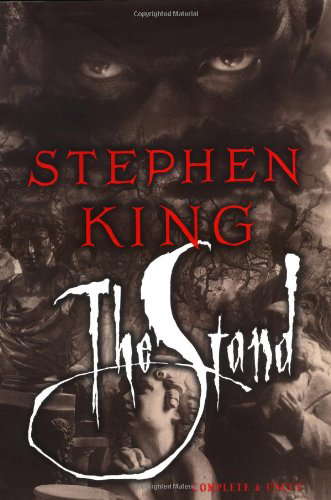
This is the way the world ends: with a nanosecond of computer error in a Defense Department laboratory and a million casual contacts that form the links in a chain letter of death.And here is the bleak new world of the day after: a world stripped of its institutions and emptied of 99 percent of its people. A world in which a handful of panicky survivors choose sides -- or are chosen. A world in which good rides on the frail shoulders of the 108-year-old Mother Abigail -- and the worst nightmares of evil are embodied in a man with a lethal smile and unspeakable powers: Randall Flagg, the dark man.In 1978 Stephen King published The Stand, the novel that is now considered to be one of his finest works. But as it was first published, The Stand was incomplete, since more than 150,000 words had been cut from the original manuscript.Now Stephen King's apocalyptic vision of a world blasted by plague and embroiled in an elemental struggle between good and evil has been restored to its entirety. The Stand : The Complete And Uncut Edition includes more than five hundred pages of material previously deleted, along with new material that King added as he reworked the manuscript for a new generation. It gives us new characters and endows familiar ones with new depths. It has a new beginning and a new ending. What emerges is a gripping work with the scope and moral comlexity of a true epic.For hundreds of thousands of fans who read The Stand in its original version and wanted more, this new edition is Stephen King's gift. And those who are reading The Stand for the first time will discover a triumphant and eerily plausible work of the imagination that takes on the issues that will determine our survival.
In 1978, science fiction writer Spider Robinson wrote a scathing review of The Stand in which he exhorted his readers to grab strangers in bookstores and beg them not to buy it.The Stand is like that. You either love it or hate it, but you can't ignore it. Stephen King's most popular book, according to polls of his fans, is an end-of-the-world scenario: a rapidly mutating flu virus is accidentally released from a U.S. military facility and wipes out 99 and 44/100 percent of the world's population, thus setting the stage for an apocalyptic confrontation between Good and Evil. "I love to burn things up," King says. "It's the werewolf in me, I guess.... The Stand was particularly fulfilling, because there I got a chance to scrub the whole human race, and man, it was fun! ... Much of the compulsive, driven feeling I had while I worked on The Stand came from the vicarious thrill of imagining an entire entrenched social order destroyed in one stroke." There is much to admire in The Stand: the vivid thumbnail sketches with which King populates a whole landscape with dozens of believable characters; the deep sense of nostalgia for things left behind; the way it subverts our sense of reality by showing us a world we find familiar, then flipping it over to reveal the darkness underneath. Anyone who wants to know, or claims to know, the heart of the American experience needs to read this book. --Fiona Webster
In its 1978 incarnation, The Stand was a healthy, hefty 823-pager. Now, King and Doubleday are republishing The Stand in the gigantic version in which, according to King, it was originally written. Not true . The same excellent tale of the walking dude, the chemical warfare weapon called superflu and the confrontation between its survivors has been updated to 1990, so references to Teenage Mutant Ninja Turtles, the Reagan years, Roger Rabbit and AIDS are unnecessarily forced into the mouths of King's late-'70s characters. That said, the extra 400 or so pages of subplots, character development, conversation, interior dialogue, spiritual soul-searching, blood, bone and gristle make King's best novel better still. A new beginning adds verisimilitude to an already frighteningly believable story, while a new ending opens up possibilities for a sequel. Sheer size makes an Everest of the whole deal. BOMC selection, QPB main selection. Copyright 1990 Reed Business Information, Inc.
This is the way the world ends: with a nanosecond of computer error in a Defense Department laboratory and a million casual contacts that form the links in a chain letter of death.And here is the bleak new world of the day after: a world stripped of its institutions and emptied of 99 percent of its people. A world in which a handful of panicky survivors choose sides -- or are chosen. A world in which good rides on the frail shoulders of the 108-year-old Mother Abigail -- and the worst nightmares of evil are embodied in a man with a lethal smile and unspeakable powers: Randall Flagg, the dark man.In 1978 Stephen King published The Stand, the novel that is now considered to be one of his finest works. But as it was first published, The Stand was incomplete, since more than 150,000 words had been cut from the original manuscript.Now Stephen King's apocalyptic vision of a world blasted by plague and embroiled in an elemental struggle between good and evil has been restored to its entirety. The Stand : The Complete And Uncut Edition includes more than five hundred pages of material previously deleted, along with new material that King added as he reworked the manuscript for a new generation. It gives us new characters and endows familiar ones with new depths. It has a new beginning and a new ending. What emerges is a gripping work with the scope and moral comlexity of a true epic.For hundreds of thousands of fans who read The Stand in its original version and wanted more, this new edition is Stephen King's gift. And those who are reading The Stand for the first time will discover a triumphant and eerily plausible work of the imagination that takes on the issues that will determine our survival.
CHAPTER 1 Hapscomb's Texaco sat on Number 93 just north of Arnette, a pissant four-street burg about 110 miles from Houston. Tonight the regulars were there, sitting by the cash register, drinking beer, talking idly, watching the bugs fly into the big lighted sign. It was Bill Hapscomb's station, so the others deferred to him even though he was a pure fool. They would have expected the same deferral if they had been gathered together in one of their business establishments. Except they had none. In Arnette, it was hard times. In 1980 the town had had two industries, a factory that made paper products (for picnics and barbecues, mostly) and a plant that made electronic calculators. Now the paper factory was shut down and the calculator plant was ailing—they could make them a lot cheaper in Taiwan, it turned out, just like those portable TVs and transistor radios. Norman Bruett and Tommy Wannamaker, who had both worked in the paper factory, were on relief, having run out of unemployment some time ago. Henry Carmichael and Stu Redman both worked at the calculator plant but rarely got more than thirty hours a week. Victor Palfrey was retired and smoked stinking home-rolled cigarettes, which were all he could afford. "Now what I say is this," Hap told them, putting his hands on his knees and leaning forward. "They just gotta say screw this inflation shit. Screw this national debt shit. We got the presses and we got the paper. We're gonna run off fifty million thousand-dollar bills and hump them right the Christ into circulation." Palfrey, who had been a machinist until 1984, was the only one present with sufficient self-respect to point out Hap's most obvious damfool statements. Now, rolling another of his shitty-smelling cigarettes, he said: "That wouldn't get us nowhere. If they do that, it'll be just like Richmond in the last two years of the States War. In those days, when you wanted a piece of gingerbread, you gave the baker a Confederate dollar, he'd put it on the gingerbread, and cut out a piece just that size. Money's just paper, you know." "I know some people don't agree with you," Hapsaid sourly. He picked up a greasy red plastic paper-holder from his desk. "I owe these people. And they're starting to get pretty itchy about it." Stuart Redman, who was perhaps the quietest man in Arnette, was sitting in one of the cracked plastic Woolco chairs, a can of Pabst in his hand, looking out the big service station window at Number 93. Stu knew about poor. He had grown up that way right here in town, the son of a dentist who had died when Stu was seven, leaving his wife and two other children besides Stu. His mother had gotten work at the Red Ball Truck Stop just outside of Arnette—Stu could have seen it from where he sat right now if it hadn't burned down in 1979. It had been enough to keep the four of them eating, but that was all. At the age of nine, Stu had gone to work, first for Rog Tucker, who owned the Red Ball, helping to unload trucks after school for thirty-five cents an hour, and then at the stockyards in the neighboring town of Braintree, lying about his age to get twenty back breaking hours of labor a week at the minimum wage. Now, listening to Hap and Vic Palfrey argue on about money and the mysterious way it had of drying up, he thought about the way his hands had bled at first from pulling the endless handtrucks of hides and guts. He had tried to keep that from his mother, but she had seen, less than a week after he started. She wept over them a little, and she hadn't been a woman who wept easily. But she hadn't asked him to quit the job. She knew what the situation was. She was a realist. Some of the silence in him came from the fact that he had never had friends, or the time for them. There was school, and there was work. His youngest brother, Dev, had died of pneumonia the year he began at the yards, and Stu had never quite gotten over that. Guilt, he supposed. He had loved Dev the best . . . but his passing had also meant there was one less mouth to feed. In high school he had found football, and that was something his mother had encouraged even though it cut into his work hours. "You play," she said. "If you got a ticket out of here, it's football, Stuart. You play. Remember Eddie Warfield." Eddie Warfield was a local hero. He had come from a family even poorer than Stu's own, had covered himself with glory as quarterback of the regional high school team, had gone onto Texas A&M with an athletic scholarship, and had played for ten years with the Green Bay Packers, mostly as a second-string quarterback but on several memorable occasions as the starter. Eddie now owned a string of fast-food restaurants across the West and Southwest, and in Arnette he was an enduring figure of myth. In Arnette, when you said "success," you meant Eddie Warfield. Stu was no quarterback, and he was no Eddie Warfield. But it did seem to him as he began his junior year in high school that there was at least a fighting chance for him to get a small athletic scholarship . . . and then there were work-study programs, and the school's guidance counselor had told him about the NDEA loan program. Then his mother had gotten sick, had become unable to work. It was cancer. Two months before he graduated from high school, she had died, leaving Stu with his brother Bryce to support. Stu had turned down the athletic scholarship and had gone to work in the calculator factory. And finally it was Bryce, three years' Stu's junior, who had made it out. He was now in Minnesota, a systems analyst for IBM. He didn't write often, and the last time he had seen Bryce was at the funeral, after Stu's wife had died—died of exactly the same sort of cancer that had killed his mother. He thought that Bryce might have his own guilt to carry . . . and that Bryce might be a little ashamed of the fact that his brother had turned into just another good old boy in a dying Texas town, spending his days doing time in the calculator plant, and his nights either down at Hap's or over at the Indian Head drinking Lone Star beer. The marriage had been the best time, and it had only lasted eighteen months. The womb of his young wife had borne a single dark and malignant child. That had been four years ago. Since, he had thought of leaving Arnette, searching for something better, but small-town inertia held him—the low siren song of familiar places and familiar faces. He was well liked in Arnette, and Vic Palfrey had once paid him the ultimate compliment of calling him "Old Time Tough." As Vic and Hap chewed it out, there was still a little dusk left in the sky, but the land was in shadow. Cars didn't go by on 93 much now, which was one reason that Hap had so many unpaid bills. But there was a car coming now, Stu saw. It was still a quarter of a mile distant, the day's last light putting a dusty shine on what little chrome was left to it. Stu's eyes were sharp, and he made it as a very old Chevrolet, maybe a '75. A Chevy, no lights on, doing no more than fifteen miles an hour, weaving all over the road. No one had seen it yet but him. "Now let's say you got a mortgage payment on this station," Vic was saying, "and let's say it's fifty dollars a month." "It's a hell of a lot more than that." "Well, for the sake of the argument, let's say fifty. And let's say the Federals went ahead and printed you a whole carload of money. Well then those bank people would turn round and want a hundred and fifty. You'd be just as poorly off." "That's right," Henry Carmichael added. Hap looked at him, irritated. He happened to know that Hank had gotten in the habit of taking Cokes out of the machine without paying the deposit, and furthermore, Hank knew he knew, and if Hank wanted to come in on any side it ought to be his. "That ain't necessarily how it would be," Hap said weightily from the depths of his ninth-grade education. He went on to explain why. Stu, who only understood that they were in a hell of a pinch, tuned Hap's voice down to a meaningless drone and watched the Chevy pitch and yaw its way on up the road. The way it was going Stu didn't think it was going to make it much farther. It crossed the white line and its lefthand tires spumed up dust from the left shoulder. Now it lurched back, held its own lane briefly, then nearly pitched off into the ditch. Then, as if the driver had picked out the big lighted Texaco station sign as a beacon, it arrowed toward the tarmac like a projectile whose velocity is very nearly spent. Stu could hear the worn-out thump of its engine now, the steady gurgle-and-wheeze of a dying carb and a loose set of valves. It missed the lower entrance and bumped up over the curb. The fluorescent bars over the pumps were reflecting off the Chevy's dirt-streaked windshield so it was hard to see what was inside, but Stu saw the vague shape of the driver roll loosely with the bump. The car showed no sign of slowing from its relentless fifteen. "So I say with more money in circulation you'd be—" "Better turn off your pumps, Hap," Stu said mildly. "The pumps? What?" Norm Bruett had turned to look out the window. "Christ on a pony," he said. Stu got out of his chair, leaned over Tommy Wannamaker and Hank Carmichael, and flicked off all eight switches at once, four with each hand. So he was the only one who didn't see the Chevy as it hit the gas pumps on the upper island and sheared them off. It plowed into them with a slowness that seemed implacable and somehow grand. Tommy Wannamaker swore in the Indian Head the next day that the taillights never flashed once. The Chevy just kept coming at a steady fifteen or so, like the pace car in the Tournament of Roses parade. The undercarriage screeched over the concrete island, and when the wheels hit it everyone but Stu saw the driver's head swing limply...
Find it on
AmazonNo videos available yet.
No news articles linked to this title yet.
No tags available.

Overall
Overall rating of the media
Atmosphere
How immersive and tense is the atmosphere
Gore
Level and quality of gore/violence
Story
Quality of the storyline and plot
Writing
Quality of the written content
Character Development
Depth and growth of characters
Pacing
Flow and timing of the narrative