
BOOK
0
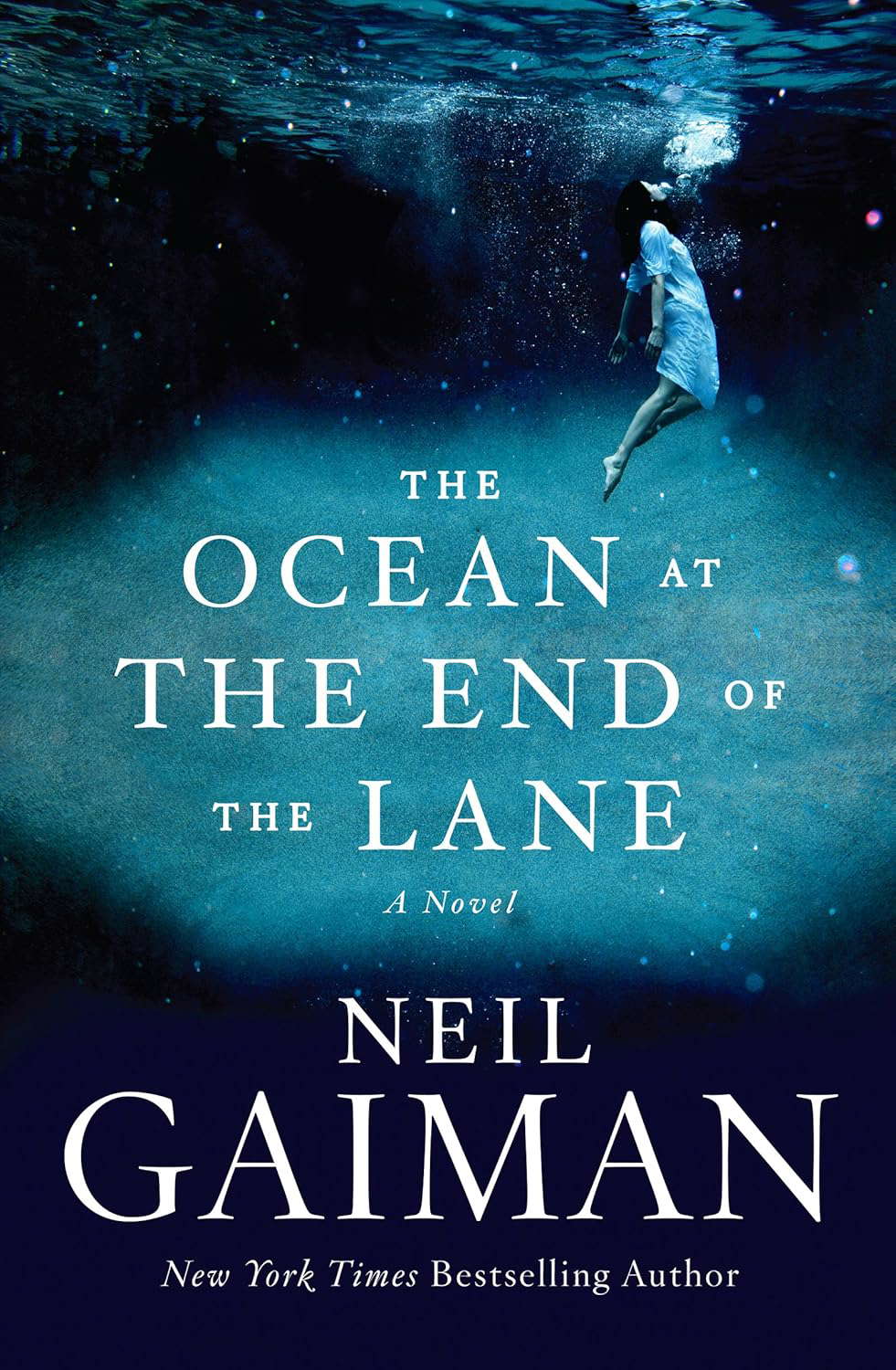
A brilliantly imaginative and poignant fairy tale from the modern master of wonder and terror, The Ocean at the End of the Lane is Neil Gaiman’s first new novel for adults since his #1 New York Times bestseller Anansi Boys.This bewitching and harrowing tale of mystery and survival, and memory and magic, makes the impossible all too real...
An Amazon Best Book of the Month, June 2013: Neil Gaiman's intent was simple: to write a short story. What he ended up with instead was The Ocean at the of the Lane--his first adult novel since Anansi Boys came out in 2005, and a narrative so thoughtful and thrilling that it's as difficult to stop reading as it was for Gaiman to stop writing. Forty years ago, our narrator, who was then a seven-year-old boy, unwittingly discovered a neighboring family’s supernatural secret. What happens next is an imaginative romp through otherwordly adventure that could only come from Gaiman's magical mind. Childhood innocence is tested and transcended as we see what getting between ancient, mystic forces can cost, as well as what can be gained from the power of true friendship. The result is a captivating tale that is equal parts sweet, sad, and spooky. --Robin A. Rothman
*Starred Review* In Gaiman’s first novel for adults since Anansi Boys (2005), the never-named fiftyish narrator is back in his childhood homeland, rural Sussex, England, where he’s just delivered the eulogy at a funeral. With “an hour or so to kill” afterward, he drives about—aimlessly, he thinks—until he’s at the crucible of his consciousness: a farmhouse with a duck pond. There, when he was seven, lived the Hempstocks, a crone, a housewife, and an 11-year-old girl, who said they were grandmother, mother, and daughter. Now, he finds the crone and, eventually, the housewife—the same ones, unchanged—while the girl is still gone, just as she was at the end of the childhood adventure he recalls in a reverie that lasts all afternoon. He remembers how he became the vector for a malign force attempting to invade and waste our world. The three Hempstocks are guardians, from time almost immemorial, situated to block such forces and, should that fail, fight them. Gaiman mines mythological typology—the three-fold goddess, the water of life (the pond, actually an ocean)—and his own childhood milieu to build the cosmology and the theater of a story he tells more gracefully than any he’s told since Stardust (1999). And don’t worry about that “for adults” designation: it’s a matter of tone. This lovely yarn is good for anyone who can read it. HIGH-DEMAND BACKSTORY: That this is the popular author’s first book for adults in eight years pretty much sums up why this will be in demand. --Ray Olson
“[W]orthy of a sleepless night . . . a fairy tale for adults that explores both innocence lost and the enthusiasm for seeing what’s past one’s proverbial fence . . . Gaiman is a master of creating worlds just a step to the left of our own.”
“Remarkable . . . wrenchingly, gorgeously elegiac. . . . [I]n The Ocean at the End of the Lane, [Gaiman] summons up childhood magic and adventure while acknowledging their irrevocable loss, and he stitches the elegiac contradictions together so tightly that you won’t see the seams.”
“Gaiman has crafted an achingly beautiful memoir of an imagination and a spellbinding story that sets three women at the center of everything. . . .[I]t’s a meditation on memory and mortality, a creative reflection on how the defining moments of childhood can inhabit the worlds we imagine.”
“His prose is simple but poetic, his world strange but utterly believable
“Poignant and heartbreaking, eloquent and frightening, impeccably rendered, it’s a fable that reminds us how our lives are shaped by childhood experiences, what we gain from them and the price we pay.”
“[A] compelling tale for all ages . . . entirely absorbing and wholly moving.”
“[A] story concerning the bewildering gulf between the innocent and the authoritative, the powerless and the powerful, the child and the adult. . . . Ocean is a novel to approach without caution; the author is clearly operating at the height of his career.”
“Ocean has that nearly invisible prose that keeps the focus firmly on the storytelling, and not on the writing. . . . This simple exterior hides something much more interesting; in the same way that what looks like a pond can really be an ocean.”
“This slim novel, gorgeously written, keeps its talons in you long after you’ve finished.”
“In Gaiman’s latest romp through otherworldly adventure, a young boy discovers a neighboring family’s supernatural secret. Soon his innocence is tested by ancient, magical forces, and he learns the power of true friendship. The result is a captivating read, equal parts sweet, sad, and spooky.”
“’The Ocean at the End of the Lane’ is fun to read, filled with his trademarked blend of sinister whimsy. Gaiman’s writing is like dangerous candy
“The impotence of childhood is often the first thing sentimental adults forget about it; Gaiman is able to resurrect, with brutal immediacy, the abject misery of being unable to control one’s own life.”
“[W]ry and freaky and finally sad. . . . This is how Gaiman works his charms. . . . He crafts his stories with one eye on the old world, on Irish folktales and Robin Hood and Camelot, and the other on particle physics and dark matter.”
“When I finally closed the last page of this slim volume it was with the realization that I’d just finished one of those uncommon perfect books that come along all too rarely in a reader’s life.”
A Globe & Mail 100 SelectionA major new work from "a writer to make readers rejoice" (Minneapolis Star Tribune)— a moving story of memory, magic, and survivalSussex, England. A middle-aged man returns to his childhood home to attend a funeral. Although the house he lived in is long gone, he is drawn to the farm at the end of the road, where, when he was seven, he encountered a most remarkable girl, Lettie Hempstock, and her mother and grandmother. He hasn't thought of Lettie in decades, and yet as he sits by the pond (a pond that she'd claimed was an ocean) behind the ramshackle old farmhouse, the unremembered past comes flooding back. And it is a past too strange, too frightening, too dangerous to have happened to anyone, let alone a small boy.Forty years earlier, a man committed suicide in a stolen car at this farm at the end of the road. Like a fuse on a firework, his death lit a touchpaper and resonated in unimaginable ways. The darkness was unleashed, something scary and thoroughly incomprehensible to a little boy. And Lettie—magical, comforting, wise beyond her years—promised to protect him, no matter what.A groundbreaking work from a master, The Ocean at the End of the Lane is told with a rare understanding of all that makes us human, and shows the power of stories to reveal and shelter us from the darkness inside and out. It is a stirring, terrifying, and elegiac fable as delicate as a butterfly's wing and as menacing as a knife in the dark.
The Ocean at the End of the LaneBy Neil GaimanHarperCollins PublishersCopyright © 2013 Neil GaimanAll rights reserved.ISBN: 978-0-06-225565-5[I.Nobody came to my seventh birthday party.There was a table laid with jellies and trifles, with a party hat beside each place, and a birthday cake with seven candles on it in the center of the table. The cake had a book drawn on it, in icing. My mother, who had organized the party, told me that the lady at the bakery said that they had never put a book on a birthday cake before, and that mostly for boys it was footballs or spaceships. I was their first book.When it became obvious that nobody was coming, my mother lit the seven candles on the cake, and I blew them out. I ate a slice of the cake, as did my little sister and one of her friends (both of them attending the party as observers, not participants) before they fled, giggling, to the garden.Party games had been prepared by my mother but, because nobody was there, not even my sister, none of the party games were played, and I unwrapped the newspaper around the pass-the-parcel gift myself, revealing a blue plastic Batman figure. I was sad that nobody had come to my party, but happy that I had a Batman figure, and there was a birthday present waiting to be read, a boxed set of the Narnia books, which I took upstairs. I lay on the bed and lost myself in the stories.I liked that. Books were safer than other people anyway.10 Neil GaimanMy parents had also given me a Best of Gilbert and Sullivan LP, to add to the two that I already had. I had loved Gilbert and Sullivan since I was three, when my father's youngest sister, my aunt, took me to see Iolanthe, a play filled with lords and fairies. I found the existence and nature of the fairies easier to understand than that of the lords. My aunt had died soon after, of pneumonia, in the hospital.That evening my father arrived home from work and he brought a cardboard box with him. In the cardboard box was a soft-haired black kitten of uncertain gender, whom I immediately named Fluffy, and which I loved utterly and wholeheartedly.Fluffy slept on my bed at night. I talked to it, sometimes, when my little sister was not around, half-expecting it to answer in a human tongue. It never did. I did not mind. The kitten was affec-tionate and interested and a good companion for someone whose seventh birthday party had consisted of a table with iced biscuits and a blancmange and cake and fifteen empty folding chairs.I do not remember ever asking any of the other children in my class at school why they had not come to my party. I did not need to ask them. They were not my friends, after all. They were just the people I went to school with.I made friends slowly, when I made them.I had books, and now I had my kitten. We would be like Dick Whittington and his cat, I knew, or, if Fluffy proved particularly in-telligent, we would be the miller's son and Puss-in-Boots. The kitten slept on my pillow, and it even waited for me to come home from school, sitting on the driveway in front of my house, by the fence, until, a month later, it was run over by the taxi that brought the opal miner to stay at my house.I was not there when it happened.I got home from school that day, and my kitten was not waiting The Ocean at the End of the Lane 11to meet me. In the kitchen was a tall, rangy man with tanned skin and a checked shirt. He was drinking coffee at the kitchen table, I could smell it. In those days all coffee was instant coffee, a bitter dark brown powder that came out of a jar.“I'm afraid I had a little accident arriving here,” he told me, cheerfully. “But not to worry.” His accent was clipped, unfamiliar: it was the first South African accent I had heard.He, too, had a cardboard box on the table in front of him.“The black kitten, was he yours?” he asked.“It's called Fluffy,” I said.“Yeah. Like I said. Accident coming here. Not to worry. Dis-posed of the corpse. Don't have to trouble yourself. Dealt with the matter. Open the box.”“What?”He pointed to the box. “Open it,” he said.The opal miner was a tall man. He wore jeans and checked shirts every time I saw him, except the last. He had a thick chain of pale gold around his neck. That was gone the last time I saw him, too.I did not want to open his box. I wanted to go off on my own. I wanted to cry for my kitten, but I could not do that if anyone else was there and watching me. I wanted to mourn. I wanted to bury my friend at the bottom of the garden, past the green-grass fairy ring, into the rhododendron bush cave, back past the heap of grass cut-tings, where nobody ever went but me.The box moved.“Bought it for you,” said the man. “Always pay my debts.”I reached out, lifted the top flap of the box, wondering if this was a joke, if my kitten would be in there. Instead a ginger face stared up at me truculently.The opal miner took the cat out of the box.12 Neil Gaiman He was a huge, ginger-striped tomcat, missing half an ear. He glared at me angrily. This cat had not liked being put in a box. He was not used to boxes. I reached out to stroke his head, feeling un- faithful to the memory of my kitten, but he pulled back so I could not touch him, and he hissed at me, then stalked off to a(Continues...)Excerpted from The Ocean at the End of the Lane by Neil Gaiman. Copyright © 2013 Neil Gaiman. Excerpted by permission of HarperCollins Publishers. All rights reserved. No part of this excerpt may be reproduced or reprinted without permission in writing from the publisher.Excerpts are provided by Dial-A-Book Inc. solely for the personal use of visitors to this web site.
Find it on
AmazonNo videos available yet.
No news articles linked to this title yet.

Overall
Overall rating of the media
Atmosphere
How immersive and tense is the atmosphere
Gore
Level and quality of gore/violence
Story
Quality of the storyline and plot
Writing
Quality of the written content
Character Development
Depth and growth of characters
Pacing
Flow and timing of the narrative