
BOOK
0
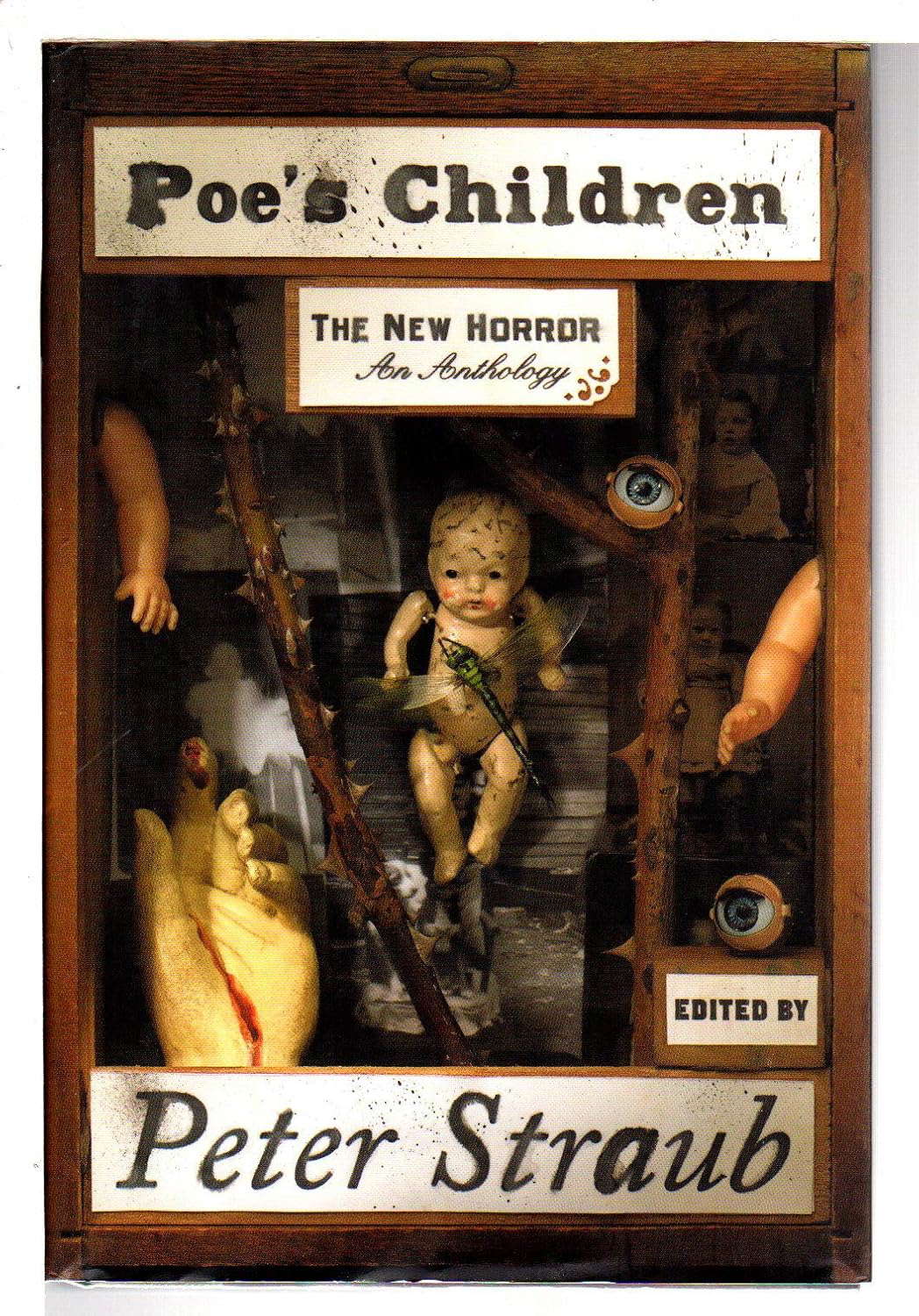
From the incomparable master of horror and suspense comes an electrifying collection of contemporary literary horror, with stories from twenty-five writers representing today’s most talented voices in the genre.Horror writing is usually associated with formulaic gore, but New Wave horror writers have more in common with the wildly inventive, evocative spookiness of Edgar Allan Poe than with the sometimes-predictable hallmarks of their peers. Showcasing this cutting-edge talent, Poe’s Children now brings the best of the genre’s stories to a wider audience. Featuring tales from such writers as Neil Gaiman and Jonathan Carroll, Poe’s Children is Peter Straub’s tribute to the imaginative power of storytelling. Each previously published story has been selected by Straub to represent what he thinks is the most interesting development in our literature during the last two decades.Selections range from the early Stephen King psychological thriller “The Ballad of the Flexible Bullet,” in which an editor confronts an author’s belief that his typewriter is inhabited by supernatural creatures, to “The Man on the Ceiling,” Melanie and Steve Rasnic Tem’s award-winning surreal tale of night terrors, woven with daylight fears that haunt a family. Other selections include National Book Award finalist Dan Chaon’s “The Bees”; Peter Straub’s “Little Red’s Tango,” the legend of a music aficionado whose past is as mysterious as the ghostly visitors to his Manhattan apartment; Elizabeth Hand’s visionary and shocking “Cleopatra Brimstone”; Thomas Ligotti’s brilliant, mind-stretching “Notes on the Writing of Horror: A Story”; and “Body,” Brian Evenson’s disturbing twist on correctional facilities.Crossing boundaries and packed with imaginative chills, Poe’s Children bears all the telltale signs of fearless, addictive fiction.
Starred Review. Anyone concerned about the future of horror will find plenty of reassurance in this outstanding reprint anthology showcasing short fiction by today's best writers in the genre. Straub (The Throat) skillfully varies tempo and style, mixing stories of psychological terror with more traditional ghostly tales. Thomas Tessier puts a fresh spin on the empty old house theme in the memorable In Praise of Folly, in which the lonely protagonist pursues his fascination with bizarre structures to the Adirondacks. Tessier subtly raises chills even as the tale proceeds to its inevitable and dark conclusion. Another winner is Dan Chaon's The Bees, a powerful account of a man haunted by mistakes of the past. Ramsey Campbell's terrifying The Voice of the Beach echoes Algernon Blackwood's classic The Willows, with its account of two friends' fateful encounter with a remote beach that may be an entry point to another dimension. Aimed at a general audience, this volume also includes works by Stephen King, Elizabeth Hand, Kelly Link and Joe Hill. (Nov.) Copyright © Reed Business Information, a division of Reed Elsevier Inc. All rights reserved.
With an introduction by the much honored Straub (Ghost Story), this collection can be dubbed New Wave horror, considering that most of its 24 stories were published fairly recently and it includes contributions by celebrity horror writers. The tales mostly eschew buckets of blood, instead employing mood and suggestion in the manner of Edgar Allan Poe. "Little Red's Tango," Straub's lengthy quasigospel of a record-collecting obsessive, complete with beatitudes and a seductive demon, ably represents the editor's definition of New Wave horror. All the stories honor Poe, like the moody, contagious delusions of Stephen King's "The Ballad of the Flexible Bullet." The genre can be literary, as exemplified by Tia V. Travis's vengeful "The Kiss," Thomas Tessier's surprising "In Praise of Folly," and, probably the most demonstrably Poe-like, Ramsey Campbell's "The Voice of the Beach," featuring a neurasthenic narrator, suffocating suggestibility, and nearly palpable imagery. Brian Evenson's creepy "Body" and Dan Chaon's touching "The Bees" culminate in the horror of bad deeds catching up. The other stories included are without exception excellent. Recommended for all libraries.—Jonathan Pearce, California State Univ.Stanislaus, Stockton
In this sumptuous, 25-story anthology, horror veteran Straub eschews the genre’s common macabre trimmings in favor of literary style. The authors featured represent Poe’s legacy with a level of craftsmanship equal to that of the best writers in contemporary literature. Most of them—the likes of Stephen King, Neil Gaiman, Ramsey Campbell, and Straub himself—are already familiar to horror fans, while a few, such as Dan Chaon and Brian Evenson, may be more recognizable to mainstream readers. The selections include King’s early “The Ballad of the Flexible Bullet,” about an editor whose typewriter is infested with crumb-eating elves called Fornits; Melanie and Steve Rasnic Tem’s award-winning “The Man on the Ceiling,” a faux-autobiographical account of the uncommon terrors haunting a family; and Ben Percy’s eerie “Unearthed,” describing the madness afflicting an amateur archaeologist when he digs up an Indian corpse. Full of unusual themes and finely nuanced prose, this is a collection to spend time with and savor slowly. --Carl Hays
“Revelatory. . . . A remarkably consistent, frequently unsettling book.”
“Straub is uniquely qualified to hold forth on what makes a good horror story. . . . [He] collects the best scary short stories out there.”
From The Washington Post's Book World/washingtonpost.com Peter Straub's revelatory anthology Poe's Children is subtitled "The New Horror," a designation that raises a couple of questions: What exactly is the "new horror?" What makes it different from, or better than, the old stuff? The answers, as Straub notes in his elegant introduction, have their roots in the horror boom that peaked and crashed in the 1980s. That boom began with the immense popular success of such novels as Ira Levin's Rosemary's Baby (1967), Thomas Tryon's The Other (1971) and William Peter Blatty's The Exorcist (1971). Shortly afterward, in 1974, Stephen King published Carrie, launching one of the most successful careers in the history of popular culture. Suddenly, horror was hot, and the public's appetite for "malevolent orphans, haunted brownstones" and -- in Michael McDowell's memorable phrase -- "underwater lesbian Nazi vampire turtles" seemed inexhaustible. But a parade of satanic knockoffs had a deadening effect. Interest in these generic creations gradually declined, and the boom inevitably went bust. The problem lay in the narrow view of horror fiction as a marketing category tied to specific tropes and specific expectations, rather than as a flexible instrument capable of addressing the "essential terror within the human animal." The 24 stories in Poe's Children illuminate that "essential terror" through an impressive, highly personal assortment of perspectives and techniques. The result is a remarkably consistent, frequently unsettling book that does as much to blur the artificial boundary between genre fiction and "literature" as any anthology in living memory. The stories are all of a relatively recent vintage, i.e., post-Carrie. The oldest (and by far the most traditional) is Ramsey Campbell's Lovecraftian novella "The Voice of the Beach," published in 1982. The contributors, who come from all over the demographic map, include several writers with long-term connections to the horror field (King, Campbell, Thomas Tessier, Thomas Ligotti), along with rising stars such as Joe Hill (King's son) and Tia V. Travis. Two respected members of the literary mainstream (Bradford Morrow and Dan Chaon) are present, as are such uncategorizable writers as Jonathan Carroll, Kelly Link and Neil Gaiman. There are almost too many good ones to comment on, but here are a few that struck me with particular force: In Elizabeth Hand's "Cleopatra Brimstone," a young American woman moves to England in the aftermath of a brutal rape. Once there, she discovers a latent capacity to effect astonishing -- and lethal -- transformations on the men who come into her life. This tale of predators and prey -- a kind of entomological horror story -- is erotic, disturbing and strangely beautiful. Graham Joyce's "Black Dust" is a subtly written ghost story set in the coal-mining region near Coventry, England. A young boy whose father has been trapped by a cave-in suffers through a protracted rescue effort, in the course of which he comes face-to-face with the massive contradictions of adult behavior. As its title indicates, M. John Harrison's "The Great God Pan" is a modern riff on Arthur Machen's classic tale about an ill-advised attempt to pierce the veil between this world and the next. Harrison's version is both an enigmatic horror story with some truly unsettling images and a grimly affecting portrait of lives scarred by grinding disappointment. Pan makes an appearance of a different sort in John Crowley's "Missolonghi 1824." In this beautifully composed story, the dying Lord Byron remembers a magical encounter with an ancient pagan creature that has come to symbolize the "wild possibility" that animated his life and freed him to pursue his central preoccupations -- poetry and love -- in the face of the impending void. Finally, there is Straub's own contribution, "Little Red's Tango," an impressionistic portrait of a New York City music collector that powerfully reiterates a characteristic theme: the persistence of the sacred in a chaotic, darkening world. Like the best of the stories in this splendid anthology, "Little Red's Tango" transcends genre labels and deserves to be recognized for what it is: first-rate fiction by a first-rate American writer. Copyright 2008, The Washington Post. All Rights Reserved.
Find it on
AmazonNo videos available yet.
No news articles linked to this title yet.

Overall
Overall rating of the media
Atmosphere
How immersive and tense is the atmosphere
Gore
Level and quality of gore/violence
Story
Quality of the storyline and plot
Writing
Quality of the written content
Character Development
Depth and growth of characters
Pacing
Flow and timing of the narrative