

BOOK
0
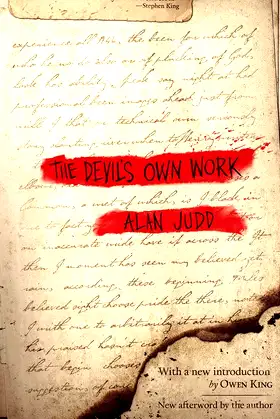
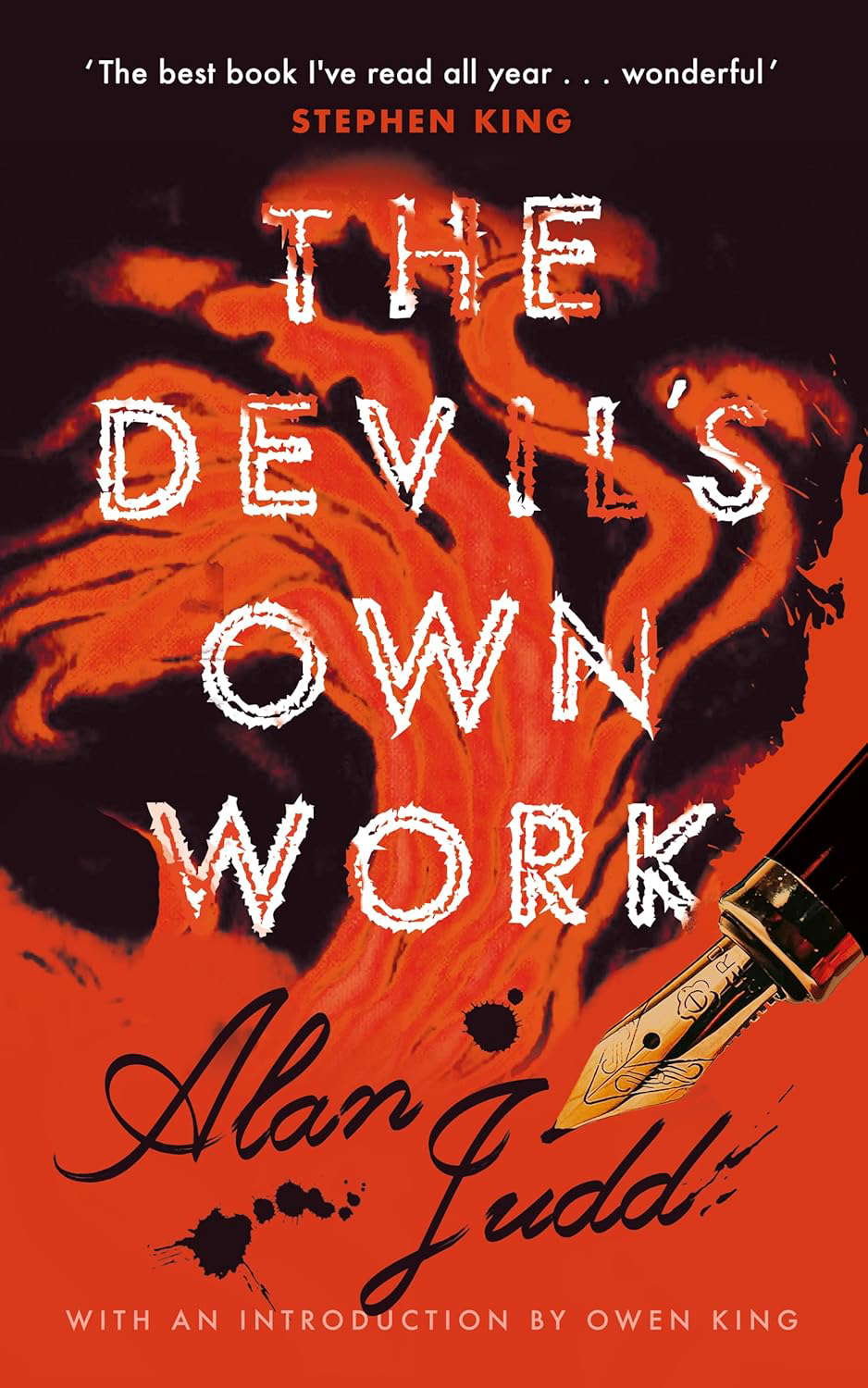
After Edward, a rising young author, pens a savage review of the new novel by the world-famous O.M. Tyrrel, he is surprised to receive an invitation to visit the old man at his villa in the south of France. The night of their meeting, Tyrell dies, and soon after, Edward’s career mysteriously starts to soar as he earns fame, fortune and critical acclaim. But despite his achievements, Edward seems haunted, even tormented. His friend, the narrator, begins to put together the pieces of the story: an ancient, inscrutable manuscript, a beautiful, ageless woman who attaches herself to whatever writer possesses it, and a bargain to achieve success at a terrible price . . .Winner of Britain’s prestigious Guardian Fiction Prize, Alan Judd’s modern classic The Devil’s Own Work (1991) is, as Owen King writes in the new introduction to this edition, “a perfect novel about the demonic possession that is literary ambition.” This edition also features a new afterword by the author, in which he reveals the inspirations for this haunting tale.“More chills in its little length than in a whole shelf of bestsellers.” – Stephen King“At once moral fable, cautionary ghost story and inspired attack on the whole hellbent drift of modern letters, this is a splendid tale, splendidly told, which Ford or Henry James would have been glad to have written.” – Robert Nye, Guardian“Wry and insightful . . . toys with the notion of demonic possession but becomes a thoroughly realistic and highly original story of revenge; a chilling cautionary tale.” – Elaine Kendall, Los Angeles Times“A brief return to the world of Faust, Mephistopheles and the Devil pact. Mr. Judd . . . achieves a deep polish.” – Robert Grudin, The New York Times Book Review“Elegantly succinct. . . . The secret of Mr. Judd’s success is instantly apparent; this tightly written story eloquently suggests more than it explains.” – Wall Street Journal“It is seldom that a novel demands such attentive reading; and seldom that a reading is so amply rewarded. Ford would have been proud to have such a disciple.” – Times Literary Supplement (London)“Judd’s creation is perfect in itself: totally true, totally real, totally right. And superbly written.” – Financial Times (London)
This modern version of the Faust legend has an old man of letters pass down to a young writer an ancient manuscript which bestows the gift of easy literary style and fluency -- and consequently head-turning success -- while blocking entirely any genuine creative power. To underline the devilishness of the bargain, the young author is seen to gradually throw away normal human decency as he gives in to overwhelming self-indulgence, and comes under the sensual sway of the old man's seductive mistress. On one level then, pure Faust. On another, Alan Judd's book, winner of the 1991 Guardian Fiction Prize, is a sophisticated self-referential commentary on the cliquish post-modern literary scene. This stylish and substantial novel is a clever attack on those who elevate insubstantial style. --This text refers to an out of print or unavailable edition of this title.
Judd's fifth novel (Tango, 1990, etc.), winner of a Guardian Fiction Prize in England, pays self-conscious homage to Ford Madox Ford's classic, The Good Soldier, as befits a book by a Ford biographer. As in The Good Soldier, the novel is recounted by an unnamed narrator, an unassuming secondary school teacher who tells readers about the rise and fall of his friend Edward. At the outset, Edward is a promising young writer who makes a major leap in his career with a scathing essay about O.M. Tyrrel, the aged ``doyen of English letters.'' The reclusive Tyrrel unexpectedly invites Edward to interview him at his home on the French Riviera. At the end of their interview, Tyrrel gives him a mysterious and incomprehensible manuscript, then keels over dead. Not long after, Edward begins a meteoric rise, enjoying both critical and popular success, and becomes involved with the seemingly ageless Eudoxie, who was Tyrrel's mistress. The narrator and Edward remain friends, but there are strange phenomena surrounding Edward and his household, including the mysterious noise of a pen writing whenever he is thinking about work and the peculiar behavior of Eudoxie. Gradually, the narrator learns the secret of the manuscript and the woman who comes with it. He discovers that his wife and Edward have had an affair, which ultimately causes her to have a breakdown. Edward declines into morbid old age. In his final encounter with the narrator, he reveals the secret of his success before passing the manuscript on to another writer. Ironically, his critical reputation declines, as Tyrrel's had, after his death. Judd seems to intend his tale as an allegory about the price of success, but the connections are strained and the plotting predictable. An uneasy, unhappy, and unproductive mix of Ford Madox Ford and Stephen King. -- Copyright ©1994, Kirkus Associates, LP. All rights reserved. --This text refers to an out of print or unavailable edition of this title.
Those who believe that short novels are more effective than long ones are supported in their conviction by this elusive, mysterious, yet piquant gem. Stylistic, thematic, and technical shades of Henry James add scent to, rather than shore up, this tale related by an English teacher ({ }a la the Jamesian passive narrator) who remembers--not in strict chronology but in the elliptical way memory works--his friendship with a certain Edward. Edward was a rising star in the British literary firmament when the narrator first met him, and Edward's final ascent to the top of the heap resulted from his journey to the French Riviera, beckoned there by a famous novelist Edward had recently trashed in a review. During the course of their South of France interview, as the narrator learns piece by piece after the fact, Edward comes into the possession of an odd manuscript; and from that time on, Edward achieves great heights in popularity and prolificacy. The source of such literary wealth is the odd manuscript itself, as if it were a genie-bearing lamp, and though the dividends of its ownership are breathtaking, Edward tries to the death to escape its ironically smothering trap. A beautiful novel sheer in its delivery as a jab from a stiletto blade. Brad Hooper --This text refers to an out of print or unavailable edition of this title.
British novelist Judd's short, ambivalent fable on the hazards of creativity and fame is distinguished by a style as psychologically nuanced as that of Henry James. Moments before he dies, O. M. Tyrrel, reclusive octogenarian doyen of English letters, bequeaths to the protagonist, fledgling writer Edward, an ancient manuscript. This virtually illegible handwritten document bestows endless creativity on its owner, dictating ideas and themes to Edward as it takes possession of his soul. Achieving fame and wealth as a postmodern novelist, Edward is also possessed by Eudoxie, Tyrell's ageless, elusive mistress, who becomes his live-in companion. Eudoxie exerts a sinister force on him and also may be the wraithlike presence made visible to the story's nameless narrator, an English teacher and old friend of Edward's who envies his success. The action moves from London to the French Riviera, where Edward seduces the narrator's wife, Chantal. Judd, a biographer of Ford Madox Ford, pays homage to that writer and his novel The Good Soldier in this homiletic parable that supports the dictum that "truth in art matters." He charges postmodernist fiction with betraying that principle by blurring the line between reality and fantasy, and he tweaks the British literary establishment for its cliquishness, pretension, inflated egos and embrace of style over substance--an accusation that apparently did not serve as a handicap when the novel won the 1991 Guardian Fiction Prize in England. Copyright 1994 Reed Business Information, Inc. --This text refers to an out of print or unavailable edition of this title.
Written in homage to Ford Madox Ford's The Good Soldier, this slender novel mesmerizes the reader with its tale of literary possession. The narrator, a teacher of literature, describes how his friend Edward, a writer, receives the gift of a mysterious manuscript at the death of a great writer. Somehow this manuscript, and the woman friend who is transferred along with it, enable Edward to become a literary celebrity and his books to become best sellers, though he seems to lose his sense of self in the process. Included is a discourse on the tendency of authors to be so preoccupied with form that they neglect the content of their works. The friendship between the literary couple and the narrator and his wife parallels the story in The Good Soldier. Judd (Ford Madox Ford, LJ 12/90) first published this novel in England, where it won the Guardian Fiction Prize. Highly recommended for public and academic libraries.Ann Irvine, Montgomery, Ct.Copyright 1994 Reed Business Information, Inc. --This text refers to an out of print or unavailable edition of this title.
Find it on
AmazonNo videos available yet.
No news articles linked to this title yet.

Overall
Overall rating of the media
Atmosphere
How immersive and tense is the atmosphere
Gore
Level and quality of gore/violence
Story
Quality of the storyline and plot
Writing
Quality of the written content
Character Development
Depth and growth of characters
Pacing
Flow and timing of the narrative