

BOOK
0
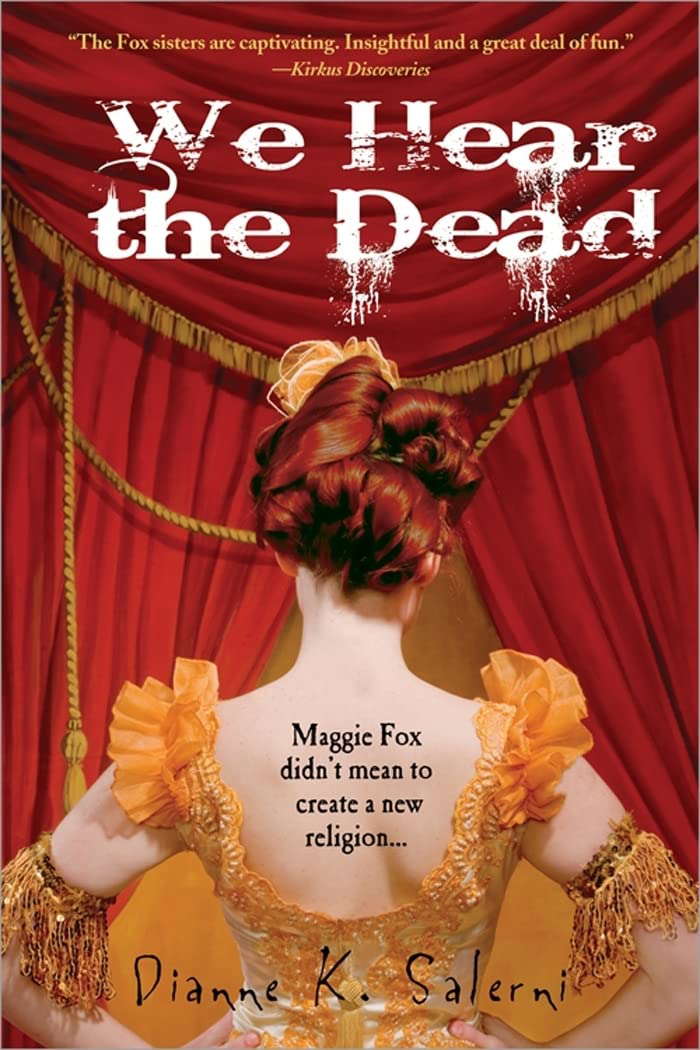
"Readers will be swept along with Maggie and Kate as they bamboozle an entire nation, and will feel for Maggie as she debates whether or not to leave the profession…Dianne K. Salerni has written a brilliant debut novel."―TeensReadToo.comMaggie:I began the deception when I was too young to know right from wrong. Only with the passing of time did I come to understand the consequences of my actions.Kate:I do not believe that I have ever intentionally deceived anyone. Maggie has a different understanding of the events that have happened. To her the spirits were always a game. For me they were my life's calling. I have no regrets.It starts as a harmless prank…then one lie quickly grows into another. Soon Kate and Maggie Fox are swept into a dizzying flurry of national attention for their abilities to communicate with the dead. But living a lie is sometimes too much to handle, even if you have the best intentions. Based on a true story, We Hear the Dead reveals how secrets and lies can sometimes lead you to what's real and what's right. And how sometimes talking with the dead is easier than talking with the people around you.What Readers Are Saying:"Masterfully written…a first-class novel.""A crafty, enchanting, mesmerizing read.""Adventure, romance, heartbreak, a bit of history, and a story that will touch you.""Dianne Salerni is masterful.""An enjoyable ride…and one well worth taking.""A great read that had me turning pages long after I should have gone to bed."
Grade 6–9—Maggie and Kate Fox were real celebrities in the mid-1800s, sisters said to have an ability to communicate with the dead. Salerni brings the séance culture vividly to life without ever pretending that the mediums believed in their own "ghost rapping." Maggie, the older sister, reveals in the opening pages that her spiritualism is deception and humbug and prank. An occasional chapter is written by Kate, who believes that she can truly communicate with the dead, even if the actual rapping comes from trickery. Egged on by an older sister, the girls find they enjoy the perks of their fame, and Maggie in particular is pleased to reassure grieving patrons that their loved ones are at peace. Despite the seeming focus on the supernatural, the novel offers much historical context and several richly developed subplots, most notably the romance between Maggie Fox and Elisha Kane. Kane was a renowned explorer, and his funeral was second in size only to that of Abraham Lincoln's. The author's word choices ("spectacles," "peevishly," "devilment," "bedchamber") draw readers into the past. She paints vivid scenes of life in upstate New York during a time when exposed ankles were shocking and the Underground Railroad offered a dangerous route to freedom for both conductors and slaves. Historical fiction at its best.—Maggie Knapp, Trinity Valley School, Fort Worth, TX Copyright © Reed Business Information, a division of Reed Elsevier Inc. All rights reserved.
In upstate New York in 1848, two young sisters, Maggie and Kate Fox, created a spiritual hoax to frighten a detested cousin. Through eerie rapping sounds produced by cracking joints, they convinced their family and then the whole town that they could communicate with ghosts. What began as a childhood prank turned into their adult livelihood, and the sisters became famous, even “rapping” for First Lady Jane Pierce. Alternating narration between Maggie and Kate, Salerni imagines the young adult years of these closely bonded, very different siblings: Maggie feels guilty for their trickery, while Kate believes that she has a sixth sense and has never “intentionally deceived anyone.” Salerni details the sisters' performances and their troubled family dynamics, but much of the book's later half focuses on a passionate, fraught romance between Maggie and a wealthy explorer, leaving Kate's story underdeveloped. Still, the events, based in fact, are inherently fascinating, and older readers may want to move on to the several adult books, listed in an appended bibliography, about the wily and tragic Foxes. Grades 8-11. --Gillian Engberg
"Maggie is a bright, interesting, and down to earth character who believes that she is offering a service by giving comfort to grieving families… Those who like historical fiction will find this an entertaining romance."
"The research is excellent, and the author displays a facility for fluid prose even as she writes in a modified archaic style that lends credence to the first-person conceit of the novel. Although the book’s length may discourage some readers, those caught in the story will enjoy it. A promising debut."
"Inherently fascinating"
From Chapter One:I was not happy about leaving the cheerful and bustling city of Rochester for the dreary, vacant countryside of Wayne County. I had just turned fourteen, and I thought that being banished to "frontiersland" would be the end of my life. To make matters worse, the rooms that my family rented in Rochester had become unavailable because the owner, Mr. Isaac Post, had sold the house. It was necessary to move out of our lodgings before the new home was built, so my father rented a small house within the town limits of Hydesville.Hydesville wasn't much of a town, as far as I was concerned, and ours wasn't much of a house. Its best feature was a south-facing parlor with several windows to brighten the room. The kitchen, however, was dark and dreary. The house's single bedroom received sunlight only in the morning. There was a buttery off the kitchen, and a cobwebbed attic over the back half of the house. The absolutely most horrible part of the house was the cellar.Kate and I explored it while Father and David moved furniture above us. Foul water squelched around our shoes, bubbling up from the damp earth floor. The wood beams supporting earthen walls leaned inward at an alarming angle, giving the unsettling impression of imminent collapse."It smells like an open grave," I stated in disgust."To be sure," answered Kate, "and there lies the corpse." She pointed at the darkest corner of the cellar, where I could dimly make out a mound of loose earth piled carelessly against a crooked wall."What are you girls doing down there?"The voice made us jump. We turned and saw my father leaning in through the doorway, peering at us in the dim light.I opened my mouth, ready to burst out with fresh complaints about moving into a house built over a pauper's cemetery. But Kate took my hand firmly and spoke before me. "We were just curious, Father." She led me toward the stairs, and I followed silently, without voicing my opinion.Hydesville was less a town than a cluster of houses and farms that had grown up around a tavern, which later closed down and left the townsfolk wondering why they had come. My mother, I know, was relieved to see the boarded doors on the old Hyde's Tavern. She had forgiven her husband for his years of drunkenness but had never quite forgotten. We had lived in the Hydesville house less than two weeks when a letter from my sister Leah arrived, telling us to expect her daughter to arrive by canal boat within a few days. Lizzie was coming "to lend us a hand." Only Leah could imagine that feeding and housing another person under our present circumstances would be a help. Especially Lizzie, a great big horse of a girl with the brains of a cow and the liveliness of a fencepost.Leah obviously needed to be rid of Lizzie for her own purposes. Perhaps she wanted to put a boarder in the girl's room to make extra money. Leah held piano lessons and rented rooms but always seemed to be in an endless state of acquiring funds. Whenever she could persuade my parents to feed, clothe, and shelter her daughter, she did so.Anticipating Lizzie's arrival did not improve my outlook on the house, Hydesville, or the dismal end of my former life. Kate and I moaned and threw fits, but Lizzie was already on her way, and our mother actually looked forward to her arrival. Honestly, I cannot tell why, unless it was simply because she was the eldest grandchild and the daughter of her precious Leah. Lizzie did not resemble my sister, who was pretty and bold and the center of any gathering of people. I never met Mr. Bowman Fish, who ran off to marry a rich widow when Lizzie was only a baby, but I imagine that he must have resembled his own name and passed those features on to his daughter."Lizzie Fish is a stinky old cod," Kate chanted out of the hearing of our parents."Face like a path where the oxen trod," I rejoined, turning the jump rope, which we had tied to a tree."Screwed up little eyes and pale, thin hair―""For a penny and a half I would push her down the stair.""How many steps did Lizzie fall down?""One...two...three...four...five...six..."My seventeen-year-old niece, Lizzie, was the least important person in this entire story―and also the most important. She was the reason for everything that was to come: the rapping, the lecture halls, the spirit circles, and the messages from the dead.Kate and I did not like Lizzie. We did not look forward to her arrival, and we resented sharing our bed with her.Everything that happened―everything―was originally just a plan to scare Lizzie and make her go home.
Find it on
AmazonNo videos available yet.
No news articles linked to this title yet.

Overall
Overall rating of the media
Atmosphere
How immersive and tense is the atmosphere
Gore
Level and quality of gore/violence
Story
Quality of the storyline and plot
Writing
Quality of the written content
Character Development
Depth and growth of characters
Pacing
Flow and timing of the narrative