
BOOK
0
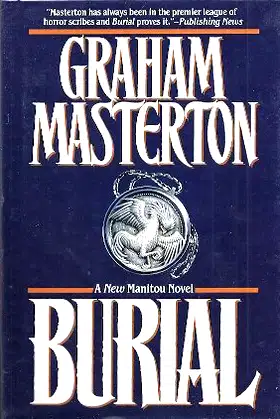
First published in 1991, this is the story of New York City. Friday night. Untouched by anything visible, Mrs Greenberg's furniture starts to slide across the room - and however hard she tries, she can't move it back.Harry Erskine, self-taught fortune teller, agrees to investigate - but soon realises that Mrs Greenberg's moving furniture is just the beginning of a nightmare, for it is being drawn by the same inexorable force which drags us all to the grave.City by city, America is on the brink of falling into the abyss - women and children, streets and buildings - one and all brought thundering and screaming into the dominion of the dead...
Masterton blends horror and humor with aplomb in this gleefully gruesome second sequel to his best-known novel, The Manitou . Once again the spirit of Misquamacus, the greatest of all Indian medicine men, ventures forth from the world of the dead to avenge the near-extermination of his people. But this time the horrific wraith teams up not only with a Lovecraft-like god of the underworld (a hulking shadow complete with tentacles) but also with the spirit of a voodoo priest eager to pay back whites for their enslavement of his tribe. Against these forces, modern America writhes in agony. Chicago and New York are reduced to rubble; a man possessed by Misquamacus reaches deep into a woman's body and pulls her inside out; the Indian spirit performs the hastiest eyeball-removal seen on paper since Jerzy Kosinski's The Painted Bird. None of this is inherently funny, of course, but what gives the novel its bright comic glaze is the wisecracking narration (alternating with third-person scenes of carnage) by Harry Erskine, the charlatan clairvoyant who's taken on Misquamacus twice before. And what saves it from fatal political incorrectness, though not from soap-boxing, is Masterton's hammering home of injustices done to Indians and blacks by whites. All in all, this is a treat for horror fans enamored of steak tartare and even bloodier books. Copyright 1994 Reed Business Information, Inc.
Fortune-teller Harry Erskine, older but no wiser, returns to do battle with Misquamacus, the powerful Indian spirit first encountered in two earlier Manitou novels (The Manitou, 1977, and The Revenge of Manitou, 1982). Misquamacus has joined forces with a zombie voodoo priest to re-create the United States as it was in pre-Columbian times. Cities and other signs of the white man's civilization are pulled into holes that appear at sites of Indian slaughters, and Harry and his friends, both alive and dead, must try to outwit the spirits from the Great Outside. Masterton's style and imagination place him head and shoulders over many current horror writers. Burial integrates themes of guilt, revenge, and the blindness of nostalgia into a smashing novel that is alternately chilling, horrific, and mordantly humorous. Readers unfamiliar with the earlier Manitou books will have no problems following the latest adventure. Recommended for general fiction collections; horror fans will love it.Eric W. Johnson, Teikyo Post Univ. Lib., Waterbury, Ct.Copyright 1994 Reed Business Information, Inc.
Masterton's third outing with the Manitou provides another spine-tingling excursion into the supernatural universe, the "black infinite lake that lies beneath our feet." The series hero, small-time scam artist Harry Erskine, is again drawn into danger by the anger of American Indian spirits. From the East Coast to the West, the white man's world is being torn asunder by ghosts seeking revenge, and Harry, as well as his companions Karen, Papago Joe the shaman, and E. C. Dude, is forced to combat the vengeful spirits. The eerie manifestations of the Manitou continue to dismay and baffle until the final, authoritative, chilling climax. Dennis Winters
Modern America is in peril of being sucked down the spiritual drain by dead, angry Indians in this follow-up to Manitou and Revenge of the Manitou (both not reviewed). In the Greenbergs' Manhattan apartment, a hunched-up shadow appears on the wall and tears a humanlike shadow to pieces, while in other parts of America houses, cars, Kentucky Fried Chicken cartons, human corpses, and the Sears Tower are dragged into gaping holes. Thus commences the vengeance of Misquamacus, a Native American spirit who wants to reclaim his land by sucking everything the white man ever built or brought into a shadow world below the earth. There, Aktunowihio, the god of the underworld, will tear the bodies and souls of all white men and women to pieces, so that they will be tortured forever. Harry Erskine, the charlatan fortune teller and reluctant hero who battled and defeated Misquamacus earlier in the series, is drawn into the current battle when he witnesses the spirit manifest himself in the body of a medium with a Central Park West practice, hurl his fist down Mrs. Greenberg's throat and wiggle it through her innards until it emerges out of her vagina, then reverse the process, bringing her insides with it. The skeptical Harry quickly combines the talents of mediums, Indians, and spirits of the dead--including Singing Rock, who was beheaded earlier in the series--to bring the horror to a rapid and dull conclusion. Masterton is a good storyteller, but he exploits revisionist Native American history to detail unrelenting violence. The absurdity of disgorged intestines and forked-out eyeballs panders to juvenile tastes for blood and guts and precludes any possibility of inducing spine-tingling fear. Should Indian spirits ever really take their revenge, with any luck the sinkhole will open under Burial and send it where it belongs. -- Copyright ©1994, Kirkus Associates, LP. All rights reserved.
Find it on
AmazonNo videos available yet.
No news articles linked to this title yet.

Overall
Overall rating of the media
Atmosphere
How immersive and tense is the atmosphere
Gore
Level and quality of gore/violence
Story
Quality of the storyline and plot
Writing
Quality of the written content
Character Development
Depth and growth of characters
Pacing
Flow and timing of the narrative