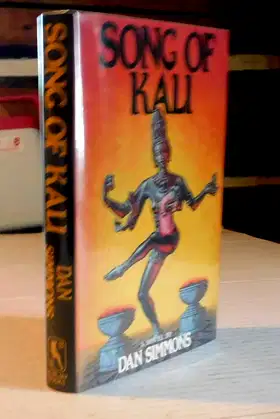
BOOK
0
The World Fantasy Award winner by the author of the Hyperion Cantos and Carrion Comfort: An American finds himself encircled by horrors in Calcutta. Praised by Dean Koontz as “the best novel in the genre I can remember,” Song of Kali follows an American magazine editor who journeys to the brutally bleak, poverty-stricken Indian city in search of a manuscript by a mysterious poet—but instead is drawn into an encounter with the cult of Kali, goddess of death. A chilling voyage into the squalor and violence of the human condition, this novel is considered by many to be the best work by the author of The Terror, who has been showered with accolades, including the Bram Stoker Award, the International Horror Guild Award, and the Hugo Award.
"O terrible wife of Siva / Your tongue is drinking the blood, / O dark Mother! O unclad Mother." It is remarkable that prior to writing this first novel, Dan Simmons had spent only two and a half days in Calcutta, a city "too wicked to be suffered," his narrator says. Fortunately back in print after several years during which it was hard to obtain, this rich, bizarre novel practically reeks with atmosphere. The story concerns an American poet who travels with his Indian wife and their baby to Calcutta to pick up an epic poem cycle about the goddess Kali. The Bengali poet who wrote the poem cycle has disappeared under mysterious circumstances.Horror critic Edward Bryant calls Song of Kali "an exactingly constructed, brutal, and uncompromising study of the degree to which an evil place may permeate and steep all that makes us human" and writes that it embodies "the stance of a psychologically violent novel about a violent society as a defensible and indisputably moral work of art." Song of Kali won a World Fantasy Award. --Fiona Webster
Chapter One "Today everything happens in Calcutta…Who should I blame?" --Sankha Ghosh "Don't go, Bobby," said my friend. "It's not worth it."It was June of 1977, and I had come down to New York from New Hampshire in order to finalize the details of the Calcutta trip with my editor at Harper's. Afterward I decided to drop in to see my friend Abe Bronstein. The modest uptown office building that housed our little literary magazine, Other Voices, looked less than impressive after several hours of looking down on Madison Avenue from the rarefied heights of the suites at Harper's.Abe was in his cluttered office, alone, working on the autumn issue of Voices. The windows were open, but the air in the room was as stale and moist as the dead cigar that Abe was chewing on. "Don't go to Calcutta, Bobby," Abe said again. "Let someone else do it.""Abe, it's all set," I said. "We're leaving next week." I hesitated a moment. "They're paying very well and covering all expenses," I added."Hnnn," said Abe. He shifted the cigar to the other side of his mouth and frowned at a stack of manuscripts in front of him. From looking at this sweaty, disheveled little man--more the picture of an overworked bookie than anything else--one would never have guessed that he edited one of the more respected "little magazines" in the country. In 1977, Other Voices hadn't eclipsed the old Kenyon Review or caused The Hudson Review undue worry about competition, but we were getting our quarterly issues out to subscribers; five stories that had first appeared in Voices had been chosen for the O'Henry Award anthologies; and Joyce Carol Oates had donated a story to our tenth-anniversary issue. At various times I had been Other Voices assistant editor, poetry editor, and unpaid proofreader. Now, after a year off to think and write in the New Hampshire hills and with a newly issued book of verse to my credit, I was merely a valued contributor. But I still thought of Voices as our magazine. And I still thought of Abe Bronstein as a close friend."Why the hell are they sending you, Bobby?" asked Abe. "Why doesn't Harper's send one of its big guns if this is so important that they're going to cover expenses?"Abe had a point. Not many people had heard of Robert C. Luczak in 1977, despite the fact that Winter Spirits had received half a column of review in the Times. Still, I hoped that what people--especially the few hundred people who counted--had heard was promising. "Harper's thought of me because of that piece I did in Voices last year," I said. "You know, the one on Bengali poetry. You said I spent too much time on Rabindranath Tagore.""Yeah, I remember," said Abe. "I'm surprised that those clowns at Harper's knew who Tagore was.""Chet Morrow called me," I said. "He said that he had been impressed with the piece." I neglected to tell Abe that Morrow had forgotten Tagore's name."Chet Morrow?" grunted Abe. "Isn't he busy doing novelizations of TV series?""He's filling in as temporary assistant editor at Harper's," I said. "He wants the Calcutta article in by the October issue."Abe shook his head. "What about Amrita and little Elizabeth Regina…""Victoria," I said. Abe knew the baby's name. When I had first told him the name we'd chosen for our daughter, Abe had suggested that it was a pretty damn Waspy title for the offspring of an Indian princess and a Chicago pollock. The man was the epitome of sensitivity. Abe, although well over fifty, still lived with his mother in Bronxville. He was totally absorbed in putting out Voices and seemed indifferent to anything or anyone that didn't directly apply to that end. One winter the heat had gone out in the office, and he had spent the better part of January here working in his wool coat before getting around to having it fixed. Most of Abe's interactions with people these days tended to be over the phone or through letters, but that didn't make the tone of his comments any less acerbic. I began to see why no one had taken my place as either assistant editor or poetry editor. "Her name's Victoria," I said again."Whatever. How does Amrita feel about you going off and deserting her and the kid? How old's the baby, anyway? Couple months?""Seven months old," I said."Lousy time to go off to India and leave them," said Abe."Amrita's going too," I said. "And Victoria. I convinced Morrow that Amrita could translate the Bengali for me." This was not quite the truth. It had been Morrow who suggested that Amrita go with me. In fact, it was probably Amrita's name that had gotten me the assignment. Harper's had contacted three authorities on Bengali literature, two of them Indian writers living in the States, before calling me. All three had turned down the assignment, but the last man they contacted had mentioned Amrita--despite her field being mathematics, not writing--and Morrow had followed up on it. "She does speak Bengali, doesn't she?" Morrow had asked over the phone. "Sure," I'd said. Actually, Amita spoke Hindi, Marathi, Tamil, and a little Punjabi as well as German, Russian, and English, but not Bengali. Close enough, I'd thought."Amrita wants to go?" asked Abe."She's looking forward to it," I said. "She hasn't been back to India since her father moved the family to England when she was seven. She's also looking forward to our spending some time in London on the way to India so her parents can meet Victoria." This last part was true. Amrita had not wanted to go to Calcutta with the baby until I convinced her that it was important to my career. The stopover in London had been the deciding factor for her."Okay," grunted Abe. "Go to Calcutta." His tone of voice let me know precisely what he thought of the idea."Tell me why you don't want me to," I said."Later," said Abe. "Right now tell me about this Das thing Morrow's talking about. And I'd like to know why you want me to save half of next spring's issue of Voices for more Das stuff. I hate reprints, and there can't be ten lines of his verse that hasn't been printed and reprinted ad nauseum.""Das, yes," I said. "But not reprints. New things.""Tell me," said Abe.I told him.* * *"I'm going to Calcutta to find the poet M. Das," I said. "Find him, talk to him, and bring back some samples of his new work for publication."Abe stared at me. "Uh-uh," he said. "No way. M. Das is dead. He died six or seven years ago. In 1970, I think.""July of 1969," I said. I could not keep a trace of smugness out of my voice. "He disappeared in July of 1969 while on his way back from his father's funeral, cremation actually, in a village in East Pakistan--Bangladesh now--and everyone assumed he was murdered.""Yeah, I remember," said Abe. "I stayed with you and Amrita for a couple of days in your Boston apartment when the New England Poets' Alliance held that commemorative reading for him. You read some of Tagore's stuff, and excerpts from Das's epic poems about what'shername, the nun--Mother Teresa.""And two of my Chicago Cycle pieces were dedicated to him," I said. "But I guess we were all a bit premature. Das seems to have resurfaced in Calcutta, or at least some of his new poetry and correspondence has. Harper's got some samples through an agency they work with there, and people who knew Das say that he definitely wrote these new things. But nobody's seen the man himself. Harper's wants me to try to get some of his new work, but the slant of the article is going to be 'The Search for M. Das,' that kind of crap. Now here's the good news. Harper's gets first refusal on any of the poetry I get rights to, but we can print the rest in Other Voices.""Sloppy seconds," grumbled Abe and chewed on his cigar. This was the kind of enthusiastic gratitude I'd grown used to during my years with Bronstein. I said nothing, and eventually he spoke again. "So where the hell's Das been for eight years, Bobby?"I shrugged and tossed him a photocopied page that Morrow had given me. Abe inspected it, held it at arm's length, turned it sideways like a centerfold, and tossed it back. "I give up," he said. "What the shit is it?""That's the fragment of a new poem that Das is supposed to have written within the past couple of years.""What's it in, Hindi?""No, Sanskrit and Bengali, mostly. Here's the English translation." I handed over the other photocopy.Abe's sweaty brow furrowed as he read. "Sweet Christ, Bobby, is this what I'm holding the spring issue for? This is about some dame scewing doggie-style while drinking the blood of a headless man. Or did I miss something?""Nope. That's about it. Of course there are only a few stanzas in that fragment," I said. "And it's a rough translation.""I thought Das's work was lyrical and sentimental. Sort of the way you described Tagore's stuff in your article.""He was. He is. Not sentimental but optimistic." It was the same phrase I'd used many times to defend Tagore. Hell, it was the same phrase I'd used to defend my own work."Uh-huh," said Abe. "Optimistic. I like this optimistic part here--'Kama Rati kamé/viparita karé rati.' According to the translator's copy it means--'Maddened by lust, Kama and Rati fuck like dogs.' Sweet. It has a distinctive lilt to it, Bobby. Sort of early Robert Frost-ish.""It's part of a traditional Bengali song," I said. "Notice how Das had embedded the rhythm of it in the general passage. He shifts from classical Vedic form to folk-Bengali and then back to Vedic. It's a complicated stylistic treatment, even allowing for translation." I shut up. I was just repeating what Morrow had told me, and he had been repeating what one of his "experts" had said. It was very hot in the little room. Through the open windows came the lulling sound of traffic and the somehow reassuring cry of a distant siren. "You're right," I...
Find it on
AmazonNo videos available yet.
No news articles linked to this title yet.

Overall
Overall rating of the media
Atmosphere
How immersive and tense is the atmosphere
Gore
Level and quality of gore/violence
Story
Quality of the storyline and plot
Writing
Quality of the written content
Character Development
Depth and growth of characters
Pacing
Flow and timing of the narrative