
BOOK
0
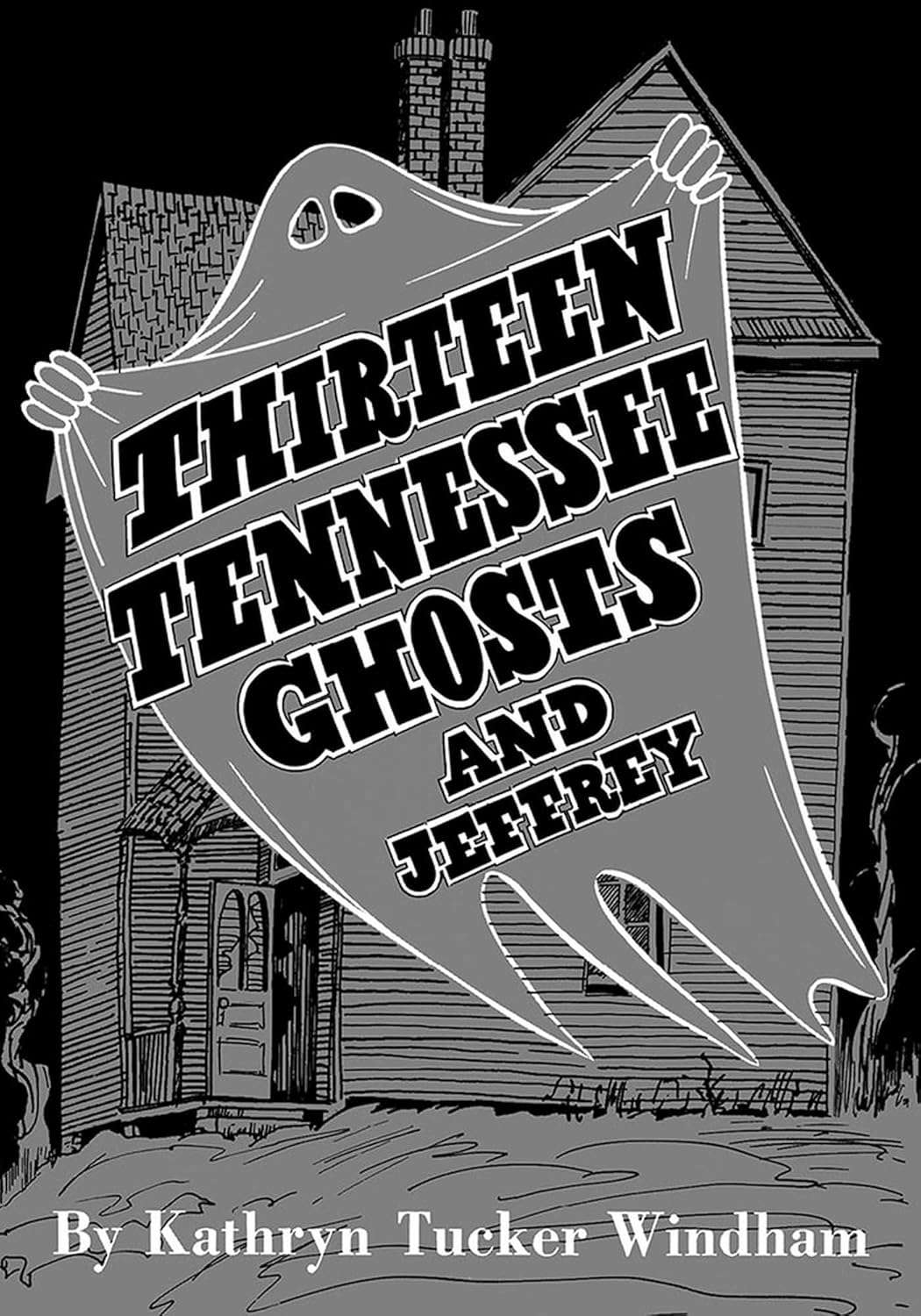
A deluxe, commemorative edition of famed southern author and folklorist Kathryn Tucker Windham’s introduction to the Volunteer State’s most enduring ghost stories In Thirteen Tennessee Ghosts and Jeffrey, beloved and best-selling folklorist Kathryn Tucker Windham presents a spine-tingling collection of Tennessee’s eeriest ghost tales. Accompanied by her faithful companion, Jeffrey, a friendly spirit who resided in her home, Windham traveled from the mysterious muds of Memphis to the haunted hollow’s of east Tennessee to collect the spookiest collection of Volunteer State revenants ever written. In these perennial favorites, Windham captures the gentle folk humor of native Tennesseans as well as fascinating facts about the state’s rich history. In “The Dark Legend,” Windham recounts the story of explorer Merriwether Lewis, who met an untimely end on the Natchez Trace 1809 and whose spirit, it is said, still treads through Tennessee’s forests. Windham also visits central Tennessee’s Chapel Hill, where people who know the town say those who stand on the train tracks on dark, lonely nights can often see a disembodied light floating along the tracks. Neighbors say it’s the ghost of a headless flagman who returns to cavort with night-time guests. High in Tennessee’s Appalachian mountains, Windham encounters Martin, the phantom fiddler of Johnson County. Legend has it that in life Martin’s musical skills so mesmerized the snakes of the Stone Mountains that they would slither from their dens to listen tamely to his fiddling. Intrepid visitors to the rocky tops of northeast Tennessee’s mountains say you can still hear Martin’s ghost fiddling in the hollows. This handsome, new commemorative hardback edition returns Windham’s suspenseful classic to its original keepsake quality and includes a new afterword by the author’s children.
“In Windham’s tales . . . myth and fact intertwine to present a picture of the South that is as true as any textbook.”
“Almost every town has its own ghostly legends. It’s separating fact from fiction and fantasy that requires someone of Mrs. Windham's expertise.”
13 Tennessee Ghosts and JeffreyCommemorative EditionBy Kathryn Tucker Windham, Lecia BrogdonThe University of Alabama PressCopyright © 2016 University of Alabama PressAll rights reserved.ISBN: 978-0-8173-1901-4ContentsI. The Snake Charmer, II. The Rosary, III. The Trees, IV. Long Dog, V. The Barrel of Sin, VI. The Dark Legend, VII. The Chapel Hill Light, VIII. Memphis' Great Jar Mystery, IX. Shiloh Revisited, X. The Exorcism of Aunt Crecy, XI. The Restless Rocker, XII. The Blessing, XIII. Stains on the Mausoleum, The Witch Who Tormented The Bell Family, Afterword to the Commemorative Edition Dilcy Windham Hilley and Ben Windham, CHAPTER 1The Snake CharmerSometimes on summer nights, when moonlight softens the rough profiles of Stone Mountains, snatches of fiddle music drift from Fiddler's Rock. The tunes change, blend, swell, fade, and swell again as though a distant fiddler were warming up for a performance.Not everyone hears the music. And some mountaineers, especially the younger ones, say it is not music at all but the sound of wind rushing down from high rocks and swishing through the trees and losing itself in the twisting coves and hollows. Others say it is only the music from record players or radios bouncing against the cliffs and echoing into the valleys.But other mountain dwellers hear the tunes plainly, recognize the distinctive style of the fiddler."Listen," they say. "Listen. Old Martin is playing tonight. What's that? 'Cripple Creek'! Hear it? Just as plain. That's old Martin, all right. Up there charming his snakes. Bet that old flat rock is thick with rattlers now, crawling out of their dens to hear Martin play his fiddle. Old Martin. The snake charmer. Just listen...."It has been better than a hundred years — closer maybe to a century and a quarter — since Martin lived up in Johnson County, Tennessee. Some folks say he was born near Trace, and others claim his family lived not far from Elk Mills.Wherever it was that Martin was born, he grew up in those rugged east Tennessee mountains. He hunted and he fished and he trapped, when he wasn't helping his daddy cut logs. Long before most boys could even open a jack knife, Martin was whittling little wooden figures of animals — squirrels and rabbits and bears and such. His grandfather taught him how to see a creature in a piece of wood.His grandfather taught Martin how to play the fiddle, too. He taught him to play the old tunes brought over from England, the staid hymns, the dancing play-party rhythms, and the wailing laments for times long past.With his grandfather's help, Martin made his first fiddle, whittling it out of seasoned wood and carving decorations on it to suit his fancy.By the time he was half grown, Martin had the name of being the best fiddler in Johnson County. He played for weddings, and he played for funerals. He played for barn raisings, and he played for church sociables. He played for dances, and he played for idlers sitting around the store down at the crossroads. He could play any tune anybody called for, and he made up a hundred or more tunes of his own."Tunes are just singing around in my head. I can hear them as plain as anything," Martin told folks who asked where he got his new melodies.Neighbors used to say that if a restless, fretful baby was brought within earshot of Martin's fiddling, the baby would quit crying and drop off to sleep as peaceful as you please. It was like magic.There was even some belief that Martin's music had curative powers, that it could make sick people well. Martin himself never made any such claims, though he was perfectly willing to go wherever he was asked to play for someone who was ailing."If my music helps them get well, that's fine. If it doesn't, at least maybe I've given them a little joyful time." Joyful times were important to Martin.Up around Laurel Bloomery, they used to say that Martin had the only singing mule in the mountains. They said Martin would be playing his fiddle while he rode his mule, riding bareback the way he always did, and every now and then the mule would bray in time to the music. Some folks even said the mule's bray was in harmony with the fiddle and that anybody who halfway listened could recognize the song the mule brayed. That could have been true. Maybe.When Martin played for dances, they say listeners forgot their rheumatism and their stiff joints and were out on the floor stomping up a dust before Martin had played six measures of "Sourwood Mountain." "Even the preachers can't help dancing when Martin plays," they used to say.People at Pandora, some of them, swore that Martin hunted with his fiddle. He used to go into the woods without a gun or any kind of weapon, just take his fiddle, and in a little while he'd come out with his hunting sack full of squirrels. All his pockets would be full, too. And not a one of those squirrels ever had a mark on them. Not everybody believed that tale.But just about everybody who heard him play believed that Martin was the finest fiddler in east Tennessee. Maybe he was the finest fiddler in the whole state: middle Tennessee wasn't much known for fiddling, and not many Johnson Countians had ever been as far away as west Tennessee so they couldn't accurately judge. But in east Tennessee, where music was appreciated and respected, even the oldest fiddlers agreed that Martin handled the bow better than any music-maker they'd ever heard.Such praise didn't make Martin proud or strutified. "I can't paint pictures, and I ain't never made much success at farming, and I didn't do good in school, and I can't sing — not even as good as my mule can — and I can't make speeches. But the Good Lord talented me with fiddling. So that's how I want to be remembered: long after I'm dead and gone, I want folks to recollect how I played my fiddle."Well, one afternoon Martin was sitting on the edge of the store porch playing his fiddle, entertaining the idlers, when Absalom Stanley rode up and tied his mule to a post by the steps.Soon as Martin finished playing the piece he had started, Absalom asked, "Martin, reckon you can charm snakes with your music?"Martin thought a minute, and then he said he never had once considered doing such a thing, and he didn't know if he wanted to try, and he wondered why Absalom would ask such a question."It's my boy, Polk. He wants to know," Absalom said. "He brought his geography book home from school, and that book tells about men somewhere — Indy, I think it is — who play little horns and charm snakes. Even make them dance. Soon as my boy, Polk, read that, he said, 'I bet Martin can charm snakes with his fiddle.' Can you?"Martin didn't answer right away. Nobody had ever asked him such a question before. He sat there on the store porch studying about it. He laid his fiddle across his knees and picked the strings with his thumb and forefinger while he thought. He picked those strings a pretty good while, not making any kind of a tune, before he said, "Charming snakes ain't a easy thing to do. At least I don't figure it is. Never heard of anybody around here doing it. But maybe I can. Bring Polk's book tomorrow afternoon and let me read about it. Then I'll see what I think."Then Martin took his fiddle and got on his mule and headed home.News about Martin's upcoming decision spread fast, and the next afternoon there was a sizable crowd gathered on the store porch. Martin entertained them with music until Absalom got there with Polk's geography book.Absalom handed the book to Martin, and Martin, though he wasn't the best reader in the county, read aloud the short paragraph about the Indian snake charmer.The men were quiet as a cistern while Martin read, but as soon as he stopped, one of them asked, "You reckon that's really so? Reckon them men do charm snakes with their playing?""Must be so," Martin replied. "They got a picture here of a little old man squatting down on his haunches and playing a horn, and a funny looking snake is reared up right in front of him, looking him in the eye. It must be so."He passed the book around for them all to see."Don't reckon that cloth wrapped around the fellow's head has anything to do with his power over the snakes, do you?" one of the men looking at the sketch asked. "Don't know as we could get Martin's head wrapped up like that!""It ain't the head-wrapping that bothers me," Martin replied. "I just wish I could hear a sample of the tune the man is playing. I don't know whether it takes a dancing tune or a doleful melody to charm a snake.""You're gonna do it, then?" Absalom asked."I'm gonna try," Martin replied. "If snakes in Indy can be charmed, so can snakes in Tennessee. Snakes is snakes.""When you aiming to do it?""Tomorrow, I reckon. Too late today, not enough daylight left. I'll set out in the morning, not too early, for that flat ledge up on the mountain. By the time I get there, the sun will be pretty high, and the snakes'll be coming out of their dens to stretch out on the rock ledge and warm themselves. I'll sort of ease in there, me and my fiddle, and see how they like my music."One or two of the older men in the crowd cautioned Martin about fooling around with rattlesnakes, but Martin had made up his mind.So the next morning Martin, astride his mule, set out with his fiddle for Stone Mountains. He guided the mule up the steep path as far as the footing was safe. Then he tethered the animal to a stout sapling and continued to climb afoot.Martin climbed over rough boulders and skirted deep crevices, brushing against clumps of rhododendron and laurel, until he reached the flat ledge where he intended to stage his experiment. Then he settled himself on a rock, a big one shaped like a footstool, near the center of the ledge and began to play.He started off slowly, playing a gentle melody. Then he picked up the tempo, and he played a little louder, sort of coaxing the snakes out of their hiding places.Out of the corner of his eye, Martin saw a rattler ease out of a rock pile and glide toward him. Martin played a little louder and a little faster. The snake — he was monstrous big — slid up closer and then stretched out full length on the gray rock.Martin kept playing. He was careful not to pat his foot — and the naturalness of beating a rhythm with his foot was hard to control — fearing the movement might cause a snake to strike. Only his fingers on the strings and his hand wielding the bow moved. And his eyes: they moved almost constantly as Martin watched the arrival of other snakes who came to share the concert.Pretty soon there were almost a dozen rattlers out on the ledge. They weren't exactly charmed, Martin decided, but his music had lured them out of their dens, and they were all still and quiet.Martin knew, having grown up in the wilds, that snakes have no ears, so it stood to reason they couldn't hear the tunes he was playing. They were attracted, he decided, not by the beauty of his music but by the vibrations of the sound waves.After awhile, Martin got tired: even the world's finest fiddler can't keep playing forever. He was uneasy, too, not knowing what the snakes would do if he quit playing. He gradually slowed the pace and the volume of his music until it trailed off into nothingness. Then he eased his fiddle and his bow across his knees and sat there as still as the stone he had chosen for his stage.Maybe it was half an hour, maybe longer, before the snakes began to crawl away, heading back to wherever it was they had come from. Martin was muchly relieved: he didn't know what he would have done if they had decided to stay.But they did leave, all except one. That one snake and Martin looked at each other for a long time. Finally Martin decided the snake was asleep (it's hard to be sure: a snake has no eyelids to close). Martin took a stout stick with a small fork on the end, and he quickly pinned the snake to the ledge. Then he crushed the writhing reptile's head with the heel of his boot.He dropped the dead snake into his hunting bag, and he climbed down the mountain to where his mule was waiting.As soon as he got in sight of the store, Martin could tell there was a big crowd waiting for him."Did you charm them snakes?" somebody hollered."Sure did!" Martin called back.Martin sat on the porch and munched cheese and crackers (he hadn't realized how hungry he was) while he told his listeners everything that had happened. Parts of his story he repeated half a dozen times. Then he showed them the snake he had brought back."He's not so big — most of them were a lot bigger," Martin said half apologetically.The men stretched the snake out on the floor, and the storekeeper measured it: five feet, eight and one-quarter inches, counting the rattles.Martin took the snake home with him, skinned it, and tacked the skin up on the side of the smokehouse to dry. He drapped the brown rattles down into his fiddle as a sort of a good luck charm.At first Martin thought one effort, and a rather successful one, to charm rattlesnakes would be enough, but it didn't satisfy the populace of Johnson County (seems that as word about the snake-charming spread, more and more people got interested in it), and it didn't fully satisfy Martin either.So he went back again. Again he played for the snakes, and again they responded to his music. And again Martin brought back a big snake, quite dead, to show off at the store.It finally got to where Martin was going up to the ledge three or four times a week to play for the snakes. He had a feeling sometimes that they were waiting for him, that they missed him when he didn't come.A story got started around the region (whether Martin himself told it or not is uncertain) that the snakes — at least some of them — got to where they would shake their rattles in time to Martin's music.Anyhow, Martin kept giving those concerts for a long time. His whole smokehouse was covered with the drying skins of trophies he brought home.Then Martin got to wondering if the rattlers would come out to hear him play at night. He wondered about it for a week or two, and since there wasn't anybody to ask, he determined to find out for himself.One moonlight night, a warm night in early September, Martin followed the familiar trail up Stone Mountains to where the jutting ledge of rock formed his strange concert hall.It was Martin's last trip up that mountain.About daylight the next morning, a rider passing along the valley road heard a mule braying in a peculiar way. He found Martin's mule tethered on the slope of the mountain where Martin always left him.A search party found Martin's body lying on the trail, about halfway down the mountain. Fang marks, more than two dozen of them, pocked his swollen hands and face. His fiddle was lying beside him, but his bow was missing.While some of the men took Martin's body home, a few others continued the climb up the mountain to look around the ledge. These searchers found Martin's missing bow lying beside the round rock where Martin sat during his concerts.Nobody is fully certain what happened. It appears that Martin got careless, just for an instant. He must have dropped his bow, reached down in the shadows to pick it up (he knew better — he momentarily forgot the deadliness of his audience), and been bitten by a rattler. Other reptiles joined in the attack, thrusting their fangs into the hands that had played for them, had tried to charm them.They still talk about Martin up there in east Tennessee. His performances gave the name to the ledge high up on Stone Mountains where he played to the snakes: Fiddler's Rock, natives call it.And on summer nights when fiddle tunes drift softly from the isolated heights of Fiddler's Rock, folks who hear the music recall Martin and his music."Listen," they say. "Listen. It's Martin playing his fiddle to charm the snakes. I reckon he'll be playing up there forever."CHAPTER 2The RosaryDr. J. Lake McClary, M.D., had worked all day moving books, medical instruments, and furniture into his new office in Charleston, and he was very tired. He did not welcome the intrusion of the stranger who stopped in the doorway to gaze around the office."Looks like you're about to get moved in, Dr. McClary," the stranger said. "I'm Hornsby." He extended his hand.Dr. McClary shifted his armload of books and shook hands with his visitor. "Yes, I'm making progress," he replied. He was in no mood for interruptions of any kind, but he did not wish to appear rude."Don't look like you've got a skeleton in your office," the visitor observed. "The old doc — the one who was here before you came — set a real store by the skeleton he had. You ain't got one?" (Continues...)Excerpted from 13 Tennessee Ghosts and Jeffrey by Kathryn Tucker Windham, Lecia Brogdon. Copyright © 2016 University of Alabama Press. Excerpted by permission of The University of Alabama Press. All rights reserved. No part of this excerpt may be reproduced or reprinted without permission in writing from the publisher.Excerpts are provided by Dial-A-Book Inc. solely for the personal use of visitors to this web site.
Find it on
AmazonNo videos available yet.
No news articles linked to this title yet.

Overall
Overall rating of the media
Atmosphere
How immersive and tense is the atmosphere
Gore
Level and quality of gore/violence
Story
Quality of the storyline and plot
Writing
Quality of the written content
Character Development
Depth and growth of characters
Pacing
Flow and timing of the narrative