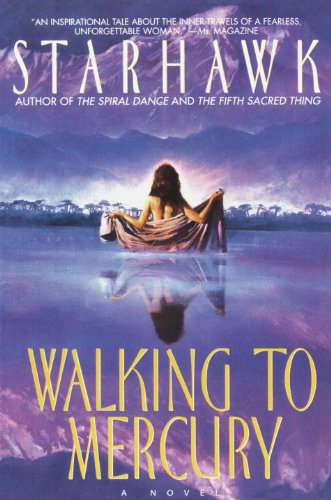


BOOK
0
In The Fifth Sacred Thing, readers fell in love with Maya Greenwood, the 98-year-old writer who led Northern California's successful 21st century rebellion against a racist, totalitarian regime of the South. Walking to Mercury takes readers back to the 20th century and powerfully dramatizes the forces that shaped this extraordinary woman.The book opens and closes with the middle-aged Maya struggling with a profound personal and spiritual crisis. The culminating factor has been her mother's death, and now Maya embarks on a trek in the Himalayas, intending to sprinkle her mother's ashes at the base of Mt. Everest and finally lay to rest her tumultuous past. At rest stops in tiny Tibetan villages, she reads diary pages her lover Johanna has tucked into her bag—the diary Johanna kept throughout their shared youth during the Vietnam era.In vivid flashbacks to those radical days, we accompany the young Maya as she awakens to the summer of love, joins the anti-war movement, and enters into a relationship with the abusive, alcoholic Rio. She finally gathers the strength to break free and seek her own true path, which takes her from the streets of Manhattan to the mountains of Mexico. Eventually she emerges, stronger and wiser, infused with the wisdom of the earth and the spirit of the goddess. Traveling through the landscape of memories helps Maya reclaim her past and foreshadows the miraculous events readers of The Fifth Sacred Thing know her to be capable of in the future.
The word mercury conjures many images--the messenger god, the planet that rules over communication, the liquid metal that defies attempts to be held--images that form the backbone of Walking to Mercury, a story chronicling the early life of Maya Greenwood. Readers familiar with Starhawk's fiction may remember Maya as the 21st-century rebel leader who was introduced in The Fifth Sacred Thing . In Walking to Mercury, a younger Maya treks through Nepal carrying the ashes of her mother on her back as she searches for a reunion with her sister. Along the way, she finds messages (through the pages of her best friend Johanna's diary, in letters from her former lover Rio, and in notes from her elusive sister) that raise spiritual mountains rivaling the peaks of the Himalayas. She struggles with her past and hopes to find out why the power that once pounded through her like a drumbeat has fallen silent. However, like the metal mercury, the answer to her troubles continually slips through her fingers. While eco-feminism plays a supporting role, the star of Walking to Mercury is everything that Starhawk has to tell us about being human. As Maya discovers, no matter how independent one is, one's life is inextricably entangled with the lives of others--parents, siblings, friends, lovers, and even strangers who nudge us in one direction or another (sometimes imperceptibly) despite our best attempts at isolation. Starhawk permeates every step of Maya's journey with emotion, and pulls no punches, hitting us with everything from grief to ecstasy. There is no padding to separate us from the story, but Walking to Mercury is no stark, utilitarian piece of minimalist fiction. This is life, with all its bitterness and all its magic. --Brian Patterson
When spiritual leader and ecofeminist Starhawk turned to fiction in The Fifth Sacred Thing (1993), readers embraced her vision of a future in which power is redefined and women's realities are celebrated. This prequel focuses on Maya Greenwood, a rebellious centenarian in the previous book. Enlisted in revolutionary politics during the '60s, Maya lived underground for years after and discovered herself as a witch and a ritualist. Starhawk recounts Maya's life in flashbacks and through journal entries and the letters from her two lovers, fiery Rio Connolly and earthy Johanna Weaver, which Maya reads on a trip to Nepal to find her estranged sister. Nepal serves as a framing device for Maya's probings of the past, especially the secret that Rio is the father of Johanna's child--a secret the women have kept from Rio, but which has driven them and him apart. The resolution of this and other estrangements is the core of the book. Despite Starhawk's warning against such an interpretation, her fans will probably read the strong-willed feminist witch Maya as a stand-in for the author. They will, no doubt, also find, once again, Starhawk's vision of the union of personal life, spirituality, and politics to be invigorating and inspiring. Patricia Monaghan
Prequel to Starhawk's eco-feminist future fantasy The Fifth Sacred Thing (1993), which placed 99-year-old witch Maya Greenwood in the Great War of the 21st century. Here, Maya, an aging flower child and the author of the Goddess-celebrating work From the Mountain, has lost interest in her black lover, Johanna Weaver; is overweight; burnt out; and decides that she needs recharging in Nepal, the home of the gods. While on her Himalayan trek, Maya reviews her life. Others on the journey keep her answering well-meant but irritating questions about matriarchy and the Goddess Mother of the Universe. Maya carries with her the ashes of her mother; she intends to scatter them on high. Maya is a bisexual lesbian, as is Johanna. They had become lovers in high school and have lived together on and off, although the mercurial Johanna has also had a series of male and female lovers. Why can't Johanna call herself a lesbian? Maya implores. ``It's easy for you to call yourself a lesbian, make the great political gesture,'' Johanna replies, ``but I am a black woman before I'm anything else, and the first word in that is black.'' As a witch, Maya tries to teach through rituals that arouse energy and help ``heal our shattered cultural imagination.'' Another ex-lover, the hard-drinking stud Rio Connolly, reenters the scene. They've recently reencountered each other, after 17 years, at the Nevada Test Site Peace Camp, where Maya had joined the protest against nuclear testing. Their youthful love affair (which left Maya pregnant) was severed by Rio's lengthy jail term for second-degree murder. Juggling two ex-lovers, Maya also has agonizing memories of her sister and mother to make peace with while trying to grasp the guidance of the Rinpoche on the mountain and to deepen her understanding of the Goddess. Starhawk's cult will find this uplifting and entertaining, if too loose for great impact. (Regional author tour) -- Copyright ©1997, Kirkus Associates, LP. All rights reserved.
Critical acclaim for The Fifth Sacred Thing:"Slated to be one of the great visionary Utopian novels of the century...It's a rare book to which I give such a high recommendation; but I spent the best part of three days reading it, and at the end, I would have loved it to be longer. I simply fell in love with both characters and setting. It's a wonderful book."--Marion Zimmer Bradley, author of The Forest House"For the future of our kind, The Fifth Sacred Thing is an anthem of hope. Generations to come will bless the name of Starhawk."--Daniel Quinn, author of Ishmael and The Story of B
Fifth Sacred Thing, readers fell in love with Maya Greenwood, the 98-year-old writer who led Northern California's successful 21st century rebellion against a racist, totalitarian regime of the South. Walking to Mercury takes readers back to the 20th century and powerfully dramatizes the forces that shaped this extraordinary woman.The book opens and closes with the middle-aged Maya struggling with a profound personal and spiritual crisis. The culminating factor has been her mother's death, and now Maya embarks on a trek in the Himalayas, intending to sprinkle her mother's ashes at the base of Mt. Everest and finally lay to rest her tumultuous past. At rest stops in tiny Tibetan villages, she reads diary pages her lover Johanna has tucked into her bag the diary Johanna kept throughout their shared youth during the Vietnam era.In vivid flashbacks to those radical days, we accompany the young Maya as she awakens to the summer of love, joins the anti-war movement, and enters int
"Bright skies and crisp air greet us our first morning on the trail, where primroses and rhododendrons wave you on your way past fields and farmhouses to the entrance of Sagarmatha National Park. You'll stop for an early lunch. Eat hearty, because afterwards it's a four-hour climb to the village of Namche Bazaar. You'll sleep well tonight!"--Mountain Co-Op Adventures brochureThe bridge swayed as Maya stepped out on it. For a moment she felt a sharp sense of vertigo, as if the poles of the earth might shift and a new dimension open up at the far side of the gorge. Maybe there, she thought, where the bridge ends, I'll walk out of this world and find--what? The elusive faery call that I've been following all my life, that lately seems to have stopped calling? Maybe I'll step into the Otherworld, and never go home again.Again the bridge shuddered in the wind and instinctively Maya grabbed one of the rusty cables that supported the narrow, wooden span. Get a grip, she told herself. More likely to step through a hole in the bridge and encounter new dimensions of mortality. Here and there a board was indeed missing underfoot. Through the gaps, Maya could see the milk-white, foaming waters of the Dudh Kosi river, rushing down from the high, high mountains which waited, somewhere above.Surely this is safe, she told herself. After all, she was following behind a train of heavily laden porters: small, lean men carrying high loads in the baskets they supported by tump lines across their foreheads. They were joined by equally burdened young girls in gold nose rings and saris or the wool jumpers and striped aprons of Tibet, and young boys in flip flops and T-shirts proclaiming I Love New York, all carrying loads that towered above them: drums of oil and stacks of cooking pots and piles of duffel bags and crates marked Japanese Everest Expedition. And the porters were following a train of yaks, laboring under bulging packs and high loads of wood.The bridge had withstood all that weight; surely the cables would hold for one more woman, on the hefty side of slender, granted, but not nearly as heavy as a loaded yak. She carried only a small day pack, whose contents held a weight that was emotional rather than anything measured in poundage. An old journal, a collection of letters, a gift for her sister Debby who might or might not be waiting to see her. And a plastic bag filled with her mother's ashes.Don't think about it, just do it, she told herself, walking on. What was wrong with her, anyway? She had never been concerned with safety. She had never been afraid of heights.When she reached the opposite side, she breathed a deep sigh as she planted her feet on solid ground. Turning, she waited for the rest of her group. Jan and Lonnie had gone on ahead with Tenzing Sherpa, their head guide, but the others would be following behind her. On the level stretches, she could take the lead, but on the uphill climbs, she fell behind, coughing and stopping for breath. The cough had begun on the airplane, gotten worse in the dust of Kathmandu, and didn't seem inclined to go away.Forests of blue pine climbed the steep slopes of the gorge. Every patch of remotely level ground was terraced and farmed, supporting small villages of stone houses. The river was a white thread at the bottom of thegorge, the bridge a metal spider's thread. She took out her camera. I look like a tourist, might as well act like one. Take a picture. Maybe a series. Scary Bridges of Nepal. It would make a nice coffee table book.The picture would have been better with the train of yaks crossing, but she was not the sort of photographer who managed to find herself in the right place for the ultimate shot. No, she could focus and get the needle of the light meter in between the notches--that was about her speed. But here came someone walking on the bridge, a human figure to add scale. Maya snapped, and then lowered the camera to watch as a young woman stepped confidently out onto the first of the wooden slats. Maya recognized her; she had seen her yesterday in Lukla, in the cafe where they'd waited as their pack train was loaded. The woman was young, barely more than a girl, really, and Maya had caught just a scrap of her conversation with an older couple."...and at night my legs ached so badly, I couldn't sleep well," she'd said. "We hadn't found much food at the teahouse, only some dahl, and I'm still growing, you know, so if I walk too far without eating, I feel it."Still growing. Maya had stopped growing, vertically at any rate, at thirteen."...Everyone told me not to try the pass over Cho La, but I went anyway..."Once I was like her, Maya had thought, daring the passes that everyone warns you against. What am I doing here now, preparing for this prepackaged adventure?But I've done that--the life-on-the-line challenge. And that's not what I wanted. I wanted time to walk and rest and think things through. Still, I'd like to know more about that girl. Woman. Oh hell, girl--she can't be more than eighteen. I could be her mother. She's just about the age Johanna and I were that summer on the coast with Rio, when we were still sweet and wild as beach plums, unmarred, our skins unbroken.I'll speak to her, Maya had thought, but when she'd turned around, the girl was gone.Now here she came, a young woman in a green wool sweater with a small rip in the left shoulder, and a long, Tibetan style wool skirt over her heavy hiking boots. Her dark hair was pulled back with a brown scarf, her cheeks ruddy and windburned over a deep tan, her gray eyes big in her thin face. She was older than thirteen--seventeen, eighteen maybe? A full pack was strapped to her back, and her right hand gripped one of the T-shaped sticks the porters used as walking sticks and as supports for their load when resting. She walked with an easy balance over the swaying span, as if she were used to instability.Good, Maya thought, now I'll speak to her. She nodded and smiled as the girl reached her side of the gorge."Hello.""Namaste," the girl said, dipping her head in greeting and moving past Maya on the path. Maya spoke up quickly."I took your picture. I hope you don't mind."The girl shrugged. "It's okay."I feel shy with her, Maya thought. Like the time I met Alice Walker at the homeless benefit and couldn't bring myself to say anything. Or with someone I've fantasized about, as a lover. What do I say to her? She's walking away."Where are you going?" Maya asked quickly. It was the standard Nepalese greeting, one of the phrases she'd learned from the language tape she'd studied on the plane. But of course, she said it in English. The girl was American, by her voice, from somewhere west of the Mississippi."To Namche, today," the girl said."And after that?"She shrugged, an eloquent gesture.Oh yes, Maya thought, that's what I need, to not know where I'm going, to wander in the wilderness without a route and a schedule and a set destination."Are you traveling alone?""Yes."Once I was like you, Maya wanted to say. Young and alone and free. Look at me, I want you to know me, know how alike we are, how I belong with you.Instead she said, "Aren't you afraid?"Instantly she could have kicked herself. The girl just smiled. "I like traveling alone," she said, and walked on.How could I ask her that? Me, Maya Greenwood, author of From the Mountain? Me, who's been asked over and over and over again, 'Aren't you afraid?' What was I thinking of? What's wrong with me?Afraid! I'm the one who was afraid--afraid to try and find my sister without a guide or to be too dependent on her uncertain welcome. Afraid to struggle up these mountains with a thirty-pound pack on my back. And just well-off enough to be able to afford to let someone else carry it for me.And what's wrong with that? I'm not eighteen any more, I'm not twenty-one like I was that summer on my mountain. I'm pushing forty. I've some sense, and I've earned my comforts.Ang was now crossing the bridge, leading the train of yaks, their sides bulging with duffel bags. NO, not yaks, she must remember to stop thinking of them as that. They were zopkios, a cow-yak cross, indistinguishable as far as Maya could make out from the real thing, but happier at lower altitudes. So said the guidebook, her Himalayan Bible.Ang was their sirdar, in charge of all the porters and the practical details of the trip. Their four stolid animals followed him, and behind them came Ila, the driver, a heavy-browed, square-faced man of forty with hair as shaggy as that of the beasts he cared for."Now much uphill," Ang said to Maya, with a nod and a grin. He was also in his forties, spare and wiry with a broad, smooth face, close-cropped hair, and a calm smile.She smiled back at him. "Then I'd better get started." She turned and began to climb up the path.
Find it on
AmazonNo videos available yet.
No news articles linked to this title yet.

Overall
Overall rating of the media
Atmosphere
How immersive and tense is the atmosphere
Gore
Level and quality of gore/violence
Story
Quality of the storyline and plot
Writing
Quality of the written content
Character Development
Depth and growth of characters
Pacing
Flow and timing of the narrative